
Results
-
 £38.95
Unity Series Band Journal - Numbers 558 - 561, October 2026
558: Jesus is the winner! (Samuel Ekong)Jesus is the Winner is the publishing debut of Samuel Ekong, Band Secretary at Abuja Central Corps in the Nigeria Territory. Based on a popular song associated with renowned worship leader Ron Kenoly, this arrangement centres on the infectious chorus, "Jesus is the winner man". While the original song was performed in a reggae style, Ekong has reimagined it with a lively swing feel, creating a joyful and accessible work for brass band. Full of rhythmic energy and uplifting spirit, the arrangement encourages a light, buoyant approach throughout and offers an engaging concert item that is sure to be enjoyed by performers and audiences alike.559: Festival Arrangement - Hearts Ablaze (Marcus Venables)Written at the request of Jonathan Evans for Sale Salvation Army Band, Hearts Ablaze is based on the popular contemporary worship song Build Your Kingdom Here that has become especially significant within the corps. The music captures the passion, prayer and enthusiasm of its message, combining bold opening statements with lyrical moments and energetic rhythmic drive. After introducing the familiar melody, the work develops into a vibrant celebration built around the song's call: "Set your Church on fire... Build your kingdom here, we pray." Uplifting and engaging throughout, the piece offers both performers and audiences a joyful and inspiring musical experience.560: Cornet Solo - Soul Saver (Ian Robinson)Based on the well-known chorus Thank You, Lord, for Saving My Soul by Seth and Bessie Sykes, this solo is a heartfelt expression of gratitude for God's gift of salvation. The familiar melody is presented in an expressive setting that allows the soloist to communicate the simple yet powerful message of the song. Contrasting lyrical passages, rich harmonic colours and moments of gentle brilliance combine to create an engaging musical journey. Throughout, the focus remains on the chorus's timeless theme of thanksgiving, making this a moving and devotional addition to the brass band solo repertoire.561: Chorus Selection - God's Presence (Howard Davies)God's Presence by Major Howard Davies combines three well-known songs that explore the believer's walk with God. The selection includes Philip P. Bliss's Let the lower lights be burning, Charles H. Fillmore's O I love him, and the familiar Salvation Army chorus God is with us all the time (S.A.S.B. 1028). Each melody expresses a different aspect of Christian faith, from witness and devotion to the assurance of God's presence. Suitable as both a concert item and a congregational feature, this accessible arrangement offers warmth, variety and a clear spiritual message for performers and audiences alike.
Estimated dispatch 7-14 working days
-
 £77.00
General Series Brass Band Journal, Numbers 2234 - 2237, August 2023
2234: Festival March - Above all names (Geoff McCorriston)This Festival March was originally written for the Camberwell Citadel Band, Melbourne, Australia. This composition marks the composers debut within our band journals. Geoff McCorriston served as Deputy Bandmaster at Preston Corps (Australia) for many years before joining the Camberwell Citadel Band. He has also been a member of the Melbourne Red Shield Band. Above all names is distinct from a standard street march in that it is more developed, both rhythmically and thematically. It is an original march that references We plough the fields and scatter (S.A.S.B. 70) and Camberwell (T.B. 182).2235: Flugel Horn Solo - Father, Creator (Simon Gash)Emma Pears has a gift for contemporary song-writing, with several of her songs featuring in the Sing to the Lord publication. The style and relaxed nature of the melody of Father, Creator (first published in the Children's Voices Series in 2011, and later in the Mixed Voices in 2014) seemed a perfect fit for the Flugel Horn. Throughout the piece, juxtaposed with Father, Creator, we hear snippets of the tune St Theodulph (T.B. 231), which outline the first lines of Albert Chesham's words, 'O Father and Creator, Thou God of perfect love' (S.A.S.B. 46).2236: A winter's carol (trs. Neil Smith)The history of the carol O come, Immanuel (C.C. 62) is, like the carol itself, a little mysterious! The melody was conceived as a monastic chant during the 8th century. It was not until 1851 that the priest and hymn writer John Mason Neale translated the verses into English, exposing the carol to a wider audience. There is an aura and enigmatic feel to this melody which is captivating to so many who hear it. This setting was originally conceived for wind band by American composer Mark Williams. The brass band transcription introduces a new name to our journals, Bandmaster Neil Smith, who is the Territorial Music Director for the USA Western Territory.2237: Mighty to keep (Eiliv Herikstad)Mighty to keep marks the composer's first publication since his Promotion to Glory in April 2023. Bandmaster Eiliv Herikstad served faithfully in his native Norway throughout his life, and since the early 1970s, has provided The Salvation Army with a wealth of original compositions and skilful arrangements. Eiliv explored many styles of big-band and jazz writing which, in the 70s, were not commonplace amongst brass bands, particularly in The Salvation Army. Music Editorial are grateful to Eiliv for using his gifts to support Salvation Army music ministry.The subject of this piece is Herbert Booth's song Mighty to keep, which was first published by The Salvation Army in 1889. The chorus of the song is more well-known that the verse and was included in the chorus section of the 1986 Salvation Army Song Book.
Estimated dispatch 7-14 working days
-
 £125.00
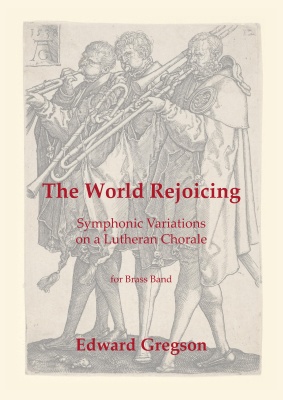
The World Rejoicing (Brass Band - Score and Parts)
The World Rejoicing was commissioned by the National Brass Band Associations of Belgium, Netherlands, Norway, Switzerland, and the British Open, as the test piece for their competitions in 2020/21. Although the work was completed in 2019, the pandemic of 2020 meant that these competitions were postponed until 2021/22. The premiere took place in September 2021 at Symphony Hall, Birmingham, UK.In searching for a common link between the brass band traditions of the various European countries that commissioned this work, I considered the fact that hymns have always played an important role in the relationship that brass bands have with their particular communities; and thus I turned to a well- known Lutheran chorale, Nun danket alle Gott (Now thank we all our God), written around 1636 by Martin Rinkart, with the melody attributed to Johann Cruger. A number of composers have incorporated this chorale into their music, most famously J.S. Bach in his Cantatas no. 79 and 192, and Mendelssohn in the Lobsegang movement of his 2nd Symphony (the harmonisation of which is usually used when this hymn is sung).It seemed fitting therefore for me to return to a compositional form I have used many times before (Variations) and to write a work based on this hymn. I have used it in a similar way to that which I employed in my Variations on Laudate Dominum of 1976 - that is, rather than writing a set of variations using elaborations of the complete tune, I have taken various phrases from the chorale and used them within the context of other musical material, applying an overall symphonic process of continuous variation and development. The structure, or sub-divisions of the work, which is through composed and plays without a break, is as follows:Prelude, Capriccio, La Danza 1, Processional, La Danza 2, Arias and Duets, Fuga Burlesca, Chorale, and Postlude.The work, which is around 16 minutes in length, is also partly autobiographical - in the manner say of Strauss's Ein Heldenleben - in that I have incorporated into the score brief quotations from many of my other major works for brass band. In that respect, The World Rejoicing sums up a particular facet of my life as a composer, and reflects the admiration I have always had for what is surely one of the great amateur music-making traditions in the world.Duration: 16.00
Estimated dispatch 7-14 working days
-
£40.00
The World Rejoicing (Brass Band - Score only)
The World Rejoicing was commissioned by the National Brass Band Associations of Belgium, Netherlands, Norway, Switzerland, and the British Open, as the test piece for their competitions in 2020/21. Although the work was completed in 2019, the pandemic of 2020 meant that these competitions were postponed until 2021/22. The premiere took place in September 2021 at Symphony Hall, Birmingham, UK.In searching for a common link between the brass band traditions of the various European countries that commissioned this work, I considered the fact that hymns have always played an important role in the relationship that brass bands have with their particular communities; and thus I turned to a well- known Lutheran chorale, Nun danket alle Gott (Now thank we all our God), written around 1636 by Martin Rinkart, with the melody attributed to Johann Cruger. A number of composers have incorporated this chorale into their music, most famously J.S. Bach in his Cantatas no. 79 and 192, and Mendelssohn in the Lobsegang movement of his 2nd Symphony (the harmonisation of which is usually used when this hymn is sung).It seemed fitting therefore for me to return to a compositional form I have used many times before (Variations) and to write a work based on this hymn. I have used it in a similar way to that which I employed in my Variations on Laudate Dominum of 1976 - that is, rather than writing a set of variations using elaborations of the complete tune, I have taken various phrases from the chorale and used them within the context of other musical material, applying an overall symphonic process of continuous variation and development. The structure, or sub-divisions of the work, which is through composed and plays without a break, is as follows:Prelude, Capriccio, La Danza 1, Processional, La Danza 2, Arias and Duets, Fuga Burlesca, Chorale, and Postlude.The work, which is around 16 minutes in length, is also partly autobiographical - in the manner say of Strauss's Ein Heldenleben - in that I have incorporated into the score brief quotations from many of my other major works for brass band. In that respect, The World Rejoicing sums up a particular facet of my life as a composer, and reflects the admiration I have always had for what is surely one of the great amateur music-making traditions in the world.Duration: 16.00
Estimated dispatch 7-14 working days
-
 £35.00
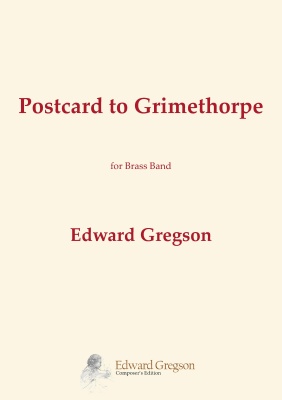
Postcard to Grimethorpe (Brass Band - Score and Parts)
I composed the original version of Postcard to Grimethorpe in 1993 at the request of Elgar Howarth, for a concert at the Queen Elizabeth Hall, London, given by the Grimethorpe Colliery Band. This was at a time when after the Grimethorpe Colliery pit closed the future of the band was in severe jeopardy. The concert was given in aid of the band, both through publicity and funding.Then in late 2022 Jack Stamp, the American composer, conductor and educator, and at that time international composer-in-association with Grimethorpe, contacted me to say that he had discovered my short piece in the band library, and asked if I might extend it for a recording he was sponsoring for the band - the repertoire to consist entirely of music specially composed for Grimethorpe.I agreed and decided to extend the piece by using the miner's hymn Gresford, as a symbolic gesture of protest at the many thousands of miners in the UK who were made redundant from their jobs. After an angular (quasi-atonal) first section, the hymn enters, softly at first, but with each phrase it becomes more powerful and insistent, ending with the final phrase triumphantly accompanied by melodic percussion (replacing the drums and cymbals of the earlier phrases, as if the band were then on the march). However, this short work ends softly and gently, as if anger has been replaced by quiet resolution and determination, looking to the future with confidence.- Edward GregsonDuration: 3.00
Estimated dispatch 7-14 working days
-
 £110.00
Diversions After Benjamin Britten (Brass Band - Score and Parts)
Suite by Lucy Pankhurst, Simon Dobson, Paul McGhee and Gavin HigginsHaving devised a collective centenary tribute for Michael Tippett at the 2006 RNCM Festival of Brass (Variations on a Theme of Michael Tippett by five eminent composers of brass band music, PHM002), I commissioned this companion piece as a Benjamin Britten tribute for the 2013 festival. In the late 1970s, while researching a book about the English composer, and Britten's first teacher, Frank Bridge (1879 - 1941), I came across a copy of the printed score of Benjamin Britten's Variations on a Theme of Frank Bridge (Op.10) for string orchestra, in which Britten had written descriptive titles for each of the variations suggesting appropriate character traits of his much loved mentor and guide. The character variations are cast in march, song and dance forms.Taking inspiration from Britten's youthful tribute, I invited four award-winning composers, who have all made significant contributions to the brass band medium, to create their own personal reflections on four aspects of Britten's character and music, designed to form a suite of Diversions after Benjamin Britten, but which can also be played separately.Lucy Pankhurst's hauntingly lyrical Prelude: His Depth refers to the emotional and symbolic subtexts that underpin Britten's operas, taking its musical cue from Britten's many arrangements of folk songs. The flugel horn takes a prominent role throughout.Simon Dobson's breathless Scherzo: His Vitality reminds us with its rapid passage work and leaping bass 'groove' that Britten loved tennis and fast cars in his younger days.Paul McGhee's evocative interpretation of the March: His Sympathy represents Benjamin Britten's pacifism, as the composer writes: 'We view the music through the eyes of a pacifist. Whilst war and violence surround us, we do not engage in it and though it continues to happen around us. With the use of muted effects in most of the band throughout the piece, the flugel horn is the lone voice of reason, standing firm against the mechanical and destructive society in which it is forced to live. As the machine of war continues around the lone voice, the voice is gradually dismissed and mocked as the war machine rumbles on into the distance.'In an extended finale, entitled Toccata: His Skill, Gavin Higgins celebrates Benjamin Britten's consummate creativity. For the RNCM Festival of Brass premiere, the four contrasting movements were framed and connected by Britten's Fanfare for St. Edmundsbury for three trumpets, with the trumpet soloists spaced round the hall. I am grateful to the Britten Estate and publishers Boosey & Hawkes for giving permission for the elements of Britten's fanfare to be incorporated in the collective work.- Paul HindmarshDuration: 19.30
Estimated dispatch 7-14 working days
-
£45.00
Diversions After Benjamin Britten (Brass Band - Score only)
Suite by Lucy Pankhurst, Simon Dobson, Paul McGhee and Gavin HigginsHaving devised a collective centenary tribute for Michael Tippett at the 2006 RNCM Festival of Brass (Variations on a Theme of Michael Tippett by five eminent composers of brass band music, PHM002), I commissioned this companion piece as a Benjamin Britten tribute for the 2013 festival. In the late 1970s, while researching a book about the English composer, and Britten's first teacher, Frank Bridge (1879 - 1941), I came across a copy of the printed score of Benjamin Britten's Variations on a Theme of Frank Bridge (Op.10) for string orchestra, in which Britten had written descriptive titles for each of the variations suggesting appropriate character traits of his much loved mentor and guide. The character variations are cast in march, song and dance forms.Taking inspiration from Britten's youthful tribute, I invited four award-winning composers, who have all made significant contributions to the brass band medium, to create their own personal reflections on four aspects of Britten's character and music, designed to form a suite of Diversions after Benjamin Britten, but which can also be played separately.Lucy Pankhurst's hauntingly lyrical Prelude: His Depth refers to the emotional and symbolic subtexts that underpin Britten's operas, taking its musical cue from Britten's many arrangements of folk songs. The flugel horn takes a prominent role throughout.Simon Dobson's breathless Scherzo: His Vitality reminds us with its rapid passage work and leaping bass 'groove' that Britten loved tennis and fast cars in his younger days.Paul McGhee's evocative interpretation of the March: His Sympathy represents Benjamin Britten's pacifism, as the composer writes: 'We view the music through the eyes of a pacifist. Whilst war and violence surround us, we do not engage in it and though it continues to happen around us. With the use of muted effects in most of the band throughout the piece, the flugel horn is the lone voice of reason, standing firm against the mechanical and destructive society in which it is forced to live. As the machine of war continues around the lone voice, the voice is gradually dismissed and mocked as the war machine rumbles on into the distance.'In an extended finale, entitled Toccata: His Skill, Gavin Higgins celebrates Benjamin Britten's consummate creativity. For the RNCM Festival of Brass premiere, the four contrasting movements were framed and connected by Britten's Fanfare for St. Edmundsbury for three trumpets, with the trumpet soloists spaced round the hall. I am grateful to the Britten Estate and publishers Boosey & Hawkes for giving permission for the elements of Britten's fanfare to be incorporated in the collective work.- Paul HindmarshDuration: 19.30
Estimated dispatch 7-14 working days
-
 £95.00
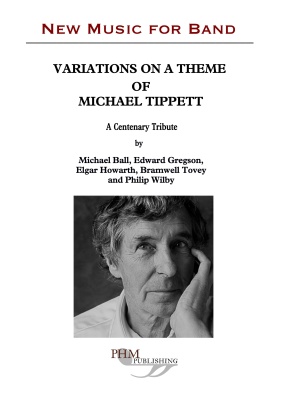
Variations on a Theme of Michael Tippett (Brass Band - Score and Parts)
A Centenary Tribute by Michael Ball, Edward Gregson, Elgar Howarth, Bramwell Tovey and Philip WilbyThis unique 'pice d'occasion' arose out of a telephone conversation in 2004 with Alan Wycherley, who was the soprano cornet player of the Foden's Richardson Band at the time. He indicated that the band would like to include an original birthday tribute for Edward Gregson (60) and Elgar Howarth (70) in its concert at the 2005 RNCM Festival of Brass in Manchester. I have been Artistic Director of Manchester's Festival of Brass since it was established in 1990 as a BBC Radio 3 series, As the centenary of the birth of Sir Michael Tippett fell on 5 January 2005, I devised this collective work as a way of embracing all three anniversaries in a novel way.The idea of joint compositions is not a new one in the classical music world. In the 1860s, Verdi was joined by a number of his contemporaries in a Requiem Mass for Rossini. In this country there have been a number of orchestral examples over the past fifty years, but never before for the brass band. Although Tippett composed only one work for brass band, Festal Brass with Blues, his orchestral works and operas are full of idiomatic brass writing. The theme I chose for this celebration is one of Tippet's most memorable miniatures featuring wind and brass. In the opera Midsummer Marriage it marks the entry of the Ancients. It is also included in the orchestral Suite in D (1948), for the Birthday of Prince Charles.I invited five of the leading contemporary voices in brass band music to add their own creative perspectives to the little Tippett theme, with it's characteristic rhythms, embellishments and modality - the Lydian mode. Each contribution was designed to fit into a tonal and formal template to give the whole work a flow and continuity. In Danse des Amis, Bramwell Tovey has composed a jazzy, humorous variation. Inspiration came from Tippett's love of jazz and, more personally, from the characteristically syncopated gait of the distinguished music critic John Amis, who Tovey once observed leaving a performance of Tippett's opera King Priam before the end. Incidentally, that performance was conducted by Elgar Howarth.We hear Edward Gregson in lyrical mode. His Midsummer Song is redolent of the sound world of Tippett's opera A Midsummer Marriage and it ends with a brief reference to a favourite of Gregson's, Tippett's Concerto for Orchestra. Michael Ball provides a brief moment of light, airy activity bringing to mind perhaps Tippett's love of Shakespearian fantasy, especially The Tempest. Elgar Howarth juxtaposes a slowed down version of the processional theme with distant recollections of fanfares from King Priam. Philip Wilby has rounded the tribute off with a spectacular fugue. During its inexorable progress Wilby ingeniously introduces the two other birthday references - the three-note musical signature that Elgar Howarth includes in much of his music and the characteristic theme which begins Edward Gregson's substantial work for brass an organ The Trumpets of the Angels. An elaborated reprise of Tippett's little theme is followed by a dynamic coda.- Paul HindmarshDuration: 13.00
Estimated dispatch 7-14 working days
-
£40.00
Variations on a Theme of Michael Tippett (Brass Band - Score only)
A Centenary Tribute by Michael Ball, Edward Gregson, Elgar Howarth, Bramwell Tovey and Philip WilbyThis unique 'pice d'occasion' arose out of a telephone conversation in 2004 with Alan Wycherley, who was the soprano cornet player of the Foden's Richardson Band at the time. He indicated that the band would like to include an original birthday tribute for Edward Gregson (60) and Elgar Howarth (70) in its concert at the 2005 RNCM Festival of Brass in Manchester. I have been Artistic Director of Manchester's Festival of Brass since it was established in 1990 as a BBC Radio 3 series, As the centenary of the birth of Sir Michael Tippett fell on 5 January 2005, I devised this collective work as a way of embracing all three anniversaries in a novel way.The idea of joint compositions is not a new one in the classical music world. In the 1860s, Verdi was joined by a number of his contemporaries in a Requiem Mass for Rossini. In this country there have been a number of orchestral examples over the past fifty years, but never before for the brass band. Although Tippett composed only one work for brass band, Festal Brass with Blues, his orchestral works and operas are full of idiomatic brass writing. The theme I chose for this celebration is one of Tippet's most memorable miniatures featuring wind and brass. In the opera Midsummer Marriage it marks the entry of the Ancients. It is also included in the orchestral Suite in D (1948), for the Birthday of Prince Charles.I invited five of the leading contemporary voices in brass band music to add their own creative perspectives to the little Tippett theme, with it's characteristic rhythms, embellishments and modality - the Lydian mode. Each contribution was designed to fit into a tonal and formal template to give the whole work a flow and continuity. In Danse des Amis, Bramwell Tovey has composed a jazzy, humorous variation. Inspiration came from Tippett's love of jazz and, more personally, from the characteristically syncopated gait of the distinguished music critic John Amis, who Tovey once observed leaving a performance of Tippett's opera King Priam before the end. Incidentally, that performance was conducted by Elgar Howarth.We hear Edward Gregson in lyrical mode. His Midsummer Song is redolent of the sound world of Tippett's opera A Midsummer Marriage and it ends with a brief reference to a favourite of Gregson's, Tippett's Concerto for Orchestra. Michael Ball provides a brief moment of light, airy activity bringing to mind perhaps Tippett's love of Shakespearian fantasy, especially The Tempest. Elgar Howarth juxtaposes a slowed down version of the processional theme with distant recollections of fanfares from King Priam. Philip Wilby has rounded the tribute off with a spectacular fugue. During its inexorable progress Wilby ingeniously introduces the two other birthday references - the three-note musical signature that Elgar Howarth includes in much of his music and the characteristic theme which begins Edward Gregson's substantial work for brass an organ The Trumpets of the Angels. An elaborated reprise of Tippett's little theme is followed by a dynamic coda.- Paul HindmarshDuration: 13.00
Estimated dispatch 7-14 working days
-
 £82.95
Occasion (Brass Band - Score and Parts)
Occasion was published especially for the National Youth Brass Band Championship of Great Britain, held at the Royal Albert Hall, London, on 4th October, 1986.Occasion for Brass Band is in four movements: Fanfare, Festivities, Elegy and Dance. The opening Fanfare was originally written as a Wedding Fanfare for Paul and Hazel Patterson in 1981, while the Elegy and Dance were commissioned as a test-piece for the first Westsound/Ayrshire Invitation Contest in 1982 for the leading bands in Scotland. Festivities was therefore written last, to complete the work and give it its essentially 'festive' character. Except for the Elegy, which is contemplative, the music throughout is extrovert and joyful. The opeing Fanfare may be performed separately - of the Fanfare may be ledt out entirely, making the work a three movement Suite.Duration: 11 minutes
Estimated dispatch 7-14 working days