
Results
-
 £47.50
FANFARE BRITANNICA (Brass Band) - Hosay, James L.
This regal and stately fanfare-opener is a sterling new offering for band. Sixteen opening bars of thrilling fanfare lead inexorably to a theme expressing dignified momentum. Frequent but simple meter changes help to make this an interesting and educational piece that both the band and the audience will enjoy. A recap of the opening fanfare brings the piece to an exciting finish that will set a noble yet festive tone for your concert or special event. It even makes a great graduation recessional. Let Fanfare Britannica be the crown jewel of your next performance! Duration: 2:20
Estimated dispatch 7-14 working days
-
 £32.50
Kingdom of Dragons (Brass Band - Score only) - Harper, Philip
The 'Kingdom of Dragons' is Gwent in South Wales, known in ancient times as the Kingdom of Gwent, and more recently home to the Newport Gwent Dragons Rugby Union team.This piece was commissioned by the Gwent Music Service with additional funding from Ty Cerdd - Music Centre Wales to celebrate the 50th anniversary in 2010 of the formation of the Gwent Youth Brass Band.Although the music is continuous, it is divided into four distinct sections, each one representing one of the unitary authorities which make up the County of Gwent.Monmouthshire, which has a large number of ancient castlesBlaenau Gwent, an historic area of iron and coal miningTorfaen, where Pontypool Park is a notable landmarkNewport, the largest city in the regionThe music begins with a two-bar fanfare, which sets out all the thematic material of the piece. The mood of pageantry that follows describes some of the ancient castles in Monmouthshire, with rolling tenor drums and fanfaring cornets. After a majestic climax the music subsides and quite literally descends into the coal mines of Blaenau Gwent. The percussion provides effects that suggest industrial machinery clanking into life, and the music accelerates to become a perilous white-knuckle ride on the underground railroad. There is a brief respite as a miner's work-song is introduced and, after a protracted build-up, this is restated at fortissimo before the music comes crashing to an inglorious close, much like the UK's mining industry itself. The middle sonorities of the band portray the tranquillity of Pontypool Park, a place of great natural beauty. Brief cadenzas for cornet and euphonium lead to a full band reprise of the pastoral mood. At the end of this section we find ourselves at the top of the park's 'Folly Tower' from which the distant castle turrets of Monmouthshire are visible. Pontypool RFC was one of eleven clubs in the first Welsh league in 1881 and a brief but bruising musical portrayal of the formidable Pontypool front-row, the 'Viet Gwent' leads into the work's final section. This portrays Newport, a symbol for progress and optimism for the future, ideals shared by the Gwent Youth Band itself. The music is a vigorous fugue which advances through various keys and episodes before the final triumphant augmented entry which brings the work to a magnificent conclusion.Duration: 12:00
Estimated dispatch 7-14 working days
-
 £67.50
Columbus (Brass Band - Score and Parts) - Deleruyelle, Thierry
Columbus is a brilliant and dynamic overture for brass band, with a soft and melodious central passage. In addition to the many American towns that hold the name, Columbus is a European space laboratory that is part of the International Space Station. Launched in 2008 by the American space shuttle Atlantis, it makes it possible to carry out continuous scientific experiments in fundamental physics, life sciences, fluid physics, etc. Several hundred experiments take place within Columbus every year. Commissioned by the Brass Band Bourgueillois, this piece celebrates the 10th anniversary of the launch of the band at the instigation of its conductor, Michal Auclert. The ensemble brings together musicians from the various wind bands of the Bourgueillois region and beyond. Thus, just like the space laboratory that inspired this work, the Brass Band Bourgueillois also serves as a laboratory, albeit a musical one, within a territory that is discovering this ensemble and its original repertoire.Duration: 5.15
Estimated dispatch 7-14 working days
-
 £52.50
Farewell with a Little Smile (Brass Band - Score and Parts) - Doss, Thomas
A farewell can have many faces: sad, happy, content, grateful... This special piece was composed as a heart-warming gift for an exceptional musician upon retirement from his beloved music society. The work carries an important message: every farewell is also an opportunity for a new beginning; a moment to cherish with a little smile.This atmospheric work opens with subdued, warm brass sounds that create a sense of intimacy. Through alternating (smaller) instrumentations, it builds up to a sonorous tutti climax, eventually leading to a subdued mood again. The closing passage offers room for reflection, memories, and gratitude. Farewell With a Little Smile is a beautiful, solemn composition suitable for countless occasions. Whether the work serves as a resting point in a concert programme or is used to frame a meaningful farewell, this music will add lustre to numerous precious moments.Duration: 6.30
Estimated dispatch 7-14 working days
-
 £32.50
Partita (Brass Band - Score only) - Gregson, Edward
Selected as the Section 4 test piece for the National Brass Band Championships of Great Britain 2025Partita dates from 1971, when it was commissioned by the Redbridge Youth Band. The musical thread that runs through the work is the 13th century plainsong Dies Irae from the Requiem Mass. This gives the work a rather sombre tone which is audible right from the start of its first movement Intrada. The initial hammer-like chords of the opening and conclusion are only interrupted momentarily by a more lyrical modal tune. Even here, on its repetition, it is surrounded by more insistent textural patterns.The second movement, Chorale and Variations, uses the Dies Irae as the basis for an extended melody in the manner of a baroque sarabande. The five variations that follow are varied in texture, tempi, and dynamics. The final March is more optimistic in mood and presents as its main idea a rather jaunty theme which gets developed throughout the movement. However, the ominous presence of the Dies Irae has the last say with a final statement to round off the work.Duration: 11.00
Estimated dispatch 7-14 working days
-
£17.50
The Father?s Blessing (Brass Band - Score only) - Downie, Kenneth
This music is a treatment of the tune that William Tomer wrote for the words 'God be with you till we meet again'. In recent years, Ralph Vaughan Williams' tune 'Randolph' has often been the preferred choice to accompany these words although this composer was drawn to the original tune. Serenity is the prevailing mood of the piece although there is chance for the band to 'open up' in the link passages.
Estimated dispatch 7-14 working days
-
 £27.50
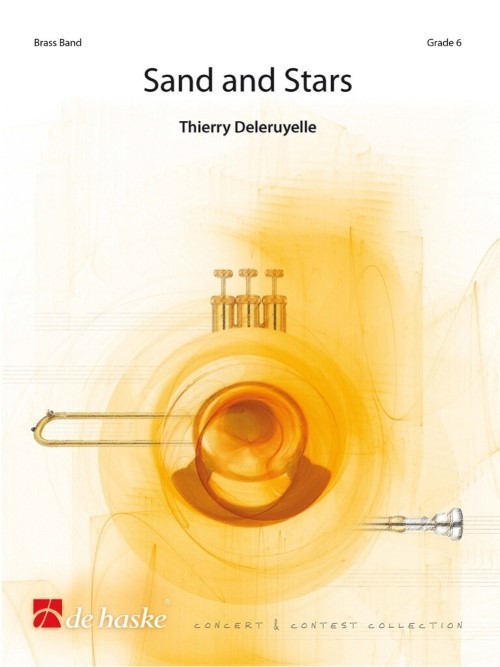
Sand and Stars (Brass Band - Score only) - Deleruyelle, Thierry
Sand and Stars illustrates the journey of the aviator-writer Antoine de Saint-Exupery when he attempted to break the record for a Paris-Saigon flight. Having started as planned, the journey ended prematurely in the heart of the Sahara with a broken plane and the rescue, just in time, of the pilot and his navigator. Written in six parts, this highly colourful piece varies between a mysterious atmosphere, the deafening noise of a plane hitting the ground and the vivacity of an Arabic dance, punctuated with cornet and euphonium solos, before concluding with spectacular musical fireworks.Duration: 17.45
Estimated dispatch 7-14 working days
-
 £89.50
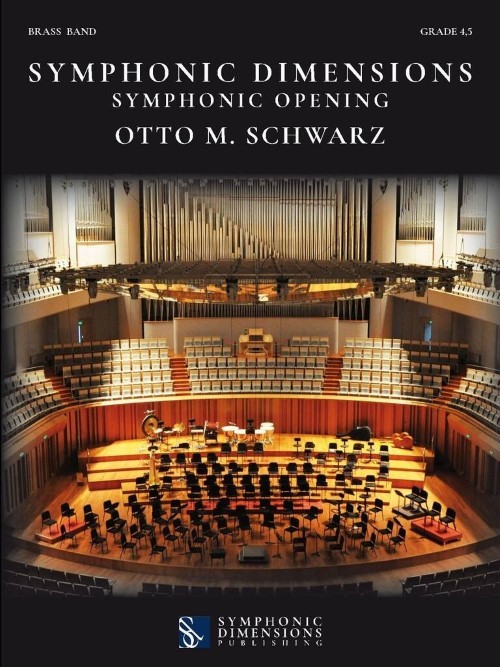
Symphonic Dimensions (Brass Band - Score and Parts) - Schwarz, Otto M.
Symphonic Dimensions is a powerful opening piece with a continually recurring motif. Beginning with a festive fanfare in which the leitmotif is heard for the first time, it continues in a buoyant 12/8 meter. The themes alternate again and again, in various instrumentations, and end in an epic finale. Symphonic Dimensions can equally be played at the end of a concert as a rousing finale.Duration: 3.45
Estimated dispatch 7-14 working days
-
 £47.50
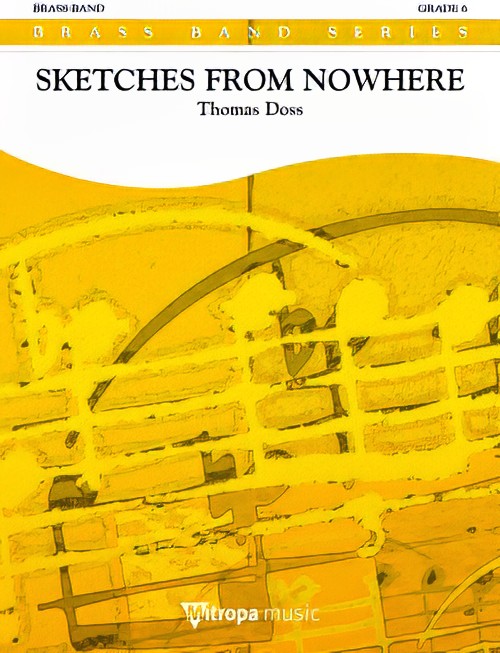
Sketches from Nowhere (Brass Band - Score only) - Doss, Thomas
Sketches from Nowhere is the second composition that Thomas Doss has written for brass band. The title was inspired by various images the composer saw in his mind's eye while working on this piece: pictures of foreign places; pictures of the creation of our world. The main motif that weaves its way from the beginning to the end of the work is meant to parallel humanity's great evolution: from its humble beginnings as mere stardust to the present day.
Estimated dispatch 7-14 working days
-
£22.50
Gaudete (Brass Band - Score only) - Norbury, Kevin
A Christmas mini-overture featuring three medieval carols; 'Coventry Carol', 'Gaudete' and 'Unto us a boy is born'. A fun piece for player and listener alike.
Estimated dispatch 7-14 working days
 View Music