
Results
-
£29.50
Brass Monkey's American Tour - Gavin Somerset
It is well known that our learners learn much quicker if they can recognise the music that they are playing. The 'Brass Monkey's American Tour' ensures that your ensemble, whatever its size, will have fun and learn, whilst playing these well-known American classics. Melodies are passed around the band (with appropriate doubling up on parts) to ensure that every player has a chance to shine and contribute to the music. This selection is the perfect choice for teaching and performing.OH SUZANNAYANKEE DOODLE DANDYHOME ON THE RANGEWHEN JOHNNY COMES MARCHING HOME
In Stock: Estimated dispatch 1-3 working days
-
£37.50
Brass Monkey's Occasions - Gavin Somerset
Never be caught out again on a concert with this selection that caters for just about every occasion. Your training band will be prepared to perform anything from a Fanfare to the National Anthem and even 'He's A Jolly Good Fellow'. The music included in this publication is used all over the world, all year around. "Land Of Hope & Glory" is also included, in the same key as the popular senior band arrangement (by J. Ord Hume) so your training band can join in with the senor band in a proms concert finale. This release puts well-known, often requested tunes in one publication letting your training band shine, whatever the occasion. Music included isaAFANFARENATIONAL ANTHEM (God Save The Queen/King)ROYAL NAVY HYMN (Melita)HARVEST HYMN (St. George's Windsor)ONWARD CHRISTIAN SOLDIERS (St. Gertrude)DANNY BOY (Londonderry Air)HE'S A JOLLY GOOD FELLOWF.A. CUP THEME (Eventide)LAND OF HOPE & GLORY (Pomp & Circumstance March No.1)
In Stock: Estimated dispatch 1-3 working days
-
 £24.50
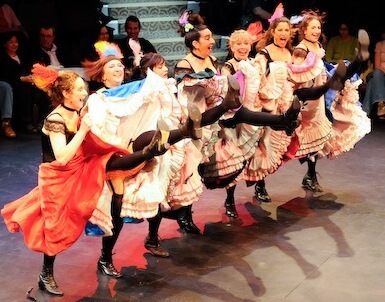
Can - Can - Jacques Offenbach - Gavin Somerset
The gallop from Offenbach's overture to "Orpheus In The Underworld" is one of the most famous finales to any classical piece of music. Used countless times from pop music to Moulin Rouge dancers, the piece has become a favourite encore/finale item. Now arranged by Gavin Somerset to be playable by lower section bands, and with some extra parts to really liven the item up, this piece is sure to leave your audience wanting more. A perfect finisher for any concert.
In Stock: Estimated dispatch 1-3 working days
-
 £24.50
In Flanders Fields - Gavin Somerset
Many are familiar with the ever popular poem, 'In Flanders Fields' written by Lieutenant Colonel John McCrae during the first World War. The poem tells of the fields strewn with crosses where fallen soldiers had been laid to rest. The opening stanza states 'In Flanders fields the poppies blow, Between the crosses, row on row,'. These words form the foundation on which this music was composed. The music pulls on the varying emotions one might feel if you journeyed through the fields and will leave your audience in little doubt of the sadness, bravery and honour, which those who fell in the Great War endured. Also Available for Wind Band
In Stock: Estimated dispatch 1-3 working days
-
£37.50
Triumphalis - Ed Keeley
Triumphalis is a celebration that honours victory - a musical epitaph that reflects on the horrors and sacrifices of WWII. The BBC began prefixing its transmissions to the European Mainland with V for Victory in Morse Code (3 dots and a dash) in 1941, this motif corresponds to the famous opening of Beethoven's 5th Symphony on the timpani - becoming a symbol of resistance and hope. The music continues with a quasi bugle call, followed by a victory fanfare. Then, the music meanders through both major and minor keys symbolising victories and defeats, joy and sorrow, finally culminating in a joyous and flourishing celebration.
In Stock: Estimated dispatch 1-3 working days
-
£37.50
Brass Monkeys Jazz Workout - Paul H Traves
This huge release brings together a selection of music composed by Paul H Traves that introduces your learners to the different style of Jazz that is available. Naturally, the rhythmic work required to play such styles means that this publication will push your learners on and will challenge them at a new level. Syncopation and swing are at the heart of the music in this collection and it is the perfect way to get your learners playing in new styles not always covered by training band music. This title offers excellent value for money with seven titles included. This publication features:SNAKES & LADDERS - (teaching dynamics and expressive playing)CHROMATICS - (As the title suggest, ensuring every valve us used!)ROCKIN' GERONIMO - (featuring triplets and accidentals)TRUMPET DRIFT - (introducing crotchet triplets & syncopation)J.B.'s 12 BAR BLUES - (a well-known style that feature sharp key signatures)J.B.'s CALYPSO (unison playing and tight rhythmic playing required)ZIG-ZAG (getting players into a lazy swing style)
In Stock: Estimated dispatch 1-3 working days
-
 £38.95
Unity Series Band Journal - Numbers 530 - 533, June 2024
530: Carol Arrangement - God rest you merry, gentlemen (Noel Jones)This swing arrangement of the traditional English carol also features references to O come, all ye faithful (C.C. 61) and Jingle Bells (C.C. 121). Play with imagination and a sense of style!531: Go, tell it on the mountain! (Nathanael Watchorn)Historically, the passion of enslaved people in America for singing about the Gospel of Jesus is well documented, but it was men of three generations, each named John Wesley Work, who enabled spirituals to become more widely known. John Wesley Work Sr, a church choir director in Nashville, Tennessee, wrote and arranged music for the pioneering Fisk Jubilee Singers whose early repertoire consisted largely of spirituals. This passion and knowledge of spirituals was passed down through the generations. John Work III travelled hundreds of miles to collect songs by attending church services in remote areas. In 1940, he published a collection of 230 songs which included a setting of Go, tell it on the mountain! that is still performed today.Nathanael Watchorn, a Bandsman at Regent Hall Corps in London, is a new contributor to the journals. He originally wrote this as a vocal arrangement for the group FourHymn, subsequently transcribing it for the corps' Young People's Band, while he was Band Leader.532: Carol Arrangement - They all were looking for a king (Stephen Hull)At the North American Composers Forum, Major Len Ballantine challenged participants to find an unfamiliar song in the Salvation Army Song Book and try to write an arrangement of the listed tune. Stephen Hull happened across They all were looking for a king (S.A.S.B. 128) and the tune Childhood (T.B. 421) which lead to this arrangement.533: March - Washed and healed (Eiliv Herikstad)The Christian experience of many people will have been positively impacted by the life of the late Bandmaster Eiliv Herikstad, either personally or through his musical leadership and compositions. This march is the second publication from this well-known Salvation Army composer since his Promotion to Glory last year. This march is more traditional in style that many of his compositions but contains a strong Christian message and demonstrates his compositional expertise.
Estimated dispatch 7-14 working days
-
 £20.00
King Lear Fanfare - Claude Debussy
King Lear is a tragedy by William Shakespeare. Lear descends into madness bringing tragic consequences for all. Based on a mythological pre-Roman Celtic king, the play has been widely adapted for the stage and motion pictures, with the title role coveted by many of the world's most accomplished actors. Its first known performance was in 1607, George Bernard Shaw wrote, "No man will ever write a better tragedy than Lear". Originally orchestrated for 2 flutes, 4 horns, 3 trumpets, timpani, side drum, 2 harps, and strings, Debussy wrote five minutes of incidental music for a production of King Lear, produced at the Theatre Mogador Paris in 1904.
-
 £55.00
Mary Did You Know?
ABOUT THIS PIECE: Upon being asked to write a Christmas musical for his church, Mark Lowry penned a series of monologues based on Christmas Songs including a conversation with Mary about the birth and life of her Son, Jesus. Lowry worked on the lyrics for years until he approached southern gospel singer-songwriter and harmonica player, Buddy Greene. Greene agreed to pen music for his words, completing the instrumentation within a few days. The result is this new-age Christmas classic: 'Mary Did You Know". ENSEMBLE: Standard British Brass Band WHEN YOU BUY THIS PRODUCT, YOU GET: High-quality printed score and parts LEVEL: 2 LISTEN: Listen here DURATION: 4-minutes 30-secondsEXAMPLE SCORE: Click here LEVEL GUIDE: Level 1- Accessible to all Level 2 - c. UK third section and higher Level 3 - c. UK second section and higher Level 4 - c. UK first section and higher Level 5 - c. UK championship section level .
Estimated dispatch 5-7 working days
-
£73.00
Dig a Little Deeper (From "The Princess and the Frog") - Randy Newman - Svein H. Giske
Dig a little Deeper is one of the featured songs in the Disney animated movie The Pricess and the Frog from 2009.The movie is a so-called American animated musical romantic fantasy comedy-drama.Randy Newman composed the music for the movie which features the famous Dirty Dozen Brass Band on several of the tracks. Dig a little Deeper is performed by Jennifer Lewis and Pinnacle Gospel Choir.This arrangement for Brass Band by Svein H. Giske was written to Askoy Brass Band for their participation in the entertainment-competition Siddis Brass in 2015.
Estimated dispatch 7-14 working days
 View Music
 Listen to MP3