
Results
-
 £44.95
Trombone Concerto (Trombone Solo with Brass Band - Score only) - Gregson, Edward
The Gregson Trombone Concerto was originally written in 1979 to a commission from Bedfordshire Education Service, for a new work for Michael Hext, winner of the first BBC Young Musician of the Year competition. This version for brass band was commissioned by Nicholas Childs, Music Director of the Black Dyke Band, specially for Brett Baker, the then principal trombone of the band. He has recorded it on the Doyen label with the Black Dyke Band.The work falls into three main sections, played without a break, but conforming to the traditional pattern of concerto structure. After a slow introduction, containing most of the motivic and rhythmic ideas used in the work, there follows the main fast section which is itself divided into three parts and concludes with a fierce climax (timpani and gong). The slow and rather intense middle section is linked to a cadenza for the soloist, at first unaccompanied but leading to accompanied references to earlier material. The final section is a scherzo which ends dramatically with a re-statement of the opening slow introduction. A brisk coda concludes the work. The interval of a fourth (and its augmented form) provides melodic and harmonic unity for the work, whilst the tonal juxtaposition between E minor and B flat major throughout the concerto is an important element of the structure.The writing for trombone is virtuosic, encompassing the whole range of the instrument, but it also exploits the rather beautiful lyrical sound of which this instrument is capable.Duration: 16.00
Estimated dispatch 7-14 working days
-
 £44.95
Fantasia on 'Glory to his Name' (Brass Band - Score and Parts) - Bright, Dudley
This Fantasia is a celebration of the work of Ray Steadman-Allen. Through most of his 92 years, his music has had a profound and wide-ranging impact on Salvation Army music. Always innovative, rather than stylistically stereotypical, his music has led the way forward for Salvationist composers. As the title suggests, his light-hearted 1960's vocal solo provides thematic material and highlights his motivation. There are also references to and quotations from several more of his pieces. Yet, although much of his music can be challenging, he has also given us music that speaks directly to the heart. His much-loved songs 'He giveth more grace' ('Blacklands') and 'Remember Me' are heard in humble and sincere tribute to a life dedicated to giving the glory to God through his music.
Estimated dispatch 7-14 working days
-
£22.50
Fantasia on 'Glory to his Name' (Brass Band - Score only) - Bright, Dudley
This Fantasia is a celebration of the work of Ray Steadman-Allen. Through most of his 92 years, his music has had a profound and wide-ranging impact on Salvation Army music. Always innovative, rather than stylistically stereotypical, his music has led the way forward for Salvationist composers. As the title suggests, his light-hearted 1960's vocal solo provides thematic material and highlights his motivation. There are also references to and quotations from several more of his pieces. Yet, although much of his music can be challenging, he has also given us music that speaks directly to the heart. His much-loved songs 'He giveth more grace' ('Blacklands') and 'Remember Me' are heard in humble and sincere tribute to a life dedicated to giving the glory to God through his music.
Estimated dispatch 7-14 working days
-
 £45.00
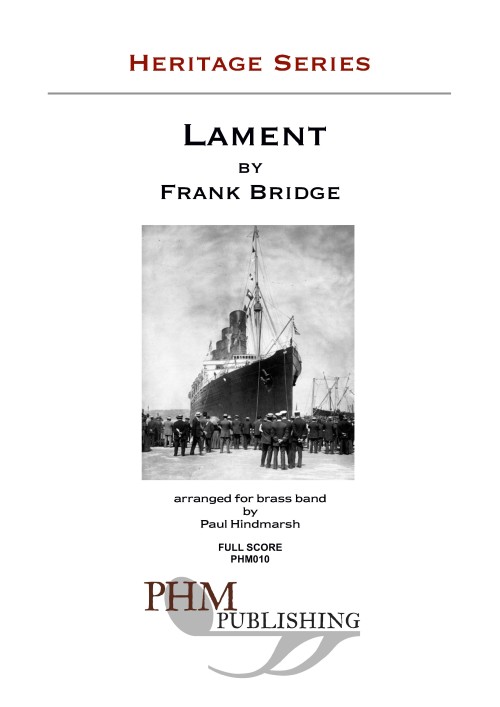
Lament (Brass Band - Score and Parts) - Bridge, Frank - Hindmarsh, Paul
The English composer Frank Bridge (1879 - 1941) did not take an active part in the First World War. However, he was devastated by the slaughter on the western and the eastern fronts, especially the loss of so many of his musicians friends and colleagues. Writing in 1963, his former pupil Benjamin Britten confessed that 'a lot of my feelings about the First World War which people seemed to see in the War Requiem came from Bridge. He had written a piano sonata in memory of a friend killed in France and though he didn't encourage me to take a stand for the sake of a stand, he did make me argue and argue and argue. His own pacifism was not aggressive, but typically gentle'.Bridge composed this Lament for string orchestra on 14 June 1915, in memory of Catherine Crompton, who drowned when the Cunard liner Lusitania was torpedoed by a German submarine on 7 May, 1915. According to figures researched by Liverpool historian Kevin Roach (www.lusitania.net), 1201 men, women and children lost their lives out of the 1962 people aboard. Ninety-four children died, including Catherine, her twin brother Paul and four other siblings. Paul Crompton, Snr. (44), a British businessman working in Philadelphia, his wife Gladys (40) and the family nanny were also drowned. How Bridge's dedication came about is uncertain. The music critic Edwin Evans, who knew Bridge well, has written that the Catherine was a young friend. It is also possible that he came across the family photograph which was published in many newspapers in the wake of the tragedy. By that time, Bridge was greatly distressed by the war as a whole. It seems perfectly in keeping with his pacifist leanings and the strength of his reaction, that this poignant and deeply touching 'war memorial' should mourn a child who he did not know, rather than one of the thousands of young men who fell in battle.Through the musical tears of this melancholy lullaby, Bridge may have regarded the death of young Catherine Crompton as symbolic of the loss of so many innocent lives in wartime. His response to this personal tragedy was characteristically spontaneous and utterly sincere. It is one of his most effective miniatures, poignant yet restrained in its lyrical beauty, with a compelling directness and simplicity of construction.This brass band transcription is pitched one tone lower than the original for string orchestra.- Paul HindmarshDuration: 5.00
Estimated dispatch 7-14 working days
-
 £137.99
Metamorphosis (Brass Band - Score and Parts) - De Haan, Jan
The opening of this three-movement work features an initial appearance of the thematic material that returns in various guises later on in the work. The leitmotiv centres on a minor second.A range of thematic variations is heard in the lively and energetic Metamorphosis One. This movement is interrupted by an atmospheric meno mosso, containing melodic passages that return to the opening theme.Metamorhosis Two is characterised by various changes in tempo and musical character. Seven different soloists transform the thematic material - each in their own way. This eventually culminates in a passionate tutti passage.The source of inspiration for Metamorphosis Three is the so-called BACH-motif, a musical autograph consisting of the notes B flat, A, C and B. This distinctive motif arises from the leitmotiv (here a descending minor second), which continues to evolve through various transpositions and transformations. For the composer, this spectacular last movement is an homage to one of the greatest and most influential composers in the history of music: Johann Sebastian Bach.Duration: 17:00
Estimated dispatch 7-14 working days
-
 £29.50
REM-Scapes (Brass Band - Score only) - Doss, Thomas
Sweet echoes of Beethoven's Moonlight Sonata in the introduction bring a gentle slumber. Breathing is calm and sleep holds the promise of rest and relaxation. With the onset of the REM sleep phase, however, in which most dreams take place and where the day's events are worked through, we hear other sounds played. With distorted sounds, reminiscent of an old gramophone, the music pulls the listener inevitably ever deeper into the dreamscape, in a very realistic dangerous situation that comes to a dramatic head. It triggers a desperate struggle between the impulse to awaken and the exhausting urge to flee. For a short moment, it seems as if the wakeful urge has won out, before dream's powerful spell is again cast, and there's no escapeDuration: 17:00
Estimated dispatch 7-14 working days
-
 £154.99
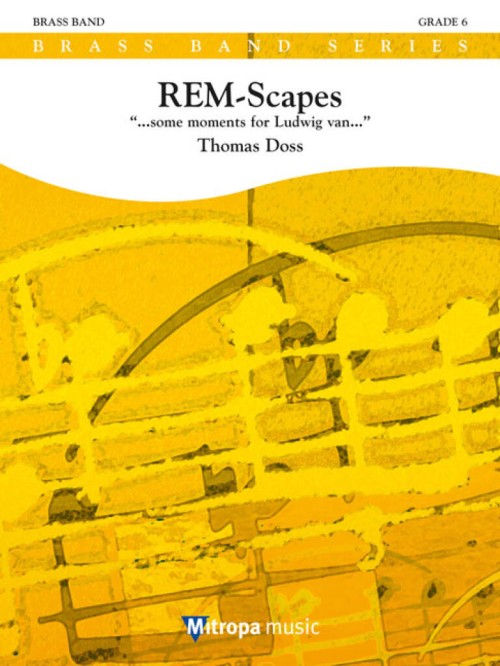
REM-Scapes (Brass Band - Score and Parts) - Doss, Thomas
Sweet echoes of Beethoven's Moonlight Sonata in the introduction bring a gentle slumber. Breathing is calm and sleep holds the promise of rest and relaxation. With the onset of the REM sleep phase, however, in which most dreams take place and where the day's events are worked through, we hear other sounds played.With distorted sounds, reminiscent of an old gramophone, the music pulls the listener inevitably ever deeper into the dreamscape, in a very realistic dangerous situation that comes to a dramatic head. It triggers a desperate struggle between the impulse to awaken and the exhausting urge to flee. For a short moment, it seems as if the wakeful urge has won out, before dream's powerful spell is again cast, and there's no escape...Duration: 17:00
Estimated dispatch 7-14 working days
-
 £38.00
Funk (Brass Band - Score and Parts) - Anderson, Keiron
The driving rhythms and lush harmonies of funk music is a perfect vehicle for the tight, dynamic playing of a solid brass band. The brass sections of Tower of Power and Earth, Wind and Fire inspired players from the 1980s onwards and being part of this type of rhythmic force is a great experience. This piece is designed to be rewarding for all the performers and of course the most important group; the audience! Duraion: 4.00. Suitable for 1st Section Bands and above.
Estimated dispatch 7-14 working days
-
 £23.00
King Lear Fanfare (Brass Band - Score and Parts) - Debussy, Claude - Wilson, Duncan
King Lear is a tragedy by William Shakespeare. Lear descends into madness bringing tragic consequences for all. Based on a mythological pre-Roman Celtic king, the play has been widely adapted for the stage and motion pictures, with the title role coveted by many of the world's most accomplished actors. Its first known performance was in 1607, George Bernard Shaw wrote, "No man will ever write a better tragedy than Lear". Originally orchestrated for 2 flutes, 4 horns, 3 trumpets, timpani, side drum, 2 harps, and strings, Debussy wrote five minutes of incidental music for a production of King Lear, produced at the Theatre Mogador Paris in 1904. Duration: 1.30. Suitable for 4th Section Bands and above.
Estimated dispatch 7-14 working days
-
 £38.00
Jubilee Gigue (Brass Band - Score and Parts) - Wiseman, Debbie - Houlding, Christopher
Composer Debbie Wiseman is one of the UK's most successful female music ambassadors. Throughout the past 20 years, there are probably few people in the UK who have not heard a theme from one of Debbie's many film or television productions. Honoured in the Queen's New Year's with an MBE for services to the music and film industry, she has been awarded honorary fellowships at both the music colleges where she studied, Trinity College of Music and the Guildhall School of Music and Drama. "Jubilee Gigue" was commissioned to be performed on the Georgian barge as part of the Queen's Diamond Jubilee Pageant. Inspired by the "Gigue" in Handel's original Water Music, the work has a rollicking, upbeat feel and is now newly arranged for brass band by Chris Houlding. Duration: 5.30. Suitable for 3rd Section Bands and above.
Estimated dispatch 7-14 working days
 View Music