
Results
-
 £25.00
Cadishead - Concert March
ABOUT THIS PIECE: Introduce a spirited addition to your next programme with this new march - Cadishead. Written by Adam DJ Taylor in 2019, this vibrant march was composed for the Cadishead Public Band near Manchester as a tribute to the memory of James Roy Hesford. The piece embodies the classic elements of a brass band march, making it a versatile choice for concerts. ENSEMBLE: Standard British Brass Band WHEN YOU BUY THIS PRODUCT, YOU GET: High-quality printed score and parts LEVEL: 1 LISTEN: Click here DURATION: 3-minutes, 20 secondsEXAMPLE SCORE: Click here LEVEL GUIDE: Level 1- Accessible to all Level 2 - c. UK third section and higher Level 3 - c. UK second section and higher Level 4 - c. UK first section and higher Level 5 - c. UK championship section level
Estimated dispatch 5-7 working days
-
The Tricorn - Len Jenkins - Len Jenkins
The Tricorn is a style of three-cornered hat from Europe in the 18th century, generally referred to as a 'cocked hat' in Britain and popular in America at the time of the War of Independence. It may still be seen on ceremonial occasions as part of the town-cryer's dress in England and features in a popular German song for children 'Mein Hut, der hat drei Ecken'. However, in the case of this music, the reference is to the cornet section and the requirement for triple-tonguing on the Eb Soprano cornet. Whilst ostensibly a concert march in style, its jaunty rhythm makes you want to stride along and it may therefore be used as a 'road march' as well. Pressure on the Soprano cornetist as a soloist is reduced by adding the Solo Cornets to the melody line in the 'road march' version. With this in mind, we supply the music in both A4 (concert) and A5 (march-card) sizes as a package.
-
 £189.95
'The New Christmas Collection' - Full Set March Card Size
The new Christmas Collection carol books contain all the traditional Christmas Carols, with some new 'pop' music arrangements included to add more variety to your carolling this year.
* Note, these are not compatible with the New Christmas Praise books.
Full list of works in The Christmas Collection:-
• A child this day is born
Estimated dispatch 7-14 working days
• A Christmas lullaby
• A great and mighty wonder
• All I want for Christmas is you
• All my heart this night rejoices
• Angels, from the realms of Glory (Come and worship)
• Angels, from the realms of Glory (Iris)
• Angels we have heard on high
• A starry night
• As with gladness men of old
• Auld lang syne
• A virgin most pure
• Away in a manger (The manger scene)
• Away in a manger (Traditional)
• A winter’s tale
• Bethlehem
• Brightest and best (Spean)
• Brightest and best (Traditional)
• Calypso Carol
• Carol for the Nativity
• Carol of the bells
• Carol of the drum
• Child of Mary
• Christians Awake!
• Christ is born (Il est né)
• Christ was born on Christmas Day
• Come and join the celebration
• Come, children, come quickly
• Coventry Carol
• Deck the hall
• Ding dong! merrily on high
• Do you hear what I hear?
• Frosty the snowman
• Gabriel’s Message
• Gaudete
• Glory in the highest
• Glory in the highest Heaven
• God of God, the uncreated
• God rest you merry, gentlemen
• Good Christian men, rejoice
• Good King Wenceslas
• Go, tell it on the mountain!
• Happy Christmas (War is over)
• Hark the glad sound!
• Hark! the herald angels sing
• Have yourself a merry little Christmas
• Here we come a-wassailing
• How far is it to Bethlehem?
• Huron Carol
• Infant Holy
• In the bleak midwinter (Cranham)
• In the bleak midwinter (Darke)
• I saw mommy kissing Santa Claus
• I saw three ships come sailing in
• It came upon a midnight clear (Traditional)
• It came upon a midnight clear (Willis)
• It’s beginning to look a lot like Christmas
• It’s the most wonderful time of the year
• I wish it could be Christmas everyday
• I wonder as I wander
• Jesus, good above all other
• Jingle Bells
• Jingle bell rock
• Joy to the world!
• Last Christmas
• Let it snow!
• Little baby Jesus
• Little children, wake and listen
• Little Donkey
• Little Jesus, sweetly sleep
• Lo! he comes with clouds descending
• Long, long ago
• Love came down at Christmas
• Mary’s boy child
• Mary’s Child
• Masters in this hall
• Merry Christmas everyone
• Mistletoe and wine
• Noel
• O Christmas tree
• O come, all ye faithful
• O come, Immanuel
• O Heaven-sent King
• O holy night!
• O little town of Bethlehem (Christmas Carol)
• O little town of Bethlehem (Forest Green)
• O little town of Bethlehem (St Louis)
• Once in royal David’s city
• Past three o’clock
• Patapan
• Personent Hodie
• Praise ye the Lord
• Ring the bells
• Rise up, shepherd!
• Rockin’ around the Christmas tree
• Rudolph, the red-nosed reindeer
• Sans day carol
• Santa Claus is comin’ to town
• Saviour’s Day
• See, amid the winter’s snow
• Silent Night!
• Sleigh Ride
• Softly the night is sleeping
• So here it is, merry Christmas
• Stars are shining
• Still, still, still
• Stop the cavalry
• Sussex Carol
• Sweet chiming bells
• Sweet chiming Christmas bells
• The candle song
• The cherry tree carol
• The Christmas song
• The first Nowell
• The holly and the ivy
• The infant King
• The light has come
• The shepherds’ farewell
• The stable door
• The star in the east
• The twelve days of Christmas
• The virgin Mary had a baby boy
• They all were looking for a king
• Thou didst leave thy throne
• Three kings’ march
• Unto us a boy is born
• Walking in the air
• We gather round the manger-bed
• We three kings of Orient are
• We wish you a merry Christmas
• What child is this?
• When a child is born
• When Santa got stuck up the chimney
• Whence is that goodly fragrance flowing?
• When wise men came seeking
• While shepherds watched (Cranbrook)
• While shepherds watched (Handel)
• While shepherds watched (Winchester Old)
• White Christmas
• Who is he?
• Winter Wonderland
• Worldwide Christmas message
• Zither Carol
• A starry night
• Christmas Joy
• Christmas Praise
• Coventry Carol
• Infant Holy
• Mid-winter
• Rudolph, the red-nosed reindeer
• The everlasting light
• To celebrate his birth
• Yuletide Rag
-
 £25.00
Zephyrus. March for Brass Band
Recommended - Suitable for all bands The Big Blow, was a formal record attempt to create the largest brass band in the world. It took place at Butlin's Resort, Skegness on 20 January 2007, and it's main goal was to raise money in support of the work of Brass Band Aid, and specifically to provide long-term sponsorship for two children in the village of Adet in Ethiopia. The Music Company (UK) Ltd were one of the Official Partners of The Big Blow, providing the performance piece for the record attempt. Andrew Duncan wrote 'Zephyrus' to mark the occasion. The title takes its name from the Greek God of the West Winds - Zephyrus. Zephyrus is a traditional British brass band march with an interesting African-feel lilt to the trio. This is enhanced by optional percussion instruments including djembi and bongos, which can alternatively be covered by standard drum kit. The Music Company are pleased to continue their support of Brass Band Aid by offering a donation to this worthy charity for every set of this music sold. Includes score & parts
-
£34.95
CANADIAN, The (Brass Band Set) - James Merritt
The centrepiece of this decidedly patriotic and stately march is the Canadian anthem 'O Canada' although the original score (1932) refers to a different set of words ('O Canaan'). The anthem is presented in successively more ornate fashion in the trio section, the musical drama building like a Sousa march so that a da capo is not required. While now considered to be bit of a 'war horse', the march remains great fun to play.
Estimated dispatch 7-14 working days
-
 £34.95
The Canadian (Brass Band - Score and Parts)
The centrepiece of this decidedly patriotic and stately march is the Canadian anthem 'O Canada' although the original score (1932) refers to a different set of words ('O Canaan'). The anthem is presented in successively more ornate fashion in the trio section, the musical drama building like a Sousa march so that a da capo is not required. While now considered to be bit of a 'war horse', the march remains great fun to play.
Estimated dispatch 7-14 working days
-
 £45.00
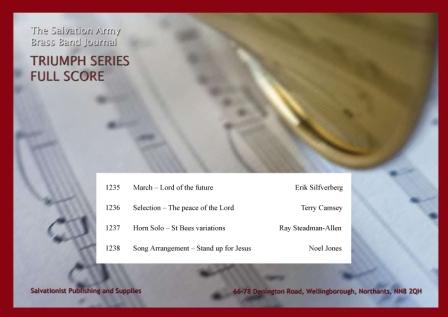
Triumph Series Band Journal March 2013 Numbers 1235 - 1238
No. 1235 March - Lord of the future (Erik Silfverberg)The title of this short, lively march is connected to the tune 'With Christ into the future' which appears in its second half.No. 1236 Selection - The peace of the Lord (Terry Camsey)This selection seeks to portray the peace that is found in Jesus, both in its style and the tunes used; 'Peace, peace, sweet peace', 'O the peace' and 'Brahms' Lullaby'.No. 1237 Horn Solo - St Bees variations (Ray Steadman-Allen)St Bees is a simple melody and this treatment is compatible with its character. Florid and meditative passages conclude with a brisk finale.No. 1238 Song Arrangement - Stand up for Jesus (Noel Jones)The old well-known gospel song appears here in a swing style.
Estimated dispatch 7-14 working days
-
£50.00
King Kong March - Steiner, M - Harper, P
From the original 1933 King Kong movie, this hidden gem of a march is sure to become a big favourite in the band world.Philip Harper has woven Gerschwin's Rhapsody in Blue into the Trio theme to enhance the throwback to the time of the Great Depression in the USA.1st Section +Duration 4 mins Click to listen - Courtesy of Cory Band
In Stock: Estimated dispatch 1-3 working days
-
 £45.00
The Thunderer (Brass Band - Score and Parts)
This march, one of Sousa's most popular compositions, was written in 1889 and was dedicated to the Knights Templar of Washington, D.C. Sousa had been knighted by that organization three years earlier. The origins of the name of the march are unclear and the march is noteworthy not only for Sousa's usual creative skills but also for the use, in two sections of the march, of military-style percussion and, in the last section, of featured fanfares.This arrangement was prepared for the 2009 Summer concerts of Brass Band of the Western Reserve, musical director Dr Keith M Wilkinson. The arrangement highlights the particular features mentioned above and performances will be enhanced by following the indicated staging directions.
Estimated dispatch 7-14 working days
-
 £33.62
Coronation March from 'Le Prophete' (Brass Band) Meyerbeer arr. Rob Bushnell
The Coronation March by the German composer Giacomo Meyerbeer comes from Act 4, Scene 2 of his grand opera, Le Prophete (The Prophet). Set in the 16th century, it is based on the life of John of Leiden, Anabaptist leader and "King of Munster", with the libretto influenced by the works of Voltaire. The 5-act opera deals with love, revenge and tragedy. It was premiered by the Paris Opera at the Salle Le Peletier on 16 April 1849, with audience members including Chopin, Verdi, Delacroix, Charles Dickens and Berlioz.During his life, Meyerbeer was a dominant figure in the world of opera, with Hector Berlioz saying of him 'he has not only the luck to be talented, but the talent to be lucky.' To view a rolling score video of the work please visit www.youtube.com/watch?v=_M4DtUdQzhA Duration: Approx. 3.40 minutes Difficulty Level: 3rd Section + PDF download includes parts and score. Also includes alternative parts for horns in F and lower brass in bass clef. Sheet music available from www.brassband.co.uk Instrumentation: Soprano Cornet Eb Solo Cornet Bb Repiano Cornet Bb 2nd Cornet Bb 3rd Cornet Bb Flugel Horn Bb Solo Horn Eb 1st Horn Eb 2nd Horn Eb 1st Baritone Bb 2nd Baritone Bb 1st Trombone Bb 2nd Trombone Bb Bass Trombone Euphonium Bb Bass Eb Bass BbTimpani Percussion
In Stock: Estimated dispatch 1-3 working days
 View Music