
Results
-
£54.99
Barcelona '92 - Horst Schelcke
The Olympic Games from the summer of 1992, officially known as theGames of the XXV Olympiad of the modern era, were held in the sunnySpanish city of Barcelona. This was the first time the Olympic Gameshad been held in Spain, and to celebrate this Horst Schelke composedthis rousing concert march with a typically Spanish feel. Relive theexcitement of this great event with this superb march.
Estimated dispatch 5-14 working days
-
 £59.99
The Bandwagon - Philip Sparke
Band director and radio presenter Yutaka Nishida hails from Tokyo and is the Frank Renton of the Japanese Brass Band world. He presents a weekly two-hour music programme on the Japanese national radio station, Digital Radio Musicbird. The programme is called The Bandwagon and the station commissioned Philip Sparke to compose a march, which could be used as the theme tune. The result is this bright and breezy march in simple ABA form. A great lively item for any concert.
Estimated dispatch 5-14 working days
-
 £60.99
Pioneers of the Lowlands - Jacob de Haan
This concert march is a tribute to the "pioneers" in the world of brass music in the Lowlands of Netherlands, the original founders of the bands and the people who take the lead in organising the societies and associations in the band movement. Celebrate the joy and friendship of the brass band movement with this truly uplifting march.
Estimated dispatch 5-14 working days
-
 £34.30
Arromanches - Albert E. Kelly - Gosling Mol
Kelly wrote this march for the 1948 Kneller Hall March Contest. With the 4/7th Dragoon Guards Kelly took part into the landing in Normandy on D Day, june the 6th 1944; actually he was injured himself at the end of july. 'ARROMANCHES' is a suiting tribute to the heroes of the Allied landings at Arromanches.
Estimated dispatch 5-14 working days
-
 £54.99
Images for Brass - Stephen Bulla
Stephen Bullas highly descriptive work was written to commemorate the 50th anniversary of the Battle of Iwo Jima, which took place between the 19th February and 26th March 1945.Casualties on both the American and Japanese sides were horrendously high before the famous image of the raising of the flag on top of Mount Suribachi signalled the end of one of the most significant and terrifying Pacific conflicts of the SecondWorld War.The work received its first performance by the brass choir of the U.S. Marine Band at the National Cathedral in Washington D.C. and is divided into four programmatic sections.The first portrays the sense of anticipation before conflict (Prologue), before the arduous journey to the scene of the battle (Approach by Sea) is followed by introspection and prayer featuring the hymn tune Melita (Chorale Prayer), andfinally, the hostile confrontation itself (Engagement).There are frequent references to the Marines Hymn and the US National Anthem, particularly in the closing bars, depicting the ultimate raising of the American flag.
Estimated dispatch 5-14 working days
-
£60.99
Marching Blues - Hayato Hirose
Marching Blues was written in the blues and swing-jazz style of the great big bands. It is an ideal show march that can be used for encores, popular performances, family concerts and much more. As an added entertaining feature why not get your Eb bass player to stand for his/her 28-bar solo! From small ensembles to large bands, Marching Blues will bring great joy to all generations of performers and audiences on many occasions.
Estimated dispatch 5-14 working days
-
 £49.00
Salentin - Gauthier Dupertuis
Salentin is Gauthier Dupertuis' tribute to the Valais, the Swiss Canton where he was born. Salentin is a mountain from which there is a spectacular view of Vernayaz, the composer's village of origin.This piece is structured in such a way that all registers of the band are highlighted. It is suitable for performance in parade, but also as a concert march.Salentin is dedicated to the Concert Band of Martigny (Valais/Switzerland) and its conductor, Dany Rossier, who premiered Salentin during a concert on 3rd December, 2023.
Estimated dispatch 5-14 working days
-
 £74.99
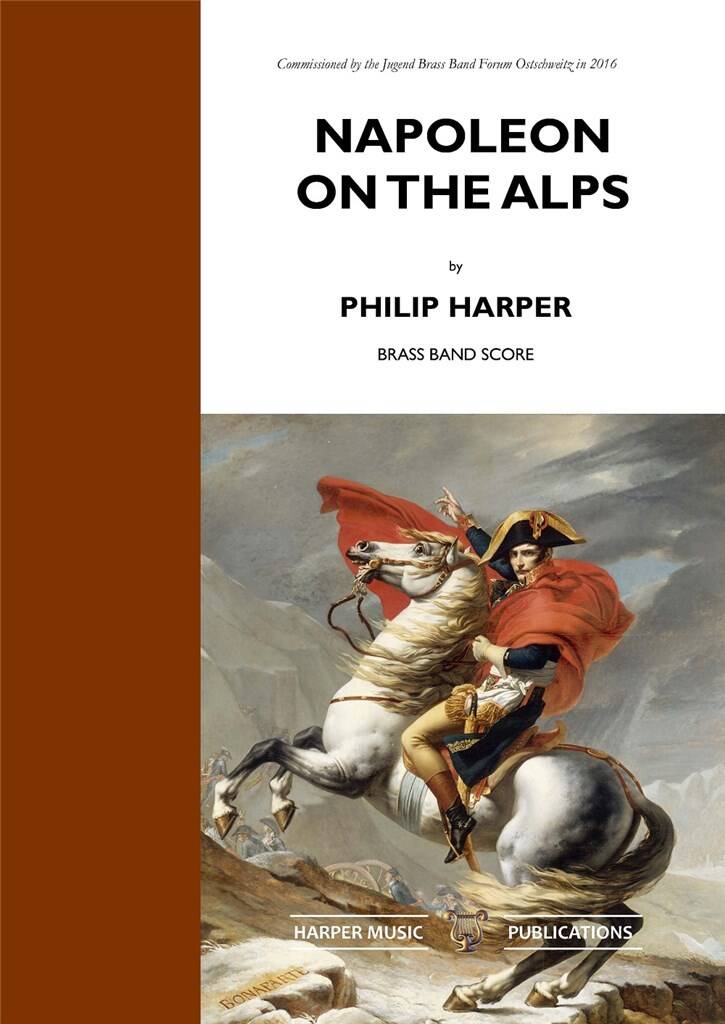
Napoleon on the Alps - Philip Harper
This dramatic piece is based on the famous oil painting by Jacques-Louis David, 'Napoleon Crossing the Alps'. There are three parts: Approaching the Great Saint-Bernard Pass depicting snowy mountains and the determined march of the NapoleonicArmy: The Emperor Napoleon a noble and heroic theme, accompanied by stately fanfares with an exotic flavour: and Onwards, to the Empire! describing Napoleon's relentless drive to expand the French empire across the globe at. This piecewas first performed directly in front of the Napoleon Museum in Arenenberg, Switzerland in Summer 2016.
Estimated dispatch 5-14 working days
-
 £104.99
Purcellian Fantasia - Jan de Haan
This composition is based on the march from Henry Purcell's Music for the funeral of Queen Mary II, a work written in 1694. In this fantasia, various movements flow from one to the next following the main theme; these movements not onlyelaborate on the theme, but also contrast with it. At times, the thematic material diverges so much, that the work acquires a character of its own; however, the composer often refers back to fragments of the theme. This work was test piece in the 4thdivision of the Dutch National Brass Band Championships (NBK) in 2017.
Estimated dispatch 5-14 working days
-
£54.99
Studio-Pop - Kees Vlak
Studio-Pop consists of five movements. The first movement, entitled Marching on a String, is an energetic rock march in a modern rhythm. Next, the charming Dreaming of Summer has been composed in three-four time - which is quite unusual in modern pop music. The inspiration for the third movement, Chicken-Charley was a youngman selling chicken legs from a stall. His supple, dancing movements can be recognised in the music. The fourth movement, Candlelight is a modern, attractive ballad. Finally, Discoteca takes us along on a night visit to a Spanish discotheque. The typically Spanish chords and the stirring, high-spirited rhythm provide an exuberant closing to Studio-Pop.
Estimated dispatch 5-14 working days
 View Music