
Results
-
 £7.46
£7.46Euphonium Concerto with Brass Band (Karl Whelan) Soloist Copy
*Karl Whelan's Euphonium Concerto with Brass Band is written in three linked movements: I: Prelude II: Aria III: Scherzo The first movement, Prelude, is in a mirror image sonata form and with its menacing ostinato sets the tone for the entire concerto and also introduces material on which the concerto is based. During this movement, the soloist has the opportunity to display their technical ability as well as the extremes of the instruments range. A chord based on the notes of the ostinato signal the beginning of the second movement, Aria. Here, material from the first movement has been weaved together and moves through a multitude of keys, the soloist is able to show the expressive side of the instrument to create an almost yearning, operatic aria. A reiteration of the 1st subject takes us into an almost march like figure at the beginning of the third movement, Scherzo. This is then interrupted both times by dance-like scherzo which, as with the rest of the concerto navigates itself through different keys leading to the cadenza that even the temple blocks have the the chance of participating in! The concerto concludes with almost a battle between the band (playing fragments of the first and second subjects from the first movement), and soloist who is attempting to have the last word! To view a follow-the-score video of the work please visit: www.youtube.com/watch?v=aEnou67XHqA To purchase the full band set please visit www.brookwrightmusic.com/product-page/euphonium-concerto-with-brass-band-karl-whelan *Please note this download only includes the soloist copy. Sheet music available from: UK - www.brassband.co.uk USA - www.solidbrassmusic.com Instrumentation: Euphonium Soloist Bb Soprano Cornet Eb Solo Cornet Bb 2nd Cornet Bb 3rd Cornet Bb Flugel Horn Bb Solo Horn Eb 1st Horn Eb 2nd Horn Eb 1st Baritone Bb 2nd Baritone Bb 1st Trombone Bb 2nd Trombone Bb Bass Trombone Euphonium Bb Bass Eb Bass Bb Timpani Percussion 1-3
In Stock: Estimated dispatch 1-3 working days
-
£29.95
INVINCIBLE ARMY, The (Brass Band Set) - Erik Leidzen
When the New York Staff Band toured England in 1960 they featured much new music written for them by Erik Leidzen, including this march. The trio section is in the unusual key (brass band pitch) of Db major, a major third away from the opening key of F major, rather than the more predictable subdominant of Bb major. This presents a technical and mental challenge to the players but provides a particularly brilliant sonority when played in tune!
Estimated dispatch 7-14 working days
-
£34.95
MONTCLAIR CITADEL (Brass Band Set) - Stephen Bulla
Stephen Bulla is a former member of Monclair Citadel Band and gladly supplied Bandmaster Charles Baker with this fine march for a recording made by the band in 2001. The tune 'Onward Christian Soldiers' forms the bulk of the trio, first being tossed around in various registers and then, just the chorus, in the festive ending.
Estimated dispatch 7-14 working days
-
 £94.95
An Age of Kings (Mezzo-Soprano Solo with Brass Band and optional choir - Score and Parts) - Gregson, Edward
The origins of this work date back to 1988, when I was commissioned by the Royal Shakespeare Company to write the music for The Plantagenets trilogy, directed by Adrian Noble in Stratford-upon-Avon. These plays take us from the death of Henry V to the death of Richard III. Later, in 1991, I wrote the music for Henry IV parts 1 and 2, again in Stratford. All of these plays are concerned with the struggle for the throne, and they portray one of the most turbulent periods in the history of the British monarchy.Much of the music used in these productions was adapted into two large symphonic suites for wind band - The Sword and the Crown (1991) and The Kings Go Forth (1996). An Age of Kings is a new version for brass band incorporating music from both the symphonic suites for wind band. It was specially composed for a recording made by the Black Dyke Band, conducted by Nicholas Childs, in 2004.An Age of Kings is music on a large-scale canvas, scored for augmented brass band, with the addition of harp, piano, mezzo-soprano solo, male chorus, as well as two off-stage trumpets. The music is also organized on a large-scale structure, in three movements, which play without a break - "Church and State", "At the Welsh Court", and "Battle Music and Hymn of Thanksgiving".The first movement, "Church and State", opens with a brief fanfare for two antiphonal trumpets (off-stage), but this only acts as a preface to a Requiem aeternam (the death of Henry V) before changing mood to the English army on the march to France; this subsides into a French victory march, but with the English army music returning in counterpoint. A brief reminder of the Requiem music leads to the triumphal music for Richard Plantagenet, Duke of York, father of Edward IV and Richard III (the opening fanfare transformed). However, the mood changes dramatically once again, with the horrors of war being portrayed in the darkly-drawn Dies Irae and Dance of Death, leading to the final section of the first movement, a funeral march for Henry VI.The second movement, "At the Welsh Court", takes music from the Welsh Court in Henry IV part 1 with a simple Welsh folk tune sung by mezzo-soprano to the inevitable accompaniment of a harp. This love song is interrupted by distant fanfares, forewarning of battles to come. However, the folk song returns with variation in the musical fabric. The movement ends as it began with off-stage horn and gentle percussion.The final movement, "Battle Music and Hymn of Thanksgiving", starts with two sets of antiphonally placed timpani, drums and tam-tam, portraying the 'war machine' and savagery of battle. Trumpet fanfares and horn calls herald an heroic battle theme which, by the end of the movement, transforms itself into a triumphant hymn for Henry IV's defeat of the rebellious forces.- Edward GregsonDuration - 22'00"Optional TTBB available separately.
Estimated dispatch 7-14 working days
-
 £34.95
Chalk Farm No.2 (Brass Band - Score and Parts) - Gregson, Edward
Like so many of the best composers for brass band - Eric Ball, Wilfred Heaton, Elgar Howarth and Robert Simpson - Edward Gregson's youthful talents came to the fore in the Salvation Army. In 1975 Gregson was commissioned by the Chalk Farm Band of the Salvation Army to write a march for the centenary of the birth of the band's most long-serving bandmaster Alfred W Punchard, who conducted the band from 1894 to 1944. In 1909 the Salvation Army published a march called Chalk Farm featuring the old Army chorus 'March on, we shall win the day'.Gregson uses the same tune in his Chalk Farm No 2 march, but this is a symphonic march clearly to be played sitting down. He includes irregular bars of 5 and 7 beats as well as a tongue-in-cheek treatment of the tune, complete with bongos (in the march) and bi-tonality (in the trio). Chalk Farm No 2 imaginatively composed. Gregson's own main theme 'fits' the chorus as a counter-subject. The playful irreverence of the style has more in common with Wilfred Heaton's Praise or Glory, than the conventional Salvation Army March.Duration: 4.00
Estimated dispatch 7-14 working days
-
 £34.95
A Swedish March and Fanfare (Brass Band - Score and Parts) - Gregson, Edward
A Swedish March:This little march was written in 1975 and was commissioned for the Jnkping Summer School, Sweden, where Edward Gregson was guest composer and conductor. It incorporates the old Swedish folksong Britta at its heart, but otherwise is quite conventional in every aspect.Duration: 3.00Fanfare:This fanfare was originally written for brass ensemble, organ and percussion, under the title Fanfare for Europe, and was commissioned for a concert at the Royal Albert Hall, London, to celebrate Great Britain's entry into Europe. The composer then created this version for brass band which was published in 1976.Duration: 1.30
Estimated dispatch 7-14 working days
-
 £45.00
Crown Imperial, March (Brass Band - Score and Parts) - Walton, William - Littlemore, Phillip
William Walton composed his Crown Imperial for performance at the coronation of King Edward VIII, which was scheduled for the 12th May 1937. However, due to the dramatic abdication of Edward, it was in fact performed at the Coronation of the new monarch, King George VI, which took place on the same scheduled date. The march became popular immediately, and arrangements for piano solo, organ, small orchestra and military band were all published within a year. It has been used at all Royal events since, most notably the Coronation of Queen Elizabeth II in 1953. This new brass band transcription?is in keeping with the shorter, 6-minute concert version that Walton created immediately following the Coronation of George VI. However, the scoring is more in keeping with contemporary brass band voicings, and provides an exciting version for brass band.?Duration: 7:00
Estimated dispatch 7-14 working days
-
 £45.00
March Slav (Brass Band - Score and Parts) - Littlemore, Phillip
March Slav?was composed in 1876 at the request of Nicolai Rubenstein (who had recently spurned Tchaikovsky's first piano concerto, and might have wanted to return to favour with the composer). Tchaikovsky loved Russian folk music--looking to it for inspiration throughout his career--and he makes considerable use of it here. From the opening theme to the final glorious statement of the Czarist national anthem, the march draws on the music of his motherland. It was first performed in a charity concert to support a war effort in the Balkans. He composed and fully scored the march in the short time of just 5 days. At the first performance its impact was such that it had to be encored in full, receiving a tumultuous reception - twice! Duration: 7:20
Estimated dispatch 7-14 working days
-
 £59.99
Royal Salute (Brass Band - Score and Parts) - Sparke, Philip
This march from Philip Sparke is in the tradition of the English ceremonial or concert march, such as the masterpieces written by Sir Edward Elgar and Sir William Walton. It attempts to continue this tradition with a march for intermediate band that has all the recognisable hallmarks such as broad melodies, counter melodies and a nobilmente trio.Duration: 5:15
Estimated dispatch 7-14 working days
-
 £90.00
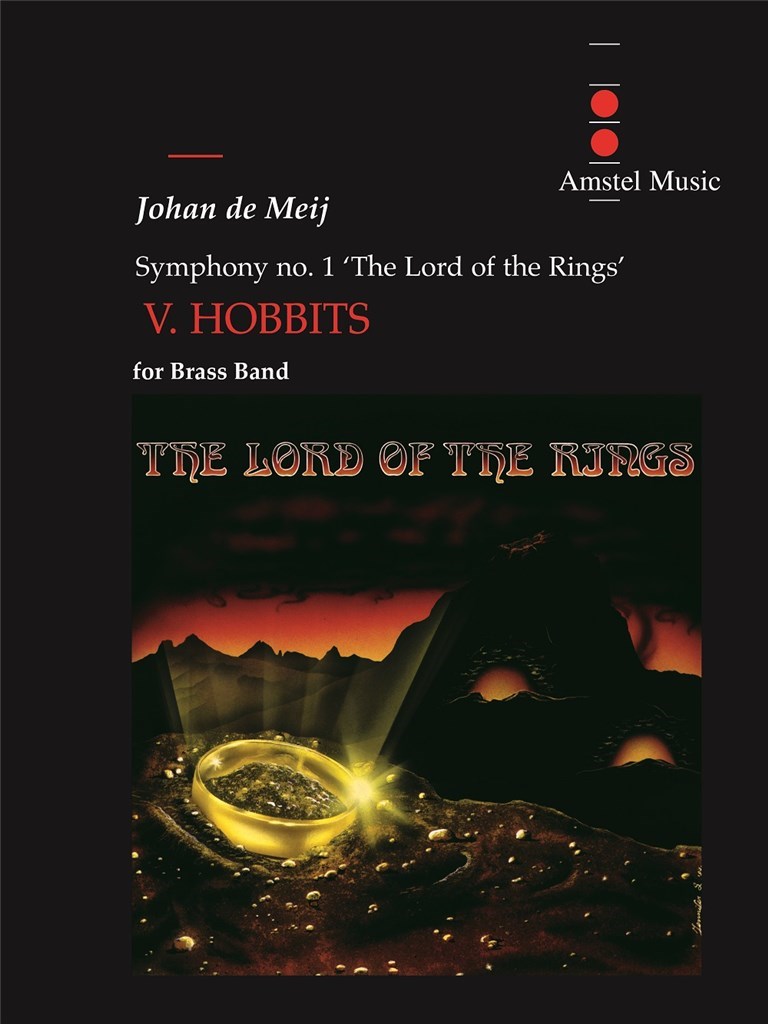
Hobbits (from Symphony No.1: The Lord of the Rings) (Brass Band - Score and Parts) - De Meij, Johan
Johan de Meij's first symphony The Lord of the Rings is based on the trilogy of that name by J.R.R. Tolkien. This book has fascinated many millions of readers since its publication in 1955. The symphony consists of five separate movements, each illustrating a personage or an important episode from the book. This transcription for brass band has been arranged by the composer. The symphony was written in the period between March 1984 and December 1987, and had its premiere in Brussels on 15th March 1988, performed by the The Royal Band ofthe Belgian Guides under the baton of Norbert Nozy. In 1989, the symphony The Lord of the Rings was awarded a first prize in the Sudler International Wind Band Composition Competition in Chicago, and a year later, the symphony was awarded a grant by the Dutch Composers Fund. In 2001, the orchestral version was premiered by the Rotterdam Philharmonic Orchestra and recorded by the London Symphony Orchestra. Duration: 9.00
Estimated dispatch 7-14 working days
 View Music