
Results
-
 £76.99
Bread and Games - William Vean
'Panem et Circenses', Bread and Games were essential for keeping the citizens of ancient Rome in check. While the bread was meant for the poorest among the Romans, the Games were Popular Pastime Number One for everybody.There were different kinds of games, such as chariot races (especially popular with female spectators), or wild-beast fights, where lions, tigers, bulls or bears were set on one another or even on human beings. Most popular, however, were the Gladiator fights. In 'Bread and Games' William Vean depicts one of the many fights in the antique Colosseum. 1. Entrance of the Gladiators: By powerful bugle-calls the attention of the peoplewas asked for, after which the Gladiators entered the Arena at the sound of heroic marching-music.2.Swordfight: We can hear that the fights were not mere child's play in this part.On the contrary, they were a matter of life and death and were fought accordingly.3.Mercy of the Emperor: Sometimes a wounded gladiator could be fortunate, depending on the mercy of the audience. Waving one's handkerchief meant mercy, a turned-down thumb meant no pardon. The Emperor had the right to take the final decision, but he usually complied with the wish of the majority of the public. 4.Lap of Honour: Gladiators were mainly selected among slaves, convicted criminals, or prisoners of war. Consequently, winning was very important, as it would mean fame, honour and sometimes even wealth. A lap of honour, therefore, was the winner's due reward.
Estimated dispatch 5-14 working days
-
 £115.60
Griffenfeldt - John Philip Hannevik
Here we present "Griffenfeldt, a folk-dance in the style of a Norwegian reinlender.This arrangement can be used as the first item in a concert, or after an interval.The musicians can come on stage as they join in. That is why two of the measures are notated "repeat till ready", here you have to wait until everyone is in place! If everyone is ready from the start, the repetition can be omitted.Be sure to play with a bouncy but singing style, not with short and harsh articulations.Do the trills on the beat, but these can also be omitted if it makes it too difficult.To bring out the folk music style a little extra, you can ask the musicians to play on the "backbeat", i.e. emphasize the last half of each quarter-note.In addition, the music will really come to life if all "solo" places are done standing up.The musician Anon Egeland tells this story:This song got its name from a party where it all just got a bit too lively: one of the party-goers started shooting into the ceiling with a gun just as this reinlender was being played. The fiddler - or was it the man with the gun? - was called Griffenfeldt, and that gave the name for the song.
Estimated dispatch 5-14 working days
-
 £109.99
Columbus - Rob Goorhuis
Christopher Columbus was born in Genoa in 1451. His father was a wool merchant. Originally he seemed destined to follow in his father's footsteps, and thus sailed the oceans to countries as far apart as Iceland and Guinea. In 1476 his ship was sunk during a battle off the coast of Portugal. Columbus saved his own life by swimming to shore. In 1484 he conceived the idea of sailing to the Indies via a westward sea route, but it was only in 1492 that he was able to realize this plan. On this first voyage he was in command of three ships: the flag-ship, called the Santa Maria, the Pinta, and the Ni?a. From Spain Columbus sailed via the Canary Islands to the Bahamas, whichhe sighted on October 12th 1492. Without being aware of it Columbus discovered the 'New World' he thought he had landed in the eastern part of Asia. The motif from Dvooak's 9th Symphony 'Aus der neuen Welt' forms a little counterfeit history at this point in the composition. After this first voyage Columbus was to undertake another three long voyages to America. These voyages were certainly not entirely devoid of misfortune. More than once he was faced with shipwreck, mutiny and the destruction of settlements he had founded. After Columbus had left for Spain from Rio Belen in 1503, he beached his ships on the coast of Jamaica. The crew were marooned there and it was only after a year that Columbus succeeded in saving his men and sailing back to Spain with them. In the music the misunderstanding about which continent Columbus discovered in his lifetime resounds, for does this part in the composition not contain Asiatic motifs? Poor Columbus! In 1506 the famous explorer died in Valladolid.
Estimated dispatch 5-14 working days
-
 £60.99
So nimm denn meine Hande - Friedrich Silcher - Jacob de Haan
This celebrated song is based on a poem by Julie Hausmann (1826-1901), a Latvian teacher who was probably blind. The text draws on her personal experience and unshakeable faith in God, death and eternal life. The melody by Friedrich Silcher is written in a simple and delicate style but also draws on the grand romantic tradition of Wagner and Bruckner. This arrangement can also be performed with a mixed choir. The choir parts are in German.
Estimated dispatch 5-14 working days
-
 £87.99
Black Gold - Thierry Deleruyelle
Black Gold was commissioned by Musikverein 1891 "Harmonie" Saarwellingen e.V. (Germany) to mark its 130th anniversary. This composition pictures the history of the mining industry in the town of Saarwellingen and its surrounding region, where the life of the miners as well as their families revolved around coal, or black gold, for centuries on end. The piece is based on motifs from the famous song "Gluck auf, Gluck auf, der Steiger kommt..." ("Good luck, good luck, the mining foreman comes"), a veritable anthem for miners the world over.
Estimated dispatch 5-14 working days
-
 £73.60
A Spring Lullaby - Andrew Pearce
During the past few years, Andrew Pearce enjoyed a fruitful collaboration with Phillip Cobb, principal trumpet of the London Symphony Orchestra, composing such works as The Maestro and Interlude for his album in 2012. Later Cobb invited Pearce to compose a slow melody, accompanied by the Central Band of the Royal Air Force for Cobb's upcoming album, displaying his softer, expressive side on flugelhorn. This song-like, warm lilting lullaby reflects on the joy of life.
Estimated dispatch 5-14 working days
-
 £104.99
Like a Child - Andreas Ludwig Schulte
The young have the future. This is the statement made at the beginning of 'Like a Child' by Andreas Ludwig Schulte. The opening radiates strength and ambition, but one is also made to wonder which direction will be chosen, which choices will have to be made.After the introduction the first steps on the path of life are taken, still somewhat unsteadily (the 3/4th time used illustrates this uncertainty). However, the child has now set off and will meet the future with an open mind, unafraid, even though experience will teach it how easily it can be hurt.Fortunately, it is sometimes allowed to be vulnerable and it discovers there will always be someone to offer shelter,support and love. (Adagio) The last part breathes a far greater independence. Youth is able to face the future, it can even take on the whole world!
Estimated dispatch 5-14 working days
-
 £90.30
Reclamation - Feike van Tuinen
Here is a splendid composition by Feike van Tuinen commissioned by the municipality 'Het Bildt' on the occasion of its 500th anniversary in 2005. The score describes the history of the place situated in a nice area near to the Waddenzee, a sea bordering the Northern part of The Netherlands. It starts with the very first reclamation in 1505, and then comes the hard labour of the workers in the mud, the joy of winning new land on the sea, the continuous struggle or game between the wind and the water, and finally the festivities in 2005. This composition challenges both the conductor and the musicians to bring this score to life.
Estimated dispatch 5-14 working days
-
 £67.50
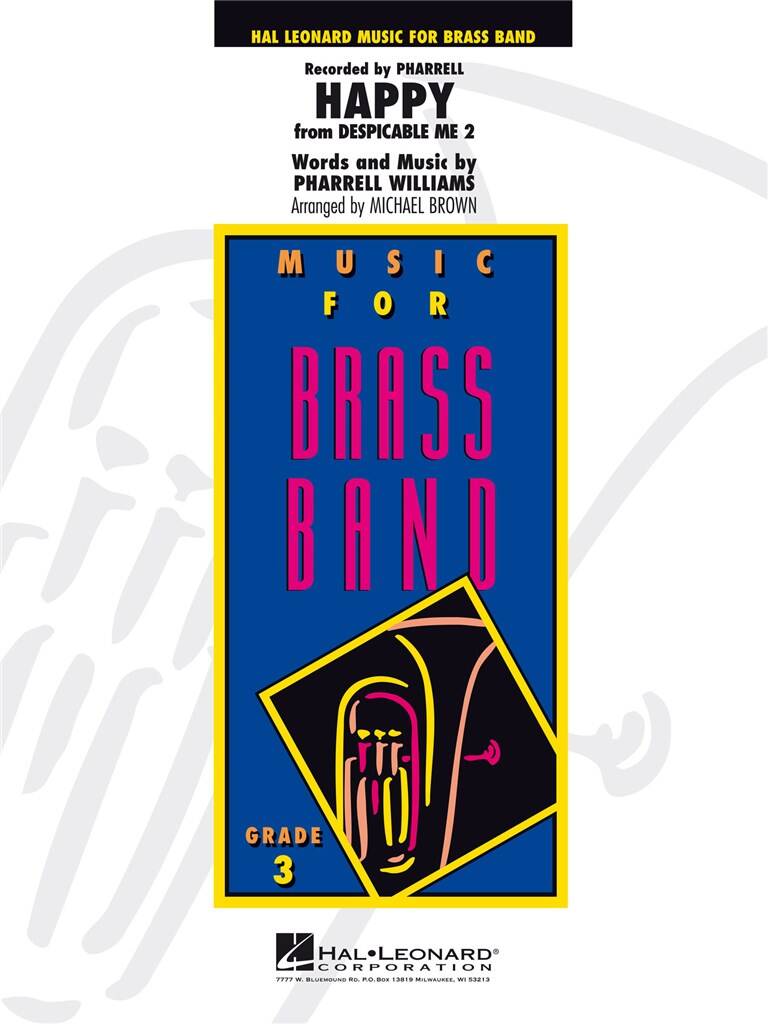
Happy - Pharrell Williams - Michael Brown
Rarely does the title of a song so accurately describe the actual music! Pharrell Williams megahit was recorded for the movie DESPICABLE ME 2 but has taken on a life of its own on the internet and pop charts. Just hearing this tune makes you feel good!
Estimated dispatch 5-14 working days
-
 £134.99
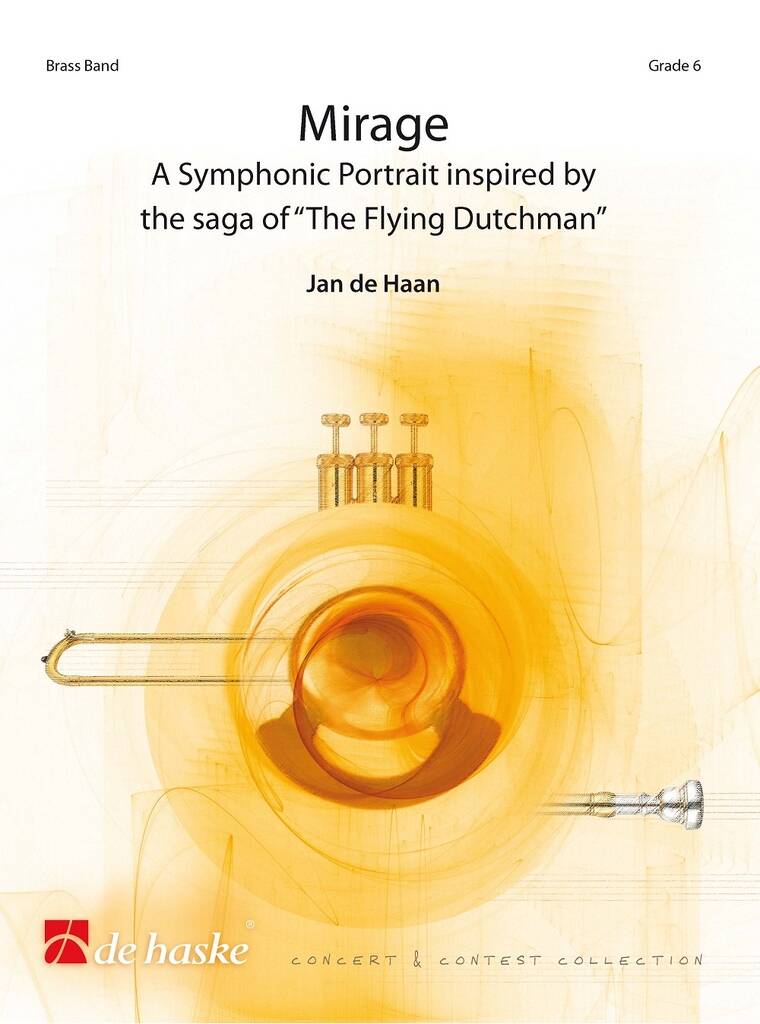
Mirage - Jan de Haan
The composition Mirage takes inspiration from the legendary ghost ship "The Flying Dutchman", a story deeply rooted in maritime folklore. Cursed to wander the oceans forever, the ship often looms like a mirage on the horizon - a mysterious apparition in which reality and illusion blend intangibly.In Mirage the music tries to bring this mystical appearance to life. The piece begins with an atmosphere of mystery and wonder, creating the illusion of a mirage. The listener is taken to the vast sea, where the boundaries between the real and the unreal blur and the ghostly silhouette of the ship gradually becomes visible. Suddenly the tone changes. Powerful rhythms and stormy harmonies follow, expressing the ship's battle against the raging forces of nature. After this intense section, in which the musicians are pushed to their limits, the tranquility of the sea returns. The recurring mirages inspired the composer to create a lyrical middle section, in which various soloists tell their stories within this legend. In the final part, the sails are hoisted again, and the three-master continues its endless journey.
Estimated dispatch 5-14 working days
 View Music