
Results
-
 £108.00
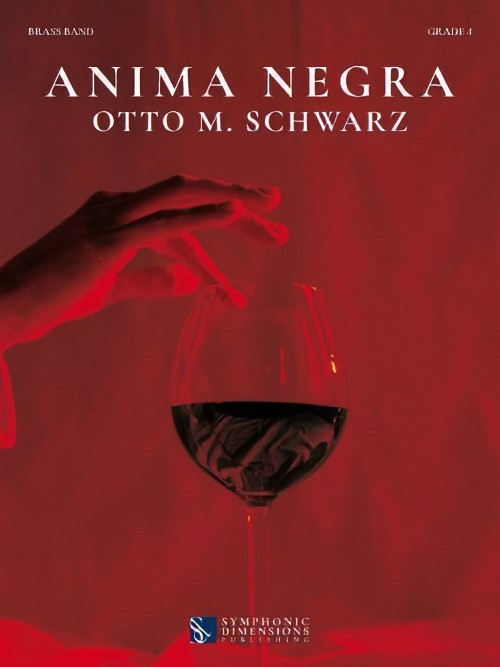
Anima Negra (Brass Band - Score and Parts) - Schwarz, Otto M.
Two boys from Felanitx: Pere Obrador and Miquel Angel Cerda. Having finished school, one stayed in Mallorca, while the other one left to study in Madrid. Some years later, homesickness and a yearning for the sea brought Miquel back. The turning point in their lives came in 1994. They realised their dream and produced their first wine. Their vision was to produce a real "Balearic Wine" from native grapes such as Callet, Mantonegro and Fogoneu. Anima Negra captures the stunning landscape of Mallorca in a single glass of wine. It reflects the sun, salinity and energy of the island and has conquered the world.Duration: 9.15
Estimated dispatch 7-14 working days
-
 £23.95
The Red Kite (Euphonium Solo with Brass Band - Score and Parts) - Wiffin, Rob
At one time the Red Kite was close to national extinction in the UK but now it is possible to admire this distinctive bird of prey with its red colouring and forked tail. I love watching it soaring so gracefully through the sky. I attempted to catch that feeling in this solo composed for Martin Smith. In writing it I had in mind making the euphonium glide solitary and effortlessly, occasionally swooping down then reclaiming its high altitude.To create the desired atmosphere, I avoided too many root position chords and enhanced the feeling of floating by adding notes to a lot of the harmony, giving it subtle colour. The harmonic rhythm is slow but the movement switches in the way that the Red Kite can make slight changes of direction by minor adjustments of its tail. On top of this accompaniment the soloist is left to sing with a sense of grace and freedom.- Rob WiffinDuration: 3.45
Estimated dispatch 7-14 working days
-
 £104.99
Viking Age (Brass Band - Score and Parts) - Deleruyelle, Thierry
The Viking age lasted from the late eighth, to the middle of the eleventh century. During this period, Scandinavian warriors and merchants explored, plundered and left their mark on numerous territories. This work is based on a series of four notes that appear in different forms, consisting of 4 movements: Northern Men, Explorer, Raids and Heritage. It is an impressive and spectacular piece, with lots of interesting and playful parts for all sections. This is a perfect contest piece or an outstanding work for thematic concerts.Duration: 10.40
Estimated dispatch 7-14 working days
-
£22.99
Viking Age (Brass Band - Score only) - Deleruyelle, Thierry
The Viking age lasted from the late eighth, to the middle of the eleventh century. During this period, Scandinavian warriors and merchants explored, plundered and left their mark on numerous territories. This work is based on a series of four notes that appear in different forms, consisting of 4 movements: Northern Men, Explorer, Raids and Heritage. It is an impressive and spectacular piece, with lots of interesting and playful parts for all sections. This is a perfect contest piece or an outstanding work for thematic concerts.Duration: 10.40
Estimated dispatch 7-14 working days
-
 £43.00
La Perla Negra (Brass Band - Score and Parts) - Skinner, Colin
For this brooding piece the composer has used the following storyline. "A sad elderly man sits alone in a bar whilst an accordionist plays a slow tango. A beautiful woman walks in wearing a single black pearl necklace and proceeds to dance with the old man. Gradually the music becomes more and more spirited and the dance faster as the old man becomes youthful again. With a passionate kiss he passes out in the girls arms and when he awakens he is back in the bar alone save for the accordionist. As he contemplates his dream he notices a single black pearl left behind on the bar. The sombre mood is lightened in the middle section by a deliberately trite and vibrato fuelled section, but we soon return to the opening material for a slow fade-out" Composer Colin Skinner wrote this piece especially for Superbrass' debut CD, Under the Spell of Spain. Duration: 6.30. Suitable for 2nd Section Bands and above.
Estimated dispatch 7-14 working days
-
 £80.00
The Unfortunate Traveller (Brass Band - Score and Parts) - Holst, Imogen - Hindmarsh, Paul
Imogen Holst (1907-1984) submitted The Unfortunate Traveller (1929) as her final work as a student portfolio at the Royal College of Music, where her composition teacher was Gordon Jacob. The title was taken from Thomas Nashe's famous 1594 picaresque novel of the same title. The Suite was first performed on 12 February 1933 at her Majesty's Theatre, Carlisle, by the St. Stephen's Band, with the composer conducting. Te concert was given in memory of Holst's uncle, Dr. H.A. Lediard. Holst had been impressed with the band's performance of his A Moorside Suite at the 1928 National Brass Band Championships (The Crystal Palace, South London) and was keen to work with them. Writing in Imogen Holst, a life in music, Christopher Grogan indicates that it was Gustav Holst's suggestion to include his daughter's work in the programme, quoting Imogen Holst's remarks made in interview to The Daily Mail as follows: "....it is the first time, so far as I know, that a woman has conducted a brass band at a public concert....It has been a delight to rehearse the St. Stephen's Band. It was their performance at the Crystal Palace Festival that inspired me to write this Suite, which I have dedicated to them."Imogen Holst accompanied her father to the Crystal Palace in 1928 to hear the performances of A Moorside Suite, and was so excited by the played and, audibly, by her father's music that she decided to write a brass band piece for her final examination. Te result was The Unfortunate Traveller (1929). However, it was not possible for her to present a brass band work for examination. She arranged it for string orchestra so that it could be played before she left the RCM in July 1930. Following the premiere of the original in 1933, the manuscripts did not resurface until 1969 Imogen found them among her late mother's effects. Although she requested score and parts be destroyed, they ended up in the possession of Manchester composer John Golland, who marked up the score presumably with the intention of creating a new performing edition. The original scoring reveals a lack of experience with what can be a tricky medium.With the agreement of the Holst Foundation, a revised edition, with additional percussion, was prepared in 2011 since when the work has been fortunate to travel round the world as a concert and contest piece. The original includes drums in the March only. The title was taken from Tomas Nashe's famous 1594 picaresque novel of the same title. Several Morris Dance tunes are introduced during the course of the four short movements, including Bonnie Green Garters, Shepherd's Hey, The Rose and The Wind Blaws Cauld. Quirky twists and turns of harmony and spirited rhythms that remind us how much Imogen Holst loved tradition English dance music.In September 2025, I made a performing edition of the composer's arrangement for string orchestra. The manuscript lacks the final movement, which I arranged in a similar style, ie. without extending the upper ranges. Making this edition raised some issues regarding the accuracy of my band version and some of the solutions I used to smooth out the voicing. I have used the composer's second thoughts to refine my performing edition and to correct a textual errors.- Paul HindmarshDuration: 10.00
Estimated dispatch 7-14 working days
-
£40.00
The Unfortunate Traveller (Brass Band - Score only) - Holst, Imogen - Hindmarsh, Paul
Imogen Holst (1907-1984) submitted The Unfortunate Traveller (1929) as her final work as a student portfolio at the Royal College of Music, where her composition teacher was Gordon Jacob. The title was taken from Thomas Nashe's famous 1594 picaresque novel of the same title. The Suite was first performed on 12 February 1933 at her Majesty's Theatre, Carlisle, by the St. Stephen's Band, with the composer conducting. Te concert was given in memory of Holst's uncle, Dr. H.A. Lediard. Holst had been impressed with the band's performance of his A Moorside Suite at the 1928 National Brass Band Championships (The Crystal Palace, South London) and was keen to work with them. Writing in Imogen Holst, a life in music, Christopher Grogan indicates that it was Gustav Holst's suggestion to include his daughter's work in the programme, quoting Imogen Holst's remarks made in interview to The Daily Mail as follows: "....it is the first time, so far as I know, that a woman has conducted a brass band at a public concert....It has been a delight to rehearse the St. Stephen's Band. It was their performance at the Crystal Palace Festival that inspired me to write this Suite, which I have dedicated to them."Imogen Holst accompanied her father to the Crystal Palace in 1928 to hear the performances of A Moorside Suite, and was so excited by the played and, audibly, by her father's music that she decided to write a brass band piece for her final examination. Te result was The Unfortunate Traveller (1929). However, it was not possible for her to present a brass band work for examination. She arranged it for string orchestra so that it could be played before she left the RCM in July 1930. Following the premiere of the original in 1933, the manuscripts did not resurface until 1969 Imogen found them among her late mother's effects. Although she requested score and parts be destroyed, they ended up in the possession of Manchester composer John Golland, who marked up the score presumably with the intention of creating a new performing edition. The original scoring reveals a lack of experience with what can be a tricky medium.With the agreement of the Holst Foundation, a revised edition, with additional percussion, was prepared in 2011 since when the work has been fortunate to travel round the world as a concert and contest piece. The original includes drums in the March only. The title was taken from Tomas Nashe's famous 1594 picaresque novel of the same title. Several Morris Dance tunes are introduced during the course of the four short movements, including Bonnie Green Garters, Shepherd's Hey, The Rose and The Wind Blaws Cauld. Quirky twists and turns of harmony and spirited rhythms that remind us how much Imogen Holst loved tradition English dance music.In September 2025, I made a performing edition of the composer's arrangement for string orchestra. The manuscript lacks the final movement, which I arranged in a similar style, ie. without extending the upper ranges. Making this edition raised some issues regarding the accuracy of my band version and some of the solutions I used to smooth out the voicing. I have used the composer's second thoughts to refine my performing edition and to correct a textual errors.- Paul HindmarshDuration: 10.00
Estimated dispatch 7-14 working days
-
 £60.00
From the Shores of the Mighty Pacific (Cornet Solo with Brass Band - Score and Parts) - Clarke, Herbert L. - Wilkinson, Keith M.
Cornet Solo with Brass BandHerbert L. Clarke (1867 - 1945) is regarded by many as one of the finest cornet players of all time, noted not only for his amazing technique but also for his warm, lyrical tone. He has left a multitude of cornet solos as well as collections of studies which are still very widely used. He was a member of The Sousa Band briefly in 1893 and then from 1898 to 1917 where he was not only the distinguished cornet soloist but also became assistant director.From The Shores Of The Mighty Pacific is an all-time favourite rondo-caprice cornet solo and was first published in 1912. A brass band arrangement was requested by Chris Lichtler, principal cornet of Brass Band of the Western Reserve, musical director Dr. Keith M. Wilkinson. Chris has performed it many times with BBWR and it was recorded by them on the CD, Without Reserve!.
Estimated dispatch 7-14 working days
-
 £60.99
Susato Variations (Brass Band - Score and Parts) - De Haan, Jan
Tylman Susato (circa 1500-1561) was one of the worlds first music publishers and seller of musical instruments. He left behind several collections containing arrangements of Dutch songs and dance and also published several of his own works. Three of these, published in 1551, were called Musyck Boexken, or music book. Almost 500 years later, Jan de Haan has used one of these melodies, Mohrentanz, for this theme with three variations.Duration: 6:45
Estimated dispatch 7-14 working days
-
 £72.99
Lilo & Stitch (Music featured in the Film) (Brass Band - Score and Parts) - Schaars, Peter Kleine
In this great Disney musical a little girl, Lilo, adopts what she believes is a puppy but is what turns out to be an alien that has landed on earth by mistake. Their friendship is sealed by their mutual love of the music of the king - Elvis Presley. This arrangement contains a selection of Elvis classics that were featured in the film and is sure leave your audience humming Elvis songs long after they have left the concert.Duration: 6.15
Estimated dispatch 7-14 working days
 View Music