
Results
-
 £37.35
Fallen Souls (Brass Band) Andrew Wainwright
Fallen Souls was the winner of Grimethorpe Colliery Band's 1st Annual Composition Competition in 2023. This depictive and impactful work explores the theme of human fallibility. The piece begins with a slow, yearnful introduction that depicts a fall from grace, represented by a horn solo that reflects the innate goodness of humanity. However, the music soon becomes more agitated and dissonant as it represents the temptations that can lead us astray. The opening reaches a climax of chaos and despair, as we are shown the devastating consequences of our choices. The following section depicts the temptations of humanity. The music is chaotic and seductive in this section, with regular time changes and rhythmic instability, representing the many temptations that surround us. The section ends with a sense of uncertainty, as we are left wondering whether we will succumb to these temptations. There is a reprise of the opening horn solo, and a return to the notion of human fallibility, but this time in extended form. Again there is a build toward chaos, and the music becomes more complex and textured, reflecting the complexity of the human journey. The work ends somewhat abruptly with a blaze, leaving the listener with a sense of both hope and uncertainty. To view a rolling score video featuring Grimethorpe Colliery Band please visit www.youtube.com/watch?v=rM-p8CjnYo0 Duration: 5.00 minutes approx. Difficulty Level: 1st Section + PDF download includes parts and score. Sheet music available from www.brassband.co.uk/sheet-music/fallen-souls-brass-band-andrew-wainwright-brookwright Instrumentation: Soprano Cornet Eb Solo Cornet Bb Repiano Cornet Bb 2nd Cornet Bb 3rd Cornet Bb Flugel Horn Bb Solo Horn Eb 1st Horn Eb 2nd Horn Eb 1st Baritone Bb 2nd Baritone Bb 1st Trombone Bb 2nd Trombone Bb Bass Trombone Euphonium Bb Bass Eb Bass BbTimpani Percussion 1-3
In Stock: Estimated dispatch 1-3 working days
-
 £14.94
Jingle Boogie-Woogie Bells (Brass Band - Ukraine Charity Release) Ovcharenko
This piece was arranged by Halyna Ovcharenko, a Ukrainian composer who was born in Lugansk, a Ukrainian city that is currently under occupation by the Russian Federation. All the proceeds from this sale will go towards the 'A family for every orphan' appeal, which is providing emergency relief services to thousands of children and families in Ukraine. For more information about the charity please visit https://afamilyforeveryorphan.org/ukraine/ Halyna Ovcharenko has been composing music since she was 11. Many of her compositions of various genres have received international awards, but she discovered the world of brass band music with its specific timbre and huge range of musical colors only recently, in 2022, while composing her Vyshyvanka for Grimethorpe Colliery Band. Halyna comments: "I enjoyed my experience. Since then I have had an appetite to write more for brass bands, and here we are - an arrangement of a traditional English Christmas song which I have done especially to raise money for Ukrainian orphans. Their heroic parents stood for my Lugansk, for our Ukraine and for the whole World. I hope that the World will make these children feel that they are not left alone, giving them love, care and joy." The picture on the front cover was drawn by Victoria Lebed, a Ukrainian girl. This PDF download includes parts and score. Sheet music available from www.brassband.co.uk Instrumentation: Soprano Cornet Eb Solo Cornet Bb Repiano Cornet Bb 2nd Cornet Bb 3rd Cornet Bb Flugel Horn Bb Solo Horn Eb 1st Horn Eb 2nd Horn Eb 1st Baritone Bb 2nd Baritone Bb 1st Trombone Bb 2nd Trombone Bb Bass Trombone Euphonium Bb Bass Eb Bass Bb Percussion 1-2
In Stock: Estimated dispatch 1-3 working days
-
 £67.24
Letters from Flanders (Brass Band) Andrew Batterham
This descriptive work by Australian composer Andrew Batterham portrays the experiences of his maternal grandfather, Corporal Reginald Littlejohns, (4th Australian Machine Gun Battalion) in the First World War. Reginald left Melbourne for Europe in May 1916 then served in Flanders through to the end of the war. He returned in April 1919, having sent hundreds of letters home during his service. His honest, articulate, and highly descriptive prose served as inspiration for this piece. Each of the 5 movements portrays a different aspect of Reginald's war, with a quote from his letters included. The first movement was premiered by the Box Hill City Band, conducted by Matt van Emmerik, in Melbourne. Daniel van Bergen conducted Booroondara Brass performing most of the work in April 2019, and Box Hill premiered the complete version in November 2019 conducted by Simon Brown. The work is comprised of the following movements: i. The World at War ii. Over the Sea iii. Passchendaele iv. Homecoming Parade v. Elegy Length: c.12.00 minutes PDF download includes score and parts. Sheet music available from www.brassband.co.uk Difficulty Level: 1st Section + Instrumentation: Soprano Cornet Eb Solo Cornet Bb Repiano Cornet Bb 2nd Cornet Bb 3rd Cornet Bb Flugel Horn Bb Solo Horn Eb 1st Horn Eb 2nd Horn Eb 1st Baritone Bb 2nd Baritone Bb 1st Trombone Bb 2nd Trombone Bb Bass Trombone Euphonium Bb Bass Eb Bass Bb Percussion 1-3
In Stock: Estimated dispatch 1-3 working days
-
 £29.88
March - St. Julien (Brass Band) Arthur W. Hughes arr. Keith M. Wilkinson
St Julien is a town near the French/Belgian border which witnessed several battles during WW1. The composer Arthur W. Hughes (1870-1950) was born in Kingston, Ontario, and left home when he was quite young to perform with circus bands in US. He wrote several marches and a few other compositions but this one, dating from 1918, is the most well-known. The march also works as a fast circus march. Here it has been expertly arranged for brass band by Dr. Keith M. Wilkinson. Difficulty Level: 4th Section + Sheet music available from: UK - www.brassband.co.uk USA - www.solidbrassmusic.com Instrumentation: Soprano Cornet Eb Solo Cornet Bb Repiano Cornet Bb 2nd Cornet Bb 3rd Cornet Bb Flugel Horn Bb Solo Horn Eb 1st Horn Eb 2nd Horn Eb 1st Baritone Bb 2nd Baritone Bb 1st Trombone Bb 2nd Trombone Bb Bass Trombone Euphonium Bb Bass Eb Bass Bb Percussion 1-3
In Stock: Estimated dispatch 1-3 working days
-
 £33.62
Miserere mei, Deus (Brass Band) Gregorio Allegri arr. Espen Haukas
Miserere mei, Deus was composed by the Italian composer Gregorio Allegri (1582-1652) during the 1630s for use in the Sistine Chapel during matins, as part of the exclusive Tenebrae service on Wednesday and Friday of the Holy Week. The Miserere is written for two choirs, one of five and one of four voices, and is generally accepted to be one of the finest examples of Renaissance polyphony to survive to the present day. Tutti choirs sing a simple version of the original Miserere chant; one voice then, spatially separated, sings an ornamented "commentary" on this. The comment-part is left out in this arrangement due to its meaning with text, though monotonous in tune. The introduction is added by the arranger to set the right atmosphere before the original chant is played. The brass choirs are meant to be placed opposite each other in a church or large hall. To view a video of Norges Nasjonale Brassband performing the piece please visit www.youtube.com/watch?v=YrJU3lwYD9U PDF download includes score and parts. Sheet music available from: UK - www.brassband.co.uk USA - www.solidbrassmusic.com Difficulty Level: 4th Section + Instrumentation: Brass Choir 1: Solo Cornets (incl. Repiano) Horn in Eb Tenor Trombones in Bb Euphoniums Basses in Bb Timpani Brass Choir 2: Soprano Cornet in Eb 2nd Cornets in Bb 3rd Cornets in Bb Flugelhorn Horns in Eb Baritones Bass Trombone Basses in Eb
In Stock: Estimated dispatch 1-3 working days
-
 £40.00
Reflections of Freedom. Andrew Duncan
Recommended - Championship & 1st Section Reflections of Freedom depicts the feelings and emotions of the many migrant farmers who left 19th Century Scotland to set up a new life in the 'New World'. In particular, the joy experienced on reaping their first harvest, so the American folk tune, Bringing in the Sheaves in featured throughout the piece. Reflections of Freedom was Written for the US Army Brass Band in Washington DC and premiered by them in 1997. Reflections of Freedom was the title track on the Whitburn Band CD of the same name, recorded in 2004. Suitable as a test piece for 1st section brass bands. Includes score & parts
-
 £79.95
Amundsen - Jonathan Bates
DURATION: 14'00". DIFFICULTY: 1st+. 'Amundsen' was commissioned by rskog Brass, Norway for their winning performance at the 2020 Norwegian National Championships held at the Grieghallen in Bergen. In December 1911, Norwegian Roald Amundsen gained global fame by becoming the first explorer to lead a team to the geographic South Pole. Amundsen and 4 other members of his team arrived 5 weeks ahead of a rival team from the UK led by Robert Falcon Scott, all of which perished on their attempted return from the pole. Initially when Amundsen's team set out in 1910, they were under the impression that they would be making the far shorter journey to the arctic drift to attempt to reach the North Pole, but Amundsen had received news that American explorers Peary and Cook had beaten them to this goal, and so Amundsen's focus changed southward. 'Fram, Forward' - 'Fram' (translating to English as "forward") was the name of the ship Amundsen used for this particular polar expedition. Amundsen had only informed 2 people of his real intentions of conquering the South Pole when the ship first left port in Kristiansand before heading south to the Portuguese island of Madeira in the Atlantic Ocean. After weeks at sea - causing the uninformed members of the crew to raise a number of questions and produce a general feel of uncertainty and low spirits - it was here that Amundsen announced his true plans to the rest of his crew. They were asked whether they wished to continue with their expedition, to which all - some begrudgingly - agreed to sail on to the South Pole, through the great Ice Barrier before docking in the Bay of Whales on the Ross Ice Shelf. 'Ross Ice Shelf' - Upon Amundsen's arrival in the Bay of Whales, the team were greeted by the sight of the enormous ice plateau's and glaciers, towering into the Antarctic sky. In 1907, Ernest Shackleton had attempted - and failed - to reach the South Pole, but his route and mapping was by now well documented. Scott and the UK team were to follow this route, whereas Amundsen and his men forged their own way to the pole through unchartered territory and deadly terrain littered with deep crevasses and canyons. The music here though, is a picture of tranquility. The eerie silence of total emptiness with only the heavy snow falling around Amundsen as Fram and the Bay of Whales disappears into the distance, faced by the maginute of the expedition ahead. 'Advance to Polheim' - The first new challenge Amundsen discovered on this route was a rough, sharp and extremely steep glacier (which was later named the Axel heiberg Glacier after the Norwegian monarch who funded much of the expedition), which would take his team up from sea level to an altitude of over 9,000ft in just 20 miles, with most of this over just 7 miles. Once scaled, only the vast Antarctic Plateau stood between Amundsen and the pole. Here the race began, with only one aim - victory for himself, his team, and for the whole of Norway. .
In Stock: Estimated dispatch 1-3 working days
-
 £58.00
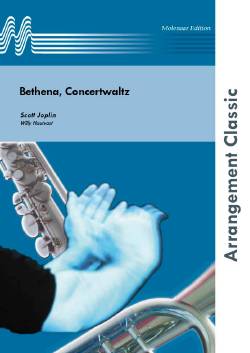
Bethena, Concertwaltz - Scott Joplin/Willy Hautvast
Bethena is the result of a fictive collaboration between Scott Joplin and Willy Hautvast. The piece was originally written for the piano, so the melody is to be found in the right hand part whereas the accompaniment is to be found in the left hand part. A
Estimated dispatch 10-14 working days
-
 £25.00
...and the winter moon rises
Description...and the winter moon riseswas inspired by a winter's evening car journey across the Pennines from Manchester to Huddersfield, through the brass band heartland of Saddleworth. There was recent snow on the ground, and the sun had just set. A bright clear moon was rising into a sky coloured with orange from the setting sun, and the moonlight made all the snow and ice sparkle.The work is the fourth movement of a larger 5 movement suite entitled "North!", but can be (and has been) performed in isolation. This work was a finalist in the 2012 Ohio Brass Arts Festival composition competition.Performance NotesThe percussion parts should be playable by three players; the "arco" parts of the vibraphone parts should be played by drawing a cello or double bass bow up the side of the bar. Motors should be left off throughout.Three of the brass players are asked to double on triangles for the first part of the piece; ideally these should be of different sizes giving clearly different sounds. The easiest solution is to tie a triangle to the music stand, rather than try to hold it and then swap instruments later in the piece.Click below to watch a playback preview of the score!
Estimated dispatch 7-14 working days
-
 £35.00
Ariel
DescriptionAll hail, great master! Grave sir, hail! I come To answer thy best pleasure, be 't to fly, To swim, to dive into the fire, to ride On the curled cloud. To thy strong bidding, task Ariel and all his quality. - William Shakespeare: The Tempest, Act 1, Scene 2Ariel was written for the Hammonds Band to open their programme at the 2019 Brass in Concert Championships at The Sage Concert Hall in Gateshead, where it received its premiere. The title is taken from the character in Shakespeare's play 'The Tempest'. Ariel is an immensely powerful "air spirit" or demon bound to serve Prospero, the exiled Duke of Milan, after being released by Prospero from imprisonment in a tree. In the play Ariel's magical abilities are used to help Prospero revenge himself on his enemies and reclaim his dukedom, whereupon Ariel finally regains his freedom.You can hear an audio preview and follow the score below: Performance notes:The cornets and horns are split into two "choirs" to be placed left and right of the band. It may be possible for the choirs to play their opening flourish offstage, and the optional repeated sections in the opening are to accommodate stage movement if required. Trombones form a third "choir" which should ideally stand centrally between basses and percussion, and the euphoniums and baritones should sit in front of the basses. The work requires four percussionists, although if four are not available the 2nd part may be omitted.Percussion 1: Kit - bass drum, snare, 3 x toms, hi-hat, suspended cymbal - and 3 x temple blocksPercussion 2: Tam tam and orchestral bass drum.Percussion 3: Glockenspiel and timpaniPercussion 4: Tubular bellsSoprano, solo cornets and 3rd cornets require cup mutes. Solo trombone requires a cup mute, second trombone requires a metal straight mute.
Estimated dispatch 7-14 working days
 Watch video
 View Music