Results
-
£42.00Hymn at Sunrise (Score only) - Ray Steadman-Allen
The idea for this work was prompted by a poem - Hymn Before Sunrise - which describes the majesty of a mountain in darkness, the sounds of a nearby waterfall and so on. Nothing came of the exposure to these pictures except for general thoughts about the dawn of day and a series of movements expressing a personal response to the wonder of creation in an imaginary moment in time. The movement titles, which were added later, are intended to underline a prevailing sense of worship, wonder and exaltation. The music is pure, not pictoral, though listeners may conjure their own images. An actual hymn - Tallis' Cannon - is incorporated. There are five movements: 1. Thanksgiving: A short prelude in two parts. First a brief passage of 'dawn music' before things become more vigorous: fanfare-like music ushers in the trombone section's presentation of the Tallis tune. A broad band version concludes the movement. 2. De Profundis: A slow movement shot through with anxious questionings featuring flugel and trombone. The mood lightens a little in the centre where the soprano cornet is featured and the movement ends serenely. 3. Celebration is characterised by rhythmic drive, this is buoyant with plenty of incident pointed up by the percussion. 4. Invocation: Melodic in nature and sober in mood, the first section is a series of short solos mingled with chorale-like statements. Central to the movement is a chorale-prelude style presentation of the Tallis tune. The third section reintroduces the earlier solo music by the full ensemble. Dissolving, the music enters the last movement without a break. 5. Paean: Marked allegro con spirito there is, quite rightly, a fair amount of fun in the rejoicing. Snatches of Tallis are heard, then comes a gentle passage with a cornet solo leading to fanfare music and recapitulation. Two recitatives are succeeded by a coda which brings the work to a sonorous and exultant conclusion.
Estimated dispatch 7-9 working days
-
£52.00Hymn at Sunrise (Parts only) - Ray Steadman-Allen
The idea for this work was prompted by a poem - Hymn Before Sunrise - which describes the majesty of a mountain in darkness, the sounds of a nearby waterfall and so on. Nothing came of the exposure to these pictures except for general thoughts about the dawn of day and a series of movements expressing a personal response to the wonder of creation in an imaginary moment in time. The movement titles, which were added later, are intended to underline a prevailing sense of worship, wonder and exaltation. The music is pure, not pictoral, though listeners may conjure their own images. An actual hymn - Tallis' Cannon - is incorporated. There are five movements: 1. Thanksgiving: A short prelude in two parts. First a brief passage of 'dawn music' before things become more vigorous: fanfare-like music ushers in the trombone section's presentation of the Tallis tune. A broad band version concludes the movement. 2. De Profundis: A slow movement shot through with anxious questionings featuring flugel and trombone. The mood lightens a little in the centre where the soprano cornet is featured and the movement ends serenely. 3. Celebration is characterised by rhythmic drive, this is buoyant with plenty of incident pointed up by the percussion. 4. Invocation: Melodic in nature and sober in mood, the first section is a series of short solos mingled with chorale-like statements. Central to the movement is a chorale-prelude style presentation of the Tallis tune. The third section reintroduces the earlier solo music by the full ensemble. Dissolving, the music enters the last movement without a break. 5. Paean: Marked allegro con spirito there is, quite rightly, a fair amount of fun in the rejoicing. Snatches of Tallis are heard, then comes a gentle passage with a cornet solo leading to fanfare music and recapitulation. Two recitatives are succeeded by a coda which brings the work to a sonorous and exultant conclusion.
Estimated dispatch 7-9 working days
-
£62.00The Night To SIng (Score only) - Bramwell Tovey
The piece takes its inspiration from the VE Day celebrations of 1945. On 8 May 1945 the end of the war in Europe was celebrated in Great Britain. VE day (Victory in Europe day) gave rise to extraordinary public celebrations all over the country, from street parties to services of thanksgiving, to impromptu singing and community music-making. Contemporary reports mention Victorian ballads and Edwardian music hall songs, as well as the latest popular craze - the Conga. Festivities continued until dawn whereupon, finally surrendering to fatigue, the remnants of the crowd headed home on foot, long after the last bus. Some felt the celebrations to be inappropriate - much of Europe lay in ruins and war still raged in Asia. Almost everyone lamented the loss of somebody who had not survived. Duration: 16:50
Estimated dispatch 7-9 working days
-
£74.00The Night To SIng (Parts only) - Bramwell Tovey
The piece takes its inspiration from the VE Day celebrations of 1945. On 8 May 1945 the end of the war in Europe was celebrated in Great Britain. VE day (Victory in Europe day) gave rise to extraordinary public celebrations all over the country, from street parties to services of thanksgiving, to impromptu singing and community music-making. Contemporary reports mention Victorian ballads and Edwardian music hall songs, as well as the latest popular craze - the Conga. Festivities continued until dawn whereupon, finally surrendering to fatigue, the remnants of the crowd headed home on foot, long after the last bus. Some felt the celebrations to be inappropriate - much of Europe lay in ruins and war still raged in Asia. Almost everyone lamented the loss of somebody who had not survived. Duration: 16:50
Estimated dispatch 7-9 working days
-
£60.50
A Gallimaufry Suite - Harper, P
I - Fanfare & ThemeII - SongIII - HymnIV - Toccata & FinaleA Gallimaufry Suite consists of four movements, all thematically independent. The first movement consists of a sparkling Fanfare followed by a stately Theme which ends quietly. The second movement is a Children's Song; quirky but cute, and the Hymn which follows is a study in calm and tranquillity, featuring a quartet-group of cornet, baritone, trombone and euphonium. The last movement is a virtuosic Toccata which eventually begins to recall the other themes of the suite before a grand reprise of the first movement Theme brings the work to a dazzling conclusion.Approximate duration: 11 minutes
In Stock: Estimated dispatch 1-3 working days
-
£45.00
Hymn to the Cross - Lane, L
This beautiful, reflective piece is filmic and expansive, portraying hope in the midst of the bleak scenario of the Korean War. Features lyrical soloists throughout and an offstage Last Post ending for cornet.2nd Section +Duration 4 minsClick to Listen - Courtesy of Cory Band
In Stock: Estimated dispatch 1-3 working days
-
£50.00
Peniel - Ball, E
This work is not intended to actually portray in music the events described in Genesis, Chapter 32, although the varying moods were evoked by a re-reading of the story. However, the following sequence of ideas may sometimes prove useful in presenting the work to audiences.Under Divine compulsion, Jacob sets out with Family, retainers, servants and cattle, to return to his homeland (Introduction and Sections 1 - 3).He is brought news of possible attack by his estranged brother Esau (Sections 4 - 6).Jacob seeks guidance in a lone vigil and, wrestling with a divine visitor, at last wins acceptance at the place he names Peniel--The Prince of God. He goes forward with his people and becomes reconciled with Esau (Section 12 to the end).Eric BallDuration 9 mins
In Stock: Estimated dispatch 1-3 working days
-
£13.00
Four Celebrated Melodies - Various
Last Rose of Summer (cornet)Rose of Tralee (soprano)Far Away (trombone)In Cellar Cool (euphonium)
In Stock: Estimated dispatch 1-3 working days
-
£38.95Unity Series Band Journal - Numbers 530 - 533, June 2024
530: Carol Arrangement - God rest you merry, gentlemen (Noel Jones)This swing arrangement of the traditional English carol also features references to O come, all ye faithful (C.C. 61) and Jingle Bells (C.C. 121). Play with imagination and a sense of style!531: Go, tell it on the mountain! (Nathanael Watchorn)Historically, the passion of enslaved people in America for singing about the Gospel of Jesus is well documented, but it was men of three generations, each named John Wesley Work, who enabled spirituals to become more widely known. John Wesley Work Sr, a church choir director in Nashville, Tennessee, wrote and arranged music for the pioneering Fisk Jubilee Singers whose early repertoire consisted largely of spirituals. This passion and knowledge of spirituals was passed down through the generations. John Work III travelled hundreds of miles to collect songs by attending church services in remote areas. In 1940, he published a collection of 230 songs which included a setting of Go, tell it on the mountain! that is still performed today.Nathanael Watchorn, a Bandsman at Regent Hall Corps in London, is a new contributor to the journals. He originally wrote this as a vocal arrangement for the group FourHymn, subsequently transcribing it for the corps' Young People's Band, while he was Band Leader.532: Carol Arrangement - They all were looking for a king (Stephen Hull)At the North American Composers Forum, Major Len Ballantine challenged participants to find an unfamiliar song in the Salvation Army Song Book and try to write an arrangement of the listed tune. Stephen Hull happened across They all were looking for a king (S.A.S.B. 128) and the tune Childhood (T.B. 421) which lead to this arrangement.533: March - Washed and healed (Eiliv Herikstad)The Christian experience of many people will have been positively impacted by the life of the late Bandmaster Eiliv Herikstad, either personally or through his musical leadership and compositions. This march is the second publication from this well-known Salvation Army composer since his Promotion to Glory last year. This march is more traditional in style that many of his compositions but contains a strong Christian message and demonstrates his compositional expertise.
Estimated dispatch 7-14 working days
-
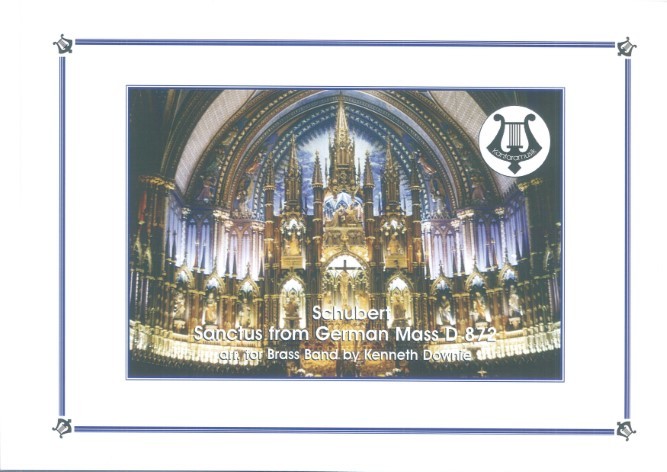
£127.95Music of the Angels (Symphonic Brass Ensemble - Score and Parts)
In 1998 Gregson was commissioned by conductor Martyn Brabbins to write a short concert opener with choir to mark his debut as Music Director of the Huddersfield Choral Society. Entitled ...and the seven trumpets... this ten minute flourish is founded on a verse from Chapter 8 of the Revelation To John (The Apocalypse), the last book in the Bible: 'and I saw the seven Angels which stood before God: and to them were given seven trumpets'. The performance employed the full power of the Huddersfield Town Hall organ and the brass section of the BBC Philharmonic, including seven trumpets and four horns placed strategically around hall.The following year, when Gregson received a commission from the Cheshire-based Foden's Brass Band (conducted at that time by Nicholas Childs) for a work to mark its centenary in 2000, he turned to the first portion of ...and the seven trumpets... as the basis for an ambitious celebratory work entitled The Trumpets of the Angels. "The opportunity to create an extended work which would break out of the brass band mould was an important milestone for me," the composer says. In 2015 he was asked by Nicholas Childs to create a new performing edition without organ for the Black Dyke Band. This received its first performance in April 2016 at the European Brass Band Festival in Lille. In 2018, Gregson revisited the music for a third time, returning the opening fanfares to orchestral brass and transforming substantial portions of the 'Black Dyke' version to create Music of the Angels, a dramatic canvas for symphonic brass and percussion.An array of bells and gongs offer an unmistakable key to the source of Gregson's inspiration. Inscribed In tribute to Olivier Messiaen, the work's principal material and its sound world, but crucially not the underlying musical processes, are influenced by Messiaen's masterpiece for wind and percussion, Et exspecto ressurectionem mortuorum (1964). Music of the Angels begins with braying of horns suggestive of the start of an ancient ritual. Six 'angel' trumpeters, set behind the ensemble, answer in sequence, with the evocative sound of tam-tams creating the Messiaen-like aura. Once the horns have reached the performing space, four of the trumpeters deliver highly contrasting fanfare cadenzas. At the climax of this episode, the individual fanfares are presented together, as if, perhaps, to reflect the Biblical writer's apocalyptic visions of hail, fire, seas of blood and the cataclysmic destruction of man and beast.This powerful vision of death and destruction gives way to a prayerful lament, re-imagining a sung Kyrie Eleison from the 'Black Dyke' edition, with flugel horn and euphonium obligati. The hushed atmosphere is broken by tenor and side drums, and trumpets five and six, which gallop away like the Horsemen of the Apocalypse. In the biblical account their steeds had 'heads like lions with fire and smoke and sulphur issuing from their mouths'.As the reverberation of a dramatic climax dies we hear the entry of the seventh trumpet, from 'on high', blazing forth with a version of the main that extends across the entire compass of the instrument - almost three octaves. Supported by a 'holy trinity' of gongs, an 'epic' final cadenza introduces new material which is further developed in a frenetic final section. This is announced by two sets of timpani, to the left and right. Braying brass (euphoniums and horns) once more adds an air of foreboding. As the music builds towards a magisterial conclusion, the Messiaen-inspired tritones of the principal motif are smoothed out into perfect 5ths and combined with the earlier material in a full-voiced chorale, over which the seventh trumpet blazes in triumph.- Programme note by Paul HindmarshScored for1 Trumpet in E flat (Trumpet 5)6 Trumpets in B flat (Trumpet 4 doubling Flugel Horn)4 Horns in F3 Tenor Trombones1 Bass TromboneEuphonium2 Tubas2 Timpani (Percussion 3 doubles Timpani 2)Percussion (3 players): 3 Tam-tams, 3 Suspended Cymbals, Bass Drum, Tenor Drum, Snare Drum, Tubular Bells.Duration: 16.00
Estimated dispatch 7-14 working days