
Results
-
 £40.00
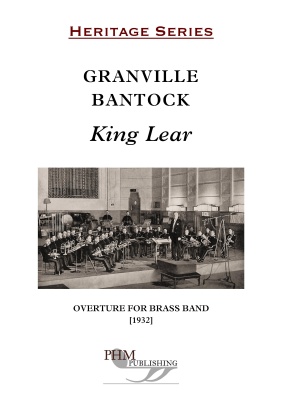
King Lear (Brass Band - Score only)
Sir Granville Bantock (1868 - 1946) composed the second of his five major brass band work for Callender's Cableworks Band, completing the commission on 30 November 1932. Based in the Thames-side district of Belvedere near Erith, the band was active between 1898 and 1961. The works band of the Callender Cable & Construction Co. Ltd, it was at the peak of its popularity during the 1930s and was a frequent broadcaster on the radio. The band employed an in-house arranger and played saxophones in its lighter material. King Lear was one of the band's major commissions and was not published in Bantock's lifetime. The manuscript score and parts were thought to be lost for decades, but were found in the library of the Haydock Band (Lancashire), which had inherited part of Callender's library of manuscripts material and bespoke arrangements after it has been transferred to nearby Prescott Cables Band after Callender's Cable Works closed.King Lear is a substantial work, in essence a dramatic tone poem in the romantic Tchaikovskian manner, presenting a series of character portraits of the foolish old king and his three daughters, Goneril, Regan and Cordelia. The music is dramatic and lyrical by turns, with the most generous lyrical episode revealing perhaps the warm-hearted Cordelia. An expansive melody that flows from this is brought back towards the end as the main climax of the work.In 2001, Bantock's score was recorded by the University of Salford Brass Band, conducted by Dr. Roy Newsome. The original is serviceable, but in comparison with the orchestral version he made in 1936 (part of which was recorded on a Paxton 78 rpm) and later brass band scores, performing editions of which were prepared by others, it lacks colour and range typical of Bantock's orchestral work. Above all it lacks percussion, which can be heard on the recorded extract. With the kind permission of the Bantock Estate, I have prepared a performing edition for publication that incorporates percussion, derived from the orchestral recording and added editorially in similar manner elsewhere. I have revoiced some of the low- lying instrumental parts to present the material in more comfortable ranges. Editorial interventions more elaborate than revoicing the original text have been identified as cue notes.- Paul HindmarshDuration: 15.00
Estimated dispatch 7-14 working days
-
 £34.95
Island Whirl (Brass Band - Score and Parts)
Island Whirl was commissioned by Margaret Milligan who wanted a brand new piece of music composed as a present for Ian, her husband for his 70th birthday. Ian Milligan is a keen and dedicated musician and he is the musical director of Callendar Brass, based in Callendar near Stirling in Scotland.Margaret contacted me about the possibility of composing a short lively piece which had a Scottish theme that would be ideal for Callendar Brass Band and any other ensemble to get their teeth into. This piece takes its inspiration from the traditional Scottish folk song 'An Eriskay Love Lilt' which is a particular favourite of both Margaret and Ian.With thunderous Celtic drums the piece opens in a whirlwind of sound with fanfare brass and an off-stage soloist that can perform using either the cornet or trumpet. After the exciting opening, the brass and drums die away to allow the off-stage soloist to air the traditional tune 'An Eriskay Love Lilt'.The beautiful haunting melody, keeping its originality throughout undergoes a series of changes in the accompanying harmonic material before dying away to allow the Celtic drums to return. The percussion whip the band into a frenzy as the piece gets faster and faster. Just prior to the final notes the band diminuendo to allow one last closing statement from the Eriskay Love Lilt lead by the off-stage soloist before the ensemble charge to a dramatic close.When performing this piece I would recommend the off-stage soloist taking a position somewhere in the audience, so they can almost feel part of the performance. In addition, with the two tom-tom parts that represent the Celtic drums, bands should make the most of showcasing them by getting the two drummers out to the front of the band to perform. The ideal stage position would be with the players set up in stereo with one player in front of the soprano cornet and the other in front of the solo trombone.With the various choreographed movements from both the off-stage soloist and the percussionists. This piece is a great addition to any concert repertoire and is an ideal showcase for bands who want to try something a little different.I wish Ian at 70 years young, all the very best with his music making in the many years to come and I hope this piece, composed especially for him and Callender Brass brings them many years of musical enjoyment.Paul Lovatt-Cooper
Estimated dispatch 7-14 working days
-
£26.50
Silent Night - Traditional - Broadbent, D
Silent Night is one of the most cherished Christmas carols of all time, known for its gentle melody and message of peace. Its simple beauty and serene tone capture the stillness and wonder of the night of Christ's birth. Translated into hundreds of languages, Silent Night continues to bring comfort and unity to people around the world during the holiday season.Part of Derek Broadbent's Showcase Carol Collection.
In Stock: Estimated dispatch 1-3 working days
-
 £38.95
Unity Series Band Journal - Numbers 514 - 517, February 2023
514: Shine! (Samuel Shelley)This is a bright, energetic piece of work which Bandsman Samuel Shelley originally wrote at the request of Young People's Band Leader Neil Baker for Staple Hill YP Band. The two songs featured are Shine, by Nick Jackson, and Graham Kendrick's Shine, Jesus, shine.515: He's got the whole world in his hands (Morgan Juel Stavik)Morgan Juel Stavik has arranged one of the most widely known and loved spirituals, He's got the whole world in his hands, into a jazzy work perfect for family services.516: The blood will never lose its power (Stephen Hull)The blood will never lose its power, is an arrangement of Andra Crouch's gospel classic. It is composer Stephen Hull's debut work in the Brass Band Journals.517: You encircle me (Andrew Mackereth)You encircle me has been popular in Scandinavia for many years and is now available in this beautifully reflective setting by Andrew Mackereth.
Estimated dispatch 7-14 working days
-
 £41.95
Crimond (Score and Parts) - Peter Graham
Here is a most attractive and creative arrangement of the well-known and much-loved hymn tune by Peter Graham - one of the most popular writers for brass band. This is not a run-of-the-mill sing-along version, but a neatly constructed piece in its own right. Not too taxing to play, yet there are some flourishes to give it added sparkle!
Estimated dispatch 7-9 working days
-
£33.00
A Whiter Shade of Pale - Reed, K & Brooker, G - Lewis, C
"A Whiter Shade of Pale," by Gary Brooker and Keith Reid, is a hauntingly beautiful 1967 classic that fuses baroque elegance with rock sensibility. Its signature organ melody--drawn in part from Bach-inspired motifs-- give the song a dreamlike, almost surreal quality. A smash hit in its day, it topped the UK charts for six weeks, and over the decades has become one of the most covered and enduring songs in popular music history.
In Stock: Estimated dispatch 1-3 working days
-
 £46.00
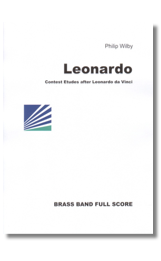
Leonardo (Score only) - Philip Wilby
At his death in 1519 Leonardo da Vinci was the most celebrated artist of his age, but his current celebrity draws much of its potency from his amazingly varied interests in all branches of Renaissance knowledge. Many of his ideas are contained in sketchbooks and Philip Wilby's work takes a sequence of these as a springboard. They traqnslate his visual studies into purely musical terms, and transform their images, tubulent or intimate, mechanistic or heraldic by turns, into a composition which draws its energy from Leonardo's great example. An abridged version of the work - Turba - is also available.
Estimated dispatch 7-9 working days
-
 £58.00
Leonardo (Parts only) - Philip WIlby
At his death in 1519 Leonardo da Vinci was the most celebrated artist of his age, but his current celebrity draws much of its potency from his amazingly varied interests in all branches of Renaissance knowledge. Many of his ideas are contained in sketchbooks and Philip Wilby's work takes a sequence of these as a springboard. They traqnslate his visual studies into purely musical terms, and transform their images, tubulent or intimate, mechanistic or heraldic by turns, into a composition which draws its energy from Leonardo's great example. An abridged version of the work - Turba - is also available.
Estimated dispatch 7-9 working days
-
£33.00
When I Fall in Love - Young, V - Broadbent, D
"When I Fall in Love" is a timeless romantic ballad composed by Victor Young with lyrics by Edward Heyman. Known for its gentle, dreamy quality, it beautifully captures the vulnerability and hope of falling deeply in love. Decades after its debut, When I Fall in Love continues to resonate with audiences as one of the most cherished love songs ever written. This arrangement features a Euphonium solo.
In Stock: Estimated dispatch 1-3 working days
-
 £33.09
E lucevan le stelle (Cornet/Euphonium Duet with Brass Band) Puccini arr.Bushnell
Tosca is an opera in three acts by the Italian composer Giacomo Puccini. The opera is set in June 1800 in Rome, and tells the story of the Kingdom of Naples and the threat to its control of Rome by Napoleon's invasion of Italy. Some of Puccini's best-known arias can be found in Tosca. The opera is based on Victorien Sardou's dramatic play of the same name (La Tosca). Puccini saw the play at least twice in 1889 and begged his publisher, Giulio Ricordi, to obtain the rights to turn it into an opera, which were secured in 1891 - although Puccini relinquished the rights to Alberto Franchetti before being recommissioned in 1895. Puccini wrote "I see in this Tosca the opera I need, with no overblown proportions, no elaborate spectacle, nor will it call for the usual excessive amount of music." It took four years to write, with Puccini arguing with his librettists (Luigi Illica and Giuseppe Giacosa) and his publisher. Although the first performance was delayed by a day due to the unrest in Rome at the time, the opera was premiered on 14 January 1900 at the Teatro Costanzi in Rome. The critics reviews were indifferent, but it was an immediate success with the public. The opera is through-composed, with the different musical elements weaved from piece to piece. Puccini used the Wagner's leitmotif concept to identity different parts of the opera. Taken from Act 3, E lucevan le stelle is sung by Cavaradossi, a painter, who has fallen for the singer Tosca. The corrupt Chief of Police, Baron Scarpia, longs for Tosca himself and, upon suspecting Cavaradossi of helping a political prisoner escape, he takes the opportunity to get rid of Cavaradossi and blackmail Tosca into being with him. The guards lead Cavaradossi to the roof of Castel Sant'Angelo, where he is told he has 1 hour to live before being executed. He asks to write a letter to Tosca, overcome by memories, he sings E lucevan le stelle (And the stars shone). It was selected by the tenor Wynne Evans as one of the most romantic songs for his top ten arias for Classic FM. He described it as "another tenor classic, both tragic and beautiful." This arrangement (for cornet and euphonium duet with brass band) includes alternative parts for horns in F and lower brass in bass clef. A recording of the original song can be found here: www.youtube.com/watch?v=EAqHQMX7GHY
In Stock: Estimated dispatch 1-3 working days
" frameborder="0" allowfullscreen>
 View Music