
Results
-
 £45.00
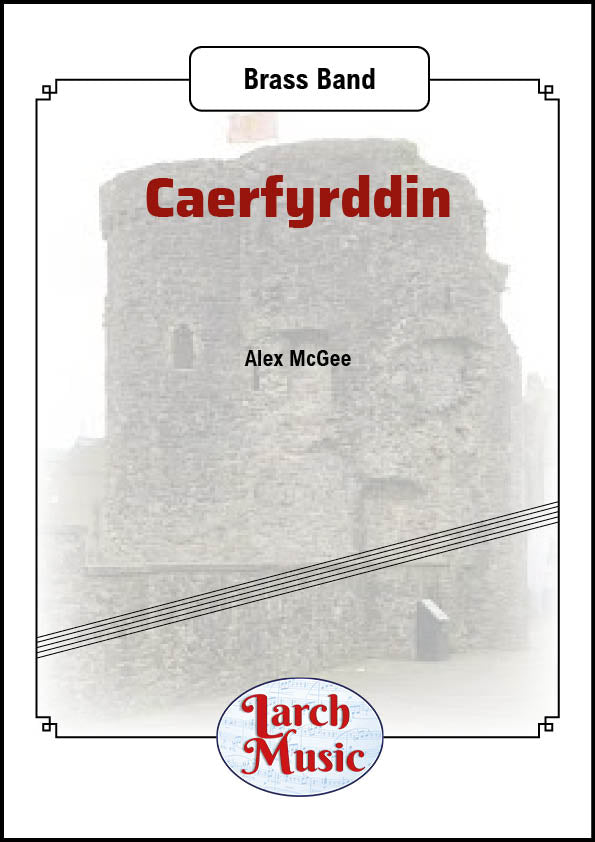
Caerfyrddin - Brass Band - LM957
COMPOSER: Alex McGeeA four movement work describing the historic county town of Carmarthen.1. FanfareThe first movement is an opening Fanfare,2. Castell Caerfyrddyn(Carmarthen Castle)The second movement is a lament describing the now ruined castle.Carmarthen Castle(Welsh:Castell Caerfyrddin) is a ruinedcastleinCarmarthen,West Wales. First built by Walter, Sheriff of Gloucester in theearly 1100s, the castle was captured and destroyed on severaloccasions before being rebuilt in stoneduring the 1190s. The castle was captured byOwain Glyndrin 1405.Henry VII's father died at Carmarthen Castle in 1456. During theWars of the Rosesthe castle fell toWilliam Herbertand, during theCivil War,was captured by Parliamentary forces. It was dismantled by order ofOliver Cromwellin the mid 1600s.It has been used as the site of Carmarthen's gaol until the 1920s.The remains of the castle were given a Grade Iheritage listingin 1954and is currently a tourist attraction and site of the town's Tourist Information Centre.3. Pysgota Cwrwgl(Coracle Fishing)The third movement is a Scherzo which depicts coracle fishing on the river Towy.Should you take an evening stroll down by the River Towy,if the weather and river conditions are suitable, you may be lucky enough to see apair of coracles float gently down river with a net suspended between them.The coracle man will hold the net in one hand and skilfully moving the paddle in afigure of eight motion in the other. As soon as a fish in caught, which many havedescribed as a 'silent noise travelling from the fish, into the net and up into thefisherman's arm', the two coracles are drawn together by pulling at the net.Sewin (sea trout) or salmon being the chosen catch.4. MarchThe Fourth movement is a March representing the town itself. Carmarthenshire in West Wales lies on the River Towy and claims to be the oldest town in Wales. Some variants of theArthurian legendclaim thatMerlinwas born outside the town and that he lies imprisoned in a cave in nearbyBryn Myrddin(Merlin's Hill), which stands right by the A40 trunk road.The myth maintains that his groans can be heard issuing forth from the hill and will continue until he is called to help his fellow countrymen. It is also claimed that, when Merlin's Oak fell, it would be the downfall of the town.For many years great effort was employed to brace the tree, situated in the town.Although it eventually died, it is hoped that catastrophe was averted by preservingsome bits in theCarmarthenshire County Museum.Larger branches are in the Civic Hall in Nott Square and a statue of Merlincarved from another local tree stands in the town centre.St. Peter's Church, the largest parish church in Wales,also has thelongest navemeasuring 60 metres and its tower containseight bellswith the heaviest weighing just under a tonne.It is surprising that few traces survive of the medieval town; however,a small section ofCivil War defences, thrown up by the Royalists, survives on the south-west of the town. They are known as "The Bulwarks," and consist of an earthwork bank and a well-preserved four-sided bastion.Suitable for Most Bands - Duration 8 mins (Approx.)
In Stock: Estimated dispatch 3-5 working days
-
 £47.00
Adventure Island - Andrew Pearce
A family enters the gates into a magical theme park with exciting rides and attractions. The swashbuckling Pirate theme is up-tempo and memorable with plenty of excitement for the brass and percussion sections, a perfect opener for any concert! For intermediate bands (level C).Also available with virtual conductor video on YouTube to create a virtual orchestra!! Video to be viewed here:copy this link into your browser:Https://www.youtube.com/watch?v=dsg04rZwmqU
Estimated dispatch 10-14 working days
-
 £35.00
Ariel
DescriptionAll hail, great master! Grave sir, hail! I come To answer thy best pleasure, be 't to fly, To swim, to dive into the fire, to ride On the curled cloud. To thy strong bidding, task Ariel and all his quality. - William Shakespeare: The Tempest, Act 1, Scene 2Ariel was written for the Hammonds Band to open their programme at the 2019 Brass in Concert Championships at The Sage Concert Hall in Gateshead, where it received its premiere. The title is taken from the character in Shakespeare's play 'The Tempest'. Ariel is an immensely powerful "air spirit" or demon bound to serve Prospero, the exiled Duke of Milan, after being released by Prospero from imprisonment in a tree. In the play Ariel's magical abilities are used to help Prospero revenge himself on his enemies and reclaim his dukedom, whereupon Ariel finally regains his freedom.You can hear an audio preview and follow the score below: Performance notes:The cornets and horns are split into two "choirs" to be placed left and right of the band. It may be possible for the choirs to play their opening flourish offstage, and the optional repeated sections in the opening are to accommodate stage movement if required. Trombones form a third "choir" which should ideally stand centrally between basses and percussion, and the euphoniums and baritones should sit in front of the basses. The work requires four percussionists, although if four are not available the 2nd part may be omitted.Percussion 1: Kit - bass drum, snare, 3 x toms, hi-hat, suspended cymbal - and 3 x temple blocksPercussion 2: Tam tam and orchestral bass drum.Percussion 3: Glockenspiel and timpaniPercussion 4: Tubular bellsSoprano, solo cornets and 3rd cornets require cup mutes. Solo trombone requires a cup mute, second trombone requires a metal straight mute.
Estimated dispatch 7-14 working days
-
 £36.00
Edward Gregson: The World Rejoicing
DescriptionComposer's NoteIn searching for a common link between the brass band traditions of the various European countries that commissioned this work, I considered the fact that hymns have always played an important role in the relationship that brass bands have with their particular communities; and thus I turned to a well-known Lutheran chorale, Nun danket alle Gott (Now thank we all our God), written around 1636 by Martin Rinkart, with the melody attributed to Johann Cruger. A number of composers have incorporated this chorale into their music, most famously J.S.Bach in his Cantatas no. 79 and 192, and Mendelssohn in the Lobsegang movement of his 2nd Symphony (the harmonization of which is usually used when this hymn is sung).It seemed fitting therefore for me to return to a compositional form I have used many times before (Variations) and to write a work based on this hymn. I have used it in a similar way to that which I employed in my Variations on Laudate Dominum of 1976 - that is, rather than writing a set of variations using elaborations of the complete tune, I have taken various phrases from the chorale and used them within the context of other musical material, applying an overall symphonic process of continuous variation and development. The structure, or sub-divisions of the work, which is through composed and plays without a break, is as follows: Prelude, Capriccio, La Danza 1, Processional, La Danza 2, Arias and Duets, Fuga Burlesca, Chorale, and Postlude.The work is also partly autobiographical - in the manner say of Strauss's Ein Heldenleben - in that I have incorporated into the score brief quotations from many of my other major works for brass band. In that respect, The World Rejoicing sums up a particular facet of my life as a composer, and reflects the admiration I have always had for what is surely one of the great amateur music-making traditions in the world.The World Rejoicing is dedicated 'in loving memory of my brother', Bramwell Logan Gregson, who sadly passed away in the Autumn of 2018.Edward Gregson
Estimated dispatch 7-14 working days
-
 £36.30
1989 - Tim Paton
Tim Paton composed this work originally for piano, and later went on to score it into this effective version for brass band.Tim comments:What happened in 1989? I wrote this piece for piano, and later scored it for brass band! The piece begins in a thoughtful mood, then very soon moves into a bluesy style. After an up-tempo dance section, and a brief re-cap of the beginning, it finishes with a majestic coda, which really shows off that special sound that only a brass band can make. Although it is called 1989, it can be any memorable year that the listener wishes it to be.
In Stock: Estimated dispatch 3-5 working days
-
 £31.40
African Trio - Kenneth Downie
As it's title suggests, this piece consists of three distinct elements, all of which maximise the stylish creativity of Kenneth Downie's renowned writing talent.After a rich, warm and hymnal opening 'movement' based upon Kum Ba Yah, the work develops and lifts into a fascinating take on 'The Lord's Prayer'. Bringing the piece to an even more positive, up-tempo close is the final section which references the South African traditional song We Are Marching (Siyahamb' ekukhanyen' kwenknos')Kenneth Downie composed this work in support of a charitable project, known in 2005 as Brass Band Aid. The organisation called for original compositions to be included in a follow-up CD release - Into Africato help raise funds for projects in Adet, Africa, and to build awareness of theMake Poverty History campaign. African Trio was featured on the CD with a recording by The National Youth Band of Wales.Now that the original BBA projects are complete, funds raised by the titles we publish from theBrass Band Aidseries continue to support other music-related projects on a regular basis.Look and Listen (performance courtesy of Golden Gate British Brass Band in 2019):
In Stock: Estimated dispatch 3-5 working days
-
 £22.93
BBA March - Roy Newsome
This is a concert march with a difference!The whole of the first section is in minor mode - unusual and intended to depict the trials and tribulations which inspired the original (and now successfully completed) Africa-based projects of Brass Band Aid. The Trio then goes into the major and begins with a Prayer motif that starts with the notes B-B-A. Following a rather turbulent episode (a reminder that there is still much to do), the Prayer theme returns triumphantly, reflecting optimism for the future.Roy Newsome composed this work in support of a charitable project, known in 2005 as Brass Band Aid. The organisation called for original compositions to be included in a follow-up CD release - Into Africato help raise funds for projects in Adet, Africa, and to build awareness of theMake Poverty History campaign. African Adventure was featured on the CD with a recording by the Wingates Band.Now that the original BBA projects are complete, funds raised by the titles we publish from theBrass Band Aidseries continue to support other music-related projects on a regular basis.
In Stock: Estimated dispatch 3-5 working days
-
 £31.40
Dignity - Alan Fernie
Alan Fernie created this beautiful work in support of a charitable project, known in 2005 as Brass Band Aid. The organisation called for original compositions to be included in a follow-up CD release - Into Africa to help raise funds for projects in Adet, Ethiopia, Africa, and to build awareness of the Make Poverty Historycampaign.This work offers a quiet, peaceful interlude. No technical fireworks, just a simplicity which reflects the dignity of the people in Ethiopia, despite the hardships they endured.'Dignity' was in fact the second donation of music made by Alan Fernie in support of the project (his first being African Funk which has featured in many a band's programme). It was recorded by the Scottish Co-Op Band and featured on the Brass Band Aid CD - Into Africa.
In Stock: Estimated dispatch 3-5 working days
-
 £35.00
Divertimento (previously Spring's Awakening) - Andrew Duncan
This original solo for Eb Tenor Horn and brass band, composed by Andrew Duncan, has proved to be a welcome addition the solo repertoire.Written to demonstrate both the technical and lyrical sides of the Horn, the piece begins with a fast, bright (slightly Latin) section. This gives way to an expressive legato tune which, first played by the Soloist, is then taken up by the whole band. The central section, Andante, allows the soloist to really sing out and, following a short cadenza, the opening material returns to lead into an exciting Coda section.Also available for Eb Tenor Horn with piano accompaniment and F Horn with piano accompaniment.Difficulty Guide:Suitable for intermediate to advanced Tenor Horn players. Range: Low F# to high Db. (optional Bb).NB: The previous working title of Spring's Awakening has now been re-edited into this final title of Divertimento.
In Stock: Estimated dispatch 3-5 working days
-
 £31.40
Heed the Word - Lucy Pankhurst
Lucy Pankhurst created this impressive work in support of a charitable project, known in 2005 as Brass Band Aid. The organisation called for original compositions to be included in a follow-up CD release - Into Africa to help raise funds for projects in Adet, Africa, and to build awareness of the Make Poverty History campaign.Lucy's creativity and imagination are very prevalent in this work - a complete mix of powerful energy and poignant emotions flow from the score. A strong use of pulsating drums are balanced with sheer tranquility and rich chords. It exudes hope and positivity and perhaps, through its title, offers a gentle warning to listen carefully to the concerns that are aired around us - not least in recognition of the challenges facing the very communities the CD was aiming to help.The work was recorded by the Prairie Brass Band, US and featured on the Brass Band Aid CD - Into Africa.
In Stock: Estimated dispatch 3-5 working days
 View Music