
Results
-
£104.99
Theme Park Fun! - Wilco Moerman
In Theme Park Fun! your orchestra pays a visit to an amusement park. During your visit, you will experience some spectacular rides and attractions this theme park offers. The uniqueness of Theme Park Fun! is the interplay between music and(moving) images. Animations and illustrations support the visual composition (downloadable after ordering a set, on www.gobelinmusic.com).Part 1: The Entrance & Parade [with animation]The opening of the park is a fact. A day fullof fun and pleasure awaits! You and the other visitors will be confronted with all the rides, attractions and adventures the theme park has to offer. Which ride shall we do first?! There is so much to do and experience on this day in the park! Aparade of colorful floats and park figures is passing by.Let the fun begin!Part 2: The Haunted House [with animation]The only ride in the park that is not related to fun, is the Haunted House. Here visitors will be challengedto visit a house full of ghosts, creepy figures and other ominous things. The clock strikes twelve, there is no turning back. Ghosts are whispering, yelling, screaming... Fortunately it is almost one oclock, so we can leave this creepy placequickly.Part 3: The Swinging Galleon [with illustrations]What a huge pirate ship! Each time you swing back and forth, you will feel that weird feeling in your stomach. When you are thrown completely into the top you will have afantastic view over the park, but you can not enjoy it for long. Before you know the ship swings back the other way.Part 4: The Fairy Tale Ride [with illustrations]After all those exciting and spectacular rides and attractions,it is time for a peaceful tour in The Fairy Tale Ride. Surrounded by a fairytale setting, you will discover fable figures, talking animals and colorful designs. Such a beauty and tranquility. Having had this experience, we are ready again for thebig rides in the park!Part 5: The Bumper Cars [with illustrations]Now its time to crawl behind the wheel of the Bumper Cars! Shall we all chase the conductor?! Before you know you are hit by another visitor or you will bumpagainst someone else. In this tough ride you can prove yourself as a real driver, or perhaps as a really bad one.Part 6: The Roller Coaster [with illustrations]The largest, fastest and scariest ride in the park ... we shoulddefinitely do the Roller Coaster! All together in the train, the over-the-shoulder restraints are lowering... be ready to ride. The train leaves the station and is heading for the big lift hill. It will be very scary when the train reaches the topand the train will be plunged down the first drop! Loops, corkscrews and other spectacular coaster elements will follow... Before you know it, the ride of your life is over. Shall we ride it again?!Part 7: Leaving the Park [withanimation]Unfortunately everything comes to an end. This day in the theme park is over, but we have a lot new experiences to talk about! The memories of all the funny and spectacular rides will come up when we walk through the park to theexit. Just one look over the shoulder, the amusement park figures are waving at us. Hopefully we will come back again soon!
Estimated dispatch 5-14 working days
-
 £59.95
Music from Kantara - Kenneth Downie
Despite the exotic sounding title, the origins of Kenneth Downies fine composition are somewhat more prosaic. When the composer and his wife moved into a new home they were intrigued to find it called Kantara. Not wanting to upset the outgoing owners, and wishing to find out more, they decided to keep the name.Some judicious research found that Kantara was a ruined castle in Northern Cyprus which the previous owners had once visited. A picture of it was left hanging on the wall of the house for the new owners to enjoy.Written in 1993 for the National School Band Association Composer Competition, it has subsequently been used at youth and senior level - from the National Youth Band Championships of Great Britain to the Pontins Championship.The three-movement work is in no way descriptive, but each has individual character - from a light hearted spiritoso followed by a short lyrical middle section to an animated presto finale.
Estimated dispatch 5-14 working days
-
 £68.90
Three Pictures for Band - Oliver Waespi
This composition consists of three sound pictures. Numerous associations mutually link those parts as far as motifs and harmony are concerned. The motif of the ascending and descending fourth plays an important role in many a theme. There are many fourth chords by means of which I try to put a harmonic and unifying stamp on the composition as a whole. Moreover there are similar or identical, though varied, motifs in the successive parts. The first part 'Cortege' (Procession) describes the dignified majestic procession by means of simple, precise rhythms. At first, the music is scarcely audible, as if coming from a distance; it gradually comes nearer until it reaches its climax in large chords, before fading away again. At each quarter note one could imagine a step. The second part 'Dialogue' consists in broad outlines of dialogues between the different orchestral groups. Some instruments are asking questions, others are giving answers. After a rather sad passage, the music turns into a climax followed by a second passage that brings comfort and leads to a quiet ending. In the third part, there is a sudden movement coming up in the shape of 'Waves'. The principle of the wave, successively swelling and decreasing, dominates the entire musical structure of this part, even in the separate motifs.Oliver Waespi
Estimated dispatch 5-14 working days
-
 £90.30
The Belly Dancers - Bob Gay - Marcel Peeters
Since several years the famous Flemish composer and arranger Marcel Peeters collaborates with his friend Bog Gay to write rather light-hearted compositions for symphonic band. In this extremely colourful oriental ballet the composers introduce the listeners into mysterious and exotic places where attractive young ladies dance voluptuously. A fascinating composition with quite some humoristic characteristics and a sparkling orchestration.
Estimated dispatch 5-14 working days
-
 £116.40
Decennium - Eric Swiggers
'Decennium' was composed in 2003 as a commission by the municipality of Berheze for its tenth anniversary. The composition describes the history of this town in the Province of Brabant, consisting of 6 different villages: Heesch, Heeswijk, Dinther, Nistelrode, Loosbroek and Vorstenbosch. The composition starts with a slow introduction, Adagio Misterioso, suggesting the atmosphere in long-ago days when the area consisted mainly of swamps, meres and low woods. (The word 'Bern' is a synonym of 'Born' meaning source or water, whereas 'Hese' is derived from 'Haisjo' meaning brushwood ). Above the dark sounds we hear far away trumpet signals announcing the Middle Ages. After a piercing crescendo, we hear the full sound of festive trumpets. A medieval dance, as was to be heard in the Heeswijk castle, follows. This dance gets a more and more stirring character and finally turns into a merry popular dance ending with a burst of laughter reproduced by descending scales with the muted trombones and trumpets. A slow transition with a quotation from a Gregorian plainsong (Domine Deus) and church bell ringing, referring to the Abbey of Berne, brings us to a romantic Larghetto. This part describes the quiet rural life in a beautiful natural surrounding. The last dying note contrasts with the threatening ostinato, referring to the rise of the industrialization, which provoked quite some resistance with the local people. Once more we hear the 'Domine Deus' but much more powerful this time. When the resistance calms down, the work concludes with an Alla Marcia. The first notes of the main theme could be heard all through the composition and now we hear the complete main theme again. The new town is born. A festive conclusion refers both to the tenth anniversary and the optimism and confidence as to the future.
Estimated dispatch 5-14 working days
-
 £61.00
Traditional Portugese Folk Tunes - Andrew Pearce
A while ago Andrew Pearce was asked to arrange some traditional folk songs into a medley that utilised an array of unusual instrumental groupings, typical of a local village band. He has re-worked the arrangements to suit any flexible instrumentation, thus catering for all players. The folk tunes are fun, catchy and to be enjoyed by all.
Estimated dispatch 5-14 working days
-
 £52.90
Bossa Nova Breakout! - Dean Jones
The music sets the scene hear of a party atmosphere! In this laid back cool groove, there is a sense of fun yet a feeling of cool calm! The music is light-hearted and intended to be easy-listening as well as toe-tapping...if not break out into dancing!
Estimated dispatch 5-14 working days
-
 £73.60
Drie Opwekkingsliederen - Henk Ummels
Revival songs are sung more frequently these days in Christian churches in the Netherlands. The cheerful nature of these songs come into their own with use of a good catchy melody, everyday language, and often accompanied by a band with wind players, instead of an organ. In this collection: Together In the Name of Jesus, Thank You For This New Morning, and Praise Him. Arranged for a flexible setting, these are also well suited to a full orchestra.
Estimated dispatch 5-14 working days
-
 £115.60
Battle of the Galaxy - Roar Minde Fagerli
Battle of the Galaxy is a suite in four movements. The composer describes the battle between the good and evil in a fantasy galaxy.The first movement is a journey into the galaxy. In the second movement dark and evil forces invade the galaxy. The third movement is the inhabitants hope for peace in the galaxy. In the last movement the heroes step forward and bring peace to the galaxy.The composer is inspired by films and TV series in the science fiction genre.
Estimated dispatch 5-14 working days
-
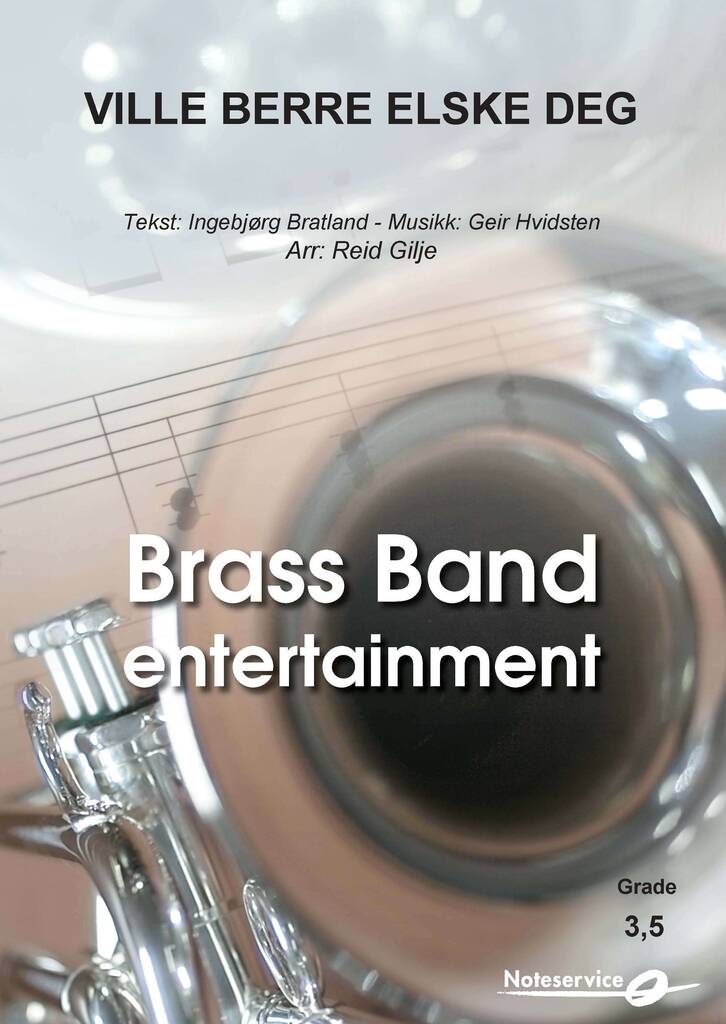 £107.80
Ville Berre Elske Deg - Ingebjørg Bratland - Reid Gilje
This evocative ballad is written by Geir Hvidsten (music) and Ingebjorg Bratland (lyrics). We recommend listening to the original recording by Ingebjorg Bratland in addition to the recording of this arrangement.The soloists must play with intensity and expression.Please balance the elements and soloists into the mood one wants to create. Be aware of the unison melody line!Enjoy the music!
Estimated dispatch 5-14 working days
 View Music