
Results
-
 £34.00
Meditation: It is Well With My Soul
ABOUT THIS PIECE: Cantatio are pleased to release this hymn meditation on the much-loved hymn by Adam D J Taylor. Commissioned by the world famous Wingates Band, this arrangement became a centrepiece of the band's online presence during the COVID pandemic. Story time... Horatio Spafford was a successful attorney and real estate investor who lost a fortune in the great Chicago fire of 1871. Around the same time, his beloved four-year-old son died of scarlet fever. Thinking a vacation would do his family some good, he sent his wife and four daughters on a ship to England, planning to join them after he finished some pressing business at home. However, while crossing the Atlantic Ocean, the ship was involved in a terrible collision and sunk. More than 200 people lost their lives, including all four of Horatio Spafford's precious daughters. His wife, Anna, survived the tragedy. Upon arriving in England, she sent a telegram to her husband that began: "Saved alone. What shall I do?" Horatio immediately set sail for England. At one point during his voyage, the captain of the ship, aware of the tragedy that had struck the Spafford family, summoned Horatio to tell him that they were now passing over the spot where the shipwreck had occurred. As Horatio thought about his daughters, words of comfort and hope filled his heart and mind. He wrote them down, and they have since become a well-beloved hymn: When peace like a river, attendeth my way, When sorrows like sea billows roll-- Whatever my lot, thou hast taught me to say It is well, it is well with my soul. ENSEMBLE: Standard British Brass Band WHEN YOU BUY THIS PRODUCT, YOU GET: High-quality printed score and parts LEVEL: 2 - 3 LISTEN: DURATION: c. 7-minutes, 30-seconds EXAMPLE SCORE: Click here LEVEL GUIDE: Level 1- Accessible to all Level 2 - c. UK third section and higher Level 3 - c. UK second section and higher Level 4 - c. UK first section and higher Level 5 - c. UK championship section level
Estimated dispatch 5-7 working days
-
 £59.95
That Promised Land - Jonathan Bates
DURATION: 8 minutes. DIFFICULTY: 1st+. That Promised Land was the culmination of 5 years of my personal interest in spiritual music since performing Michael Tippett's wonderful Oratorio 'A Child of Our Time' at the RNCM. Tippett's work combines original material, with music inspired and based upon spirituals, whilst all of the major 'chorus' sections are direct settings of those tunes. This was a work that had stuck with me for a long time, and one I tried to emulate in a smaller form with this work. The title is a quote from one of the verses of the spiritual 'Deep River'. This piece was composed for Jaren Hornmusikkforening as part of their programme for the 2018 SIDDIS Championships held in Stavanger, Norway. .
In Stock: Estimated dispatch 1-3 working days
-
£70.00
Milestone - Peter Meechan
Milestone is a concerto commissioned by Mark Wilkinson (with funds provided by the Arts Council England) to celebrate 21 years as Principal Cornet with Fodens Band. In three movements, the work is intended to not only demonstrate the soloistas virtuosic skills, but also his ability to communicate to the audience.The first movement, titled Milestone, combines sections of driving rhythms (intended to represent Markas years of continuing hard work), in the accompaniment with long legato phrases from the soloist interspersed with dexterous, virtuosic, passages.The second movement, Song, features a simple chord sequence, over which the soloist asingsa a melody, each time varying and each time becoming more expressive, leading to an emotional climax.The final movement, Twenty One, is a quasi-celebratory dance. Opening with the band clapping, the soloist weaves their way through the various textures in the band. Occasionally making both a musical and metaphorical nod to the industrious nature of the first movement, the chord sequence of the second movement also re-appears, before a brief coda takes us to the conclusion of the work.
Estimated dispatch 12-14 working days
-
 £29.95
Cairo Red Shield (Brass Band - Score and Parts)
During World War Two, Salvation Army servicemen serving in Cairo formed a 'Red Shield Club', of which one of the elements was a band. Albert Raikes (more often known affectionately by his middle name, Stan) was for some time in charge of this band and wrote this march in memory of this wartime combination and the enthusiasts who were, at one time or another, members of it.
Estimated dispatch 7-14 working days
-
 £45.00
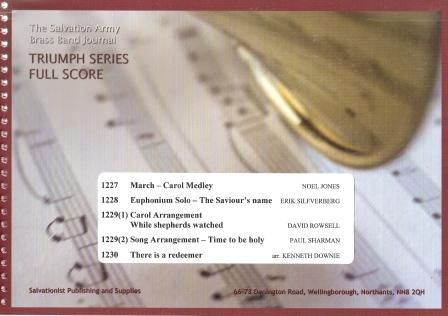
Triumph Series Band Journal July 2012 Numbers 1227 - 1230
No. 1227 March - Carol Medley (Noel Jones)This march features three carols, 'God rest ye merry, gentlemen', Hark! The herald angels sing' and 'Deck the Hall' together with brief references to others in a medley form. A couple of these references are somewhat camoflaged which provides further interest.No. 1228 Euphonium Solo - The Saviour's Name (Erik Silfverberg)A setting of Jane Clarke's lovely melody set to familiar words, 'There is a name I love to hear'.No. 1229 (1) Carol Arrangement - While shepherds watched (David Rowsell)A four-verse setting of the 16th Century tune, 'Winchester Old' commonly associated with the carol, 'While shepherds watched their flocks by night'.No. 1229 (2) Song Arrangement - Time to be holy (Paul Sharman)This arrangement of George Cole Stebbins' tune was originally made for the 2010 World Youth Convention in Sweden, the theme of which was 'Time to be holy'.No. 1230 There is a redeemer (Kenneth Downie)Melody Green-Sievright's popular song, 'There is a redeemer' was first published in 1982, 30 years before the appearance of this new setting.
Estimated dispatch 7-14 working days
-
 £12.00
Canzonetta
DescriptionCanzonetta is a tenor horn solo with optional brass band or piano accompaniment.Canzonetta was one of my earliest compositions, written in my early days as an undergraduate. Along with a companion piece called Caprice it was written for an old friend, Louise Hunt (now Louise Skillander), to whom it is dedicated. We had both been in the Northop Youth Band together, and both pieces were the result of a conversation about the lack of 'good tenor horn solos' for lower section and youth players at the time.With more mature consideration the Caprice has been consigned to the dustbin of history, but the simplicity of Canzonetta has allowed it to stand the test of time with a few minor scoring revisions.Performance Notes:Percussion instruments required are 2 x timpani, glockenspiel, suspended cymbal, concert bass drum (NOT a kit/pedal bass drum) and tam-tam. All cornets will require cup mutes.Duration approximately 3'40"You can follow the score while listening to an audio preview below:
Estimated dispatch 7-14 working days
-
£34.95
MARCH OF THE HOURS (Brass Band Set) - Emil Soderstrom
March of the Hours was first performed at Star Lake Music Camp in 1962 with the composer supplying an informative listening guide which was printed in the published score; "The phrases are of 12 crotchets each (three bars) signifying the 12 hours. Up to the trio, the music describes the headlong search for pleasure by the thoughtless. Abruptly, the trio brings 'I need thee every hour', but an episode employing the original theme pushes it aside until it reappears, this time against a background of chimes of the full hour (Westminster chimes). While the hour strikes 12, a paraphrase of the opening strains of 'When the trumpet of the Lord shall sound and time shall be no more' is heard. Here the music stops, to be followed by the trumpet sounding (cornets and trombones) and the rest of the band responds with 'When the roll is called up yonder' with a final 'I'll be there'."
Estimated dispatch 7-14 working days
-
 £38.95
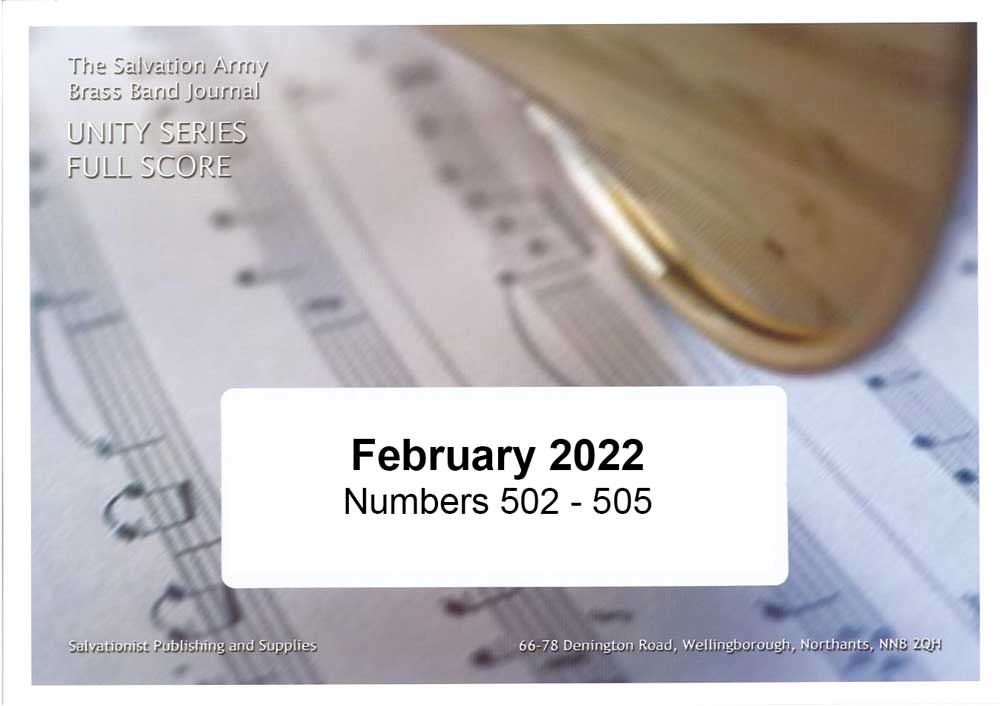
Unity Series Band Journal - Numbers 502 - 505, February 2022
502: See, what a morning (Gary Rose)This music is based on the popular Easter song of the same title (also known as Resurrection Hymn) by Keith Getty and Stuart Townsend (S.B.S. Volume VII).503: Light Force (Stephen Gibson)Originally written for a Young People's Band play-day, this exciting work brings together original themes as well as references to Jesus bids us shine (S.A.S.B. 870) and Shine, Jesus, shine (S.A.S.B. 261).504: Cornet Solo - Into your holiness (Jrgen Ijsendorn)Written for Martin Oosterbeek, who served in the military and undertook a tour of duty in Afghanistan, this work uses When I look into your holiness (T.B. 927), a song that provided solace during his time away.505: March - Turn to the Lord (Charles Craig)A tradition-style march perfect for groups with little rehearsal time.
Estimated dispatch 7-14 working days
-
 £34.95
Carol of the Bells (Brass Band - Score and Parts)
Christmas time is my favourite time of year. I love the festive spirit and all the Christmas music both traditional and modern.This piece is based on the traditional Ukrainian Bell Carol that was composed by the Ukrainian composer Mykola Dmytrovych Leontovych. Throughout the piece you hear a four note ostinato that is the backbone to the music. I have taken those ideas and motifs and have mixed them with some of my own to create this piece of Christmas music.For something different I have given this piece two endings for the conductor to choose. The first ending is at bar 189 (page 18 in the score) where there is the repeated four bar ostinato section in the solo cornets and percussion that is marked "Keep repeating and fade to nothing". This is so the piece can either fade to nothing or for a bit of originality the piece can fade into the next piece during a concert programme.For ending number two you need to cut from bar 189 to 193 (bypassing ending one). And continue to the end. The choice of endings should bring some interesting performances of this wonderful traditional Christmas piece.Paul Lovatt-Cooper
Estimated dispatch 7-14 working days
-
 £59.95
Bonnie Northumbria - Brass Band - LM786
COMPOSER: Laurie JohnstonProgramme NotesNorthumberland, or Northumbria as it is also known, is the most northern county in England and has magnificent and stunning landscapes just waiting to be explored. Filled with mystical castles, atmospheric ruins and historical sites and edged by spectacular coastal scenery, there is something wonderful to see at every turn. The Devils Causeway passes through Northumbria and reaches Berwick upon Tweed at the coast. Walkers and cyclists can also take the Coast and Castles Cycle Route or the North Sea Trail which journey through some of the most beautiful scenery along the way.The Blaydon Races is aGeordiefolk songwritten in the 19th century byGeordie Ridley, in a style deriving frommusic hall. It is regarded by many as the unofficialanthemofTynesideand is frequentlysungby supporters ofNewcastle United Football ClubandNewcastle Falconsrugby club.Blaydonis a small town inGateshead, situated about 4 miles (6.4km) fromNewcastle upon Tyne, inNorth East England. The race used to take place on the Stella Haugh 1 mile (1.6km) west of Blaydon.Stella South Power Station(demolished in 1995) was built on the site of the track in the early 1950s, after the races had stopped taking place in 1916.Water of Tyne (sometimes rendered as The Waters of Tyne) is a folk song (Roud number1364) from the north-east of England. The song is sung by a girl or woman lamenting the fact that her paramour is on the opposite bank of theRiver Tyne. Sleeve notes to Michael Hunt's recording of Tyneside songs states that "the ferry is believed to be that atHaughton Castleon theNorth Tyne". Alternatively the "rough river" in the last line may indicate a point further downstream, possiblyTynemouth.The song was collected byJohn Bellin 1810 and published two years later inRhymes of Northern Bards.The Keel Row is a traditional Tyneside folk song evoking the life and work of thekeelmenofNewcastle upon Tyne. A closely related song was first published in aScottishcollection of the 1770s, but may be considerably older, and it is unclear whether the tune is Scottish or English in origin.The opening lines of the song set it inSandgate, that part of the quayside overlooking the River Tyne to the east of the city centre where the keelmen lived and which is still overlooked by theKeelmen's Hospital.Versions of the song appear in both England and Scotland, with Scottish versions referring tothe Canongaterather than Sandgate. The earliest printing was in the 1770s inEdinburghin A Collection of Favourite Scots Tunes, edited by Charles Maclean, though the tune was also found in several late eighteenth-century English manuscript collections. As the term "keel" was used both sides of the border, it has not been determined which version was the original, althoughFrank Kidsonsurmised that like many other songs collected by Maclean it may originally have been aJacobiteair from the time of the1745 rebellion. Some versions of the song make reference to a "blue bonnet[...] with a snowy rose upon it", a clear attempt to evoke Jacobite symbolism, whether dating from 1745 or not.Kidson, however, also noted that he had found the tune of The Keel Row associated with an early dance called "The Yorkshire Lad" as early as 1748.By the 19th century the tune was well associated with the River Tyne; a few years before the 1850s the keelmen had met yearly to celebrate the founding of the Keelmen's Hospital, perambulating the town to the accompaniment of bands playing The Keel Row.Dance To Thy Daddyis a traditional Englishfolksong, originating inNorth East England. An early source for the lyrics, Joseph Robson's "Songs of the bards of the Tyne", published 1849, can be found on the Farne archive. In Farne's notes to the song, it is stated that these lyrics were written by William Watson around 1826.
In Stock: Estimated dispatch 3-5 working days
