
Results
-
 £154.99
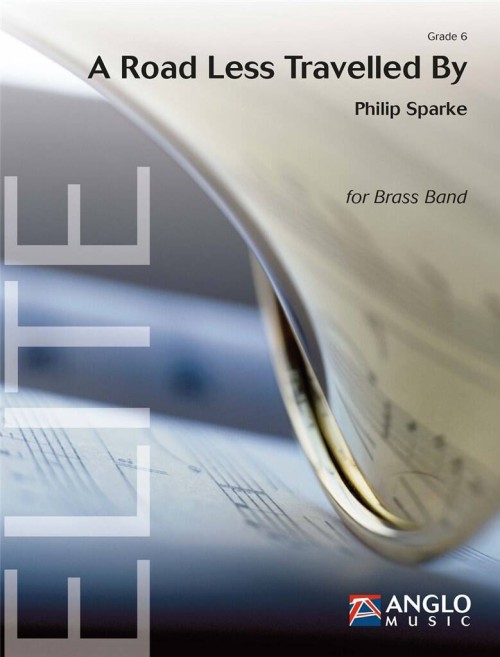
A Road Less Travelled By (Brass Band - Score and Parts) - Sparke, Philip
A Road Less Travelled By was commissioned by Palangos Orkestras for the Championship Section of the 2020 European Brass Band Championships held in Palanga, Lithuania.The following was written by the composer, Philip Sparke:The title alludes to a poem by American author, Robert Frost, which appeared in his 1916 collection, Mountain Intervals: The Road Not Taken.In common with most of my larger works, this piece in not programmatic, but purely abstract; there is no extrinsic musical story. The choice of title shares my view of how composers can often develop. There can be no 'destination' in a composer's career, but rather a continuing journey to an unknown place. From piece to piece a composer needs to decide his or her next steps, never really knowing where they might lead. As Frost so eloquently describes, these sorts of instinctive decisions guide all our lives.Set in three movements, which play without a break, A Road Less Travelled By opens with a Moto Perpetuo firmly rooted in classical language, form and syntax. A continuous river of semiquavers, veering from melody to accompaniment and back again, adds drive, every and motion. The second movement, Nocturne, is in the form of a free fantasia; solos for vibraphone, flugel horn and euphonium set the stage for a central cornet solo, quietly echoed by the full band. A triumphal climax is reached before the movement dissolves into a Scherzo Finale. Mercurial and quixotic in nature, this third movement starts jovially until trios for trombones and horns darken the atmosphere. A change of mood and meter leads to a reprise of the opening and a return of the cornet melody, this time accompanied by figures derived from the scherzo theme. A brief coda based on earlier material drives the piece to a close.Duration: 15.30
Estimated dispatch 7-14 working days
-
£36.50
A Road Less Travelled By (Brass Band - Score only) - Sparke, Philip
A Road Less Travelled By was commissioned by Palangos Orkestras for the Championship Section of the 2020 European Brass Band Championships held in Palanga, Lithuania.The following was written by the composer, Philip Sparke:The title alludes to a poem by American author, Robert Frost, which appeared in his 1916 collection, Mountain Intervals: The Road Not Taken.In common with most of my larger works, this piece in not programmatic, but purely abstract; there is no extrinsic musical story. The choice of title shares my view of how composers can often develop. There can be no 'destination' in a composer's career, but rather a continuing journey to an unknown place. From piece to piece a composer needs to decide his or her next steps, never really knowing where they might lead. As Frost so eloquently describes, these sorts of instinctive decisions guide all our lives.Set in three movements, which play without a break, A Road Less Travelled By opens with a Moto Perpetuo firmly rooted in classical language, form and syntax. A continuous river of semiquavers, veering from melody to accompaniment and back again, adds drive, every and motion. The second movement, Nocturne, is in the form of a free fantasia; solos for vibraphone, flugel horn and euphonium set the stage for a central cornet solo, quietly echoed by the full band. A triumphal climax is reached before the movement dissolves into a Scherzo Finale. Mercurial and quixotic in nature, this third movement starts jovially until trios for trombones and horns darken the atmosphere. A change of mood and meter leads to a reprise of the opening and a return of the cornet melody, this time accompanied by figures derived from the scherzo theme. A brief coda based on earlier material drives the piece to a close.Duration: 15.30
Estimated dispatch 7-14 working days
-
 £79.99
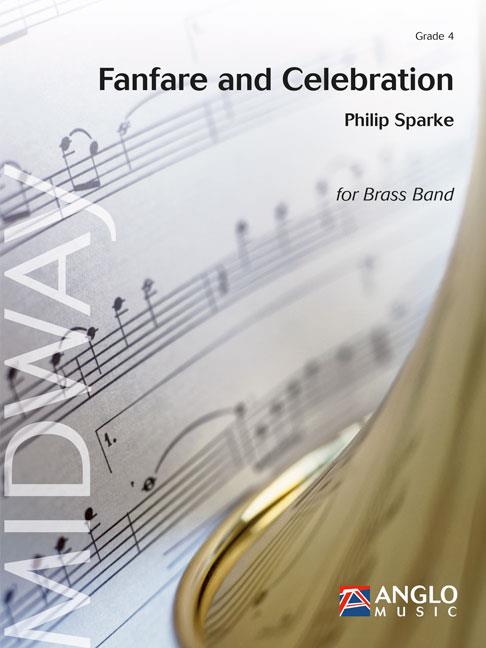
Fanfare and Celebration (Brass Band - Score and Parts) - Sparke, Philip
Fanfare and Celebration was commissioned by the Brass Band of the Western Reserve (Dr Keith M. Wilkinson, director) to celebrate their 15th anniversary. Based in north-west Ohio, the band was formed in 1997 and was competing in the Championship Section of the North American Brass Band Championships in less than three years. The first performance of Fanfare and Celebration took place in Akron, Ohio, on November 10th 2012.The opening Fanfare features the cornet section, in two groups standing either side of the band. A central horn theme brings a change of mood before the cornets take the lead once more. Celebration follows seamlessly and continues the declamatory style until a cantando theme in uneven meter is introduced. A transformed recapitulation ushers in a return of the Fanfare to close the work.Duration: 6:15
Estimated dispatch 7-14 working days
-
 £164.99
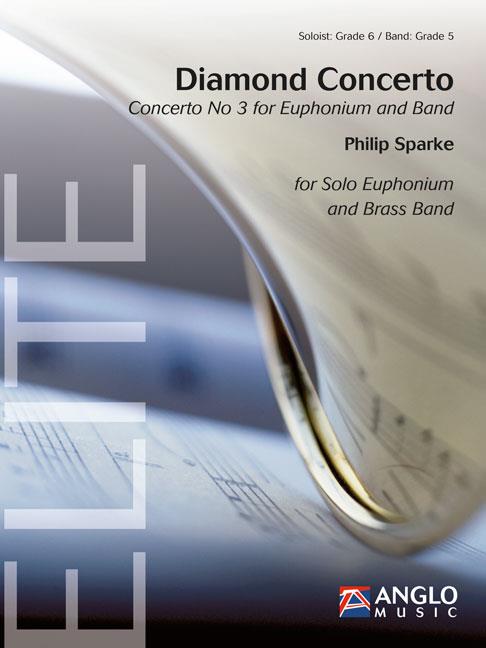
Diamond Concerto (Euphonium Concerto No.3) (Euphonium Solo with Brass Band - Score and Parts) - Sparke, Philip
Diamond Concerto was commissioned by Musikverein Morschied from Germany - Dr. Eric Grandjean, conductor - for a special concert featuring Steven Mead as guest soloist. Together they gave the world premiere on 28th April 2012 in the town theatre of Idar-Oberstein. The commission is a highlight in the 30-year friendship between composer and soloist, which has included many mutual CD projects and concerts and, now, a concerto. Sparke had Steven Mead's special euphonium sound in his head throughout the composition process and made free use of the variety of styles which the world-renowned virtuoso has made his own during his highly successful solo career.The village of Morschied lies to the west of Frankfurt am Main in the area known as the German Road of Precious Stones, which is famous for its thriving gem industry. Because of this it was decided to give the commission a local connection by choosing the title, Diamond Concerto. Each of the three movements is named after a famous diamond:Earth Star is rather stern in mood, opening with a free fantasy for the soloist over a static chord from the band. This leads to an Allegro Moderato in minor mode where small motives are gradually repeated and developed by both band and soloist.Ocean Dream uses a varied quote from the composer's Music for Battle Creek, including a melting slow melody that was originally written with Steven Mead in mind.Blue Heart was written, at Steven Mead's suggestion, in bebop style and takes the form of a jazz waltz. The quasi-improvisatory central section features a call-and-response passage for the soloist and upper woodwinds.Duration: 16:45
Estimated dispatch 7-14 working days
-
 £75.00
Iceni Autumn (Brass Band - Score and Parts) - Barry, Darrol
The piece is in four movements; SPQR, Cockley Cley, Boudicca - Battles and Requiem and Venta Icenorum.S.P.Q.R. is an initialism of a Latin noun phrase, Senatus Populusque Romanus ("The Senate and the Roman People"). This movement attempts to portray the mood in England under Roman occupation and contains important themes developed throughout the suite.Cockley Cley is a reconstruction of the type of village occupied by the Iceni. For many years it was a popular tourist attraction in Norfolk.Boudicca (also known as Boadicea) was the wife of King Prasutagus of the Iceni, a British tribe that lived in East Anglia during the time of the Roman Emperor Nero. When Prasutagus, an ally of the Romans died, the local Roman government officials decided that they would seize her wealth and lands for themselves. When Boudicca protested, saying she was a Roman ally who was being treated no better than a slave, the Roman soldiers fogged her and raped her daughters. Boudicca called her tribe to arms and revolted against their Roman oppressors; this saw the complete devastation of Colchester, St Albans and London. In the final battle the Romans slaughtered about 80,000 Britons including women, children and old men, repaying atrocities in kind. Boudicca and her two daughters poisoned themselves rather than be captured and taken to Rome as prisoners of war.Venta Icenorum was the capital of the Iceni Tribe, who inhabited the flatlands and marshes of Norfolk and earned immortality for their revolt against Roman rule under their queen Boudicca in the winter of 61 AD. This triumphant march brings various themes together and ends with a final reference.
Estimated dispatch 7-14 working days
-
 £30.00
Iceni Autumn (Brass Band - Score only) - Barry, Darrol
The piece is in four movements; SPQR, Cockley Cley, Boudicca - Battles and Requiem and Venta Icenorum.S.P.Q.R. is an initialism of a Latin noun phrase, Senatus Populusque Romanus ("The Senate and the Roman People"). This movement attempts to portray the mood in England under Roman occupation and contains important themes developed throughout the suite.Cockley Cley is a reconstruction of the type of village occupied by the Iceni. For many years it was a popular tourist attraction in Norfolk.Boudicca (also known as Boadicea) was the wife of King Prasutagus of the Iceni, a British tribe that lived in East Anglia during the time of the Roman Emperor Nero. When Prasutagus, an ally of the Romans died, the local Roman government officials decided that they would seize her wealth and lands for themselves. When Boudicca protested, saying she was a Roman ally who was being treated no better than a slave, the Roman soldiers fogged her and raped her daughters. Boudicca called her tribe to arms and revolted against their Roman oppressors; this saw the complete devastation of Colchester, St Albans and London. In the final battle the Romans slaughtered about 80,000 Britons including women, children and old men, repaying atrocities in kind. Boudicca and her two daughters poisoned themselves rather than be captured and taken to Rome as prisoners of war.Venta Icenorum was the capital of the Iceni Tribe, who inhabited the flatlands and marshes of Norfolk and earned immortality for their revolt against Roman rule under their queen Boudicca in the winter of 61 AD. This triumphant march brings various themes together and ends with a final reference.
Estimated dispatch 7-14 working days
-
 £159.99
RUSH HOUR (Brass Band) - Crausaz, Etienne
Rush Hour was commissioned by the Swiss Brass Band Association (SBBV) on the occasion of the 38th Swiss National Brass Band Championships 2012 (Montreux SBBW) as the test piece in the Championship division. Structured in three parts without breaks, the work opens in a heavy, oppressive atmosphere, sometimes even noisy. After a short passage in a lighter mood a quick tempo takes over, the music becomes nervous and unrelenting, with constant twists and turns. The tension builds, leading to a slower movement in which various soloists are highlighted. A few humorous touches are heard in contrast to a majestic, powerful and dramatic chorale. The end of this part is brighter and more peaceful. This atmosphere is soon replaced by a return of the thematic material heard in the first movement, developing into an oppressive moos. The piece concludes with a last ecstatic tutti, reusing the harmonies of the introduction in a kind of final flurry. Rush Hour attempts to express the range of feelings we may experience when caught in various stressful situations in the middle of the rush hour. Duration: 13:45
Estimated dispatch 7-14 working days
-
 £43.00
La Perla Negra (Brass Band - Score and Parts) - Skinner, Colin
For this brooding piece the composer has used the following storyline. "A sad elderly man sits alone in a bar whilst an accordionist plays a slow tango. A beautiful woman walks in wearing a single black pearl necklace and proceeds to dance with the old man. Gradually the music becomes more and more spirited and the dance faster as the old man becomes youthful again. With a passionate kiss he passes out in the girls arms and when he awakens he is back in the bar alone save for the accordionist. As he contemplates his dream he notices a single black pearl left behind on the bar. The sombre mood is lightened in the middle section by a deliberately trite and vibrato fuelled section, but we soon return to the opening material for a slow fade-out" Composer Colin Skinner wrote this piece especially for Superbrass' debut CD, Under the Spell of Spain. Duration: 6.30. Suitable for 2nd Section Bands and above.
Estimated dispatch 7-14 working days
-
 £59.95
Essay (Brass Band - Score and Parts) - Gregson, Edward
This work was specially commissioned as the test piece for a new brass band competition in 1971, held at the Royal Albert Hall, London. It is in three movements, the titles of which all have literary connotations. The first movement, Dialogue takes the form of 'conversations' between the instruments, based on the opening melody announced in unison on cornets and euphoniums. A second theme is introduced on the flugel horn and developed alongside this, creating a sonata form shell.The second movement, Soliloquy is dedicated to the memory of Gilbert Vinter - a composer who did so much in the 1960s to bring the brass band into the modern world. The movement is poignant in mood, which is depicted by a cornet solo announced after a brief introduction. The middle section builds to a powerful climax, at which point the opening theme of the first movement is heard again. Tranquillity returns however, with a solo trombone now playing the original theme with other instruments adding decorative accompanying patterns.The final movement, Epigram, creates strong rhythmic contrasts and exploits the more virtuoso character of the brass band. The middle section, with its changing time patterns and open expansive melody, suggests a 'big-country' style. A rhythmically charged coda concludes the work in exciting fashion.Duration: 12.00
Estimated dispatch 7-14 working days
-
£29.95
Essay (Brass Band - Score only) - Gregson, Edward
This work was specially commissioned as the test piece for a new brass band competition in 1971, held at the Royal Albert Hall, London. It is in three movements, the titles of which all have literary connotations. The first movement, Dialogue takes the form of 'conversations' between the instruments, based on the opening melody announced in unison on cornets and euphoniums. A second theme is introduced on the flugel horn and developed alongside this, creating a sonata form shell.The second movement, Soliloquy is dedicated to the memory of Gilbert Vinter - a composer who did so much in the 1960s to bring the brass band into the modern world. The movement is poignant in mood, which is depicted by a cornet solo announced after a brief introduction. The middle section builds to a powerful climax, at which point the opening theme of the first movement is heard again. Tranquillity returns however, with a solo trombone now playing the original theme with other instruments adding decorative accompanying patterns.The final movement, Epigram, creates strong rhythmic contrasts and exploits the more virtuoso character of the brass band. The middle section, with its changing time patterns and open expansive melody, suggests a 'big-country' style. A rhythmically charged coda concludes the work in exciting fashion.Duration: 12.00
Estimated dispatch 7-14 working days
 View Music