
Results
-
 £45.00
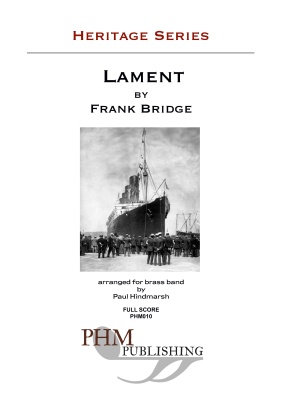
Lament (Brass Band - Score and Parts)
The English composer Frank Bridge (1879 - 1941) did not take an active part in the First World War. However, he was devastated by the slaughter on the western and the eastern fronts, especially the loss of so many of his musicians friends and colleagues. Writing in 1963, his former pupil Benjamin Britten confessed that 'a lot of my feelings about the First World War which people seemed to see in the War Requiem came from Bridge. He had written a piano sonata in memory of a friend killed in France and though he didn't encourage me to take a stand for the sake of a stand, he did make me argue and argue and argue. His own pacifism was not aggressive, but typically gentle'.Bridge composed this Lament for string orchestra on 14 June 1915, in memory of Catherine Crompton, who drowned when the Cunard liner Lusitania was torpedoed by a German submarine on 7 May, 1915. According to figures researched by Liverpool historian Kevin Roach (www.lusitania.net), 1201 men, women and children lost their lives out of the 1962 people aboard. Ninety-four children died, including Catherine, her twin brother Paul and four other siblings. Paul Crompton, Snr. (44), a British businessman working in Philadelphia, his wife Gladys (40) and the family nanny were also drowned. How Bridge's dedication came about is uncertain. The music critic Edwin Evans, who knew Bridge well, has written that the Catherine was a young friend. It is also possible that he came across the family photograph which was published in many newspapers in the wake of the tragedy. By that time, Bridge was greatly distressed by the war as a whole. It seems perfectly in keeping with his pacifist leanings and the strength of his reaction, that this poignant and deeply touching 'war memorial' should mourn a child who he did not know, rather than one of the thousands of young men who fell in battle.Through the musical tears of this melancholy lullaby, Bridge may have regarded the death of young Catherine Crompton as symbolic of the loss of so many innocent lives in wartime. His response to this personal tragedy was characteristically spontaneous and utterly sincere. It is one of his most effective miniatures, poignant yet restrained in its lyrical beauty, with a compelling directness and simplicity of construction.This brass band transcription is pitched one tone lower than the original for string orchestra.- Paul HindmarshDuration: 5.00
Estimated dispatch 7-14 working days
-
 £79.95
Amundsen - Jonathan Bates
DURATION: 14'00". DIFFICULTY: 1st+. 'Amundsen' was commissioned by rskog Brass, Norway for their winning performance at the 2020 Norwegian National Championships held at the Grieghallen in Bergen. In December 1911, Norwegian Roald Amundsen gained global fame by becoming the first explorer to lead a team to the geographic South Pole. Amundsen and 4 other members of his team arrived 5 weeks ahead of a rival team from the UK led by Robert Falcon Scott, all of which perished on their attempted return from the pole. Initially when Amundsen's team set out in 1910, they were under the impression that they would be making the far shorter journey to the arctic drift to attempt to reach the North Pole, but Amundsen had received news that American explorers Peary and Cook had beaten them to this goal, and so Amundsen's focus changed southward. 'Fram, Forward' - 'Fram' (translating to English as "forward") was the name of the ship Amundsen used for this particular polar expedition. Amundsen had only informed 2 people of his real intentions of conquering the South Pole when the ship first left port in Kristiansand before heading south to the Portuguese island of Madeira in the Atlantic Ocean. After weeks at sea - causing the uninformed members of the crew to raise a number of questions and produce a general feel of uncertainty and low spirits - it was here that Amundsen announced his true plans to the rest of his crew. They were asked whether they wished to continue with their expedition, to which all - some begrudgingly - agreed to sail on to the South Pole, through the great Ice Barrier before docking in the Bay of Whales on the Ross Ice Shelf. 'Ross Ice Shelf' - Upon Amundsen's arrival in the Bay of Whales, the team were greeted by the sight of the enormous ice plateau's and glaciers, towering into the Antarctic sky. In 1907, Ernest Shackleton had attempted - and failed - to reach the South Pole, but his route and mapping was by now well documented. Scott and the UK team were to follow this route, whereas Amundsen and his men forged their own way to the pole through unchartered territory and deadly terrain littered with deep crevasses and canyons. The music here though, is a picture of tranquility. The eerie silence of total emptiness with only the heavy snow falling around Amundsen as Fram and the Bay of Whales disappears into the distance, faced by the maginute of the expedition ahead. 'Advance to Polheim' - The first new challenge Amundsen discovered on this route was a rough, sharp and extremely steep glacier (which was later named the Axel heiberg Glacier after the Norwegian monarch who funded much of the expedition), which would take his team up from sea level to an altitude of over 9,000ft in just 20 miles, with most of this over just 7 miles. Once scaled, only the vast Antarctic Plateau stood between Amundsen and the pole. Here the race began, with only one aim - victory for himself, his team, and for the whole of Norway. .
In Stock: Estimated dispatch 1-3 working days
-
 £30.00
The Sword and the Star
DescriptionThe Sword and the Star was written in 2006 for the Middleton Band at the request of their Musical Director, Carl Whiteoak. The inspiration for the work was the band's badge, which features a medieval archer. The town of Middeton's historical link with the symbol of the Archer came from the English victory at the Battle of Flodden in September 1513, where bowmen from Middleton and Heywood under the command of Sir Richard Assheton played a vital part in crushing the invading Scottish army. Sir Richard captured one of the Scottish commanders and presented the prisoner's sword to the St Leonard's church in Middleton in recognition of the town's contribution. As long time Lords of the Manor, the Assheton family crest was for centuries featured in the coat of arms of Middleton council, and when Middleton became part of the Metropolitan Borough of Rochdale the black star from the Assheton crest was used to represent Middleton in the new borough's coat of arms. Hence the title The Sword and the Star, for a piece which attempts to give an impression of the town as it was then and as it is now.The music is in three short sections - a fanfare, a lament and a bright scherzo - and simply aims to contrast the medieval hamlet of Middleton with the bustling urban centre it has now become. The central lament features a Scottish song called "The Flowers of the Forest", written to mourn the loss of so many of Scotland's young men on the field of Flodden; the song returns in a much more positive form at the end of the piece.
Estimated dispatch 7-14 working days
-
 £15.00
Jupiter from the Planet Suite - Holst
Programme notes:The hauntingly beautiful theme from Jupiter, from The Planets Suite has a rare qualityexpressing both optimism and dignity which makes it a popular choice for many formalpublic events such as opening and award ceremonies.The tune is originally found in the Jupiter movement from the large-scale work fororchestra called 'The Planets Suite'. Written by the English composer Gustav Holt ThePlanets Suite is thought to be his finest work.The theme has a steady 3/4 rhythm which provides a contrast in terms of tempo andmeter to the rest of the movement, and has been made popular as a patriotic song called'I vow to Thee My Country'.Performance notes:This arrangement makes use of a gradual increase in dynamics, beginning p and ending ff.With this gradual increase in dynamics is a gradual increase in the scoring starting offwith only the lower instruments playing p and ending up with everyone playing ff.The percussion part is very minimal in this arrangement (only 2 notes for the suspendedcymbal) and is an optional part.Just before the final chord there is a cut off marked in the parts. This may be a newconcept for some inexperienced players so it should be fully explained by the conductor.The Flexi-Collection ApproachFlexible scoring tailored to your needs - A perfect solution for expanding the repertoire of training and junior brass bands. The Flexi-Collection currently offers two series - Popular Classics and World Tour. Based on four-part harmony, these collections provide groups with the advantage of complete flexibility when they may not be balanced. If players or instruments are missing, the show can still go on!The Flexi-Collection - Popular Classics Series, encapsulates all that is great about the wonderful range of musical styles produced by Holst, Elgar, Handel, Verdi, Tchaikovsky, Grieg, Bizet and Parry.The thoughtful scoring and arranging by Andrew Duncan now means that groups of all abilities have access to a truly flexible set of music for their needs. With world parts, rudimentary theory, terminology translations and large format typesetting, The Flexi-Collection ticks all the boxes when it comes to bringing interesting music to the training and junior band/brass group environment.Available individually or as part of the money-saving Flexi-Collection Popular ClassicsAlbum.Scored for Brass Band and supplied with additional Easy Bb, Easy Eb and world parts - The Flexi-Collection offers flexibility in every sense of the word.
In Stock: Estimated dispatch 3-5 working days
-
 £29.88
Ding Dong Merrily on High (Brass Band) Trad. arr. Stephen Tighe
VIEW SCORE PDF This arrangement of the popular carol Ding Dong Merrily on High is the first published work by BrookWright Music of English arranger Stephen Tighe. This accessible setting receives a fresh, rhythmic treatment, aided by the use of sleigh bells and tubular bells. The tune itself first appeared as a secular dance tune known under the title Branle de l'Official in Orchesographie, a dance book written by the French cleric, composer and writer Jehan Tabourot (1519-1593). The carol was first published in 1924 in his The Cambridge Carol-Book: Being Fifty-two Songs for Christmas, Easter, and Other Seasons. Woodward took an interest in church bell ringing, which no doubt aided him in writing it. The macaronic style is characteristic of Woodward's delight in archaic poetry. Sheet music available from: UK - www.brassband.co.uk USA - www.solidbrassmusic.com Difficulty Level: 4th Section + Instrumentation: Soprano Cornet Eb Solo Cornet Bb Repiano Cornet Bb 2nd Cornet Bb 3rd Cornet Bb Flugel Horn Bb Solo Horn Eb 1st Horn Eb 2nd Horn Eb 1st Baritone Bb 2nd Baritone Bb 1st Trombone Bb 2nd Trombone Bb Bass Trombone Euphonium Bb Bass Eb Bass Bb Timpani Sleigh Bells Drum Kit Tubular Bells (or Glockenspiel)
In Stock: Estimated dispatch 1-3 working days
-
 £40.00
Losgaintir. For solo Baritone/Euphonium and brass band
Recommended - Championship to 2nd Section Written for Katrina Marzella and the Black Dyke band, Losgaintir (or Luskentyre in English) is one of my favourite places in Scotland. Losgaintir is on the west coast of the isle of Harris in the Outer Hebrides and has an outstanding beach widely regarded as one of the most beautiful in the world. Losgaintir is a wonderful place to be on warm sunny days with its long stretch of white sands, aqua marine seas, the incredible mountain backdrop of south Lewis and the uninhabited island of Taransaigh in view. The weather in Harris is notorious for changing very quickly and this piece tries to reflect this. Although idyllic on a calm, sunny days, on stormy days Losgaintir's character becomes dark and foreboding, with low dark clouds and sweeping winds from the Atlantic creating a dark, brooding atmosphere. The opening melody (written modally like a traditional Scottish Gaelic air) depicts the calm serenity of Losgaintir on a beautiful summer's day. The character of the fast section that follows portrays winter in Losgaintir during a tempestuous storm with bracing winds. Includes score & parts Also see: Losgaintir for Solo Baritone/Euphonium & Piano
-
 £38.95
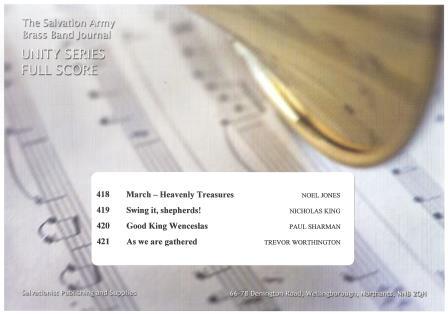
Unity Series Band Journal June 2014 Numbers 418-421
No.418 March - Heavenly Treasures (Noel Jones)Rich people cannot take money with them when they die but Christians have the joy of laying up treasure in Heaven. This march by Noel Jones incorporates two choruses 'Lay up treasure in Heaven' (TBCS 249)and 'Bright Crowns' (TB 78).No.419 Swing it, Shepherds! (Nicholas King)The traditional English Carol, 'While shepherds watched' and the spiritual carol 'Rise up, shepherd!' are combined in a bright swing arrangement by Deputy Songsters Leader Nicholas King, who is also a member of the Music Ministries Unit.No.420 Good King Wenceslas (Paul Sharman)The lyrics of the well-known carol 'Good King Wenceslas' were written by John Mason Neale in the 1850s and the tune used comes from a collection of medieval Latin songs, Piae Cantiones, published in 1582. It has been given a light-hearted treatment, which also features brief references to other carols.No.421 As we are gathered (Trevor Worthington)An arrangement of John Daniels' lovely song, the words of which say:As we are gathered, Jesus is here;One with each other, Jesus is here;Joined by the Spirit, washed in the blood,Part of the Body, the Church of God.As we are gathered, Jesus is here;One with each other, Jesus is here.
Estimated dispatch 7-14 working days
-
 £41.09
Christmas Day (Brass Band) Gustav Holst arr. Philip Rayment
VIEW SCORE PDF Well-known English composer, Gustav Holst (1874-1934) wrote this choral fantasy in 1910, about five years before his renowned orchestral suite, The Planets. The piece was originally composed for SATB choir and orchestra and dedicated to the students of Morley College, where Holst taught music. In the years since, it has been arranged for various combinations of voice and/or instruments. This arrangement is in the original key and could be adapted for use with choir and/or organ. Christmas Day features three carols in their entirety: Good Christian Men, Rejoice; God Rest Ye Merry, Gentlemen and Come, Ye Lofty, Come, Ye Lowly (an old Breton melody). There are also references to The First Nowell. Although well-received initially, this work (like many of Holst's) was neglected for many years and has not been widely recorded. It is hoped that it will be useful for brass bands during the festive season, particularly in a large acoustic. To listen to the Canadian Staff Band performing the work please visit www.youtube.com/watch?v=ccXkbWi_iWE Sheet music available from: UK - www.brassband.co.uk USA - www.solidbrassmusic.com Difficulty Level: 3rd Section + Instrumentation: Soprano Cornet Eb Solo Cornet Bb Repiano Cornet Bb 2nd Cornet Bb 3rd Cornet Bb Flugel Horn Bb Solo Horn Eb 1st Horn Eb 2nd Horn Eb 1st Baritone Bb 2nd Baritone Bb 1st Trombone Bb 2nd Trombone Bb Bass Trombone Euphonium Bb Bass Eb Bass Bb Percussion 1-3
In Stock: Estimated dispatch 1-3 working days
-
 £30.00
Be Thou My Vision (Traditional arr. by David Grace) - Brass Band Sheet Music Full Score & Parts - LM656 - Traditional - David Grace
COMPOSER: TraditionalARRANGER: David Grace"Be Thou My Vision" (Old Irish: Rop tu mo baile or Rob tu mo bhoile) is a traditional Christian hymn of Irish origin.The words are based on a Middle Irish poem that has traditionally been attributed to Dallan Forgaill in the 6th century.However, scholars believe it was written later than that.Some date it to the 8th century; others put it as late as the 10th or 11th century.That it sat untranslated for perhaps 14 centuries is astounding.The best-known English version, with some minor variations, was translated in 1905 by Mary Elizabeth Byrne, then made into verse by Eleanor Hull and published in 1912.Since 1919 it has been commonly sung to an Irish folk tune, noted as "Slane" in church hymnals, and is one of the most popular hymns in the United Kingdom.LM656 - ISMN : 9790570006564
In Stock: Estimated dispatch 3-5 working days
-
 £77.00
General Series Brass Band Journal, Numbers 2250 - 2253, December 2024
2250: Prelude on 'Rhosymedre' (Ralph Vaughan Williams trs. Douglas Engle)The English composer Ralph Vaughan Williams' work Three Preludes (founded on Welsh Hymn Tunes) was published for the organ in 1920. This is a transcription of the second movement of that work. The words associated with the hymn tune are by Samuel Crossman, My song is love unknown (S.A.S.B. 149), and vividly depict the events of Holy Week. The music is gentle and solemn and would be appropriate for a Good Friday service or as a moment of repose in a concert. 2251: Hosanna Shuffle (Sam Creamer)The half-time shuffle groove is a popular feel developed by alternative rock/pop bands of the 1980s. It marries elements of rock and swing styles together to form a new and infectious feel - Hosannah Shuffle being written as a tribute to this fusion of musical styles. Contrary to a swing style, shuffle brings the pulse back onto the beat while maintaining the swung quaver rhythms to create a rock-type rhythmic drive. 2252: Everlasting Love (Keith Manners)This piece was written for the London North East Music School in 2004. The theme of the week was 'Making a stand for Christ', reminding the school that it only takes one person to make such a stand before others follow. The music starts with a lone Solo Cornet playing the melody of Graham Kendrick's song Such Love (S.A.S.B. 199). One by one, other parts join in with the theme.2253: Festival March (Michael Cooper)This piece represents the first published brass composition of Bandmaster Michael Cooper, who is the Bandmaster at Brisbane City Temple Corps. This imposing festival march features the tunes I want to be a soldier (T.B. 683), Lift up the banner (T.B. 90) and My Jesus, I love thee (T.B. 506). These tunes depict the idea that spiritual warfare is an essential component of one's faith, success of which is articulated in the final verse of My Jesus, I love thee (S.A.S.B. 878).
Estimated dispatch 7-14 working days
 Watch video