
Results
-
 £105.20
Home for Christmas - Maria Mena - Reid Gilje
Here's an easy arrangement of this popular Christmas song composed by Maria Mena and Martin Sjolie.I have tried to spread the melody to several groups throughout the arrangement. The melody has to be played rhythmically, but also with flow and legato style.Please strive for best possible intonation and balance where the melody is played by several players.At bar 13, flugelhorn and 2/3 cornet plays a little counter theme. Please strive for best possible intonation and balance also on this. Be aware so that the cup mute sound fits the flugelhorn as good as possible.The quarter notes played by horns and trombones at bar 18 have both a harmonic and rhythmic function.This arrangement is made with several cue notes for some instruments.In the score, there are some parts marked with optional. It's possible to play the arrangement without these parts.The arrangement ends quite and calm, like a peaceful Christmas day.- Reid Gilje -
Estimated dispatch 5-14 working days
-
 £57.50
Barbie's World - Michael Brown
From the blockbuster movie Barbie comes the equally sensational soundtrack album featuring an all-star lineup of performers and songwriters. This upbeat and entertaining medley for brass band includes: Barbie Dreams Barbie Girl What Was I Made For? Dance the Night.
Estimated dispatch 5-14 working days
-
 £105.20
Ei hand a holde i - Trygve Hoff - Haakon Esplo
Norwegian artist Jorn Hoel made his breakthrough with his album Varme ut av is released in 1987. The songs "Have a Dream" and "Hold My Hand" became big hits and still stand out as some of the most played songs even today. The music was written by Svein Gundersen and lyrics by Trygve Hoff on both of them. Jorn Hoel was awarded "Singer/songwriter of the year" for this release.
Estimated dispatch 5-14 working days
-
 £57.50
Barbie's World - Christopher Bond
From the blockbuster movie Barbie comes the equally sensational soundtrack album featuring an all-star lineup of performers and songwriters. This upbeat and entertaining medley for brass band includes: Barbie Dreams Barbie Girl What Was I Made For? Dance the Night.
Estimated dispatch 10-14 working days
-
 £39.95
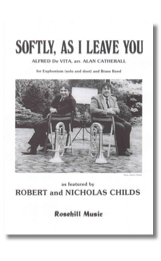
Softly, As I Leave You - Alfred de Vita arr. Alan Catherall
Made popular by many singers over the years, this lovely song was first arranged for the Childs brothers as a solo, and later a duet, by Alan Catherall. It was first performed in the duet version at the Royal Albert Hall, London, in October 1985, conducted by their late father, John Childs. Also available with piano Brass Band Set comprises: Detailed condensed conductor score Solo B-flat Euphonium B-flat Euphonium Duet (2) E-flat Soprano Cornet Solo B-flat Cornet (4) 2nd B-flat Cornet (2) 3rd B-flat Cornet (2) B-flat Flugelhorn* Solo E-flat Horn* 1st E-flat Horn* 2nd E-flat Horn 1st B-flat Baritone 2nd B-flat Baritone 1st B-flat Trombone 2nd B-flat Trombone Bass Trombone B-flat Euphonium (2) E-flat Bass (2) B-flat Bass (2) 1st Percussion 2nd Percussion 3rd Percussion (Drum Kit) * Alternative parts for use as solo or duet provided. There is no Repiano Cornet part.
Estimated dispatch 7-9 working days
-
Muss i' Denn - Schilter - Len Jenkins
Made famous as 'Wooden Heart', this piece is based on a folk song, originating from Southwest Germany. Very straightforward and jolly in this arrangement, with a middle section featuring light-hearted interjections from various members of the percussion section. Perfect for informal concerts, or garden fetes.
-
£40.00
I Will Always Love You - Parton, D - Barry, D
Written by Dolly Parton this song was made famous by Whitney Houston when used in the film The Bodyguard. A popular hit for any band.
In Stock: Estimated dispatch 1-3 working days
-
 £35.00
I Vow to Thee, My Country (Brass Band - Score and Parts) - Holst, Gustav - Littlemore, Phillip
!!I Vow to Thee My Country. Originally for unison voices with orchestra, Holst adapted it as a hymn tune and called it Thaxted , named after the village where he lived for many years. Because of the sentiment in the words it has now become a staple of Remembrance services.The American Composer, Geoff Knorr, incorporated Holst's music into his score for the strategy-based video game Civilisation, where it is used to depict the England of Elizabeth I. It is from this music that the transcription is made. Duration: 5.40
Estimated dispatch 7-14 working days
-
 £102.60
Cherubic Hymn of Ukraine - Yakiv Yatsynevych - John Philip Hannevik
Ukraine was invaded on February 24, 2022, and the world again became spectators to a conflict between unequal opponents. Once again we saw lies, injustice and brutality up close.I must admit that a feeling of powerlessness arose when experiencing this, an empty feeling of not being able to do anything useful.One early Monday morning, a few weeks into the conflict, I sat down to listen to Ukrainian music.I hardly knew any Ukrainian music, but I was familiar with the composer Mykola Leontovych, the man who composed "Carol of the Bells". He was a member of the Ukrainian liberation movement, and he was assassinated by a Soviet agent in 1921.One of his contemporary colleagues was the composer, teacher and conductor Yakiv Yatsynevych (1869-1945). He wrote church music and choral music, and I became very taken by his Hymn to the Cherubim, a part of the Orthodox Mass.I could not find any sheet music for this. But I have listened to numerous choral recordings, and I have tried to notate the music as I believe the composer himself has done originally.I chose to do the arrangement for a solo group of 4 players. These players can be placed at a distance from the ensemble, maybe on a gallery or at the back of your concert hall.The arrangement was made for Brottum Brass for their participation in the Oslo Brass Festival in April 2022.The performance in the church this particular night was met with a long-lasting silence after the last note. The warm respect, the moving response and love we felt from the audience is a memory I will carry with me for a long time.In the lyrics to this psalm, one finds the phrase:Let us now lay aside all earthly cares- John Philip Hannevik -
Estimated dispatch 5-14 working days
-
 £115.60
Funky Hedde - Torstein Aagaard-Nilsen
A good friend of mine, trombonist and professor Jesper Juul Windahl commissioned me a trombone quartet. I then wrote Four Nordic Folk Pops. The last of the four is a Norwegian tune called Havard Hedde in a funky version. Then I made a brass quintet version for Lofoten Brass Quintet for a their Australia tour. The trombonist in the quintet asked me for a brass band version to be used in an entertainment contest (SIDDIS Brass). Havard Hedde did not succeed in getting married, but I think this version wil make him dance again. Torstein Aagaard-Nilsen
Estimated dispatch 5-14 working days
 View Music