
Results
-
 £45.00
Diversions after Benjamin Britten (Brass Band - Score only)
Suite by Lucy Pankhurst, Simon Dobson, Paul McGhee and Gavin HigginsHaving devised a collective centenary tribute for Michael Tippett at the 2006 RNCM Festival of Brass (Variations on a Theme of Michael Tippett by five eminent composers of brass band music, PHM002), I commissioned this companion piece as a Benjamin Britten tribute for the 2013 festival. In the late 1970s, while researching a book about the English composer, and Britten's first teacher, Frank Bridge (1879 - 1941), I came across a copy of the printed score of Benjamin Britten's Variations on a Theme of Frank Bridge (Op.10) for string orchestra, in which Britten had written descriptive titles for each of the variations suggesting appropriate character traits of his much loved mentor and guide. The character variations are cast in march, song and dance forms.Taking inspiration from Britten's youthful tribute, I invited four award-winning composers, who have all made significant contributions to the brass band medium, to create their own personal reflections on four aspects of Britten's character and music, designed to form a suite of Diversions after Benjamin Britten, but which can also be played separately.Lucy Pankhurst's hauntingly lyrical Prelude: His Depth refers to the emotional and symbolic subtexts that underpin Britten's operas, taking its musical cue from Britten's many arrangements of folk songs. The flugel horn takes a prominent role throughout.Simon Dobson's breathless Scherzo: His Vitality reminds us with its rapid passage work and leaping bass 'groove' that Britten loved tennis and fast cars in his younger days.Paul McGhee's evocative interpretation of the March: His Sympathy represents Benjamin Britten's pacifism, as the composer writes: 'We view the music through the eyes of a pacifist. Whilst war and violence surround us, we do not engage in it and though it continues to happen around us. With the use of muted effects in most of the band throughout the piece, the flugel horn is the lone voice of reason, standing firm against the mechanical and destructive society in which it is forced to live. As the machine of war continues around the lone voice, the voice is gradually dismissed and mocked as the war machine rumbles on into the distance.'In an extended finale, entitled Toccata: His Skill, Gavin Higgins celebrates Benjamin Britten's consummate creativity. For the RNCM Festival of Brass premiere, the four contrasting movements were framed and connected by Britten's Fanfare for St. Edmundsbury for three trumpets, with the trumpet soloists spaced round the hall. I am grateful to the Britten Estate and publishers Boosey & Hawkes for giving permission for the elements of Britten's fanfare to be incorporated in the collective work.- Paul HindmarshDuration: 19.30
Estimated dispatch 7-14 working days
-
 £35.00
Postcard to Grimethorpe (Brass Band - Score and Parts) - Gregson, Edward
I composed the original version of Postcard to Grimethorpe in 1993 at the request of Elgar Howarth, for a concert at the Queen Elizabeth Hall, London, given by the Grimethorpe Colliery Band. This was at a time when after the Grimethorpe Colliery pit closed the future of the band was in severe jeopardy. The concert was given in aid of the band, both through publicity and funding.Then in late 2022 Jack Stamp, the American composer, conductor and educator, and at that time international composer-in-association with Grimethorpe, contacted me to say that he had discovered my short piece in the band library, and asked if I might extend it for a recording he was sponsoring for the band - the repertoire to consist entirely of music specially composed for Grimethorpe.I agreed and decided to extend the piece by using the miner's hymn Gresford, as a symbolic gesture of protest at the many thousands of miners in the UK who were made redundant from their jobs. After an angular (quasi-atonal) first section, the hymn enters, softly at first, but with each phrase it becomes more powerful and insistent, ending with the final phrase triumphantly accompanied by melodic percussion (replacing the drums and cymbals of the earlier phrases, as if the band were then on the march). However, this short work ends softly and gently, as if anger has been replaced by quiet resolution and determination, looking to the future with confidence.- Edward GregsonDuration: 3.00
Estimated dispatch 7-14 working days
-
£12.00
Postcard to Grimethorpe (Brass Band - Score only) - Gregson, Edward
I composed the original version of Postcard to Grimethorpe in 1993 at the request of Elgar Howarth, for a concert at the Queen Elizabeth Hall, London, given by the Grimethorpe Colliery Band. This was at a time when after the Grimethorpe Colliery pit closed the future of the band was in severe jeopardy. The concert was given in aid of the band, both through publicity and funding.Then in late 2022 Jack Stamp, the American composer, conductor and educator, and at that time international composer-in-association with Grimethorpe, contacted me to say that he had discovered my short piece in the band library, and asked if I might extend it for a recording he was sponsoring for the band - the repertoire to consist entirely of music specially composed for Grimethorpe.I agreed and decided to extend the piece by using the miner's hymn Gresford, as a symbolic gesture of protest at the many thousands of miners in the UK who were made redundant from their jobs. After an angular (quasi-atonal) first section, the hymn enters, softly at first, but with each phrase it becomes more powerful and insistent, ending with the final phrase triumphantly accompanied by melodic percussion (replacing the drums and cymbals of the earlier phrases, as if the band were then on the march). However, this short work ends softly and gently, as if anger has been replaced by quiet resolution and determination, looking to the future with confidence.- Edward GregsonDuration: 3.00
Estimated dispatch 7-14 working days
-
 £43.00
Blue Bombazine (Eb Bass Solo with Brass Band - Score and Parts) - Johns, Terry
The word Bombazine is derived from the obsolete French word Bombasin. Largely made in the Norwich area, Bombazine is a twilled fabric made of silk used mainly in dress making and popular in England in the reign of Elizabeth I. The image and feel of warm, smooth, opulent silk is aptly suited to a solo feature for tuba. Wing Commander Duncan Stubbs and the RAF Music Service commissioned Blue Bombazine for solo tuba and brass in 2014, for Senior Aircraftman Jonathan Gawn and the RAF Central Band. It was first performed at The Royal Northern College of Music in Manchester, on the 11th April 2015 at the British Festival of Wind Bands. The music is written in the jazz idiom with a testing solo part. It is available with brass band accompaniment or for ten brass with tuba solo. Duration: 5.00. Suitable for 1st Section Bands and above
Estimated dispatch 7-14 working days
-
 £94.95
An Age of Kings (Mezzo-Soprano Solo with Brass Band and optional choir - Score and Parts) - Gregson, Edward
The origins of this work date back to 1988, when I was commissioned by the Royal Shakespeare Company to write the music for The Plantagenets trilogy, directed by Adrian Noble in Stratford-upon-Avon. These plays take us from the death of Henry V to the death of Richard III. Later, in 1991, I wrote the music for Henry IV parts 1 and 2, again in Stratford. All of these plays are concerned with the struggle for the throne, and they portray one of the most turbulent periods in the history of the British monarchy.Much of the music used in these productions was adapted into two large symphonic suites for wind band - The Sword and the Crown (1991) and The Kings Go Forth (1996). An Age of Kings is a new version for brass band incorporating music from both the symphonic suites for wind band. It was specially composed for a recording made by the Black Dyke Band, conducted by Nicholas Childs, in 2004.An Age of Kings is music on a large-scale canvas, scored for augmented brass band, with the addition of harp, piano, mezzo-soprano solo, male chorus, as well as two off-stage trumpets. The music is also organized on a large-scale structure, in three movements, which play without a break - "Church and State", "At the Welsh Court", and "Battle Music and Hymn of Thanksgiving".The first movement, "Church and State", opens with a brief fanfare for two antiphonal trumpets (off-stage), but this only acts as a preface to a Requiem aeternam (the death of Henry V) before changing mood to the English army on the march to France; this subsides into a French victory march, but with the English army music returning in counterpoint. A brief reminder of the Requiem music leads to the triumphal music for Richard Plantagenet, Duke of York, father of Edward IV and Richard III (the opening fanfare transformed). However, the mood changes dramatically once again, with the horrors of war being portrayed in the darkly-drawn Dies Irae and Dance of Death, leading to the final section of the first movement, a funeral march for Henry VI.The second movement, "At the Welsh Court", takes music from the Welsh Court in Henry IV part 1 with a simple Welsh folk tune sung by mezzo-soprano to the inevitable accompaniment of a harp. This love song is interrupted by distant fanfares, forewarning of battles to come. However, the folk song returns with variation in the musical fabric. The movement ends as it began with off-stage horn and gentle percussion.The final movement, "Battle Music and Hymn of Thanksgiving", starts with two sets of antiphonally placed timpani, drums and tam-tam, portraying the 'war machine' and savagery of battle. Trumpet fanfares and horn calls herald an heroic battle theme which, by the end of the movement, transforms itself into a triumphant hymn for Henry IV's defeat of the rebellious forces.- Edward GregsonDuration - 22'00"Optional TTBB available separately.
Estimated dispatch 7-14 working days
-
 £95.00
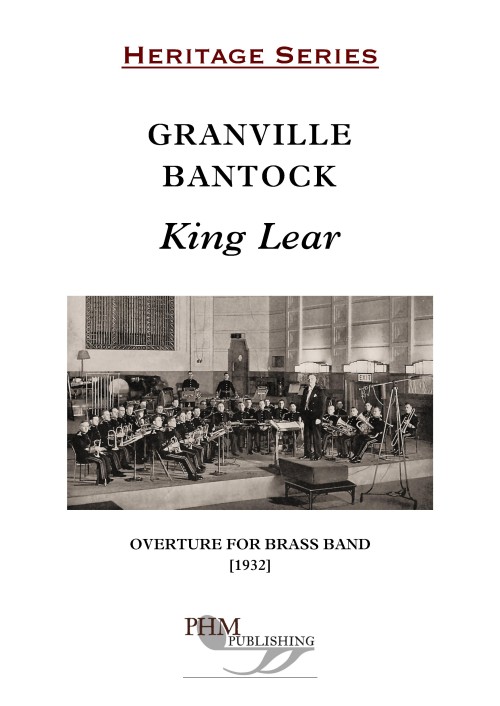
King Lear (Brass Band - Score and Parts) - Bantock, Granville - Hindmarsh, Paul
Sir Granville Bantock (1868 - 1946) composed the second of his five major brass band work for Callender's Cableworks Band, completing the commission on 30 November 1932. Based in the Thames-side district of Belvedere near Erith, the band was active between 1898 and 1961. The works band of the Callender Cable & Construction Co. Ltd, it was at the peak of its popularity during the 1930s and was a frequent broadcaster on the radio. The band employed an in-house arranger and played saxophones in its lighter material. King Lear was one of the band's major commissions and was not published in Bantock's lifetime. The manuscript score and parts were thought to be lost for decades, but were found in the library of the Haydock Band (Lancashire), which had inherited part of Callender's library of manuscripts material and bespoke arrangements after it has been transferred to nearby Prescott Cables Band after Callender's Cable Works closed.King Lear is a substantial work, in essence a dramatic tone poem in the romantic Tchaikovskian manner, presenting a series of character portraits of the foolish old king and his three daughters, Goneril, Regan and Cordelia. The music is dramatic and lyrical by turns, with the most generous lyrical episode revealing perhaps the warm-hearted Cordelia. An expansive melody that flows from this is brought back towards the end as the main climax of the work.In 2001, Bantock's score was recorded by the University of Salford Brass Band, conducted by Dr. Roy Newsome. The original is serviceable, but in comparison with the orchestral version he made in 1936 (part of which was recorded on a Paxton 78 rpm) and later brass band scores, performing editions of which were prepared by others, it lacks colour and range typical of Bantock's orchestral work. Above all it lacks percussion, which can be heard on the recorded extract. With the kind permission of the Bantock Estate, I have prepared a performing edition for publication that incorporates percussion, derived from the orchestral recording and added editorially in similar manner elsewhere. I have revoiced some of the low- lying instrumental parts to present the material in more comfortable ranges. Editorial interventions more elaborate than revoicing the original text have been identified as cue notes.- Paul HindmarshDuration: 15.00
Estimated dispatch 7-14 working days
-
£40.00
King Lear (Brass Band - Score only) - Bantock, Granville - Hindmarsh, Paul
Sir Granville Bantock (1868 - 1946) composed the second of his five major brass band work for Callender's Cableworks Band, completing the commission on 30 November 1932. Based in the Thames-side district of Belvedere near Erith, the band was active between 1898 and 1961. The works band of the Callender Cable & Construction Co. Ltd, it was at the peak of its popularity during the 1930s and was a frequent broadcaster on the radio. The band employed an in-house arranger and played saxophones in its lighter material. King Lear was one of the band's major commissions and was not published in Bantock's lifetime. The manuscript score and parts were thought to be lost for decades, but were found in the library of the Haydock Band (Lancashire), which had inherited part of Callender's library of manuscripts material and bespoke arrangements after it has been transferred to nearby Prescott Cables Band after Callender's Cable Works closed.King Lear is a substantial work, in essence a dramatic tone poem in the romantic Tchaikovskian manner, presenting a series of character portraits of the foolish old king and his three daughters, Goneril, Regan and Cordelia. The music is dramatic and lyrical by turns, with the most generous lyrical episode revealing perhaps the warm-hearted Cordelia. An expansive melody that flows from this is brought back towards the end as the main climax of the work.In 2001, Bantock's score was recorded by the University of Salford Brass Band, conducted by Dr. Roy Newsome. The original is serviceable, but in comparison with the orchestral version he made in 1936 (part of which was recorded on a Paxton 78 rpm) and later brass band scores, performing editions of which were prepared by others, it lacks colour and range typical of Bantock's orchestral work. Above all it lacks percussion, which can be heard on the recorded extract. With the kind permission of the Bantock Estate, I have prepared a performing edition for publication that incorporates percussion, derived from the orchestral recording and added editorially in similar manner elsewhere. I have revoiced some of the low- lying instrumental parts to present the material in more comfortable ranges. Editorial interventions more elaborate than revoicing the original text have been identified as cue notes.- Paul HindmarshDuration: 15.00
Estimated dispatch 7-14 working days
-
 £59.95
The Ellacombe Chronicles (Brass Band - Score and Parts) - Curnow, James
This piece was commissioned by Brass Band of Columbus for the occasion of the band's 25th anniversary in 2009. It is dedicated to current and former members of the band and its founding Director, Dr Paul Droste. The hymns of Isaac Watts (1674 - 1748) have been a source of inspiration for musical thought and development by composers for over 200 years. His glorious hymn 'I sing the mighty power of God' has been coupled with the hymn tune 'Ellacombe' in many hymnals over these two centuries. This work was created and inspired by Isaac Watts's text and chronicles the three verses of the hymn through a set of diverse variations on the hymn tune 'Ellacombe'. The opening fanfare is intended to capture the joy and exuberance of the first phrase of the first verse, 'I sing the mighty power of God that made the mountains rise'. The developmental material following the fanfare gives a hint of the three large variations that are extracted from the tune.
Estimated dispatch 7-14 working days
-
£29.95
The Ellacombe Chronicles (Brass Band - Score only) - Curnow, James
This piece was commissioned by Brass Band of Columbus for the occasion of the band's 25th anniversary in 2009. It is dedicated to current and former members of the band and its founding Director, Dr Paul Droste. The hymns of Isaac Watts (1674 - 1748) have been a source of inspiration for musical thought and development by composers for over 200 years. His glorious hymn 'I sing the mighty power of God' has been coupled with the hymn tune 'Ellacombe' in many hymnals over these two centuries. This work was created and inspired by Isaac Watts's text and chronicles the three verses of the hymn through a set of diverse variations on the hymn tune 'Ellacombe'. The opening fanfare is intended to capture the joy and exuberance of the first phrase of the first verse, 'I sing the mighty power of God that made the mountains rise'. The developmental material following the fanfare gives a hint of the three large variations that are extracted from the tune.
Estimated dispatch 7-14 working days
-
 £66.00
S.O.S. (Brass Band - Score and Parts) - Kjaernes, Bjorn Morten
When the publisher asked me to make an arrangement of an ABBA tune, S.O.S. was the first song I thought of. Its introduction and melody are well suited to play for band. Admittedly, the key had to be shifted to make it sound good for this instrumentation. To me, this is nostalgia, while for others, the Mamma Mia movie/show will be what they associate with this wonderful song. Apart from a few medleys, few of ABBA's songs are available for band. So, it was very fun to work on this classic.The arrangement is made quite simply to fit many sizes of bands. Technically, it is also relatively simple both in range and rhythm. As you can see, there are many ways to adjust this arrangement to your own ensemble. Bring out melody lines and the bassline, and a lot is done. If needed, simplify to make it sound nice.Get creative and have fun!- Bjorn Morten KjaernesDuration: 3.30
Estimated dispatch 7-14 working days
 View Music