
Results
-
 £39.95
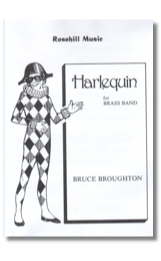
Harlequin (Score and Parts) - Bruce Broughton
Harlequin is the most popular of the comic servant characters from the Italian commedia dell'arte who, although a slow thinker, was acrobatic and nimble - he would never perform a simple action when the addition of a cartwheel or backflip would spice up the movement! These characteristics are aptly portrayed musically in Bruce Broughton's mini concert overture. Originally published for brass band in 1984, this popular work coveys all the hustle, bustle, and agility of the character in a finely crafted musical structure. Ideal as a concert opener or encore it is sure to delight audiences and provide players with an exciting new addition to their repertory. Duration: 2:30
Estimated dispatch 7-9 working days
-
 £39.95
Piece Heroique (Score and Parts) - Cesar Franck arr. Tony Rickard
Cesar Franck was appointed as organist at the newly built Paris church of Saint Clotilde in 1858, though he wrote remarkably little music for the instrument. Piece Heroique was one of the Trois Pieces pour Grand Orgue written in 1878 for the inauguration of the new Cavaille-Coll organ at the Trocadero in Paris. It's stately grandeur and stirring finale make an ideal concert item, and this skillful arrangement (which includes an optional organ part for added colour) retains the character of the original, while transferring it to the sonority of the brass band. If you're looking for the next Elsa's Procession, then here it is - an ideal concert ending when you need a grandstand finish! Duration: 9:00
Estimated dispatch 7-9 working days
-
 £51.95
Prelude and Fugue: The Spitfire (Score and Parts) - William Walton arr. Elgar Howarth
Originally part of the score Walton wrote for the film The First of the Few, this fabulous music found greater fame in the concert version he made in 1942. Now, at last, here is an authorised version for brass band by an acknowledged master of the art, in a beautiful new presentation from Winwood Music. The Prelude - essentially a march in his best Crown Imperial style leads to a dazzling Fugue which incorporates a quiet interlude before the dramatic finale. Whether used as a concert opener or roof-raising finale it is sure to delight audiences and players alike. Duration: 7:00
Estimated dispatch 7-9 working days
-
 £32.00
California Legend (Score only) - Bruce Broughton
California Legend was inspired by Las Sergas de Esplandian by Garci Ordonez de Mantalvo, published in Seville in 1510. Quoting from 'A Companion to California', the story recounts the fictional adventures of Esplandian. Among the places he visits is one "on the right hand of the indies, an island called California, very near to the Terrestial Paradise, which was peopled with black women, accustomed to live after the fashion of Amazons, there arms were full of gold. The land was ruled by a Queen named Calafia."
Estimated dispatch 7-9 working days
-
 £42.00
California Legend (Parts only) - Bruce Broughton
California Legend was inspired by Las Sergas de Esplandian by Garci Ordonez de Mantalvo, published in Seville in 1510. Quoting from 'A Companion to California', the story recounts the fictional adventures of Esplandian. Among the places he visits is one "on the right hand of the indies, an island called California, very near to the Terrestial Paradise, which was peopled with black women, accustomed to live after the fashion of Amazons, there arms were full of gold. The land was ruled by a Queen named Calafia."
Estimated dispatch 7-9 working days
-
 £42.00
The Seasons (Score only) - Philip Wilby
Composer Philip Wilby writes... "The music of this little suite of pieces traces the year's change; from a cold, late autumn to an indoor winter; though a spring waltz to a final open-air march. My aim was to provide music which is both enjoyable to rehearse and perform but not forbiddingly difficult to play". The work's popularity among brass bands the world over suggests that he hit the nail on the head - audiences love it, too!
Estimated dispatch 7-9 working days
-
 £52.00
The Seasons (Parts only) - Philip WIlby
Composer Philip Wilby writes... "The music of this little suite of pieces traces the year's change; from a cold, late autumn to an indoor winter; though a spring waltz to a final open-air march. My aim was to provide music which is both enjoyable to rehearse and perform but not forbiddingly difficult to play". The work's popularity among brass bands the world over suggests that he hit the nail on the head - audiences love it, too!
Estimated dispatch 7-9 working days
-
 £77.00
General Series Brass Band Journal, Numbers 2261 - 2264, December 2025
2261: March - Win the world (Paul Sharman)This march was written at the request of Staff Bandmaster Ken Waterworth for the Melbourne Staff Band's visit to South Africa in 2018. It features the tunes We shall win (T.B. 455) and Storm the forts of darkness (T.B. 844) - the latter chosen for its similarity to the Australian national anthem in its opening two bars.2262: Festival March - Alleluia! (Kevin Larsson)Both hymns used in this march, This is my Father's world (S.A.S.B. 66) and All creatures of our God and King (S.A.S.B. 2), bought the composer comfort as he began to grapple with the ramifications of the global pandemic in 2020. Both songs talk about God's sovereignty over nature, revealing himself to us through the beauty and majesty of our world.2263: Prayer gently lifts me (Ty Watson)This is a simple arrangement of the chorus Prayer gently lifts me (S.A.S.B. 783). The piece was written to precede the opening prayer in a band programme.2264: What a Saviour! (Steven Ponsford)This devotional music explores the events of Good Friday, dramatically reminding us of words associated with familiar Easter hymns tunes.
Estimated dispatch 7-14 working days
-
 £94.95
Rhapsody on a Theme by Purcell (Brass Band - Score and Parts)
Contest VersionIn his relatively short lifetime, Henry Purcell (1659 -1695) achieved stellar musical success and was known and admired internationally by his contemporaries. He is justifiably considered one of England's greatest composers.I thought long and hard before using this magnificent theme as the basis for a band piece because I think that Benjamin Britten has said just about everything possible regarding it in his The Young Person's Guide to the Orchestra. Bearing this in mind, I tentatively set about working on this composition. Once started though, the job became fun because the theme still yielded possibilities - even after Britten!The piece is basically a set of linked variations, much like Rachmaninov's great Rhapsody on theme by Paginini. The music starts slowly and makes much use of crisply dotted rhythms - a Purcellian characteristic. The theme is heard twice before the music changes into a jaunty duple time variation based on the opening motif of Purcell's theme. After this, the mood changes to a waltz-like variation in which clear references to the original theme can be heard. The slow movement follows, and is based on rising and descending scalic figures. This variation is an 'A-B-A' movement with two similar passages framing a more vigorous middle section which features antiphonal fanfare-like figures. Without any preamble, the last variation launches itself - a rumbustious dance which has a distinctive feel to it.The theme eventually reappears as a counter-melody to this dance music before a final triumphant treatment of the melody featuring a somewhat athletic bass line. The music accelerates at the Coda and disappears in a 'puff of smoke'.- Kevin Norbury
Estimated dispatch 7-14 working days
-
£39.95
Rhapsody on a Theme by Purcell (Brass Band - Score only)
Contest VersionIn his relatively short lifetime, Henry Purcell (1659 -1695) achieved stellar musical success and was known and admired internationally by his contemporaries. He is justifiably considered one of England's greatest composers.I thought long and hard before using this magnificent theme as the basis for a band piece because I think that Benjamin Britten has said just about everything possible regarding it in his The Young Person's Guide to the Orchestra. Bearing this in mind, I tentatively set about working on this composition. Once started though, the job became fun because the theme still yielded possibilities - even after Britten!The piece is basically a set of linked variations, much like Rachmaninov's great Rhapsody on theme by Paginini. The music starts slowly and makes much use of crisply dotted rhythms - a Purcellian characteristic. The theme is heard twice before the music changes into a jaunty duple time variation based on the opening motif of Purcell's theme. After this, the mood changes to a waltz-like variation in which clear references to the original theme can be heard. The slow movement follows, and is based on rising and descending scalic figures. This variation is an 'A-B-A' movement with two similar passages framing a more vigorous middle section which features antiphonal fanfare-like figures. Without any preamble, the last variation launches itself - a rumbustious dance which has a distinctive feel to it.The theme eventually reappears as a counter-melody to this dance music before a final triumphant treatment of the melody featuring a somewhat athletic bass line. The music accelerates at the Coda and disappears in a 'puff of smoke'.- Kevin Norbury
Estimated dispatch 7-14 working days