
Results
-
 £106.99
Evolution - Philip Sparke
Evolution was commissioned by Kunstfactor for the 4th section of the Dutch National Brass Band Championships (NBK) 2011. It is dedicated to Jappie Dijkstra and the Music Information Centre (MUI), Arnhem, Holland, in acknowledgement of their outstanding work in developing brass band repertoire. The composer writes:-The idea for the piece came when I was reading an article about a branch of Chinese philosophy which is abbreviated as Wu Xing, which has no exact translation but can mean, for example, five elements, five phases or five states of change. It is central to all elements of Chinese thought, including science, philosophy, medicine and astrology, and in simpleterms tries to create various cyclic relationships between five elements in all walks of life. An example is: Earth - Metal - Water - Wood - Fire - (Earth) etc. where (in one cycle) earth bears metal, metal changes to liquid (water) when heated, water helps trees grow, wood burns to create fire, fire produces ash (earth) and the cycle continues.I was particularly interested in the cycle of emotions: Meditation - Sorrow - Fear - Anger - Joy - (Meditation) etc. and thought this cyclic principle would provide an effective emotional journey for a piece of music. So Evolution has five equal sections which loosely characterise this emotional cycle. I have tried to make the music grow organically, with minimal repetition, and each movement evolves from the musical elements at the end of the previous one, with the opening material appearing, transformed, at the end of the piece to complete the cycle.
Estimated dispatch 5-14 working days
-
 £164.99
Diamond Concerto - Philip Sparke
Diamond Concerto was commissioned by Musikverein Morschied from Germany - Dr. Eric Grandjean, conductor - for a special concert featuring Steven Mead as guest soloist. Together they gave the world premiere on 28th April 2012 in the town theatre of Idar-Oberstein.The commission is a highlight in the 30-year friendship between composer and soloist, which has included many mutual CD projects and concerts and, now, a concerto. Sparke had Steven Mead's special euphonium sound in his head throughout the composition process and made free use of the variety of styles which the world-renowned virtuoso has made his own during his highly successful solo career.The village ofMorschied lies to the west of Frankfurt am Main in the area known as the German Road of Precious Stones, which is famous for its thriving gem industry. Because of this it was decided to give the commission a local connection by choosing the title, Diamond Concerto. Each of the three movements is named after a famous diamond:1 EARTH STARis rather stern in mood, opening with a free fantasy for the soloist over a static chord from the band. This leads to an Allegro Moderato in minor mode where small motives are gradually repeated and developed by both band and soloist.2 OCEAN DREAMuses a varied quote from the composer's Music for Battle Creek, including a melting slow melody that was originally written with Steven Mead in mind.3 BLUE HEARTwas written, at Steven Mead's suggestion, in bebop style and takes the form of a jazz waltz. The quasi-improvisatory central section features a call-and-response passage for the soloist and upper woodwinds.Soloist: Difficulty 6Diamond Concerto is available for euphonium and piano (AMP 374-401) as well as for euphonium and concert band (AMP 354-010).
Estimated dispatch 5-14 working days
-
 £169.99
The Spirit of Puccini - Hermann Pallhuber
The famous Puccini motifs in this work are taken from Tosca (E lucevan le stelle), Turandot (Nessun dorma), Gianni Schicci (O mio babbino caro) and a quite funny little persifl age of the aria Senti L'ora e vicina from Tosca. The Spirit of Puccini has testing moments for each of the principal players of the bands sections. Even although the music was inspired by this famous Italian composer, Hermann Pallhuber has succeeded in creating a piece of 'real band music' combining both the Italian influences and the modern British brass band sound.
Estimated dispatch 5-14 working days
-
 £72.99
Winter Games - David Foster - Juri Briat
Juri Briat has arranged the tunes of the winter Olympic games of the Eighties for a wind orchestra. As always, he has chosen original works and arranged them in his own typically colourful way. An ideal opening number for your concert with allure.
Estimated dispatch 5-14 working days
-
 £102.99
The Last Of The Mohicans - T. Jones - Erik Mast
This Hollywood blockbuster from 1962, is an historic and epic drama that turned out to be a massive box-office hit, despite the unknown cast. Its success can undoubtedly be attributed in part to the excellent soundtrack. Erik Mast has made a wonderful arrangement of the soundtrack which has become a masterpiece in its own right.
Estimated dispatch 5-14 working days
-
 £76.99
Oregon - Jacob de Haan
This fantasy tells the story of Oregon, one of Americas north-western states. Traveling by train on the Northern Pacific Railroad, the listener is taken through the fascinating Oregon landscape. Indians, cowboys, golddiggers and hooded wagons will file past on this adventurous journey. The piece has some similarities with a soundtrack of a movie. Various melodies, which could be the main themes of a movie, pass the review.The piece begins in a slow movement, introducing the first theme in minor. Then we hear in the following fast movement the trombones imitate the train, whistling the steam-flute. We hear the characteristic minor theme again, but now in differentvariants(also in major). The rythmic structure of 'western' stile and rock succeed each other. This is leading to the slow movement, where the signals of horns and trumpets introduce a wonderful vocal melody. After this characteristic melody, the fast movement appears shortly again, the trombones whistling the steam-flute again (now in major). We hear also some musical elements, that plays a part in the following Presto. Barchanges, jazzy chords, interesting rhytmic patterns (with bongo) and an original theme are the characteristics of this Presto. After this, the horns announce the last section of the piece. Interesting is the fact that we hear in this Allegro section a variant of the vocal melody in the slow movement. Also the Presto theme returns shortly, followed by the Allargando, which is a grand characteristic end of a soundtrack. The movie of our travelling fantasy has come to an end.
Estimated dispatch 5-14 working days
-
 £60.99
Macht hoch die Tur - Traditional - Jan de Haan
This Christmas carol arrangement consists of two continuous parts: Introductie and Koraal. Jan de Haan has orchestrated the hymn Macht hoch die Tur and has added his own introduction based on the melody.
Estimated dispatch 5-14 working days
-
 £60.99
Der Mond ist aufgegangen - Traditional - Jacob de Haan
The lyrics to Der Mond ist aufgegangen (The Moon Is Risen) come from Matthias Claudius, one of Germany's best-known poets. The 1779 poem with the original title Abendlied (Evening song) was set to music by Johann Abraham Peter Schulz and has become perhaps the most famous Abendlied in the German-speaking world. Johann de Haan has created a delightful arrangement of this poignant melody. The wind orchestra can optionally be accompanied by a choir (Dutch and German texts are provided).
Estimated dispatch 5-14 working days
-
 £54.99
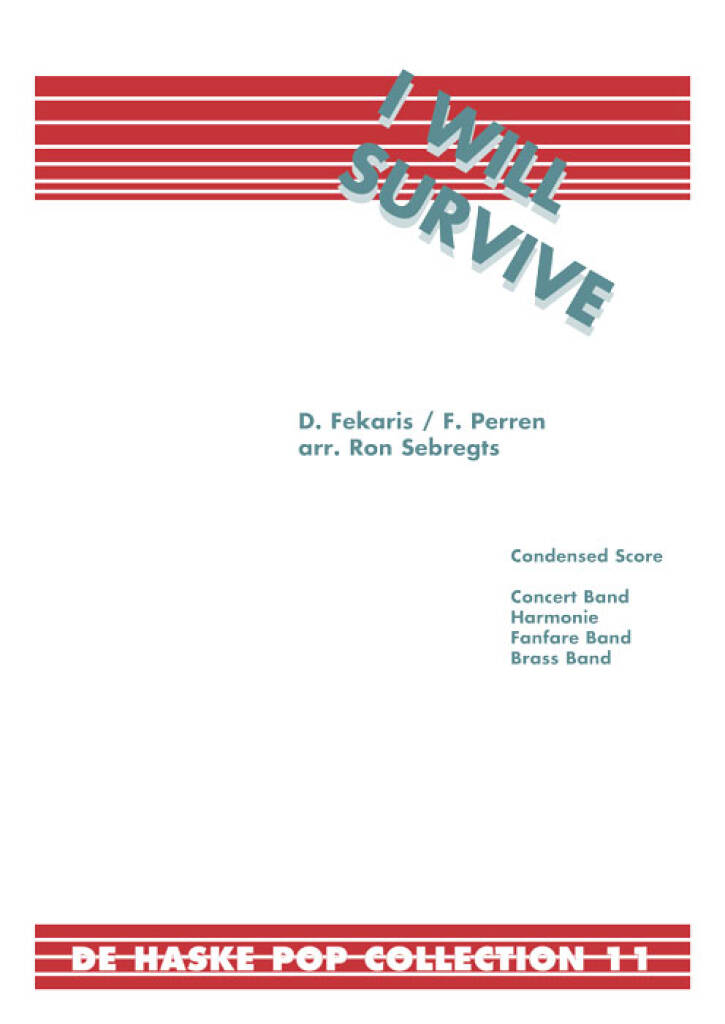
I Will Survive - D. Fekaris - Ron Sebregts
This classic disco hit was released by Gloria Gaynor in 1978. Following massive airplay it reached number one in pop charts around the world and in 1980 received a Grammy for Best Disco Recording. Since then it has appeared in many films and television programs and has been adopted by many causes such as HIV/AIDS awareness and the campaign for women's rights. It is also the 'stadium anthem' for the Dutch football team Feyenoord. Ensure your audience leaves any concert in an upbeat mood with this disco masterpiece.
Estimated dispatch 5-14 working days
-
 £60.99
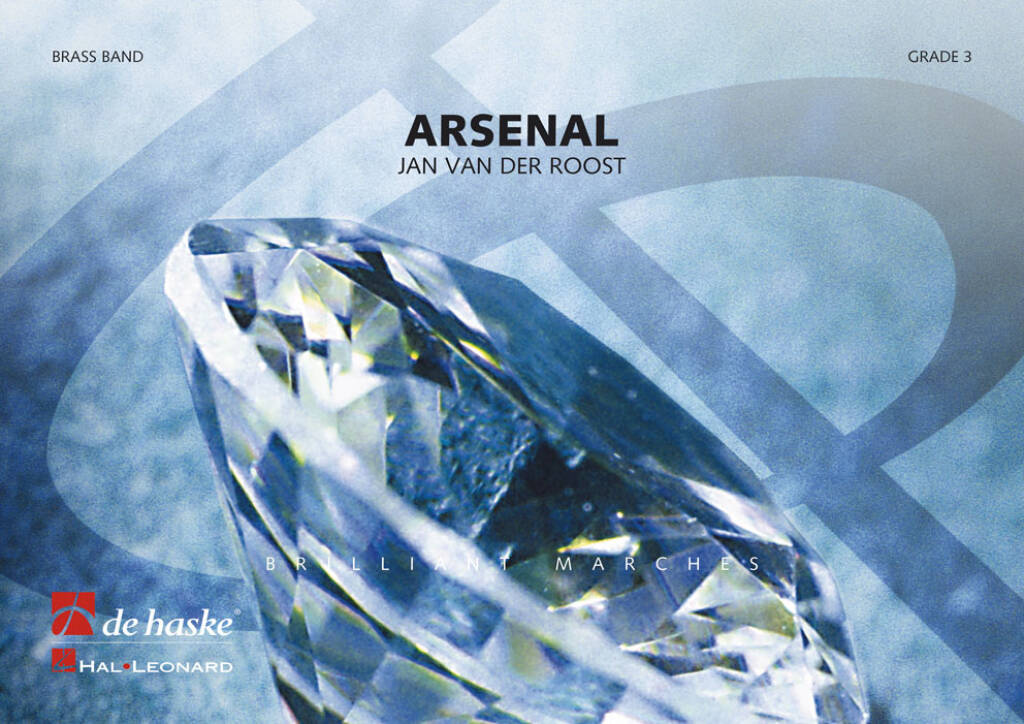
Arsenal - Jan Van der Roost
Arsenal was composed for the 50th anniversary of the 'Harmonie van het Spoorwegarsenaal'[railroad arsenal], based in Mechelen (Belgium). Rather a stately concert march, it has beautiful themes and a broad melody in the trio. It was premiered in the Mechelen Cultural Center on the 11th of May 1996 during the solemn ceremony, opening the anniversary year and conducted by the composer. In the mean time, Arsenal has been recorded several times by such renowed performers like the Tokyo Kosei Wind Orchestra, the Black Dyke BB etc.
Estimated dispatch 5-14 working days
 View Music