Results
-
£59.95
BEULAH LAND (Brass Band Set) - Wilfred Heaton - Paul Hindmarsh
Wilfred Heaton began to assemble material for 'Beulah Land' in the early 1990s following a request from the Amsterdam Staff Band for a new work. Despite reminding himself on the manuscript that he should either complete or destroy the work before his death, ultimately he did not manage either. This edition was subsequently realised in 2003 for the tour of the USA Western States by the Amsterdam Staff Band.'Beulah Land' is Heaton's vision of the joy that awaits the Christian in Heaven and, according to his family, is reminiscent of the kind of music he often improvised at the piano. The three movements are as follows;1. Better World; a waltz sequence on the tune 'Zealley' to which the words 'There is a better world, they say' are sung.2. Heavenly Home; an elegiac cortege using the tunes 'My home is in Heaven', 'I have a home that is fairer than day' and 'The home over there'.3. Happy Land; Beginning in waltz rhythm this soon gives way to a sequence of free variations on the song 'There is a happy land, Far, far away'.
Estimated dispatch 7-14 working days
-
 £74.95
A Tale of Hope (Brass Band - Score and Parts)
The piece tells the story of Chicago lawyer and Presbyterian church elder Horatio Gates Spafford. In 1873, the Spafford family planned a vacation to England, but last-minute business demands prevented Horatio from sailing with them. Tragedy struck when the ship collided with an iron sailing vessel while crossing the Atlantic, killing 226 people, including all four of Spafford's daughters. His wife, Anna, survived the tragedy, and upon arriving in Cardiff, Wales, she sent a telegram to Spafford that simply read "Saved alone." Shortly afterwards, as Spafford travelled to meet his grieving wife, he was inspired to write the hymn It Is Well with My Soul as his ship passed near where his daughters had died. The hymn was subsequently set to music by fellow American Philip Bliss, with the tune named after the ship on which Spafford's daughters died, Ville du Havre.Composer Steven Ponsford has chosen to portray this story in a substantial composition for brass band. Much of the early music is turbulent, reflecting the long voyage, and then the disaster that claimed Spafford's daughters. After a darker 'Grave' section, the hymn It Is Well With My Soul softly emerges, with the piece ending on a note of optimism and hope.Duration: 11.30
Estimated dispatch 7-14 working days
-
£31.95
A Tale of Hope (Brass Band - Score only)
The piece tells the story of Chicago lawyer and Presbyterian church elder Horatio Gates Spafford. In 1873, the Spafford family planned a vacation to England, but last-minute business demands prevented Horatio from sailing with them. Tragedy struck when the ship collided with an iron sailing vessel while crossing the Atlantic, killing 226 people, including all four of Spafford's daughters. His wife, Anna, survived the tragedy, and upon arriving in Cardiff, Wales, she sent a telegram to Spafford that simply read "Saved alone." Shortly afterwards, as Spafford travelled to meet his grieving wife, he was inspired to write the hymn It Is Well with My Soul as his ship passed near where his daughters had died. The hymn was subsequently set to music by fellow American Philip Bliss, with the tune named after the ship on which Spafford's daughters died, Ville du Havre.Composer Steven Ponsford has chosen to portray this story in a substantial composition for brass band. Much of the early music is turbulent, reflecting the long voyage, and then the disaster that claimed Spafford's daughters. After a darker 'Grave' section, the hymn It Is Well With My Soul softly emerges, with the piece ending on a note of optimism and hope.Duration: 11.30
Estimated dispatch 7-14 working days
-
 £33.62
He will hold me fast (Trombone Feature with Band) Matt Merker arr. Noel Brooks
Originally conceived as a trombone duet for the graduation recital of Andy Brooks at Western University, this setting of Matt Merker's popular choral work has been adapted by Noel Brooks as a featured work for trombone trio with brass band. The arrangement follows the emotional arc of the hymn's lyrics, utilising the brass band's colours to reflect the themes of each verse. The journey begins with a sense of vulnerability; the accompaniment is kept sparse and cold to echo the text's plea regarding a failing faith. In the second verse, the music transitions into a more encouraging and uplifted atmosphere, reflecting the assurance of being "precious in His Holy sight." A shift occurs in the third verse, which takes on a darker, more reflective character to support the gravity of the lyrics. This contemplative section builds steadily toward the final chorus, where a sense of confidence returns. The work culminates in a strong musical statement of the hymn's central promise: "He will hold me fast." To view a performance of the work by the Canadian Staff Band please visit www.youtube.com/watch?v=lArvB6HP3pI Duration: Approx. 5.00 minutes Difficulty Level: 4th Section + This PDF download includes the full score and parts. Sheet music available at www.brassband.co.uk (UK) or https://satradecentral.org (USA) Instrumentation: 1st Trombone Soloist Bb 2nd Trombone Soloist Bb Bass Trombone Soloist Soprano Cornet Eb 1st Cornet Bb 2nd Cornet Bb Flugel Horn Bb 1st Horn Eb 2nd Horn Eb 1st Baritone Bb 2nd Baritone Bb Euphonium Bb Bass Eb Bass Bb Percussion Glockenspiel
In Stock: Estimated dispatch 1-3 working days
-
 £33.62
March - Helping Hands (Rob Bushnell) Brass Band
Helping Hands was written for the British Bandsman March Composition Contest, entered into category 2 (marches for 3rd/4th section bands). The piece is loosely programmatic in nature: The introductio is fanfare-like, announcing the date of the next Whit Friday Contests and the bands' anticipation of and preparation for the event. The first section is the march of the volunteers, as they descend upon the many venues, ready to run the contests. The second section (bars 35 to 52) sees the contests start. The bands strike up, march, finish and go from place to place, whilst the volunteers manage them, the audiences, and all manner of issues and problems thrown at them. The third section (bars 53 to 69) represents the bad weather which has, at times, presented itself on that particular Friday. But everyone carries on (possibly the sun comes out) and we enjoy the day. The trio uses the hymn St. Vincent by Sigismund Neukomm: St. Vincent de Paul is the patron saint of charities and volunteering, hence its use here. The piece is influenced by marches that are commonly heard during the Whit Friday March Contests, using motifs, rhythms and harmonic progressions (sparingly) throughout the piece. March-card sized parts included, with alternatives for horns in F and lower brass in bass clef. To view a rolling score video of the piece please visit www.youtube.com/watch?v=diqDoe0XpcA PDF download includes score and parts. Sheet music available from: UK - www.brassband.co.uk USA - https://satradecentral.org Difficulty Level: 3rd Section + Length: 3.50 minutes Instrumentation: Soprano Cornet Eb Solo Cornet Bb Repiano Cornet Bb 2nd Cornet Bb 3rd Cornet Bb Flugel Horn Bb Solo Horn Eb 1st Horn Eb 2nd Horn Eb 1st Baritone Bb 2nd Baritone Bb 1st Trombone Bb 2nd Trombone Bb Bass Trombone Euphonium Bb Bass Eb Bass Bb Drums
In Stock: Estimated dispatch 1-3 working days
-
£105.00
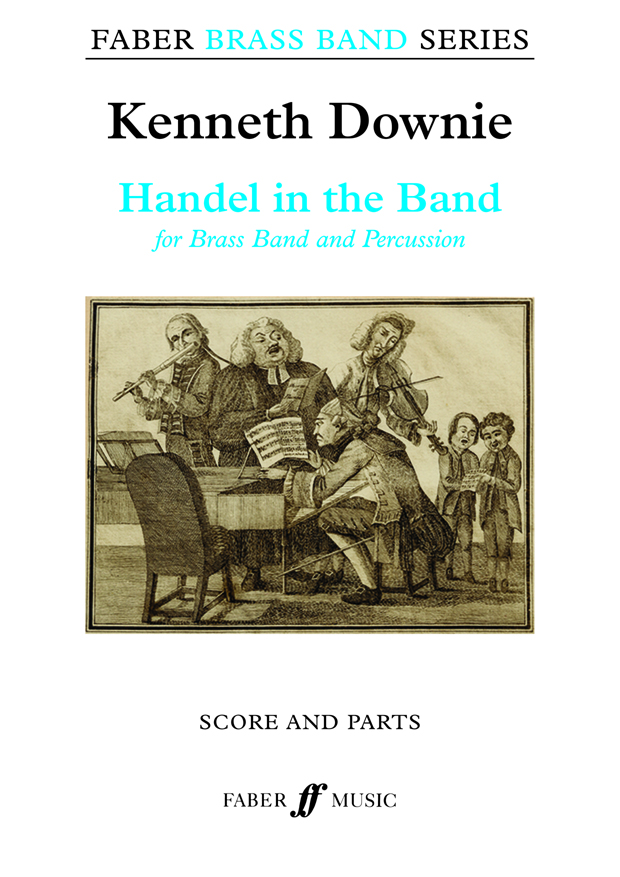
Handel in the Band - Kenneth Downie
Handel in the Band is a virtuoso set of symphonic variations on one of Handel's best known keyboard dances, the Sarabande from his Suite in D minor, HWV 437, based on the Spanish traditional dance La Folia. Kenneth Downie's work was commissioned by Brass Band Treize Etoiles, for performance at the 2013 Swiss National Brass Band Championships, where it was conducted by James Gourlay. The title is a reference to Percy Grainger's popular Handel in the Strand, and is indicative of the witty and theatrical nature of the music, which is more playful than conventional competition pieces and as such offers different challenges to brass bands as well as being thoroughly entertaining for audiences. Kenneth Downie is one of the most respected and experienced brass band composers. His music has been widely performed and published throughout the brass band world since the 1960s. Handel in the Band has been selected as the set work for the Championship Section final of this year's National Brass Band Championships of Great Britain, which takes place at the Royal Albert Hall, London, on 6th October 2018.
In Stock: Estimated dispatch 1-3 working days
-
 £25.95
Hymn for Africa - Peter Meechan
Part of the Brass Band Aid SeriesBrass Band Aid is a Charitable Organisation formed by members of Stanhope Silver Band, based in the North of England. From an original aim to raise awareness of the Make Poverty History campaign in their local area, a brass band CD recording was planned. The initiative took on a whole new dimension when the collection of local bands performing on CD were then joined by, what is now known as, The Brass Band Aid Celebrity Band, made up of many of the top brass musicians in the country.Following the success of this initial project the Celebrity Band has come together again to record a new CD - "Into Africa". This is a compilation of pieces especially written for the recording by some of the most esteemed brass band writers of today. 'Hymn for Africa' is one such piece, generously contributed by Peter Meechan in support of the ongoing work of the charity."Hymn for Africa is inspired by the the release of Nelson Mandela in the early 1990's and the effect it had upon not only South Africa, but all over the continent of Africa, as well as the World as a whole. The fact that one man can achieve this with peace and great dignity will always be an inspiration, not only to me, but many, many millions of humans around the globe.sense of dignity and peace the composer . A simple 8 bar melody, first heard on an unaccompanied flugel horn at the beginning, is the basis of the composition. A drone is then added, before a chorale, and finally a rousing climax when the percussion and full band enter. The piece ends at it began, with a peaceful, unaccompanied, flugel solo." (Peter Meechan).All sets sold raise money for Brass Band Aid - a charity The Music Company has continued to actively support since 25.
In Stock: Estimated dispatch 3-5 working days
-
 £37.35
Horn Concerto No.1 1st Movement (Tenor Horn Solo with Band) Haydn arr. Wilson
Franz Joseph Haydn's Horn Concerto No.1 in D major was composed in 1762, when he was new to the Esterhazy court. It is a virtuosic concerto that showcases the beauty and range of the horn. The concerto was originally scored for solo horn and orchestra, and is one of Haydn's most popular works. Here it has been arranged by Duncan Wilson for tenor horn with brass band. His arrangement of the concerto is a faithful and effective adaptation of the original work. The movement opens with a lively tutti introduction, followed by the entrance of the solo horn. The horn plays a series of melodies and passages that are both lyrical and virtuosic. The band provides accompaniment and contrast, and the two interact in a lively dialogue. The movement builds to a climax and then concludes with a triumphant coda. To view a follow-the-score video please visit https://www.youtube.com/watch?v=Uo2K5tge6Fs PDF download includes score and parts. Sheet music available from: UK - www.brassband.co.uk USA - www.solidbrassmusic.com Difficulty Level: 2nd Section + Instrumentation: Tenor Horn Soloist Eb Soprano Cornet Eb Solo Cornet Bb Repiano Cornet Bb 2nd Cornet Bb 3rd Cornet Bb Flugel Horn Bb 1st Horn Eb 2nd Horn Eb 1st Baritone Bb 2nd Baritone Bb 1st Trombone Bb 2nd Trombone Bb Bass Trombone Euphonium Bb Bass Eb Bass Bb Timpani
In Stock: Estimated dispatch 1-3 working days
-
A Holly Jolly Christmas - Johnny Marks - Len Jenkins
"A Holly Jolly Christmas" is a Christmas song written in 1962 by Johnny Marks. He was also responsible for Rudolph, the Red-Nosed Reindeer and Rocking Around the Christmas Tree amongst his other compositions. The most well-known vocal editions are those by Burl Ives who recorded it in 1964 for a Christmas special, and then re-recorded in 1965 for his holiday album, Have a Holly Jolly Christmas. This latter version of the song has a somewhat slower arrangement than the previous version and featured an acoustic guitar solo introduction; it is this version that has since become the more commonly heard rendition on radio. More recently, it has been recorded by Michael Buble.
-
 £100.00
Handel in the Band (Brass Band - Score and Parts)
Handel in the Band is a virtuoso set of symphonic variations on one of Handel's best known keyboard dances, the Sarabande from his Suite in D minor, HWV 437, based on the Spanish traditional dance La Folia. Kenneth Downie's work was commissioned by Brass Band Treize Etoiles, for performance at the 2013 Swiss National Brass Band Championships, where it was conducted by James Gourlay. The title is a reference to Percy Grainger's popular Handel in the Strand, and is indicative of the witty and theatrical nature of the music, which is more playful than conventional competition pieces and as such offers different challenges to brass bands as well as being thoroughly entertaining for audiences.Kenneth Downie is one of the most respected and experienced brass band composers. His music has been widely performed and published throughout the brass band world since the 1960s.Handel in the Band was selected as the set work for the Championship Section final of the 2018 National Brass Band Championships of Great Britain, which took place at the Royal Albert Hall, London, on 6th October 2018.Duration: 15.00
Estimated dispatch 7-14 working days