
Results
-
 £79.99
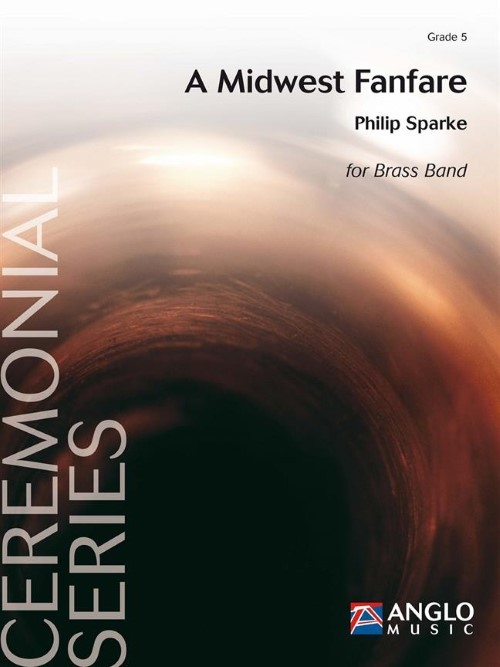
A Midwest Fanfare (Brass Band - Score and Parts) - Sparke, Philip
A Midwest Fanfare was commissioned by the Brass Band of Battle Creek and premiered by them during their appearance at the Midwest Clinic in Chicago on 20th December 2017 where this fanfare was the opening piece of the entire event. This piece is designed to be played with the cornets split into two teams either side of the band. It opens with the two groups answering each other antiphonally over a repeated figure in the lower band. A calmer central section introduces a euphonium solo which is then taken up by the whole ensemble. This leads back to a repeat of the opening fanfares over a rhythmic accompaniment and a short coda which brings the work to a close.Duration: 4.00
Estimated dispatch 7-14 working days
-
 £44.95
Scottish Folk Variants (Euphonium Solo with Brass Band - Score and Parts) - Bulla, Stephen
This solo was written for the ISB120 event in June 2011 especially for Derick Kane and The International Staff Band. The material for the solo is indicative of Derick's Scottish roots and features in turn, 'The dashing white sergeant', 'My bonnie lies over the ocean', 'Skye boat song' and 'Bonnie Dundee'.
Estimated dispatch 7-14 working days
-
£22.50
Scottish Folk Variants (Euphonium Solo with Brass Band - Score only) - Bulla, Stephen
This solo was written for the ISB120 event in June 2011 especially for Derick Kane and The International Staff Band. The material for the solo is indicative of Derick's Scottish roots and features in turn, 'The dashing white sergeant', 'My bonnie lies over the ocean', 'Skye boat song' and 'Bonnie Dundee'.
Estimated dispatch 7-14 working days
-
£29.95
The Gathering (Brass Band - Score and Parts) - Venables, Marcus
This concert opener was written for the Canadian Staff Band and its European tour, culminating in its attendance of the ISB120 event in London in June 2011. The tour included some time in Holland and, appropriately, the well-known Dutch hymn 'We gather together' was selected as the source material for this work. The melody is used in a couple of different settings before reaching a rousing conclusion.
Estimated dispatch 7-14 working days
-
£14.95
The Gathering (Brass Band - Score only) - Venables, Marcus
This concert opener was written for the Canadian Staff Band and its European tour, culminating in its attendance of the ISB120 event in London in June 2011. The tour included some time in Holland and, appropriately, the well-known Dutch hymn 'We gather together' was selected as the source material for this work. The melody is used in a couple of different settings before reaching a rousing conclusion.
Estimated dispatch 7-14 working days
-
£44.95
Fusion (Brass Band - Score and Parts) - Cordner, Martin
Fusion seeks to capture the sense of celebration that arises when a believer arrives in Heaven and is finally joined in eternal fellowship with God. In depicting this event, the work links the tune, 'Brantwood' (I know thee who thou art') with Chris Rice's contemporary hymn, 'Come to Jesus'.
Estimated dispatch 7-14 working days
-
£22.50
Fusion (Brass Band - Score only) - Cordner, Martin
Fusion seeks to capture the sense of celebration that arises when a believer arrives in Heaven and is finally joined in eternal fellowship with God. In depicting this event, the work links the tune, 'Brantwood' (I know thee who thou art') with Chris Rice's contemporary hymn, 'Come to Jesus'.
Estimated dispatch 7-14 working days
-
 £32.50
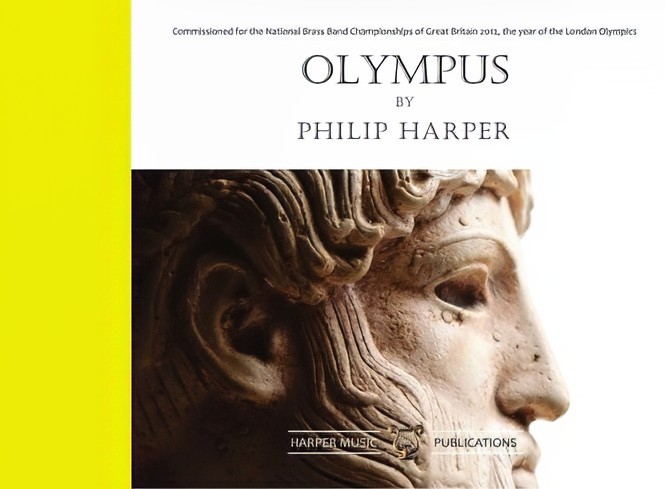
Olympus (Brass Band - Score only) - Harper, Philip
Selected as the test-piece for the 3rd Section Regional contests of the National Brass Band Championships 2012The music begins with a depiction of the exciting Opening Ceremony where noisy fanfares and sudden swells add to the cosmopolitan flag-waving clamour. Without a break the music leads to The Chariot Race, a fast compound-time gallop with thundering hooves in the basses and percussion, and a heroic melody introduced by the tenor horns. Chariot racing was the main equestrian event in the Ancient Greek Games, which were founded in memory of King Oenomaus. In the Greek legend he suffered defeat in a chariot race to his son-in-law and Zeus' grandson, Pelops, but much of the music is bitter-sweet to symbolise the fact that Pelops had to cheat to win - drawing parallels with some of the issues still facing modern-day athletics.A slow, mystical passage follows, describing The Temple of Zeus at Olympia. The statue of Zeus, who was honoured throughout the Ancient Games' history, was housed inside the temple and was one of the Seven Wonders of the Ancient World. The music depicts this period of the dawn of one of mankind's most ancient civilisations and there is a series of solo passages above a drone.The next section is called The Olympic Flame and a broad and lyrical anthem-like melody develops slowly in the euphoniums, which gradually ascends until the horns can take it over before passing upwards again to the cornets (Higher). The music bursts into bright life at the lighting of the flame and the regular rhythmic pattern which has been established goes through an accelerando (Faster).The final section is called The Olympic Truce and aims to capture the cooperative spirit of the ancient practice of ending wars for the duration of the games. The anthem-like melody makes an affirmatory return (Stronger) and the work ends as it began - with a blaze of colour and a real sense of optimism and global celebration.Citius, Altius, Fortius (Faster, Higher, Stonger)Duration: 11:30
Estimated dispatch 7-14 working days
-
£74.99
Olympus (Brass Band - Score and Parts) - Harper, Philip
Selected as the test-piece for the 3rd Section Regional contests of the National Brass Band Championships 2012The music begins with a depiction of the exciting Opening Ceremony where noisy fanfares and sudden swells add to the cosmopolitan flag-waving clamour. Without a break the music leads to The Chariot Race, a fast compound-time gallop with thundering hooves in the basses and percussion, and a heroic melody introduced by the tenor horns. Chariot racing was the main equestrian event in the Ancient Greek Games, which were founded in memory of King Oenomaus. In the Greek legend he suffered defeat in a chariot race to his son-in-law and Zeus' grandson, Pelops, but much of the music is bitter-sweet to symbolise the fact that Pelops had to cheat to win - drawing parallels with some of the issues still facing modern-day athletics.A slow, mystical passage follows, describing The Temple of Zeus at Olympia. The statue of Zeus, who was honoured throughout the Ancient Games' history, was housed inside the temple and was one of the Seven Wonders of the Ancient World. The music depicts this period of the dawn of one of mankind's most ancient civilisations and there is a series of solo passages above a drone.The next section is called The Olympic Flame and a broad and lyrical anthem-like melody develops slowly in the euphoniums, which gradually ascends until the horns can take it over before passing upwards again to the cornets (Higher). The music bursts into bright life at the lighting of the flame and the regular rhythmic pattern which has been established goes through an accelerando (Faster).The final section is called The Olympic Truce and aims to capture the cooperative spirit of the ancient practice of ending wars for the duration of the games. The anthem-like melody makes an affirmatory return (Stronger) and the work ends as it began - with a blaze of colour and a real sense of optimism and global celebration.Citius, Altius, Fortius (Faster, Higher, Stonger)Duration: 11:30
Estimated dispatch 7-14 working days
-
£29.95
Motondo (Brass Band - Score and Parts) - Osgood, Donald
This march commemorated the International Scouts 'Motondo' held in Holland in 1952. Motondo is an African word meaning 'a gathering for giving thanks'. A favourite chorus from the event is used in the trio section, 'Travel along in the sunshine, on the King's highway'. Unusually for 'general use' marches, Motondo has an alternative 'concert' ending which can be used if the Da Capo is not employed.
Estimated dispatch 7-14 working days
 View Music