
Results
-
 £60.99
Lascia ch'io pianga (Let Me Weep) - Georg Friedrich Händel - Jacob de Haan
Let Me Weep ('Lascia ch'io pianga') is an aria from Handel's opera 'Rinaldo'. According to reports he composed the music for the complete opera in just 14 days, using many melodies from earlier works. The melody of this wonderful aria is known all over the world and this arrangement by Jacob de Haan retains all the passion of the original.
Estimated dispatch 5-14 working days
-
 £40.00
Losgaintir. For solo Baritone/Euphonium and brass band
Recommended - Championship to 2nd Section Written for Katrina Marzella and the Black Dyke band, Losgaintir (or Luskentyre in English) is one of my favourite places in Scotland. Losgaintir is on the west coast of the isle of Harris in the Outer Hebrides and has an outstanding beach widely regarded as one of the most beautiful in the world. Losgaintir is a wonderful place to be on warm sunny days with its long stretch of white sands, aqua marine seas, the incredible mountain backdrop of south Lewis and the uninhabited island of Taransaigh in view. The weather in Harris is notorious for changing very quickly and this piece tries to reflect this. Although idyllic on a calm, sunny days, on stormy days Losgaintir's character becomes dark and foreboding, with low dark clouds and sweeping winds from the Atlantic creating a dark, brooding atmosphere. The opening melody (written modally like a traditional Scottish Gaelic air) depicts the calm serenity of Losgaintir on a beautiful summer's day. The character of the fast section that follows portrays winter in Losgaintir during a tempestuous storm with bracing winds. Includes score & parts Also see: Losgaintir for Solo Baritone/Euphonium & Piano
-
 £10.00
Endurance
DescriptionMen wanted for hazardous journey. Small wages, bitter cold, long months of complete darkness, constant danger, safe return doubtful. Honour and recognition in case of success. - Ernest Shackleton, 4 Burlington StreetEndurance takes its title from the ship used by Sir Ernest Shackleton's Imperial Trans-Antarctic Expedition in 1914-15. After many months of fundraising (and reputedly running the above advert in The Times) the Endurance set sail from Plymouth on 6 August 1914. Whilst at sea news of the outbreak of war led Shackleton to put his ship and crew at the disposal of the Admiralty, but their services were not required and they were encouraged to continue. On October 26 1914 they left Grytviken on South Georgia for the Antarctic continent, hoping to find the pack ice shrinking in the Antarctic spring. Two days later, however, they encountered unseasonable ice which slowed their progress considerably. On 15 January 1915, when Endurance was only 200 miles from her intended landfall at Vahsel Bay, the ship became beset by ice which had been compressed against the land to the south by gale force winds. Trapped in the ice of the Weddell Sea, the ship spent the Antarctic winter driven by the weather further from her intended destination until, on 21 November 1915 Endurance broke up forcing the crew to abandon ship and set up camp on the ice at a site they named "Patience Camp".The crew spent several weeks on the ice. As the southern spring started to reduce the extent of the ice shelf they took to their three lifeboats, sailing across the open ocean to reach the desolate and uninhabited Elephant Island. There they used two of the boats to build a makeshift shelter while Shackleton and five others took the largest boat, an open lifeboat named the 'James Caird' and sailed it for 800 terrifyingly dangerous miles across the vast and lonely Southern Atlantic to South Georgia - a journey now widely regarded as one of the greatest and most heroic small-boat journeys ever undertaken. After landing on the wrong side of the island and having to climb over a mountain range in the dark with no map, Shackleton and his companions finally stumbled back into the Grytviken whaling station on 19 May 1916.After resting very briefly to recover his strength, Shackleton then began a relentless campaign to beg or borrow a ship to rescue the rest of his crew from Elephant Island; whaling ships were not strong enough to enter polar ice, but on 30 August 1916, over two years after their departure from Plymouth, Shackleton finally returned to Elephant Island aboard a steam tug borrowed from the Chilean government. Although some were in poor health, every member of the Endurance crew was rescued and returned home alive.Endurance is dedicated to the memory of my mum, who passed away in September 2017.Listen to a computer generated preview and follow the score below:
Estimated dispatch 7-14 working days
-
£70.00
Fire in the Sky - Peter Meechan
Fire in the Sky takes its inspiration from the stunning town of Montreux in Switzerland. I was commissioned to write the work 5 days before I visited this Montreux and was at work forming ideas for the piece as I arrived on the shore of Lake Geneva and its amazing views of the Alps.Whilst the scenery is without doubt some of the most incredible views I have ever witnessed, it was the history of the town that set Fire in the Sky in motion. Whilst there, it occurred to me that many of my musical heroes had lived or performed there, and three of them in particular had a strong connection with the town. Miles Davis, Igor Stravinsky and Freddie Mercury graced Montreux - the large convention centre, where the famous summer jazz festival is held, named its two halls after Davis and Stravinsky, and there is a quite breathtaking statue of Mercury in the town too.Each musician also commemorates an anniversary in 2011, the year of the premiere of Fire in the Sky; it is 40 years since the death of Stravinsky and both Miles Davis and Freddie Mercury died in 1991, making it 20 years since their deaths. So it seemed fitting to write a piece that in some way acknowledges them, and is a kind of personal athanksa for all they have given, and continue to give, me.The title comes from the famous Deep Purple song, Smoke on the Water - whose second line is aFire in the Skya and is a reference to the night the townas casino was set alight by a Frank Zappa fan. The piece tries to recreate the atmosphere of that night, paint a picture of fire in the sky (and smoke on the water) and also uses small anuggetsa of the music of my three greatest musical heroes, Miles Davis, Freddie Mercury and Igor Stravinsky.Fire in the Sky was commissioned by the Tomra Brass Band, Norway, and is dedicated to Stijn BerbeA and Nick Ost - both of whom are connected with the band (teaching and conducting), and both have been close friends - personally and musicaly - for many years. I am indebted to them for the opportunity to write this piece.
Estimated dispatch 12-14 working days
-
£98.00
MonsterThrash (Bra) - Paul Saggers
Prepare for the fright of a lifetime as MonsterThrash takes you to the murky depths of the ocean where all sorts of unsavoury creatures lurk, waiting to devour you! From Ancient Greek mythology, Hydra a Serpentine creature with many heads guards the underworld. You can try and chop its head off but two will grow back! Be sure to escape this first monster quickly as its poisonous breath and blood will kill you instantly! Next up to thrash you are the wickedly enchanting sirens, who aim to seduce you with their looks and mesmerising singing, but will carve you up for their dinner! If you've made it this far... be prepared to face your final threat, The Leviathan! Often described as an Dragon dwelling in the watery abyss. Enormous in size, the Leviathan is said to represent the forces of chaos. When the Leviathan is hungry he sends forth from his mouth a heat so great it makes the water of the deep boil. Only the bravest of sailors can withstand these wicked beasts, if your not up to the MonsterThrash, be prepared to spend the rest of your days in the depths of Davy Jones' Locker!
Estimated dispatch 7-14 working days
-
 £118.00
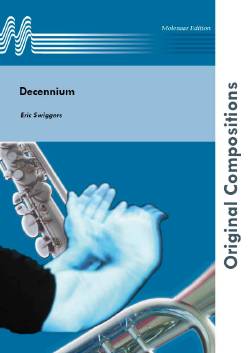
Decennium - Eric Swiggers
'Decennium' was composed in 2003 as a commission by the municipality of Berheze for its tenth anniversary. The composition describes the history of this town in the Province of Brabant, consisting of 6 different villages: Heesch, Heeswijk, Dinther, Nistelrode, Loosbroek and Vorstenbosch. The composition starts with a slow introduction, Adagio Misterioso, suggesting the atmosphere in long-ago days when the area consisted mainly of swamps, meres and low woods. (The word 'Bern' is a synonym of 'Born' meaning source or water, whereas 'Hese' is derived from 'Haisjo' meaning brushwood ). Above the dark sounds we hear far away trumpet signals announcing the Middle Ages. After a piercing crescendo, we hear the full sound of festive trumpets. A medieval dance, as was to be heard in the Heeswijk castle, follows. This dance gets a more and more stirring character and finally turns into a merry popular dance ending with a burst of laughter reproduced by descending scales with the muted trombones and trumpets. A slow transition with a quotation from a Gregorian plainsong (Domine Deus) and church bell ringing, referring to the Abbey of Berne, brings us to a romantic Larghetto. This part describes the quiet rural life in a beautiful natural surrounding. The last dying note contrasts with the threatening ostinato, referring to the rise of the industrialization, which provoked quite some resistance with the local people. Once more we hear the 'Domine Deus' but much more powerful this time. When the resistance calms down, the work concludes with an Alla Marcia. The first notes of the main theme could be heard all through the composition and now we hear the complete main theme again. The new town is born. A festive conclusion refers both to the tenth anniversary and the optimism and confidence as to the future.
Estimated dispatch 10-14 working days
-
 £35.00
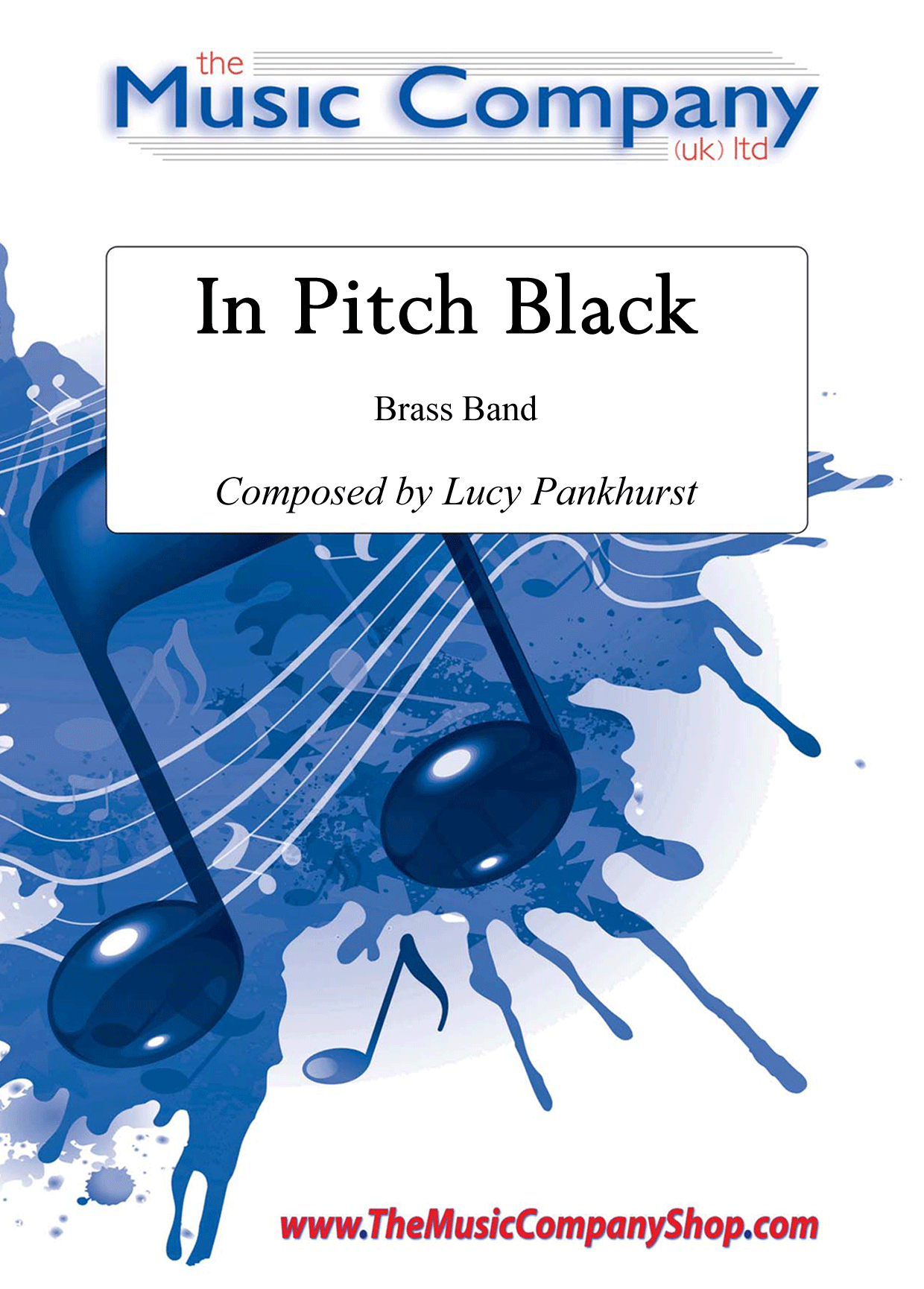
In Pitch Black - Lucy Pankhurst
An extremely emotional and poignant work for brass band composed by Lucy Pankhurst, in memory and tribute to those affected by the Pretoria Pit disaster in Lancashire on 21st December 1910. The piece is chilling in its depiction of the tragic story, sensitively conveying the atmosphere and emotions as perceived before, during and after the event. Through its use of playing techniques, effects, sound combinations and even silences, In Pitch Black offers a powerfully reflective piece.Pritoria Pit DisasterLancashire's worst pit disaster and Britain's third largest loss of life from a single mining accident happened at the No. 3 Bank Pit belonging to the Hulton Colliery Company, just 4 days before Christmas 1910. The pit known as the 'Pretoria Pit' was situated on Hulton Parkland on the border of Atherton and Westhoughton. An explosion occurred at 7.50 am on Wednesday, 21 December 1910, resulting in the death of 344 men and boys, including many members of The Wingates Band.The Writing ExperienceDuring Lucy's research for this work, she acknowledges that she found the harsh reality from the shocking images and historical accounts of the event most disturbing, and is not embarrassed to disclose that it was wholly a very emotional experience in creating the composition. Consequently, she chose to create something to illustrate the true emotion of the situation. She wanted to pay tribute to the lives lost and the devastation which remained in their absence, by creating a piece of music which begins in darkness; desolate and claustrophobic, whilst still leaving the audience feeling uplifted and thoughtful in the final bars.The significance and musical appreciation for the creation of In Pitch Black was formally recognised by BASCA in 2011, when Lucy Pankhurst won the internationally acclaimed British Composer Award (the first time a brass band work had received the award, and the first time a female composer had won the category).Full programme notes are included in the product images.Look and Listen (performance courtesy of Manchester University Brass Band):
In Stock: Estimated dispatch 3-5 working days
-
 £12.00
Canzonetta
DescriptionCanzonetta is a tenor horn solo with optional brass band or piano accompaniment.Canzonetta was one of my earliest compositions, written in my early days as an undergraduate. Along with a companion piece called Caprice it was written for an old friend, Louise Hunt (now Louise Skillander), to whom it is dedicated. We had both been in the Northop Youth Band together, and both pieces were the result of a conversation about the lack of 'good tenor horn solos' for lower section and youth players at the time.With more mature consideration the Caprice has been consigned to the dustbin of history, but the simplicity of Canzonetta has allowed it to stand the test of time with a few minor scoring revisions.Performance Notes:Percussion instruments required are 2 x timpani, glockenspiel, suspended cymbal, concert bass drum (NOT a kit/pedal bass drum) and tam-tam. All cornets will require cup mutes.Duration approximately 3'40"You can follow the score while listening to an audio preview below:
Estimated dispatch 7-14 working days
-
£70.00
Origins - Peter Meechan
Origins is in three movements, with each movement having a different subject matter, all linked by the idea of origins: the first movement refers to musical origins; the second to the origins of life; and the final movement to the space exploration - the research of all origins. The first movement is based on a short motif, heard in the first three notes the soloist plays. These three notes cover the interval of a minor third (an interval that often plays a crucial role in my music) on which the whole concerto is built. The soloist and accompaniment interplay freely throughout the opening section, before an ostinato accompaniment appears - over which the soloist sounds a long legato melody. A short cadenza follows and a return to the opening material leads the movement to an end. The second movement, titled Harryas Song, is - as tradition dictates - a slow movement. Happy and reflective in nature, the main melody was written on the evening that my closest friend, Mark Bousie (a fine euphoniumist himself), and his wife Jayne, had their first child - Harry Bousie. It seemed only fitting that this song should be written for Harry in celebration. The final movement brings me back to a lifelong fascination with space, and in this particular movement, the Space Shuttle Discovery. Having completed 39 missions (including flying the Hubble telescope in to orbit), and spent a total of 365 days in space, SS Discovery made its final voyage in 2011 and was taken to the Smithsonian in Washington D.C. in April 2012. This final movement, titled Discovery, pays tribute to the great shuttle whose missions inspired millions across the generations. Origins was commissioned by Marco Schneider, Adrian Schneider and the Dunshan Symphonic Wind Orchestra, Beijing, China.
Estimated dispatch 12-14 working days
-
 £30.00
Inchcolm - Terry Johns
The island of Inchcolm was visited by St Columba in 567 and is mentioned in Shakespeare's Macbeth. It lies on the stretch of water beyond my balcony, known locally as "Mortimer's deep", and on short winter days, the ruins of Columba's abbey are shrouded in the mists of the estuary and bring a flavour of mystery and legend to my morning coffee. Music comes easily here amidst the crying of the seabirds, and the horn has given its distinctive voice to history, myth and folklore for centuries. Its sound was born in the wide-open spaces and can paint a broad seascape with ease.
 View Music