
Results
-
 £64.95
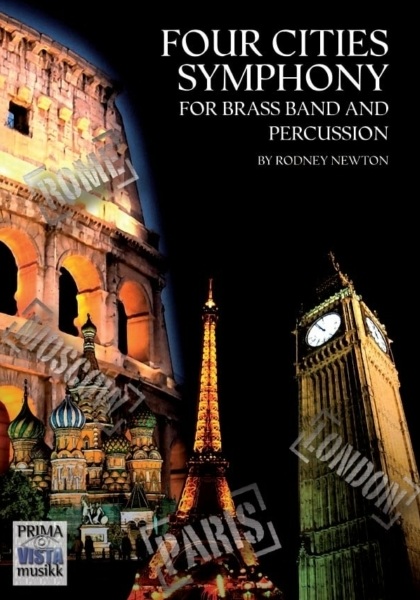
Four Cities Symphony (Brass Band - Score and Parts) - Newton, Rodney
This piece was commissioned by the National Contesting Council as the 4th section test piece for the 2008 Regional Brass Band Championships of Great Britain.This symphony (the composer's 12th) has four movements played without a break. The first centres on two aspects of the city of London: its history and pageantry and its role as a busy modern metropolis.The second movement depicts Paris, its street cafes and boulevards and riverside walks, in the form of a romantic waltz.The third movement is constructed around the Gregorian chants of the Lord's Prayer (Pater noster, qui es in caelis) and the Creed (Credo in unum Deum) in an evocation of the city of Rome. After a powerful climax, mysterious tramping footsteps are heard as the ghosts or a Roman legion march through the city by night. The vision fades and the pater noster is heard once again before the movement is brought to a close with the ancient Ambrosian chant, Christus Vincit, Christus Regnet, Christus Imperat.The final movement is an evocation of the city of Moscow, with its great historic buildings, its turbulent history and its fiery traditional music. At the outset a rather dour folk-like melody is heard which is transformed into a lively Cossack dance.This work is dedicated to Howard Wilson, former principal euphonium of City of Coventry Band who, in 1972, introduced the composer to top section brass band contesting.Duration: 11.00
Estimated dispatch 7-14 working days
-
 £69.99
Go for Brass! (Brass Band - Score and Parts) - De Haan, Jacob
Subtitled "A Young Person's Guide to the Brass Band", Go for Brass! is a musical introduction to the sound, instrumental groups and the individual instruments of the brass band. Your players will love this work as they stand to highlight their particular section with snippets of the sparkling up-tempo dance style theme. An extremely entertaining concert item with a little fun educational content!Duration: 05:40
Estimated dispatch 7-14 working days
-
 £290.99
Hymn of the Highlands (Complete Edition) (Brass Band - Score and Parts) - Sparke, Philip
Hymn of the Highlands was commissioned by David King and the Yorkshire Building Society Band for first performance at the 2002 European Brass Band Championships Gala Concert in Brussels. The complete suite lasts approximately 35 minutes however it is possible that pieces of different lengths can be constructed to feature particular soloists or fit different programming constraints.Includes:Ardross Castle, Duration: 7:00Summer Isles (Euphonium solo), Duration: 4:00Flowerdale (Soprano Cornet solo), Duration: 4:30Strathcarron (Sword Dance), Duration: 5:30Lairg Muir (Cornet solo), Duration: 4:30Alladale (Flugel Horn, Horn and Baritone trio), Duration: 4:15Dundonnell (Finale), Duration: 5:45Duration: 35:00
Estimated dispatch 7-14 working days
-
 £40.00
ESPANA CANI (Brass Band) - Marquina, Pascual - Thomas, Gareth
Pascual Marquina (1873--1948) was a Spanish bandleader who wrote music for his band to play at bullfights in Madrid. Espana Cani means Spanish Gypsy Dance. The music is popular amongst ballroom dancers as a Paso Doble. The Paso Doble is traditionally used as introduction music for a bull fight and is the music used to usher in the matadors, picadors, horses and bandilleros. Espana Cani was written in 1925 and is suitable for all grades of band.
Estimated dispatch 7-14 working days
-
 £69.99
Fanfares and Love Songs (Brass Band - Score and Parts) - Higgins, Gavin
Fanfares and Love Songs was commissioned by the National Children's Brass Band of Great Britain for performance on 25th July 2009. Its three movements contrast the extrovert and lyrical qualities of the traditional brass band. The fanfare with which the work opens involves the whole cornet section. The second movement is reflective in mood, beginning somewhat pensively on muted brass, and building to an emotional climax before subsiding back to a distant pianissimo chord. The finale is a fast dance, which with a final recapitulation of the opening fanfare drives on to a breathless close.Suitable for Advanced Youth/3rd Section Bands and aboveDuration: 12.00
Estimated dispatch 7-14 working days
-
£14.99
Fanfares and Love Songs (Brass Band - Score only) - Higgins, Gavin
Fanfares and Love Songs was commissioned by the National Children's Brass Band of Great Britain for performance on 25th July 2009. Its three movements contrast the extrovert and lyrical qualities of the traditional brass band. The fanfare with which the work opens involves the whole cornet section. The second movement is reflective in mood, beginning somewhat pensively on muted brass, and building to an emotional climax before subsiding back to a distant pianissimo chord. The finale is a fast dance, which with a final recapitulation of the opening fanfare drives on to a breathless close.Suitable for Advanced Youth/3rd Section Bands and aboveDuration: 12.00
Estimated dispatch 7-14 working days
-
 £84.95
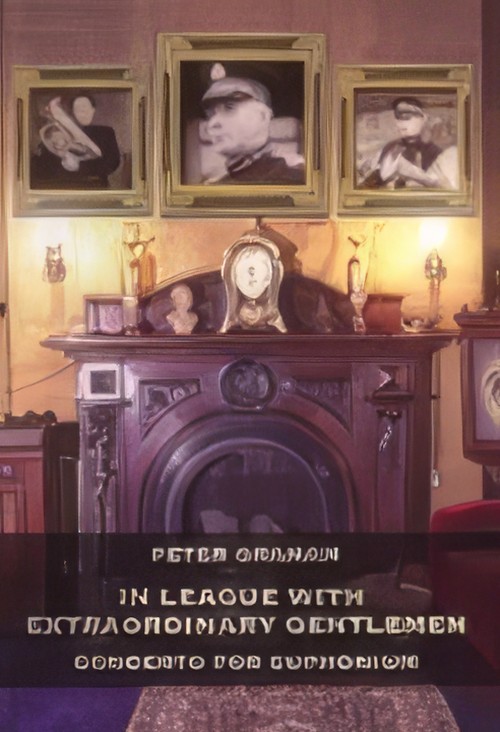
In League with Extraordinary Gentlemen (Euphonium Solo with Brass Band - Score and Parts) - Graham, Peter
Concerto for EuphoniumIn League with Extraordinary Gentlemen combines two of composer Peter Graham's life interests - composition and 19th century popular fiction. Each of the concerto's three movements takes its musical inspiration from extraordinary characters who have transcended the original genre and have subsequently found mass audiences through film, television and comic book adaptations.The first movement follows a traditional sonata form outline with one slight modification. The order of themes in the recapitulation is reversed, mirroring a plot climax in the H.G. Wells novella The Time Machine (where the protagonist, known only as The Time Traveller, puts his machine into reverse bringing the story back full circle).The Adventure of the Final Problem is the title of a short story published in The Memoirs of Sherlock Holmes by Arthur Conan Doyle. This is an account of the great detective's final struggle with his long-time adversary Professor Moriarty at the Reichenbach Falls in Switzerland. The music takes the form of a slowed down lndler (a Swiss/Austrian folk dance) and various acoustic and electronic echo effects call to mind the alpine landscape. The final bars pose a question paralleling that of Conan Doyle in the story - have we really seen the last of Sherlock Holmes?The final movement, The Great Race, (available separately) follows Phileas Fogg on the last stage of his epic journey "Around the World in Eighty Days" (from the novel by Jules Verne). The moto perpetuo nature of the music gives full rein to the soloist's technical virtuosity. As the work draws to a conclusion, the frantic scramble by Fogg to meet his deadline at the Reform Club in Pall Mall, London, is echoed by the soloist's increasingly demanding ascending figuration, set against the background of Big Ben clock chimes.In League with Extraordinary Gentlemen was first performed in the brass band version by David Thornton and the Black Dyke Band, conductor Nicholas Childs, at the RNCM Concert Hall Manchester on January 30, 2009.
Estimated dispatch 7-14 working days
-
 £79.95
Introduction, Elegy and Caprice (Brass Band - Score and Parts) - Calvert, Morley
This work was written by Morley Calvert, the Canadian composer, especially for the first European Brass Band Championships held in 1978.The piece consists of three contrasting movements. The Introduction opens with a slow, mysterious figure after the first fanfare-like unison notes. This leads to the main section, a quick 'one-in-a-bar' movement centred around a persistent figure.The Elegy opens with an unaccompanied Euphonium solo, which is then passed through to horn, cornet, and basses in the manner of a passacaglia. This is broken and then the movement fragments.After the tension of the Elegy, the Caprice provides much needed relief: a spritely dance, very rhythmical in character, the theme of which is thrown around the band with great abandon.
Estimated dispatch 7-14 working days
-
£39.95
Introduction, Elegy and Caprice (Brass Band - Score only) - Calvert, Morley
This work was written by Morley Calvert, the Canadian composer, especially for the first European Brass Band Championships held in 1978.The piece consists of three contrasting movements. The Introduction opens with a slow, mysterious figure after the first fanfare-like unison notes. This leads to the main section, a quick 'one-in-a-bar' movement centred around a persistent figure.The Elegy opens with an unaccompanied Euphonium solo, which is then passed through to horn, cornet, and basses in the manner of a passacaglia. This is broken and then the movement fragments.After the tension of the Elegy, the Caprice provides much needed relief: a spritely dance, very rhythmical in character, the theme of which is thrown around the band with great abandon.
Estimated dispatch 7-14 working days
-
 £44.95
Patterns (Brass Band - Score and Parts) - Gregson, Edward
Building musical paragraphs using short, irregular rhythmical patterns became a favourite Gregson formula in the early 1970s. Patterns is the clearest and most disciplined example. By limiting himself to a single musical motif, heard at the outset on trombones, Gregson offers a true test of technique and musicianship in a concise three part structure. The opening is another Gregson prelude with alternating patterns of 3s, 4s, 5s and 7s that are bonded by a constant quaver pulse. The music here possesses a neo-classical, pristine quality. In the central episode, the same triadic figure is transformed into a lilting barcarolle-like dialogue beginning on solo cornet and horn. When the whole band becomes involved, the trombones add a moment of bi-tonal ambiguity, which sets in motion an exuberant Latin dance and final flourish.Patterns was commissioned by the Butlins Youth Brass Band Championships for the 1974 competition at the Royal Albert Hall.Duration: 5.00
Estimated dispatch 7-14 working days
 View Music