Results
-
£149.99A Tribute to Henk Badings - Rob Goorhuis
The motivation for composing this test piece for the Concert Division Brassband of the 2001 WMC was Rob Goorhuis's deep respect for one of the greatest Dutch composers of the 20-th century who also enlarged the wind band repertoire in a most valuable way. Goorhuis wanted to light up the "soft and kind" side of the brassband and wrote about this composition : "The basis is a theme of twelve tones wich Badings once played at an International Organ Improvisation Contest in Haarlem.My organ teacher participated in that contest and so the theme remained somehow in the back of my mind." The composer worked out a series of variations and clustered them into bundles ofthree and so the melody kept its diversity while remaining easy to recognise.
Estimated dispatch 5-14 working days
-
£124.95Dynasty (Brass Band - Score and Parts) - Graham, Peter
Dynasty takes the form of a Symphonic Poem, a musical form first introduced to a contest audience at the Crystal Palace in 1913 by Percy Fletcher in his work Labour and Love.Using key passages from the autobiography of Harry Mortimer, On Brass, as the source for the narrative, the work opens with a four-note leitmotif (Harry's theme, "as if descending from the heavens"), and the timeline unfolds as follows:Harry - One's destiny decided at birth "I'll make him the best cornet player in England"War - Why do the nations so furiously rage together? Fred volunteers for military serviceTheatre - And suddenly "I dashed to the rescue like a hero in the silent movies I was about to get to know so well"Journey - Comfort Ye A new life and new challengesTogether - Come unto me "A golden age"Farewell - For behold, darkness "Fred's death surely marked the passing of an era"Amen - The Trumpet shall soundListeners familiar with brass band repertoire will recognise a few pertinent quotes within the piece.In my imagination Harry is joined by Fred on cornet and the euphoniums of Alex and Rex for the quartet cadenza from Sovereign Heritage by Jack Beaver in Together.The Amen section from Handel's Messiah provides the basis for a contrapuntal flight of fancy as the work moves towards a conclusion. Other less overt fragments contribute to the story.Dynasty was co-commissioned by the British Open Brass Band Championships for the September 2019 contest, and the Brass Band Committee VLAMO for the Belgian Brass Band Championships 2019.- Peter GrahamDuration: 17.00
Estimated dispatch 7-14 working days
-
£99.95Malcolm Arnold Variations (Score and Parts)
MALCOLM ARNOLD VARIATIONS was commissioned by Philip Biggs and Richard Franklin for the 20th All England Masters International Brass Band Championship held in the Corn Exchange, Cambridge on 25 May 2008. The work is dedicated to Anthony Day, long time carer of Sir Malcolm Arnold in his final years. I first met Malcolm and Anthony in 1990 and remained in constant touch until Malcolm's passing in 2006. Anthony, of course, remains a friend and plays his own role subliminally in this piece. The work is not based on any of Malcolm Arnold's own themes, rather it is a portrait of him (and by association Anthony Day) through my eyes and as a result of my friendship with both parties over some 18 years. If there is any theme as such it is the personalities of the players, the protagonist and his carer placed together by my own efforts coloured and influenced by aspects of Arnold's style and technique without recourse to direct quotation but through allusion and parody. It is of course designed as a brass band test piece but in my eyes is first and foremost a musical challenge. The pyrotechnical elements are there but always secondary to the musical thrust of the work's structure. I have long beforehand submerged myself in Malcolm Arnold's music and ultimately delivered this tribute. Music Directors will be advised to acquaint themselves with the composer's personal music, particularly the film scores, symphonies, concertos and ballets: the solutions towards a successful interpretation of my piece are all in there - and YES, I want, and sanction, this piece to be interpreted, and therein lies the challenge for those of you 'up front'! The challenge for players is that of virtuosity, ensemble and careful attention to where they are individually in relation to their colleagues - a question of balance, taste and insight. With regard to tempi, as is my usual custom, I have indicated all metronome marks with the prefix circa. I would suggest that the fast music is played at these tempos but that the more rubato moments can be allowed some freedom in expression and fluidity of line. With regard to the type of mutes to be employed - this decision I leave to the discretion of players and conductors. Structurally the work is cast as an Introduction, 20 Variations and a Finale. Some variations are self contained, others run into each other as sequences in the same tempo. In other variations, segments are repeated and developed. I could describe the overall concept as a miniature ballet or a condensed film score - there is much drama and character and the repeated elements assist this in driving the action forward. I have deliberately avoided the more extremely dark qualities of Malcolm's own music in this, my celebration of this master-composer, as I have always viewed (and evidenced by my previous Masters scores Tristan Encounters and Chivalry) that the Cambridge contest is a 'sunshine- affair' and firmly believe that Malcolm Arnold would have had it no other way too!
Estimated dispatch 7-14 working days
-
£49.95Malcolm Arnold Variations (Score Only)
MALCOLM ARNOLD VARIATIONS was commissioned by Philip Biggs and Richard Franklin for the 20th All England Masters International Brass Band Championship held in the Corn Exchange, Cambridge on 25 May 2008. The work is dedicated to Anthony Day, long time carer of Sir Malcolm Arnold in his final years. I first met Malcolm and Anthony in 1990 and remained in constant touch until Malcolm's passing in 2006. Anthony, of course, remains a friend and plays his own role subliminally in this piece. The work is not based on any of Malcolm Arnold's own themes, rather it is a portrait of him (and by association Anthony Day) through my eyes and as a result of my friendship with both parties over some 18 years. If there is any theme as such it is the personalities of the players, the protagonist and his carer placed together by my own efforts coloured and influenced by aspects of Arnold's style and technique without recourse to direct quotation but through allusion and parody. It is of course designed as a brass band test piece but in my eyes is first and foremost a musical challenge. The pyrotechnical elements are there but always secondary to the musical thrust of the work's structure. I have long beforehand submerged myself in Malcolm Arnold's music and ultimately delivered this tribute. Music Directors will be advised to acquaint themselves with the composer's personal music, particularly the film scores, symphonies, concertos and ballets: the solutions towards a successful interpretation of my piece are all in there - and YES, I want, and sanction, this piece to be interpreted, and therein lies the challenge for those of you 'up front'! The challenge for players is that of virtuosity, ensemble and careful attention to where they are individually in relation to their colleagues - a question of balance, taste and insight. With regard to tempi, as is my usual custom, I have indicated all metronome marks with the prefix circa. I would suggest that the fast music is played at these tempos but that the more rubato moments can be allowed some freedom in expression and fluidity of line. With regard to the type of mutes to be employed - this decision I leave to the discretion of players and conductors. Structurally the work is cast as an Introduction, 20 Variations and a Finale. Some variations are self contained, others run into each other as sequences in the same tempo. In other variations, segments are repeated and developed. I could describe the overall concept as a miniature ballet or a condensed film score - there is much drama and character and the repeated elements assist this in driving the action forward. I have deliberately avoided the more extremely dark qualities of Malcolm's own music in this, my celebration of this master-composer, as I have always viewed (and evidenced by my previous Masters scores Tristan Encounters and Chivalry) that the Cambridge contest is a 'sunshine- affair' and firmly believe that Malcolm Arnold would have had it no other way too!
Estimated dispatch 7-14 working days
-
£38.00Monteverdi Three Miniatures
ABOUT THIS PIECE: Monteverdi - Three Miniatures, is an engaging and educational brass band arrangement by Adam Taylor, originally composed for the British Open Youth Brass Band Contest at the Guild 2015. This piece masterfully reimagines themes from the works of Claudio Monteverdi, presenting them in a contemporary style that's both accessible and inspiring for modern brass ensembles. Ideal for youth bands and ensembles looking to explore early music in a fresh format, Monteverdi - Three Miniatures offers flexibility and creativity. The arrangement includes adaptable tempos to match your interpretation, a featured duet with parts available in both Bb and Eb, and written percussion parts that can be expanded with additional instruments or streamlined for smaller sections. Players are encouraged to add their own ornamentation, allowing for personal expression and an authentic touch to the music. With its nod to the grandeur of the late Renaissance and early Baroque periods, this piece serves not only as an excellent concert addition but also as a valuable educational tool, introducing young musicians to Monteverdi's timeless work. Dive into this vibrant arrangement and bring the essence of Monteverdi's genius to your next performance. ENSEMBLE: Standard British Brass Band (with adaptations) WHEN YOU BUY THIS PRODUCT, YOU GET: High-quality printed score and parts LEVEL: 1 LISTEN: Click here DURATION: 5-minutes, 30-secondsEXAMPLE SCORE: Click here LEVEL GUIDE: Level 1- Accessible to all Level 2 - c. UK third section and higher Level 3 - c. UK second section and higher Level 4 - c. UK first section and higher Level 5 - c. UK championship section level
Estimated dispatch 5-7 working days
-
£65.00Second Suite in F - Brass Band Sheet Music Full Score & Parts - LM602 - Gustav Holst
COMPOSER: Gustav HolstTRANSCRIBED : Daniel S. AugustineA brand transcription from Holst's manuscript score for brass band.A very authentic version from the original for Military Band.Can be used as a testpiece in your next own choice contestSuitable for Section 3 bands upwardsSecond Suite in FOp. 28, No. 2 (1922)1. MarchThe "March" of the Second Suite begins with a simple five note motif between the low and high instruments of the band. The first folk tune is heard in the form of a traditional British brass band march using the morris-dance tune "Glorishears". After a brief climax, the second strain begins with a euphonium solo playing the second folk tune in the suite "Swansea Town". The theme is repeated by the full band before the trio. For the trio, Holst modulates to the unconventional subdominant minor of Bb minor and changes the time signature to 6/8, thereby changing the meter. Usually one would modulate to subdominant major in traditional march form. While Sousa, reputably the "king of marches", would sometimes change time signatures for the trio (most notably in "El Capitan"), it was not commonplace. The third theme, called "Claudy Banks",[2] is heard in a low woodwind soli, as is standard march orchestration. Then the first two tunes are repeated da capo.2. Song without Words "I'll Love My Love"Holst places the fourth folk song, "I'll Love My Love" in stark contrast to the first movement. The movement begins with a chord and moves into a solo over a flowing accompaniment. The solo is then repeated, forming an arc of intensity. The climax of the piece is a fermata, followed by a cornet pick-up into the final measures of the piece.3. Song of the BlacksmithAgain, Holst contrasts the slow second movement to the rather upbeat third movement which features the folk song "A Blacksmith Courted Me". There are many time signature changes (4/4 to 3/4) making the movement increasingly difficult because the accompaniment has a pick up on the up-beats of each measure. The band joins in on the melody around the body of the piece and are accompanied with the sound of a blacksmith forging metal with an anvil called for in the score. The final major chord has a glorious, heavenly sound, which opens way to the final movement.This chord works so effectively perhaps because it is unexpected.4. Fantasia on the "Dargason"This movement is not based on any folk songs, but rather has two tunes from Playford's Dancing Master of 1651. The finale of the suite opens with a solo based on the folk tune "Dargason", a 16th-century English dance tune included in the first edition of The Dancing Master. The fantasia continues through several variations encompassing the full capabilities of the band. The final folk tune, "Greensleeves", is cleverly woven into the fantasia by the use of hemiolas, with Dargason being in 6/8 and Greensleeves being in 3/4. At the climax of the movement, the two competing themes are placed in competing sections.As the movement dies down, a duet forms a call back to the beginning of the suite with the competition of low and high registers.The name 'dargason' may perhaps come from an Irish legend that tells of a monster resembling a large bear (although much of the description of the creature has been lost over time), the Dargason tormented the Irish countryside. During the Irish uprising of the late 18th century, the dargason is supposed to have attacked a British camp killing many soldiers. This tale aside, 'dargason' is more likely derived from an Old English word for dwarf or fairy, and the tune has been considered English (or Welsh) since at least the 16th century. It is also known as 'Sedony' (or Sedany) or 'Welsh Sedony'.
In Stock: Estimated dispatch 3-5 working days
-
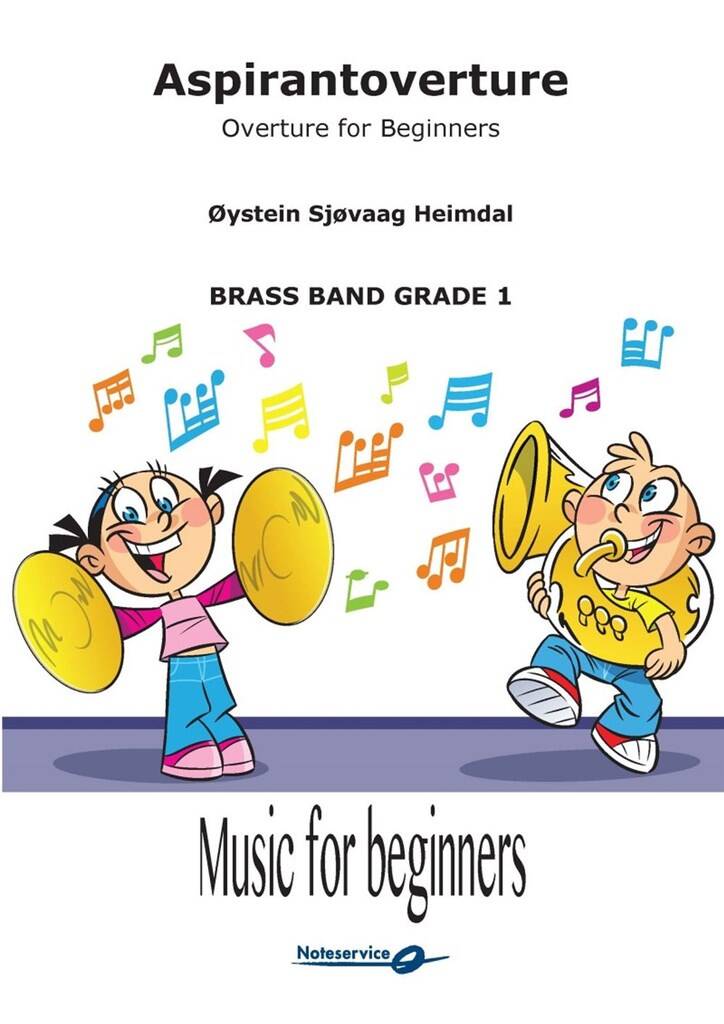
£105.20Aspirantoverture - Øystein Sjøvaag Heimdal
This original piece is intended to performed by the youngest musicians. The structure of the overture is traditional A-B-A with a slow section in the middle flanked by two Modearo sections. As the title suggest, the piece is well suited as a concert opener but also for contest use. All parts challenges the young players in many ways, both the wind- and percussionists. Please be aware of the contrasts in dynamics throughout the piece.
Estimated dispatch 5-14 working days
-
£33.32Pachelbel Rock (Brass Band) Johan Pachebel arr. Steven Ponsford
Johann Pachelbel's Canon in D is a cornerstone of the Baroque period, a work widely known and frequently heard at concerts and events globally. This brass band arrangement by Steven Ponsford offers a new perspective on this classical piece. The arrangement begins with the familiar ground bass theme, followed by a series of four-bar motifs. Ponsford has developed these motifs, distributing them across the band to give interest to every section of the band. A short fugue is included in the middle of the piece, referencing a style Pachelbel contributed to. The majority of the music is accompanied by a rock beat, aiming to create a fresh and lighthearted interpretation of the original work. This will be an ideal item for both concert and entertainment contest programmes. To view a performance video of the work please visit www.youtube.com/watch?v=M-yrBCM4xzQ Duration: approx. 4.00 minutes Difficulty Level: 2nd Section + PDF download includes parts and score. Sheet music available at www.brassband.co.uk (UK) or www.cimarronmusic.com (USA) Instrumentation: Soprano Cornet Eb Solo Cornet Bb Repiano Cornet Bb 2nd Cornet Bb 3rd Cornet Bb Flugel Horn Bb Solo Horn Eb 1st Horn Eb 2nd Horn Eb 1st Baritone Bb 2nd Baritone Bb 1st Trombone Bb 2nd Trombone Bb Bass Trombone Euphonium Bb Bass Eb Bass Bb Bass Drum Timpani Percussion 1-3
In Stock: Estimated dispatch 1-3 working days
-
£59.24The Glory of Colour (Brass Band) Ivan G. Andrews
This work by Ivan Andrews was inspired by the large Baptistry window of the new Coventry Cathedral and will be suitable both as a contest or concert work. The window was conceIved and designed by Basil Spence and was intended to be a worldwide experience. When installed it was claimed to be "the single largest window in stained glass that hitherto had ever been contemplated and brought into existance." The stained glass design was done by artist John Piper and when completed was described by Bishop Bardsley as a "triumphant expression of faith, a faith encapsulated in the 'glory of colour'".* Hence the title for the piece. The composer writes: 'When thinking of this music the traditional tune now often called Monks Gate kept coming to me. The words often sung to this tune were penned by John Bunyan and each stansa ends with the words "To be a pilgrim". The Cathedral in Coventry, although a Christian Church, is designed to bring all faiths together in Unity - there is a "Unity Chapel" opposite the Baptistry window so the concept of pilgrimage seemed perfectly apt to me. The music is therefore designed to reflect many colours as there are many expressions of faith. Single fragments of the Monks Gate tune are used as a basis for what might be deemed 'variations'. The tune is heard in full towards the end of the piece and then the music rises to a climax of bright brilliant white light. The colours of the window are darker on the outer edges but they all circulate towards the brilliant white at the centre - representing the source of all faith.' To view a rolling score video of the work please visit https://www.youtube.com/watch?v=zPN_EhhMDAE Duration: Approx. 11.30 minutes Difficulty Level: 2nd Section + PDF download includes parts and score. Sheet music available from www.brassband.co.uk Instrumentation: Soprano Cornet Eb Solo Cornet Bb Repiano Cornet Bb 2nd Cornet Bb 3rd Cornet Bb Flugel Horn Bb Solo Horn Eb 1st Horn Eb 2nd Horn Eb 1st Baritone Bb 2nd Baritone Bb 1st Trombone Bb 2nd Trombone Bb Bass Trombone Euphonium Bb Bass Eb Bass BbTimpani Percussion 1-2
In Stock: Estimated dispatch 1-3 working days
-
£44.43Summit (Brass Band) Andrew Batterham
Summit is a powerful descriptive work, lifting from broad beginnings to an exciting climax. It was written for the Hyde Street Youth Band in Melbourne's west, for the 2023 Australian National Band Championships. The piece was designed to give the band a chance to display their credentials. It will be an ideal choice for youth bands and above for both concert and contest programmes. To view a video of Hyde Street Junior Band performing the piece please visit www.youtube.com/live/G9klW3mhyI8?feature=share&t=7397 (the performance commences at 2:03:17) PDF download includes score and parts. Sheet music available from: UK - www.brassband.co.uk USA - www.cimarronmusic.com Difficulty Level: 4th Section + Instrumentation: Soprano Cornet Eb Solo Cornet Bb Repiano Cornet Bb 2nd Cornet Bb 3rd Cornet Bb Flugel Horn Bb Solo Horn Eb 1st Horn Eb 2nd Horn Eb 1st Baritone Bb 2nd Baritone Bb 1st Trombone Bb 2nd Trombone Bb Bass Trombone Euphonium Bb Bass Eb Bass Bb Percussion 1-3
In Stock: Estimated dispatch 1-3 working days