
Results
-
 £89.95
The Four Elements (Euphonium Solo with Brass Band - Score and Parts) - Ellerby, Martin
Partita for Solo Euphonium and Brass BandThe Four Elements was written for Gary Curtin and the Black Dyke Band as part of a recording project of Martin Ellerby's brass band music. The composer, having previously written a large scale concerto for the euphonium, decided to write something much more concise though still enabling the soloist to display flair and lyricism in equal measure. Each movement is approximately 2 minutes long, a set of miniatures, based on the four elements of earth, water, air and fire, and are given their Latin manes of terra, aqua, aer and ignis in the score. The term partita is used to indicate that the work is a collection, or suite, of pieces and in keeping with former examples, uses both song and dance forms to provide suitable musical structures.Duration: 8.00
Estimated dispatch 7-14 working days
-
 £24.95
SALT OF THE EARTH, FINALE (Brass Band Parts) - Scott, Andy
Brass Band parts only. A full band arrangement created by the composer from the third movement of 'Salt of the Earth', a Concerto for Tuba & Brass Band is a fiery mix of Latin rhythms and big band power! With a virtuosic introduction from the solo cornets and percussion, the full band then enters with the catchy melody, before a two part contrapuntal passage that leads into a series of short 'solo breaks'. The main theme returns, re-scored for added impact, before an extended contrapuntal section, which leads to two closing paused chords, which may be separated by an optional extended drum/percussion solo if required. Dur: 3:30
Estimated dispatch 7-14 working days
-
£15.00
SALT OF THE EARTH, FINALE (Brass Band Score) - Scott, Andy
Brass Band score only. A full band arrangement created by the composer from the third movement of 'Salt of the Earth', a Concerto for Tuba & Brass Band is a fiery mix of Latin rhythms and big band power! With a virtuosic introduction from the solo cornets and percussion, the full band then enters with the catchy melody, before a two part contrapuntal passage that leads into a series of short 'solo breaks'. The main theme returns, re-scored for added impact, before an extended contrapuntal section, which leads to two closing paused chords, which may be separated by an optional extended drum/percussion solo if required. Dur: 3:30
Estimated dispatch 7-14 working days
-
 £20.00
SALT OF THE EARTH, GOSPEL (Euphonium Solo with Brass Band Parts) - Scott, Andy
Brass Band parts only, solo part not included - available separately. 'Salt of the Earth Gospel' is a new arrangment for Solo Euphonium and Brass Band of the second movement of the Concerto for Tuba 'Salt of the Earth'. It is a seven-bar melody that is passed around different soloists whilst the solo euphonium weaves in and out of the melody in an almost improvisatory way. Tension is created by a gradual dynamic build with an ensemble release before the soloist gently brings the piece to rest. Dur: 4:30
Estimated dispatch 7-14 working days
-
£14.00
SALT OF THE EARTH, GOSPEL (Euphonium Solo with Brass Band Score) - Scott, Andy
Brass Band score only. 'Salt of the Earth Gospel' is a new arrangment for Solo Euphonium and Brass Band of the second movement of the Concerto for Tuba 'Salt of the Earth'. It is a seven-bar melody that is passed around different soloists whilst the solo euphonium weaves in and out of the melody in an almost improvisatory way. Tension is created by a gradual dynamic build with an ensemble release before the soloist gently brings the piece to rest. Dur: 4:30
Estimated dispatch 7-14 working days
-
 £44.95
Contest Music (Brass Band - Score only) - Heaton, Wilfred
Butlins 2018 Championship Section. One of the three choices of set works. The others were Year of the Dragon (Sparke) and Concerto for Brass Band No.1 (Venables).
Estimated dispatch 7-14 working days
-
£94.95
Contest Music (Brass Band - Score and Parts) - Heaton, Wilfred
Butlins 2018 Champsionship Section. One of the three choices of set works. The others were Year of the Dragon (Sparke) and Concerto for Brass Band No.1 (Venables).
Estimated dispatch 7-14 working days
-
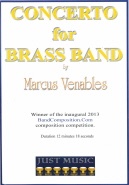 £65.00
CONCERTO for Brass Band No.1 (Venables) (Brass Band Set) - Venables, Marcus
Butlins 2018 Champsionship Section. One of the three choices of set works. The others are Contest Music (Heaton) and Year of the Dragon (Sparke)
Estimated dispatch 7-14 working days
-
 £82.95
CONCERTO FOR TRUMPET (or CORNET) (Cornet/Brass Band) - Sparke, Philip
Recorded on Polyphonic QPRL066D Twilight Dreams, Polyphonic QPRL070D Solo.
Estimated dispatch 7-14 working days
-
£82.95
CONCERTO FOR TRUMPET (or Cornet) (Trumpet or Cornet/Brass Band - Score and Parts) - Haydn, Joseph - Wright, Frank
.
Estimated dispatch 7-14 working days
 View Music