Results
-
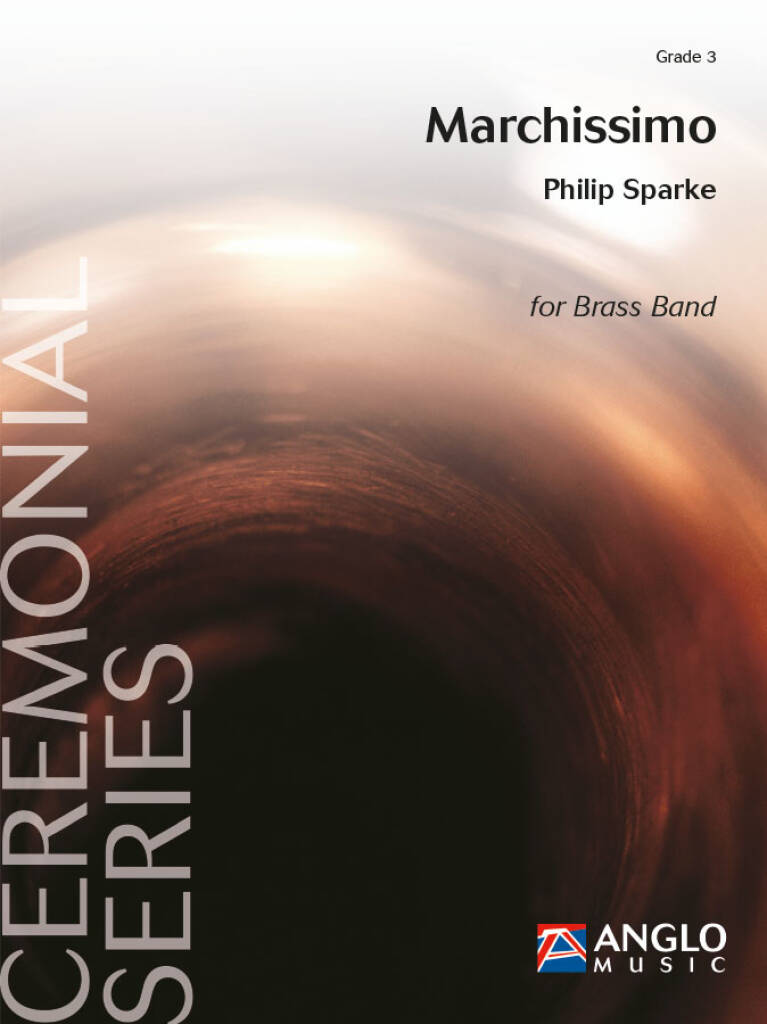
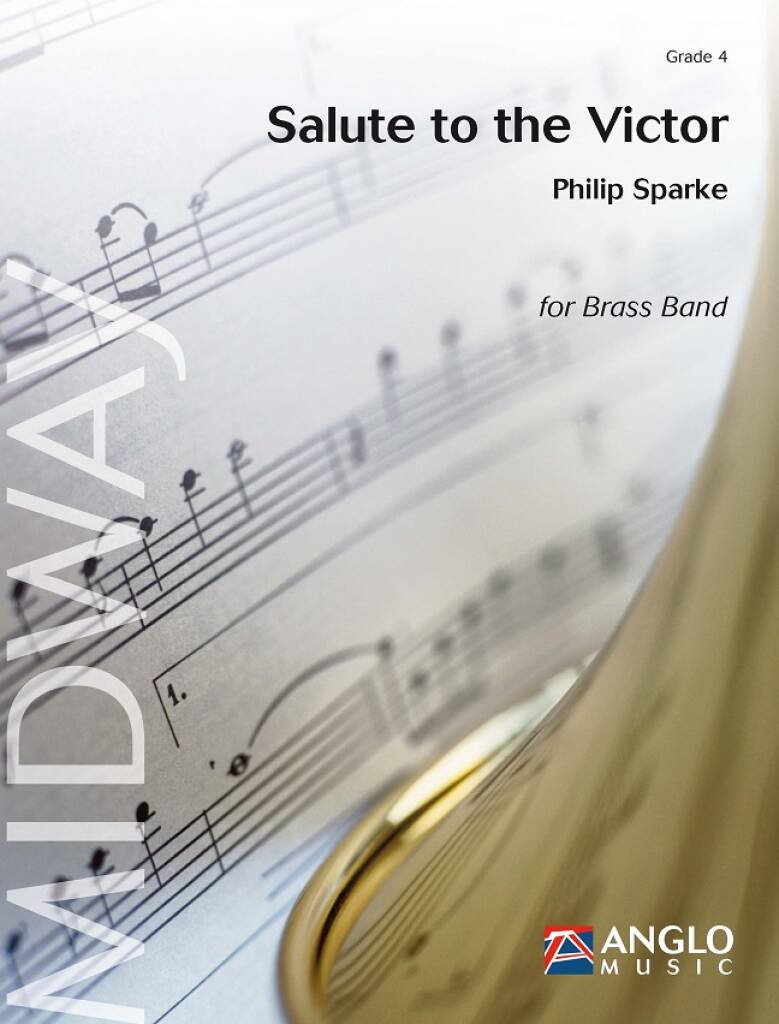
£59.99Salute to the Victor - Philip Sparke
Salute to the Victor is in traditional march form and contains, as a tribute to Victor Grieve who was a devotee of English music (in particular that of Sir Edward Elgar), a short quote from Elgar's Sea Pictures in the trio. Salute to the Victor was commissioned by Helen, Alex and James Grieve for the Golden Kangaroos (Hornsby Concert Band) from Sydney, Australia, in memory of their parents, Louise and Victor Grieve, Founder and Director.
Estimated dispatch 5-14 working days
-
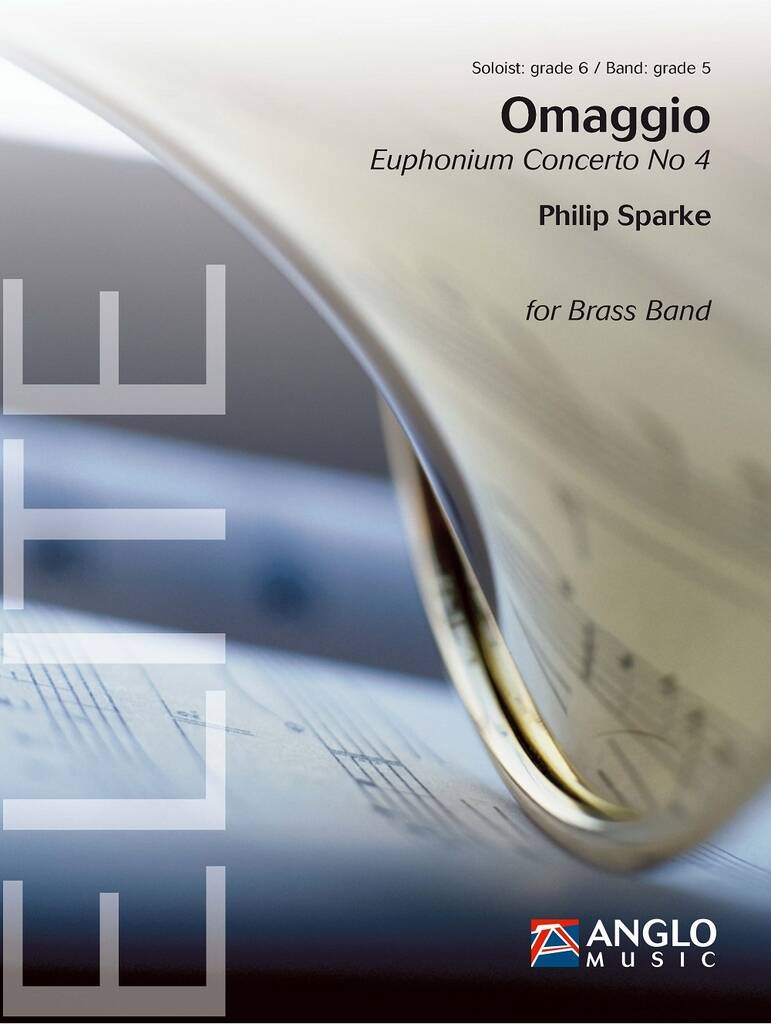
£91.99A Bandsman's Overture - Philip Sparke
A Bandsman's Overture was commissioned by British Bandsman magazine to celebrate its 125th anniversary in 2012.It was premiered by Black Dyke Band, conducted by Dr Nicholas Childs, at a special anniversary concert held in Symphony Hall, Birmingham, on July 1st.British Bandsman was for a period known as British Bandsman and Contest Field, following an amalgamation of two magazines. The then owner, John Henry Iles, celebrated this new title by commissioning Ord Hume to write the famous march, BB & CF. As a salute to this heritage A Bandsman's Overture starts with thefour notes, B(b)-B(b)-C-F, a motive which permeates an opening fanfare, which contrasts a busy opening with a more legato central section.This gives way to a bustling Vivo, based on repeated staccato notes. A change of key heralds a central cantabile melody, first on euphoniums and baritone and then played by the full band, which is followed by a short development section. This leads to a transformed reprise and a return of the opening fanfare, decorated this time by florid muted cornets.
Estimated dispatch 5-14 working days
-
£76.99Cortege de Bacchus - Léo Delibes - Stephen C. Barnwell
This majestic processional march entitled Cortge de Bacchus (Procession of Bacchus) is an extract taken from one of the most popular scenes in the ballet Sylvia by the celebrated 19th Century French composer Lo Delibes.In this arrangement for brass band by Stephen C. Barnwell, it can be used an ideal concert opener or for any festive occasion.
Estimated dispatch 5-14 working days
-
£29.95SOUNDS OF CHRISTMAS (Full Score)
Sounds of Christmas is a brand new collection of 36 Christmas arrangements and compositions that can be played by groups as small as five players, with the parts available as follows: Part 1: Bb and C; Part 2: Bb, Eb and F; Part 3: Bb, Eb, F and C BC; Part 4: Bb TC and C BC; Part 5: Eb TC, Bb TC and C BC. The full score does not contain all the instruments available, only the Bb and Eb pitched instruments (except the optional Eb Soprano cornet) and Percussion. Sounds of Christmas is sure to add interest to your Christmas carol playing and offers interesting additions to your Christmas concert repertoire. Includes: A Holly Waltz (The Holly and the Ivy); A Starry Night; Away in a Manger; Chiming Bells (Sweet Chiming Christmas Bells); Christmas Joy (March); Christmas Praise (March); Coventry Carol; Ding Dong! (Ding Dong! Merrily on High); God Rest You Merry, Gentlemen; Good Christian Men, Rejoice; Good King Wenceslas; Hark! THe Herald Angels Sing; Have Yourself a Merry Little Christmas; Infant Holy; It Came Upon a Midnight Clear; Jesus, Good Above All Other; Joy to the World; Mary's Boy Child; Mid-Winter (In the Bleak Mid-Winter); Normandy Carol (Away in a Manger); O Come, All Ye Faithful; O Little Town of Bethlehem; Once in Royal David's City; Rudolph, the Red-Nosed Reindeer; Silent Night; Sounds of Christmas (March Medley); The Andel Message (While Shepherds Watched); The Everlasting Light (O Little Town of Bethlehem); The First Nowell; The Infant King; The Manger Scene; The Virgin Mary had a Baby Boy; Three Kings' March; To Celebrate His Birth (March); We Wish You a Merry Christmas; Yuletide Rag (Deck the Hall).
Estimated dispatch 7-14 working days
-
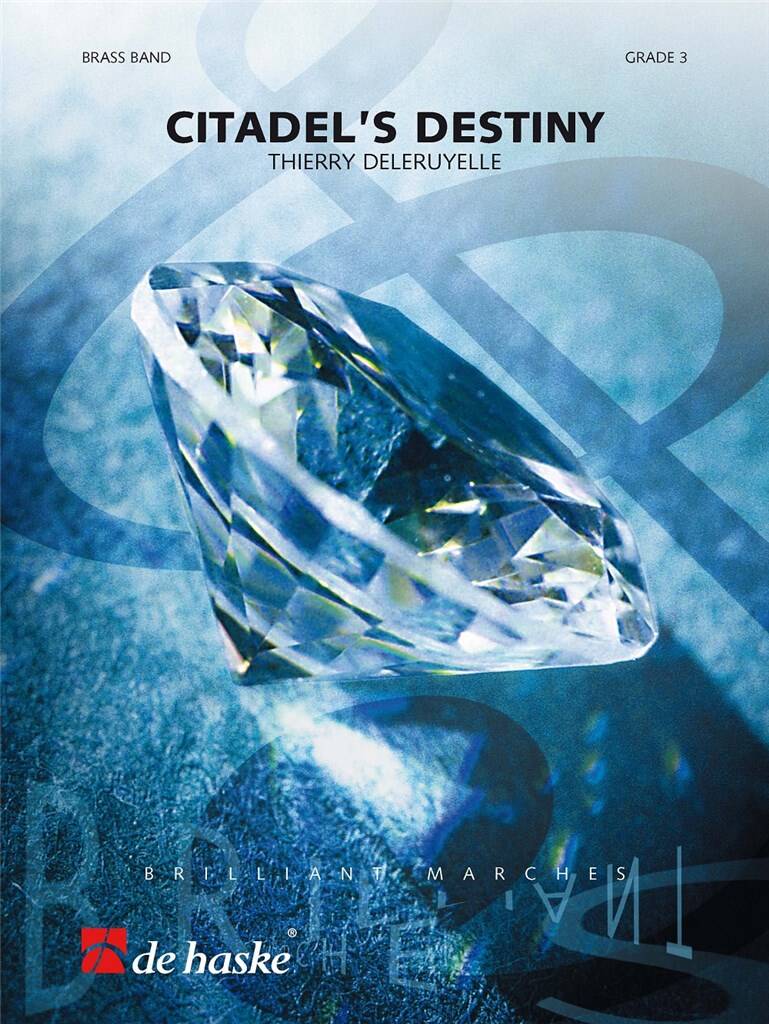
£60.99Citadel's Destiny (Brass Band - Score and Parts) - Deleruyelle, Thierry
Citadel's Destiny is a march that can be performed either in concert or on parade. It was commissioned by the Musique de l'Infanterie de Lille. A special feature is that it adheres to the conventional codes of military marches, albeit with a modern twist. The title refers to the citadel built by Vauban in Lille, "The Queen of Citadels", with which the band shares a destiny. This march is still performed by the Infantry Band as part of their traditional concert repertoire. Duration: 4.15
Estimated dispatch 7-14 working days
-
£30.00Sine Metu - Andrew Duncan
Commissioned in 2008 by the Bo'ness and Carriden Band to celebrate their 150th anniversary, this march is now available for other bands to enjoy as a great opener or closer for any concert.Its title takes the band's own motto, translated as "Without Fear", and the march offers an exciting and lively programme choice with a lovely strident trio section coming from the lower brass.An exciting item for any concert programme or entertainment competition.
In Stock: Estimated dispatch 3-5 working days
-
£45.00Symphony No.1, Finale from (Brass Band - Score and Parts) - Rachmaninoff, Sergei - Littlemore, Phillip
Rachmaninov composed his First Symphony in 1895, at the age of just 22 years. It received its first performance on March 27, 1897, at a Russian Symphony Society concert in St. Petersburg with Alexander Glazunov conducting. The premiere was not well-received, and Rachmaninov himself blamed Glazunov for a lacklustre approach for beating time rather than finding the music. Some contemporary reports even suggested that Glazunov was inebriated when he took to the stage! Despite the disappointment of the premiere performance, Rachmaninov never destroyed the score but left it behind when he left Russia to settle in the West, eventually it was given up for lost. After the composer's death, a two-piano transcription of the symphony surfaced in Moscow, followed by a set of orchestral parts at the conservatory in Saint Petersburg. In March 1945, the symphony was performed in Moscow for the first time since its 1897 premiere. It was a grand success, and this led to a new and more enthusiastic evaluation of the symphony. In March 1948 it received a similarly successful American premiere and the work proceeded to establish itself in the general repertory. The final movement (Allegro con fuoco) is colourful and grand but not without its darkly contrasting, menacing episodes that intensifies its malevolence. It is a work overflowing with ideas demonstrating a strong, highly individual, and self-assured young talent. Duration: 5:40
Estimated dispatch 7-14 working days
-
All for One! - Caradog, Hughes & Forslund - Maurice Forslund
'All for One' is a road march based on two well-known Welsh melodies 'Rachie' by Caradog Roberts and 'Calon Lan' by John Hughes. Supporters of Welsh Rugby Union will probably have sung them on more than one occasion. The two melodies have been assembled, added to, and arranged by our colleague Maurice Forslund in Stockholm, and the resulting march is one that is straightforward, in the traditional Brass Band genre, and well within the capabilities of most bands. It works equally well as a concert opener or a processional march for the village fete.
-
£80.00The Unfortunate Traveller (Brass Band - Score and Parts) - Holst, Imogen - Hindmarsh, Paul
Imogen Holst (1907-1984) submitted The Unfortunate Traveller (1929) as her final work as a student portfolio at the Royal College of Music, where her composition teacher was Gordon Jacob. The title was taken from Thomas Nashe's famous 1594 picaresque novel of the same title. The Suite was first performed on 12 February 1933 at her Majesty's Theatre, Carlisle, by the St. Stephen's Band, with the composer conducting. Te concert was given in memory of Holst's uncle, Dr. H.A. Lediard. Holst had been impressed with the band's performance of his A Moorside Suite at the 1928 National Brass Band Championships (The Crystal Palace, South London) and was keen to work with them. Writing in Imogen Holst, a life in music, Christopher Grogan indicates that it was Gustav Holst's suggestion to include his daughter's work in the programme, quoting Imogen Holst's remarks made in interview to The Daily Mail as follows: "....it is the first time, so far as I know, that a woman has conducted a brass band at a public concert....It has been a delight to rehearse the St. Stephen's Band. It was their performance at the Crystal Palace Festival that inspired me to write this Suite, which I have dedicated to them."Imogen Holst accompanied her father to the Crystal Palace in 1928 to hear the performances of A Moorside Suite, and was so excited by the played and, audibly, by her father's music that she decided to write a brass band piece for her final examination. Te result was The Unfortunate Traveller (1929). However, it was not possible for her to present a brass band work for examination. She arranged it for string orchestra so that it could be played before she left the RCM in July 1930. Following the premiere of the original in 1933, the manuscripts did not resurface until 1969 Imogen found them among her late mother's effects. Although she requested score and parts be destroyed, they ended up in the possession of Manchester composer John Golland, who marked up the score presumably with the intention of creating a new performing edition. The original scoring reveals a lack of experience with what can be a tricky medium.With the agreement of the Holst Foundation, a revised edition, with additional percussion, was prepared in 2011 since when the work has been fortunate to travel round the world as a concert and contest piece. The original includes drums in the March only. The title was taken from Tomas Nashe's famous 1594 picaresque novel of the same title. Several Morris Dance tunes are introduced during the course of the four short movements, including Bonnie Green Garters, Shepherd's Hey, The Rose and The Wind Blaws Cauld. Quirky twists and turns of harmony and spirited rhythms that remind us how much Imogen Holst loved tradition English dance music.In September 2025, I made a performing edition of the composer's arrangement for string orchestra. The manuscript lacks the final movement, which I arranged in a similar style, ie. without extending the upper ranges. Making this edition raised some issues regarding the accuracy of my band version and some of the solutions I used to smooth out the voicing. I have used the composer's second thoughts to refine my performing edition and to correct a textual errors.- Paul HindmarshDuration: 10.00
Estimated dispatch 7-14 working days
-
£40.00The Unfortunate Traveller (Brass Band - Score only) - Holst, Imogen - Hindmarsh, Paul
Imogen Holst (1907-1984) submitted The Unfortunate Traveller (1929) as her final work as a student portfolio at the Royal College of Music, where her composition teacher was Gordon Jacob. The title was taken from Thomas Nashe's famous 1594 picaresque novel of the same title. The Suite was first performed on 12 February 1933 at her Majesty's Theatre, Carlisle, by the St. Stephen's Band, with the composer conducting. Te concert was given in memory of Holst's uncle, Dr. H.A. Lediard. Holst had been impressed with the band's performance of his A Moorside Suite at the 1928 National Brass Band Championships (The Crystal Palace, South London) and was keen to work with them. Writing in Imogen Holst, a life in music, Christopher Grogan indicates that it was Gustav Holst's suggestion to include his daughter's work in the programme, quoting Imogen Holst's remarks made in interview to The Daily Mail as follows: "....it is the first time, so far as I know, that a woman has conducted a brass band at a public concert....It has been a delight to rehearse the St. Stephen's Band. It was their performance at the Crystal Palace Festival that inspired me to write this Suite, which I have dedicated to them."Imogen Holst accompanied her father to the Crystal Palace in 1928 to hear the performances of A Moorside Suite, and was so excited by the played and, audibly, by her father's music that she decided to write a brass band piece for her final examination. Te result was The Unfortunate Traveller (1929). However, it was not possible for her to present a brass band work for examination. She arranged it for string orchestra so that it could be played before she left the RCM in July 1930. Following the premiere of the original in 1933, the manuscripts did not resurface until 1969 Imogen found them among her late mother's effects. Although she requested score and parts be destroyed, they ended up in the possession of Manchester composer John Golland, who marked up the score presumably with the intention of creating a new performing edition. The original scoring reveals a lack of experience with what can be a tricky medium.With the agreement of the Holst Foundation, a revised edition, with additional percussion, was prepared in 2011 since when the work has been fortunate to travel round the world as a concert and contest piece. The original includes drums in the March only. The title was taken from Tomas Nashe's famous 1594 picaresque novel of the same title. Several Morris Dance tunes are introduced during the course of the four short movements, including Bonnie Green Garters, Shepherd's Hey, The Rose and The Wind Blaws Cauld. Quirky twists and turns of harmony and spirited rhythms that remind us how much Imogen Holst loved tradition English dance music.In September 2025, I made a performing edition of the composer's arrangement for string orchestra. The manuscript lacks the final movement, which I arranged in a similar style, ie. without extending the upper ranges. Making this edition raised some issues regarding the accuracy of my band version and some of the solutions I used to smooth out the voicing. I have used the composer's second thoughts to refine my performing edition and to correct a textual errors.- Paul HindmarshDuration: 10.00
Estimated dispatch 7-14 working days