
Results
-
The Crown of Roses - Tchaikovsky - Len Jenkins
Tchaikovsky wrote this in his 'Songs for Young People' in Moscow in 1883 to words by Pletchtcheev. The story it tells is about Jesus Christ when he was a young child, having a small wild garden in which roses grew. Passing children saw the roses and plucking them mockingly asked if he wove rose garlands in his hair. Christ says to take the roses, but to leave the thorns. Instead, they make a crown of these and forced it onto his head so that it bleeds, symbolic of what was going to happen later in his lifetime. The melody contains all the passion that we associate with Russian church music and is equally suitable for a contemplative Christmas or Passiontide. This arrangement is faithful to the four verses of the original lyrics, but with an optional ending half-way if preferred.
-
 £45.00
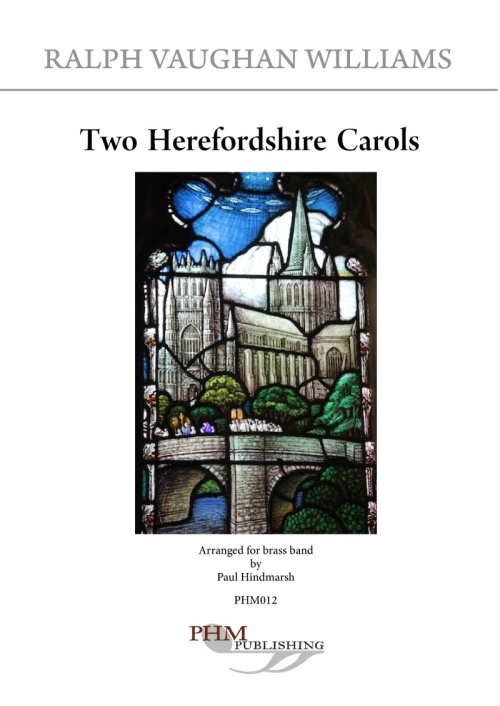
Two Herefordshire Carols (Brass Band - Score and Parts)
The two traditional tunes that comprise this straightforward setting were sung to Ralph Vaughan Williams (1872-1958) by Mrs. Esther Smith of Dilwyn, near Hereford, during one of the great composer's folk song collecting tours of England in the early years of the twentieth century. They were included in Twelve Traditional Carols from Herefordshire, edited by E.M. Leather and Vaughan Williams. The words to which Mrs. Smith sung the first tune were probably drawn from eighteenth century evangelical sources. The editors replaced these with six of the 16 verses of a traditional seventeenth century carol text, Joseph and Mary.The second melody, which appears as the centre piece of this arrangement, was sung to a carol that tells of a farmer who ploughed on Christmas Day. It is in fact a translation of a German traditional carol Gelobet seist du Jesu Christ that was published in Goodly Psalmes and Spiritualle Songes (1546) translated by Miles Coverdale. Vaughan Williams used the title Coverdale's Carol.The brass band settings follow the settings made by Vaughan Williams in 1920 for the Oxford Book of Carols. Since his simple harmonic approach is similar in both settings, three verses of his haunting version of Coverdale's Carol have been folded inside four verses of the slightly more animated treatment of Joseph and Mary. The harmonisations of Vaughan Williams have been given some brass band colour, with some verses taken by soloists from the ensemble. The accompaniment figuration that embellishes the second verse of Joseph and Mary has been used to open and close this arrangement and to bind the verses together.- Paul HindmarshDuration: 5.00
Estimated dispatch 7-14 working days
-
 £34.95
Gaudete - Christopher Bond
Gaudete is a sacred Christmas carol, which is thought to have been composed in the 16th century, but could easily have existed as a monophonic hymn in the late medieval period. Within the lyrics, there are references to Christ, Virgin Mary, Grace, Ezekiel and Salvation. This arrangement takes the striking tune and re-works it for Soprano Cornet and band, transforming the melody in places, whilst also keeping that familiar tune in its original form. Gaudete was recorded by Steve Stewart & Cory Band in 2016, featuring on its album 'A Festival of Fanfares & Carols'.
Estimated dispatch 10-14 working days
-
 £34.95
Gaudete (Cornet Solo with Brass Band - Score and Parts)
Soprano Cornet Solo with Brass BandGaudete is a sacred Christmas carol, which is thought to have been composed in the 16th century, but could easily have existed as a monophonic hymn in the late medieval period. Within the lyrics, there are references to Christ, Virgin Mary, Grace, Ezekiel and Salvation.This arrangement takes the striking tune and re-works it for Soprano Cornet and band, transforming the melody in places, whilst also keeping that familiar tune in its original form. Gaudete was recorded by Steve Stewart & Cory Band in 2016, featuring on its album 'A Festival of Fanfares & Carols'.
Estimated dispatch 7-14 working days
-
 £64.00
Il est ne, le divin Enfant - Traditional/Anton Weeren
This French traditional Christmas song has been arranged for concert band in a very surprising and idiosyncratic way. Accessible, recognizable and fresh. The snare drum starts with the piccolo making cheerful interludes, after which slowly more and more instruments join in the accompaniment and then let the sharp brass usher in the main melody with a signal. In contrast to the way the piece started by slowly getting stronger and stronger, it ends up like a candle that slowly goes out.
Estimated dispatch 10-14 working days
-
 £30.00
Drive the Cold Winter Away - Traditional
This carol first appeared in print in the early seventeenth century, being found in various notable collections; Playford's "The English Dancing Master", the "Samuel Pepys Collection" and the "Roxburghe Collection". Whilst the music is thought to have come from an earlier era the dance tune ("When Phoebus Did Rest"), the words were first printed as a broadside c.1625. As a carol, the lyrics discuss various seasonal festivities during 'Christmastide'. Alternative titles for the same carol include "In Praise of Christmas" and "All Hail to the Days".
-
Zat You, Santa Claus - Jack Fox - Len Jenkins
The Christmas song 'Zat You Santa Claus was written by Jack Fox and was first recorded and released by Louis Armstrong and The Commanders in 1953 by Decca Records. The studio orchestra was under the direction of Toots Camarata (who also made the big band arrangement) and Garth Brooks interpreted the song in the feature film "Nenn' mich einfach Nikolaus" (Just call me Nicholas) in 2001. More recently, the song was featured in the film Dr Seuss' "The Grinch" (2018) and sung by Buster Poindexter. This arrangement features the Bass Trombone.
-
 £30.00
Gaudete - Brass Band - LM389
COMPOSER: TraditionalARRANGER: Paul Pennicotte-HenrieGaudeteis a sacredChristmas carol, thought to have been composed in the 16th century.It was published inPiae Cantiones, a collection of Finnish/Swedish sacred songs published in 1582.No music is given for theverses, but the standard tune comes from olderliturgical books.Suitable Section 4 Upwards
In Stock: Estimated dispatch 3-5 working days
-
£72.00
Spikke-sage-lime-banke (Fra "Putti Plutti Pott og Julenissens skjegg") - Per Asplin - Haakon Esplo
The popular children's musical Putti Plutti Pott og Julenissens skjegg ( Plutti Plutti Pott and Santa Claus' beard) was composed by Per Asplin in 1969. It tells the story of the little boy Plutti Plutti Pott who travel to Uncle Per, Petter and Caroline with the magical beard of Santa Claus.The musical was released both as a novel, on recorings and an television version was made in 1970. The stage version from 1987 is still very popular in Norway with many sell-out shows before Christmas each years..The funny song "Spikke-Sage-Lime-Banke" which means whittle, saw, glue and knock, may be more known to many listeners as Vi ma finne skjegget ("We Must Find The Beard").
Estimated dispatch 7-14 working days
-
 £30.00
I Saw Three Ships - Traditional
This is a traditional English carol rumoured to have originated in Derbyshire. The earliest printed version is from the 17th century and the familiar version was later published in William Sandys' collection of 'Christmas Carols Ancient and Modern' in 1833. There are numerous theories as to the meaning of the carol's words; after all, Bethlehem, the place of Jesus' birth is not a coastal location. It has been suggested that the ships are actually camels (ships of the desert) used by the Magi for their visit to the baby Jesus. My arrangement takes advantage of the traditional 'jig' style of this carol to add a little 'Celtic' flavour.
 Listen to MP3
 View Music
