
Results
-
 £16.00
Coventry Carol
DescriptionCoventry Carol is a traditional English Christmas carol dating back to at least the sixteenth century, where it formed part of the Pageant of the Shearmen and Tailors, one of the Coventry mystery plays. The plays themselves date back to at least 1392, but the earliest surviving record of the music is in a manuscript writen in 1534. Religious suppression put a stop to the plays by the end of the sixteenth century, but the manuscript recording the Coventry Carol survived and was published in 1817 as part of a revival of interest in the medieval and renaissance periods. The carol refers to the 'Massacre of the Innocents' from chapter two of the Gospel of Matthew, in which Herod orders the massacre of all Hebrew children under the age of two.This arrangement was first performed by the Blackley Band conducted by Andrew Baker in 2004.You can follow the score with and audio preview below: Duration approximately 3'05".Playable by all standards of band.
Estimated dispatch 7-14 working days
-
 £16.00
Sonata Pian'e Forte
DescriptionSonata Pian'e Forte means an instrumental piece using soft and loud dynamics. A "Sonata" (at this time) meant a piece for instruments (as opposed to voices). It was probably written to be played as part of a service at St Mark's, Venice. This is the earliest known piece to specify both the instruments to be played AND the dynamics in the written music.Gabrieli was born in Venice sometime between 1554 and 1557 and studied with the renowned Dutch composer Orlando di Lassus. He also studied with his uncle, Andrea Gabrieli, and eventually succeeded him as the organist and composer at St Mark's Basilica in Venice. Already renowned as a musical centre, Venice became a magnet for composers wishing to study with Gabrieli after 'Symphoniae Sacrae' was published.Like many of his works, Sonata Pian'e Forte was written to take advantage of the unique layout of St Mark's, which had galleries on three sides where the musicians could be placed to create novel spatial effects - utterly new and exciting for sixteenth century listeners. Sonata Pian'e Forte has two different antiphonal 'choirs' and in this arrangement the band is split into two groups to reflect Gabrieli's innovative idea. Ideally the two groups should be clearly separated so the the antiphonal effect comes across clearly, although this will of course depend on the performance space. On no account should the band remain in its normal seated formation!As Gabrieli didn't have any percussionists (and percussion was widely thought inappropriate for music performed in church anyway) there are no percussion parts in this music.This arrangement is available for full brass band or 8-piece brass ensemble andwas first performed by the Blackley Band conducted by Andrew Baker in 2004.Listen to a computer realisation and follow the score in the video below:Duration approximately 4'20".
Estimated dispatch 7-14 working days
-
 £33.62
Coronation March from 'Le Prophete' (Brass Band) Meyerbeer arr. Rob Bushnell
The Coronation March by the German composer Giacomo Meyerbeer comes from Act 4, Scene 2 of his grand opera, Le Prophete (The Prophet). Set in the 16th century, it is based on the life of John of Leiden, Anabaptist leader and "King of Munster", with the libretto influenced by the works of Voltaire. The 5-act opera deals with love, revenge and tragedy. It was premiered by the Paris Opera at the Salle Le Peletier on 16 April 1849, with audience members including Chopin, Verdi, Delacroix, Charles Dickens and Berlioz.During his life, Meyerbeer was a dominant figure in the world of opera, with Hector Berlioz saying of him 'he has not only the luck to be talented, but the talent to be lucky.' To view a rolling score video of the work please visit www.youtube.com/watch?v=_M4DtUdQzhA Duration: Approx. 3.40 minutes Difficulty Level: 3rd Section + PDF download includes parts and score. Also includes alternative parts for horns in F and lower brass in bass clef. Sheet music available from www.brassband.co.uk Instrumentation: Soprano Cornet Eb Solo Cornet Bb Repiano Cornet Bb 2nd Cornet Bb 3rd Cornet Bb Flugel Horn Bb Solo Horn Eb 1st Horn Eb 2nd Horn Eb 1st Baritone Bb 2nd Baritone Bb 1st Trombone Bb 2nd Trombone Bb Bass Trombone Euphonium Bb Bass Eb Bass BbTimpani Percussion
In Stock: Estimated dispatch 1-3 working days
-
 £25.00
Meditation - John Stainer
Based on "God So Loved The World" from John Stainer's "Crucifixion".In the 19th century, the English composer John Stainer wrote an oratorio named "The Crucifixion". It contains a beautiful a capella setting of the Biblical text from John chapter 3 verses 16 & 17. Although I have added a few obligati and counter subjects, and a short fugal link, for the most part, I have not tried to add too much to a beautiful piece of traditional harmony. What I have done, is to try to emphasise the subtle changes of tone colour in the unique sound of the brass band. "Meditation" is on the latest CD from Weston Brass. Order from [email protected] price �6.95."..a beautiful concert item that reflects the title of the work perfectly." Robert Childs
In Stock: Estimated dispatch 3-5 working days
-
 £45.00
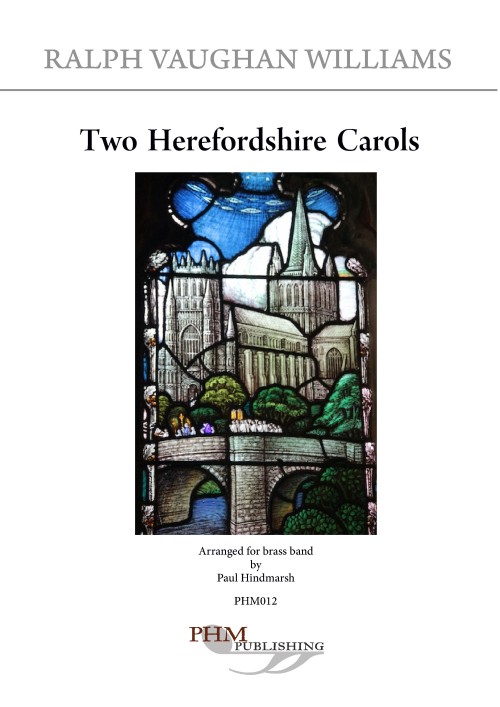
Two Herefordshire Carols (Brass Band - Score and Parts) - Vaughan Williams, Ralph - Hindmarsh, Paul
The two traditional tunes that comprise this straightforward setting were sung to Ralph Vaughan Williams (1872-1958) by Mrs. Esther Smith of Dilwyn, near Hereford, during one of the great composer's folk song collecting tours of England in the early years of the twentieth century. They were included in Twelve Traditional Carols from Herefordshire, edited by E.M. Leather and Vaughan Williams. The words to which Mrs. Smith sung the first tune were probably drawn from eighteenth century evangelical sources. The editors replaced these with six of the 16 verses of a traditional seventeenth century carol text, Joseph and Mary.The second melody, which appears as the centre piece of this arrangement, was sung to a carol that tells of a farmer who ploughed on Christmas Day. It is in fact a translation of a German traditional carol Gelobet seist du Jesu Christ that was published in Goodly Psalmes and Spiritualle Songes (1546) translated by Miles Coverdale. Vaughan Williams used the title Coverdale's Carol.The brass band settings follow the settings made by Vaughan Williams in 1920 for the Oxford Book of Carols. Since his simple harmonic approach is similar in both settings, three verses of his haunting version of Coverdale's Carol have been folded inside four verses of the slightly more animated treatment of Joseph and Mary. The harmonisations of Vaughan Williams have been given some brass band colour, with some verses taken by soloists from the ensemble. The accompaniment figuration that embellishes the second verse of Joseph and Mary has been used to open and close this arrangement and to bind the verses together.- Paul HindmarshDuration: 5.00
Estimated dispatch 7-14 working days
-
 £104.99
Cantabile (Brass Band - Score and Parts) - Harper, Philip
As long as we live there is never enough singing. - Martin Luther. Philip Harper composed this piece in response to his personal concern about the direction of new music for brass band. His goal with this 5 movement Cantabile, was to compose a piece which fully complied with all that is asked of a top-level test piece in the 21st Century, but also to reconnect with more traditional values such as lyricism in melody and richness of blended brass sound. Each of the 5 parts seek to capture this idea. Duration: 16.00
Estimated dispatch 7-14 working days
 View Music