
Results
-
 £34.99
Love Divine (Brass Band - Score and Parts) - Goodall, Howard - Wainwright, Andrew
One of Howard Goodall's most popular choral settings, Love Divine has been skilfully arranged for brass band by Andrew Wainwright, with the approval of the composer. This version is based on the setting with piano and strings and can be performed as a self-standing concert work or as an accompaniment for performance by a large choir.
Estimated dispatch 7-14 working days
-
 £84.99
Pacific Dreams (Brass Band - Score and Parts) - De Haan, Jacob
Pacific Dreams describes the experience of Miguel, a travelling composer from Spain who, feeling somewhat alienated from his homeland, is wandering through an area of Sydney known as The Rocks. At a small outdoor market in a typical street of this old colonial neighbourhood, he discovers a print of William DeShazos painting "Pacific Dreams" Portrayed in the painting is the surf of one of the exotic islands in the Pacific. Next, with the impressive Sydney Harbour Bridge looming over the narrow streets of The Rocks, he envisions sultry Pacific beaches. Suddenly a theme he once composed about the lakes in Japan comes to him. Is it the Asian influences present in cosmopolitan Sydney that bring this theme to mind? Or perhaps the waters around Sydney, over which he could sail to Tahiti? He is uncertain. Could this same theme be used to create a new composition about his feelings for the metropolis Sydney? How then to work his Pacific Dreams into the mix? Miguel is certainly no fan of Hawaiian music. Maybe he could use the vocabularies of islands like Hawaii and Tahiti, their beautiful vowel combinations being sung ad libitum by a mixed choir.With these ideas and his newly purchased print of "Pacific Dreams", he boards the Metro at Circular Quay. He has a final glimpse of the harbour and the Sydney Opera House as the train races into the ground. On to the hotel! To work! He must compose! Maestoso : Miguel is impressed as he gazes upon the Sydney Harbour Bridge. And yet, he wants to go away from this city. Away, to an exotic island in the Pacific.Steady Rock : In the Rocks, musicians are playing at a square. Miguel basks in the atmosphere but at the same time he is fantasising about Hawaii and Tahiti. Andante Lamentoso : In his hotel room, Miguel is feeling sad and lonely in this big city. He takes comfort in his "Pacific Dreams". Allegro : Miguel boards the boat that takes him from Darling Harbour to Circular Quay. In his mind he is travelling on to Hawaii. Or is it home, where the bolero is playing? He is pulled back to reality by the skyline of Sydney.Duration: 9.15
Estimated dispatch 7-14 working days
-
 £127.95
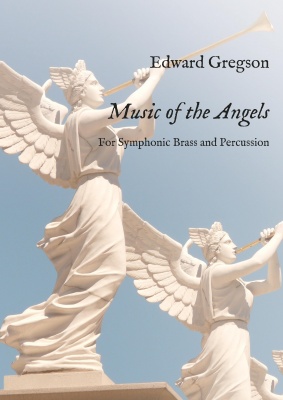
Music of the Angels (Symphonic Brass Ensemble - Score and Parts)
In 1998 Gregson was commissioned by conductor Martyn Brabbins to write a short concert opener with choir to mark his debut as Music Director of the Huddersfield Choral Society. Entitled ...and the seven trumpets... this ten minute flourish is founded on a verse from Chapter 8 of the Revelation To John (The Apocalypse), the last book in the Bible: 'and I saw the seven Angels which stood before God: and to them were given seven trumpets'. The performance employed the full power of the Huddersfield Town Hall organ and the brass section of the BBC Philharmonic, including seven trumpets and four horns placed strategically around hall.The following year, when Gregson received a commission from the Cheshire-based Foden's Brass Band (conducted at that time by Nicholas Childs) for a work to mark its centenary in 2000, he turned to the first portion of ...and the seven trumpets... as the basis for an ambitious celebratory work entitled The Trumpets of the Angels. "The opportunity to create an extended work which would break out of the brass band mould was an important milestone for me," the composer says. In 2015 he was asked by Nicholas Childs to create a new performing edition without organ for the Black Dyke Band. This received its first performance in April 2016 at the European Brass Band Festival in Lille. In 2018, Gregson revisited the music for a third time, returning the opening fanfares to orchestral brass and transforming substantial portions of the 'Black Dyke' version to create Music of the Angels, a dramatic canvas for symphonic brass and percussion.An array of bells and gongs offer an unmistakable key to the source of Gregson's inspiration. Inscribed In tribute to Olivier Messiaen, the work's principal material and its sound world, but crucially not the underlying musical processes, are influenced by Messiaen's masterpiece for wind and percussion, Et exspecto ressurectionem mortuorum (1964). Music of the Angels begins with braying of horns suggestive of the start of an ancient ritual. Six 'angel' trumpeters, set behind the ensemble, answer in sequence, with the evocative sound of tam-tams creating the Messiaen-like aura. Once the horns have reached the performing space, four of the trumpeters deliver highly contrasting fanfare cadenzas. At the climax of this episode, the individual fanfares are presented together, as if, perhaps, to reflect the Biblical writer's apocalyptic visions of hail, fire, seas of blood and the cataclysmic destruction of man and beast.This powerful vision of death and destruction gives way to a prayerful lament, re-imagining a sung Kyrie Eleison from the 'Black Dyke' edition, with flugel horn and euphonium obligati. The hushed atmosphere is broken by tenor and side drums, and trumpets five and six, which gallop away like the Horsemen of the Apocalypse. In the biblical account their steeds had 'heads like lions with fire and smoke and sulphur issuing from their mouths'.As the reverberation of a dramatic climax dies we hear the entry of the seventh trumpet, from 'on high', blazing forth with a version of the main that extends across the entire compass of the instrument - almost three octaves. Supported by a 'holy trinity' of gongs, an 'epic' final cadenza introduces new material which is further developed in a frenetic final section. This is announced by two sets of timpani, to the left and right. Braying brass (euphoniums and horns) once more adds an air of foreboding. As the music builds towards a magisterial conclusion, the Messiaen-inspired tritones of the principal motif are smoothed out into perfect 5ths and combined with the earlier material in a full-voiced chorale, over which the seventh trumpet blazes in triumph.- Programme note by Paul HindmarshScored for1 Trumpet in E flat (Trumpet 5)6 Trumpets in B flat (Trumpet 4 doubling Flugel Horn)4 Horns in F3 Tenor Trombones1 Bass TromboneEuphonium2 Tubas2 Timpani (Percussion 3 doubles Timpani 2)Percussion (3 players): 3 Tam-tams, 3 Suspended Cymbals, Bass Drum, Tenor Drum, Snare Drum, Tubular Bells.Duration: 16.00
Estimated dispatch 7-14 working days
-
 £29.95
Ballet for Band (Score Only)
Ballet for Band was written as the test-piece for the Championship section finals of the National Brass Band Championships, held at the Royal Albert Hall in October 1983.Although the work is not programmatic, within the space of ten minutes, the composer uses a form which might be considered to be the form of a ballet. Therefore there is a fanfare at the beginning which might be the overture, different characters appear, and scenes are quite clearly marked by, for instance, baritones or by muted trombone, although the listener is encouraged to use his own imagination.Thematically the work is tightly controlled, with the same material re-appearing in many different guises, as a flugel horn solo, as a waltz on the horns, and on the euphonium. Horovitz employs a rich harmonic pallet, but the work is most definitely rooted in a tonal language, with hints of Straussian richness later in the work.The work is notable for its middle section, in which the music gets slower and slower, providing a real test of control throughout the band.Ballet for Band was by no means Joseph Horovitz's first work for the medium: his fine "Concerto for Euphonium and Band" is frequently played, and he has also written a cantata entitled "Samson" for choir and band.
Estimated dispatch 7-14 working days
-
 £84.99
Christmas Brass - Richard Peaslee
Christmas Brass is a fantasy on six carols, originally commissioned by Mark Freeh for the Manhattan Brass Choir. Duration: 16:30The well-known tune, O Come, O Come Emmanuel, a hymn originally based on a plainsong melody, is here set in 5/4 meter. Modal harmonies are combined with big band style as the piece gains momentum, greatly accentuating the mood of the words, "Rejoice! Rejoice! Emmanuel." The opening 5/4 statement of the theme returns, and the piece ends quietly.In Beautiful Savior (also known by the title Fairest Lord Jesus), a hushed beginning featuring horns, euphoniums, and a muted trumpet, leads through a key change to a satisfying, chorale-likeclosing passage.In Away in a Manger, Peaslee sets two tunes, Cradle Song and Away in a Manger. Following a straightforward presentation of each melody, Peaslee plays them against one another. The music swells to a full climax followed by a hushed ending.Peaslee employs a gentle hand in It Came Upon a Midnight Clear, using flugelhorn solos and duets in a jazz-waltz style.In Silent Night, the traditional carol gets an untraditional harmonization, propelled forward by give-and-take between the two groups of brass instruments in the brass choir: trumpets and trombones versus horns, euphoniums, and tuba.Hark! The Herald Angels Sing begins with a humorous blast of discordant harmonies as multiple carols are sounded at the same time. An up-tempo 4/4 announcement of the melody in the trombone is followed by a metrical modulation in 6/8-3/4 time. An additional metrical modulation bring the music back into 4/4, but at a slower tempo and in a pronounced jazz style. Tempo I returns, and the set of six pieces closes with a big ending.Instrumentation: 4 Trumpets, 2 Horns in F, 4 Trombones, 2 Euphoniums, Tuba, Guitar, Bass, Percussion
Estimated dispatch 5-14 working days
-
 £30.00
Man In His Labour Rejoiceth (Band Parts Only) - John Ireland
This beautiful piece written by John Ireland, with words by Robert Bridges, has now been reborn.Originally commissioned by the National Coal Board in 1947 it is believed to have been performed on May 1st 1948 at the the Haringey Stadium, involving 9 bands and 8 colliery bands. Since the original brass band parts (which bring the piece to life in its full glory) were lost over time, the John Ireland Trust committed to a project to ensure the music was not lost forever.Andrew Duncan was commissioned with the honour of recreating the brass band set to bring the full performance of band and choir back to the public's enjoyment. His attention to detail and widespread knowledge of Ireland's writing style have now enabled 'Man in his Labour Rejoiceth' to be fully recreated and appreciated in its original written form, offering bands a remarkable opportunity to perform an historically significant concert work.Choir parts are sold separately and are available from The Music Company (UK) Ltd (please call 0845 68 08452 for more details) or Stainer & Bell Ltd (Catalogue Ref: 20303)
In Stock: Estimated dispatch 3-5 working days
-
 £73.00
Midwinter (Brass Band with Optional Choir - Score and Parts) - Vilhelmsen, Ingebjorg
This arrangement for full band can be performed both with and without choir. Midwinter is a Christmas song about how the holiday can be a highlight even in the darkest winters. The piece was originally written for brass quartet and choir, for Oslofjord Brass and Vivo Vokal's Christmas concert in 2019.If the piece is performed together with a choir, the dynamics of the band must be balanced with regard to the size of the choir, possibly using sound amplification if necessary.Choir Parts (SATB) available separately.Duration: 4.00
Estimated dispatch 7-14 working days
-
 £60.99
Der Mond ist Aufgegangen (Brass Band with Optional Choir - Score and Parts) - De Haan, Jacob
The lyrics to Der Mond ist aufgegangen (The Moon Is Risen) come from Matthias Claudius, one of Germany's best-known poets. The 1779 poem with the original title Abendlied (Evening song) was set to music by Johann Abraham Peter Schulz and has become perhaps the most famous Abendlied in the German-speaking world. Johann de Haan has created a delightful arrangement of this poignant melody. The wind orchestra can optionally be accompanied by a choir (Dutch and German texts are provided).Duration: 3:30
Estimated dispatch 7-14 working days
-
 £35.00
Pavane (Brass Band - Score and Parts) - Faure, Gabriel - Littlemore, Phillip
It is believed that Gabriel Faure wrote his Pavane as a piano piece in 1887, describing it as 'elegant, but not otherwise important'. He began work on the orchestral version a few months later, and scored it for modest forces, with the intention of performing it at a series of light Summer concerts that same year. At the behest of his benefactor, Elisabeth Greffulhe, he added a four-part choir, but it is rarely heard with the chorus these days. From the outset, the Pavane enjoyed great popularity. The music flows delicately and gracefully. A pulse beats gently and constantly beneath the arching melody lines, with elegant harmonic shifts and turns before the briefest of dramatic episodes. Calm is restored and the work draws to a tranquil conclusion. Duration: 6:00
Estimated dispatch 7-14 working days
-
 £87.99
An English Christmas (Brass Band - Score and Parts) - Sparke, Philip
Christmas as celebrated in England is a relatively new tradition dating from the time of Queen Victoria. Her husband Prince Albert was from Germany and he brought many German Christmas traditions with him, including the Christmas tree and Christmas cards, and even carols such as Hark, the Herald Angels Sing. Philip Sparke has however used a varied selection of English melodies to arrange into his Festival of Carols.The choir parts are seperately available (order no. AMP 227-050 or AMP 227-250 for a single copy).Duration: 9:30
Estimated dispatch 7-14 working days
 View Music