
Results
-
 £24.95
You Know That We Love You! (Trombone Feature with Brass Band - Score and Parts) - Downie, Kenneth
First published for SATB choir in 1983, the majestic feel of the melody gave the arranger the idea of featuring it for trombones, demonstrating the tender qualities of the section.
Estimated dispatch 7-14 working days
-
£12.50
You Know That We Love You! (Trombone Feature with Brass Band - Score only) - Downie, Kenneth
First published for SATB choir in 1983, the majestic feel of the melody gave the arranger the idea of featuring it for trombones, demonstrating the tender qualities of the section.
Estimated dispatch 7-14 working days
-
 £40.76
Christmas Day (Brass Band) Gustav Holst arr. Philip Rayment
VIEW SCORE PDF Well-known English composer, Gustav Holst (1874-1934) wrote this choral fantasy in 1910, about five years before his renowned orchestral suite, The Planets. The piece was originally composed for SATB choir and orchestra and dedicated to the students of Morley College, where Holst taught music. In the years since, it has been arranged for various combinations of voice and/or instruments. This arrangement is in the original key and could be adapted for use with choir and/or organ. Christmas Day features three carols in their entirety: Good Christian Men, Rejoice; God Rest Ye Merry, Gentlemen and Come, Ye Lofty, Come, Ye Lowly (an old Breton melody). There are also references to The First Nowell. Although well-received initially, this work (like many of Holst's) was neglected for many years and has not been widely recorded. It is hoped that it will be useful for brass bands during the festive season, particularly in a large acoustic. To listen to the Canadian Staff Band performing the work please visit www.youtube.com/watch?v=ccXkbWi_iWE Sheet music available from: UK - www.brassband.co.uk USA - www.solidbrassmusic.com Difficulty Level: 3rd Section + Instrumentation: Soprano Cornet Eb Solo Cornet Bb Repiano Cornet Bb 2nd Cornet Bb 3rd Cornet Bb Flugel Horn Bb Solo Horn Eb 1st Horn Eb 2nd Horn Eb 1st Baritone Bb 2nd Baritone Bb 1st Trombone Bb 2nd Trombone Bb Bass Trombone Euphonium Bb Bass Eb Bass Bb Percussion 1-3
In Stock: Estimated dispatch 1-3 working days
-
 £33.35
Miserere mei, Deus (Brass Band) Gregorio Allegri arr. Espen Haukas
Miserere mei, Deus was composed by the Italian composer Gregorio Allegri (1582-1652) during the 1630s for use in the Sistine Chapel during matins, as part of the exclusive Tenebrae service on Wednesday and Friday of the Holy Week. The Miserere is written for two choirs, one of five and one of four voices, and is generally accepted to be one of the finest examples of Renaissance polyphony to survive to the present day. Tutti choirs sing a simple version of the original Miserere chant; one voice then, spatially separated, sings an ornamented "commentary" on this. The comment-part is left out in this arrangement due to its meaning with text, though monotonous in tune. The introduction is added by the arranger to set the right atmosphere before the original chant is played. The brass choirs are meant to be placed opposite each other in a church or large hall. To view a video of Norges Nasjonale Brassband performing the piece please visit www.youtube.com/watch?v=YrJU3lwYD9U PDF download includes score and parts. Sheet music available from: UK - www.brassband.co.uk USA - www.solidbrassmusic.com Difficulty Level: 4th Section + Instrumentation: Brass Choir 1: Solo Cornets (incl. Repiano) Horn in Eb Tenor Trombones in Bb Euphoniums Basses in Bb Timpani Brass Choir 2: Soprano Cornet in Eb 2nd Cornets in Bb 3rd Cornets in Bb Flugelhorn Horns in Eb Baritones Bass Trombone Basses in Eb
In Stock: Estimated dispatch 1-3 working days
-
 £30.00
Bandamonium 2024 (Neil Lock) - Brass Band Sheet Music Full Score & Parts - LM541
COMPOSER: Neil LockThis march was submitted to the march composers' competition for "Bandamonium 3"in Hatherleigh, Devon in July 2024. The winning march was played by massed bands at the conclusion of the celebrations on Saturday 27th July 2024. Unfortunately, this march took second place in the competition, behind the march of Paul Pennicotte-Henrie, conductor of Okehampton Silver Band.The march can be played with or without the singing. (Even at the Whit Friday marches, begad!) I suggest that it should be introduced by 3-beat rolls.When played with singing, the "Bandamonium" lyrics (bars 10-13 and 56-57) are to be sung by all players, keeping to their own parts, with appropriate octave adjustment for their individual singing voices. Conductor and percussionists should sing with the main theme (Db and C at bars 10-13, F at 56-57). Listen to the 3rd cornet players!There is an additional part for Singers, in which the trio melody (bars 58 onwards) can be sung by Soprano and Tenor singers at a moderate choir standard. An octave-down option is also provided in the higher bars. This part can be given to "spare" singers within the band, or to singers external to the band if opportunity permits. The lyrics are:We are in Devon,We're in Hatherleigh,Whit Friday heaven,But we're marching free!Now it's past seven,Time to party,At BandamoniumIn Hatherleigh!LM541 - ISMN : 9790570005413
In Stock: Estimated dispatch 3-5 working days
-
 £69.99
Christmas Day (Brass Band with Optional Choir - Score and Parts) - Holst, Gustav - Beringen, Robert van
Gustav Holst composed almost 200 works, one being a very elegant and charming fantasy on the old English christmas carols: Good Christian Men, Rejoice; God Rest You Merry, Gentlemen; Come Ye Lofty, Come and The First Nowell. The fantasy called Christmas Day was originally written for mixed choir with orchestra or organ accompaniment. Robert van Beringen has arranged this work for concert band exactly 100 years later. His arrangement can be performed as an instrumental piece or with a choir, making it suitable for any occasion.Duration: 5:45
Estimated dispatch 7-14 working days
-
£37.95
Schneewalzer (The Snow-Waltz) (Brass Band with optional choir) - Richards, Goff
Brass Band Set - With optional Choir. Chorus parts (SATB or TTBB with Piano) are available separately.
Estimated dispatch 7-14 working days
-
 £60.99
Stille Nacht (Silent Night) (Brass Band with Optional Male Voice Choir - Score and Parts) - Gruber, Franz - De Haan, Jacob
Jacob de Haan wrote this arrangement for concert band, fanfare band and brass band and optional male voice choir. The original carol was written by the Austrian composer and organist Franz Gruber (1787-1863). He was asked to write Silent Night) on the 24th of December 1818 by the priest of the Church of St. Nicolas in Oberndorf, who had himself written the text. It is a romantic carol, with nuances of contemporary Austrian folk and Italian pastorale music.Duration: 4:45
Estimated dispatch 7-14 working days
-
 £60.99
Allein Gott in der Hoh' sei Ehr (Brass Band - Score and Parts) - De Haan, Jacob
Jacob de Haan begins his arrangement of the well-known hymn Allein Gott in der Hoh' sei Ehr (All Glory Be to God on High) with a quotation from his own Missa Katharina, a mass for choir, soprano, and band. To this melody he sets the Latin text from the last part of the Gloria. The chorale is then heard after an interlude and can, at the director's discretion, be accompanied by the choir singing in either German or English. A perfect work for church concerts.Duration: 4.15
Estimated dispatch 7-14 working days
-
 £50.00
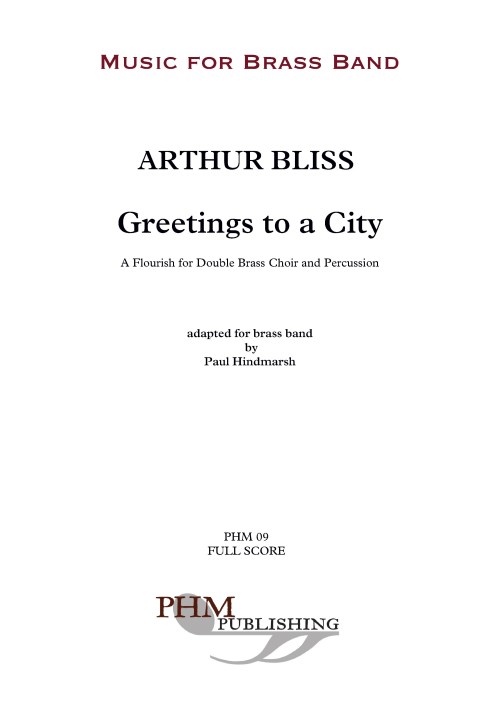
Greetings to a City (Brass Band - Score and Parts) - Bliss, Arthur - Hindmarsh, Paul
Sir Arthur Bliss (1891 - 1975) was a significant composer and pillar of the British musical establishment. Although Born in London, his father was from the United States and both countries were important in his life and career. A pupil of Stanford at the Royal College of Music, Bliss travelled to the United States with his father in 1923, taking a prominent part in Elizabeth Sprague Coolidge's Pittsfield Music Festival, as well as undertaking some teaching and conducting. In 1925 he married Trudy Hoffman and they returned to the UK early in 1926. Bliss's most influential scores were his ballets and film scores. In 1953 Sir Arthur was appointed Master of the Queen's Music, after which he added a steady stream of fanfares and ceremonial works to his list of works. In 1960 he was commissioned by the American Wind Symphony of Pittsburgh, which requested for festive work to feature on an extensive European tour, including a performance in London.Bliss scored Greetings to a City for antiphonal brass, a choir each of 2 trumpets, 2 horns and three trombones, with tuba and percussion. This adaptation for brass band instruments retains an element of antiphony, emphasing the contrast between the fanfare instruments (cornets and trombones) and the horns and tubas. Greetings to a City is cast in three connected sections, with extended fanfare episodes separated by a short lyrical interlude.- Paul HindmarshDuration: 6.00
Estimated dispatch 7-14 working days
 Watch video
 View Music