
Results
-
 £15.00
Harrison's Dream (Brass Band - Study Score) - Graham, Peter
At 8.00pm on the 22nd of October 1707, the Association, flagship of the Royal Navy, struck rocks off the Scilly Isles with the loss of the entire crew. Throughout the rest of the evening the remaining three ships in the fleet suffered the same fate. Only 26 of the original 1,647 crew members survived. This disaster was a direct result of an inability to calculate longitude, the most pressing scientific problem of the time. It pushed the longitude question to the forefront of the national consciousness and precipitated the Longitude Act. Parliament funded a prize of �20,000 to anyone whose method or device would solve the dilemma.For carpenter and self-taught clockmaker John Harrison, this was the beginning of a 40 year obsession. To calculate longitude it is necessary to know the time aboard ship and at the home port or place of known longitude, at precisely the same moment. Harrison's dream was to build a clock so accurate that this calculation could be made, an audacious feat of engineering.This work reflects on aspects of this epic tale, brilliantly brought to life in Dava Sobel's book Longitude. Much of the music is mechanistic in tone and is constructed along precise mathematical and metrical lines. The heart of the work however is human - the attraction of the �20,000 prize is often cited as Harrison's motivation. However, the realisation that countless lives depended on a solution was one which haunted Harrison. The emotional core of the music reflects on this, and in particular the evening of 22ndOctober 1707.- Peter GrahamJuly 2000 Recorded on Polyphonic QPRL219D Master Brass (Volume Fifteen). Duration: 14'30"
Estimated dispatch 7-14 working days
-
 £48.00
Tientos y Danzas (Brass Band - Score and Parts) - Wood, Gareth
Tientos y Danzas is a suite in four movements and was written especially for Superbrass. It is not literally descriptive, but conjures up a breezy, festive atmosphere. The title "Tientos" stems from the fact that a lot of the brass writing is reminiscent of virtuosic Renaissance keyboard finger-work (a "Tiento" is the Spanish equivalent of a toccata). Only later did we discover that the word is also the name of a style of flamenco dancing, which links nicely with Danzas (dances). The first movement is an extended fanfare, with military rhythms on the tenor drums and dramatic cornet and horn calls. Next comes a witty waltz featuring the horn. The music builds in complexity; the main horn theme returns before a playful coda. The following Andante makes effective use of the mutes, both in the haunting opening "pyramid" chords, and in the elaborate, recurrent cornet duets; the two cornets have the last word. After a couple of false starts, the finale sets off at a cracking pace, with dislocated accents creating an irregular rhythmic pulse. There are opportunities for every instrument to shine (metaphorically) and the music gets even faster for a thrilling conclusion. Duration: 10.30. Suitable for 1st Section Bands and above.
Estimated dispatch 7-14 working days
-
 £89.99
Broken Sword (Brass Band - Score and Parts) - Houben, Kevin
The Broken Sword is one of the five ceremonial swords kept in the Tower of London and is used during the coronation of a new king or queen. Legend has it that an angel broke off the tip of the sword in an effort to prevent an unjust killing. Composer Kevin Houben lets his music retell this intriguing legend. Broken Sword resembles a film score in many ways and will paint vivid images as the band plays its way through the legend. Many different moods create a contrast-rich work that makes for an exciting listening and playing experience every time!Duration: 11.45
Estimated dispatch 7-14 working days
-
 £76.99
The Green Hill (Euphonium Solo with Brass Band - Score and Parts) - Appermont, Bert
This piece was commissioned by Swiss euphonium virtuoso Eich Schmidli. Bert Appermont dug deep into Celtic music for inspiration and created a fantasy that shows off the incredible, but often overlooked, versatility of the euphonium. Charming lyrical melodies, virtuosic runs and exciting, colourful tuttis create plenty of contrast in this exciting work. The difficulty level for the soloist and band means that almost any band can perform this piece and showcase their euphonium player.Duration: 7:15
Estimated dispatch 7-14 working days
-
 £34.95
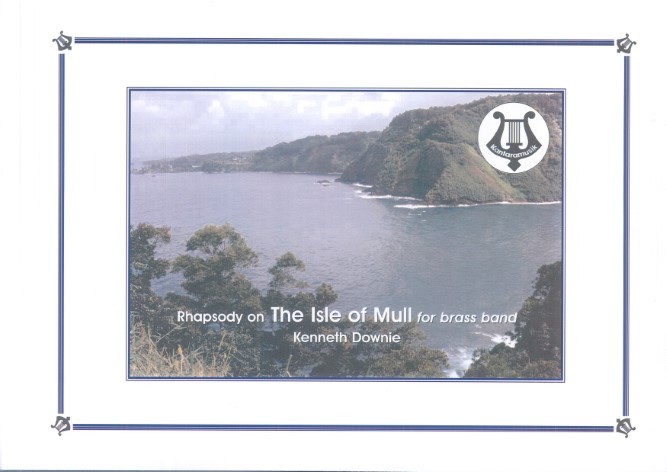
Rhapsody On The Isle Of Mull (Brass Band - Score and Parts) - Downie, Kenneth
Mull is an island off the west coast of Scotland and it gives its name to the lovely tune which forms the basis of this music. It is very scenic, with some beautiful mountains and the composer has tried to suggest something of the atmosphere of grandeur in his score. The largely pentatonic nature of the tune heavily colours the musical texture.
Estimated dispatch 7-14 working days
-
£17.50
Rhapsody On The Isle Of Mull (Brass Band - Score Only) - Downie, Kenneth
Mull is an island off the west coast of Scotland and it gives its name to the lovely tune which forms the basis of this music. It is very scenic, with some beautiful mountains and the composer has tried to suggest something of the atmosphere of grandeur in his score. The largely pentatonic nature of the tune heavily colours the musical texture.
Estimated dispatch 7-14 working days
-
 £119.95
Harrison's Dream (Brass Band - Score and Parts) - Graham, Peter
At 8.00pm on the 22nd of October 1707, the Association, flagship of the Royal Navy, struck rocks off the Scilly Isles with the loss of the entire crew. Throughout the rest of the evening the remaining three ships in the fleet suffered the same fate. Only 26 of the original 1,647 crew members survived. This disaster was a direct result of an inability to calculate longitude, the most pressing scientific problem of the time. It pushed the longitude question to the forefront of the national consciousness and precipitated the Longitude Act. Parliament funded a prize of �20,000 to anyone whose method or device would solve the dilemma.For carpenter and self-taught clockmaker John Harrison, this was the beginning of a 40 year obsession. To calculate longitude it is necessary to know the time aboard ship and at the home port or place of known longitude, at precisely the same moment. Harrison's dream was to build a clock so accurate that this calculation could be made, an audacious feat of engineering.This work reflects on aspects of this epic tale, brilliantly brought to life in Dava Sobel's book Longitude. Much of the music is mechanistic in tone and is constructed along precise mathematical and metrical lines. The heart of the work however is human - the attraction of the �20,000 prize is often cited as Harrison's motivation. However, the realisation that countless lives depended on a solution was one which haunted Harrison. The emotional core of the music reflects on this, and in particular the evening of 22ndOctober 1707.- Peter GrahamJuly 2000 Recorded on Polyphonic QPRL219D Master Brass (Volume Fifteen). Duration: 14'30"
Estimated dispatch 7-14 working days
-
£44.95
Harrison's Dream (Brass Band - Score only) - Graham, Peter
At 8.00pm on the 22nd of October 1707, the Association, flagship of the Royal Navy, struck rocks off the Scilly Isles with the loss of the entire crew. Throughout the rest of the evening the remaining three ships in the fleet suffered the same fate. Only 26 of the original 1,647 crew members survived. This disaster was a direct result of an inability to calculate longitude, the most pressing scientific problem of the time. It pushed the longitude question to the forefront of the national consciousness and precipitated the Longitude Act. Parliament funded a prize of �20,000 to anyone whose method or device would solve the dilemma.For carpenter and self-taught clockmaker John Harrison, this was the beginning of a 40 year obsession. To calculate longitude it is necessary to know the time aboard ship and at the home port or place of known longitude, at precisely the same moment. Harrison's dream was to build a clock so accurate that this calculation could be made, an audacious feat of engineering.This work reflects on aspects of this epic tale, brilliantly brought to life in Dava Sobel's book Longitude. Much of the music is mechanistic in tone and is constructed along precise mathematical and metrical lines. The heart of the work however is human - the attraction of the �20,000 prize is often cited as Harrison's motivation. However, the realisation that countless lives depended on a solution was one which haunted Harrison. The emotional core of the music reflects on this, and in particular the evening of 22ndOctober 1707.- Peter GrahamJuly 2000 Recorded on Polyphonic QPRL219D Master Brass (Volume Fifteen). Duration: 14'30"
Estimated dispatch 7-14 working days
-
 £72.99
CINEMANIA (Brass Band) - Finn, Robert
This music sounds as if it came straight off the cinema screen. However, there's no movie for this fantastic score! Just like EVERY good film score, this work also includes moving melodies, fast virtuoso passages and, last but not least, a romantic love theme. The instrumentation takes into account that a group may not be complete and this means that the piece can be played by practically every orchestra. Highly recommended for concerts and competitions.
Estimated dispatch 7-14 working days
-
 £34.99
Show Me (from My Fair Lady) (Brass Band - Score and Parts) - Lerner & Loewe - Freeh, Mark
The musical My Fair Lady (a book and lyrics by Alan Jay Lerner and music by Frederick Loewe), is based on George Bernard Shaw's Pygmalion. Show Me, arranged by Mark Freeh, is taken from Act II of My Fair Lady and is when Liza storms out of Higgins' house to stumble outside into Freddy. Freddy protests that he is in love with her, but Liza is sceptical and brushes him off.Suitable for Advanced Youth/3rd Section Bands and aboveDuration: 4.00
Estimated dispatch 7-14 working days
 View Music