
Results
-
 £29.95
First Light (Cornet Solo with Brass Band - Score and Parts)
First Light was written for Kirsty Abbotts and Carlton Main Frickley Colliery Band. A slow lilting melody is presented in the cornet solo and passed between the band and the soloist to create images of the tranquil night before the piece reaches a climactic moment which is meant to represent the beams of light emerging as the sun rises. The theme is then presented in a tutti forte section before arriving at a tranquil finish. First Light is featured on the Kirsty Abbotts and Carlton Main Frickley Colliery Bands CD, A Search for Peace.
Estimated dispatch 7-14 working days
-
 £54.99
Themes from Fantasia (Brass Band - Score and Parts)
A very playable medley from the classic movie 'Fantasia' containing 'Toccata', 'Dance Of The Sugar Plum Fairy', 'Russian Dance (Trepak), 'Dance Of The Hours' and 'Night On Bald Mountain'. Ideal for young bands and very entertaining for your audience!
Estimated dispatch 7-14 working days
-
£72.70
Salute All Bands! - Hans Offerdal
A playable and fun march with exiting challenges for the players. Lyric lines in cornets to powerful passages in low brass. We salute all bands!
Estimated dispatch 5-14 working days
-
 £228.70
Sollicitus for Brass band and Percussion - Fredrick Schjelderup
The latin title Sollicitus means upset or uneasy is important in terms of the character and form of the work. This work contains several different pcarts, all of them based around a fanfare-like theme which is presented several times. This theme change it's character, form, tonality, rhytmic and tension throughout the piece which triggers the turbulence of the music. Sollicitus is a commission for Midtun Skoles Musikkorps and their conductor Christian Breistein for their participation in the Norwegian Championships for School Bands in 2017. The version for Brass Band was written to Laksevag Musikkforening for their participation at the Norwegian Brass Band Championships 2018.
Estimated dispatch 5-14 working days
-
 £59.95
Fantastia for Brass Band - Derek Bourgeois
Original test piece for Championship & 1st Section Bands.
Estimated dispatch 5-14 working days
-
 £228.70
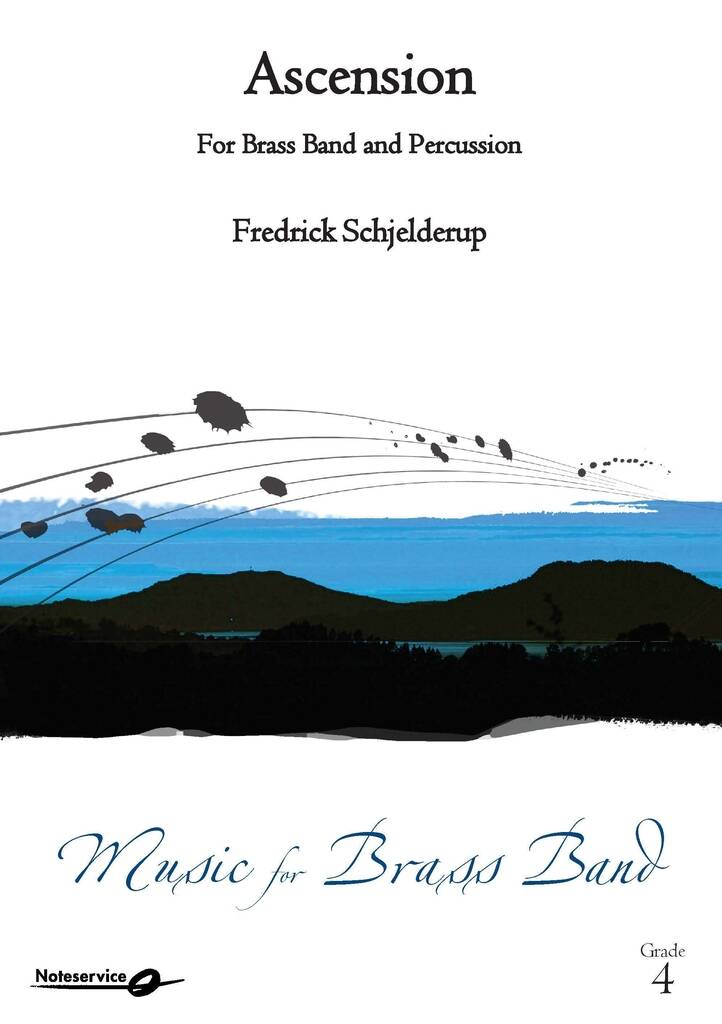
Ascension For Brass Band and Percussion - Fredrick Schjelderup
"Ascension" was commissioned in 2014 for the Norwegian school band, Hellen Skoles Musikkorps for their 60th anniversary.The piece is based on two themes, processed through rhythms, chords and solos in various time signatures.The title, "Ascension" which means rising, is central for the main thematic material and describes the band's hard work for a coming event (concert or a contest) where the musical level is ascending/rising.
Estimated dispatch 5-14 working days
-
 £69.99
South Down Pictures (Brass Band - Score and Parts) - Sparke, Philip
South Down Pictures was commissioned by Millenium Brass 2000, an organisation comprising three brass bands from the county of Sussex, England.The bands (Patcham Silver, Hangleton and Brighton Silver) had got together to organise many events to mark the new millennium and these culminated in a concert in Hove Town Hall on July 9th 2000 when all three bands combined to give the first performance of South Down Pictures. The composer spent much of his childhood amongst the South Downs, a range of hills in Sussex which runs parallel to the sea.Opening with a strong unison passage, interrupted briefly by faster figures based on the interval of a fifth, South Down Pictures develops with an often-passionate legato melody. Reaching a climax, this is then followed by the main vivo section of the work, whose main theme is based on the earlier 'fifth' figures. A bridge passage leads to a short chorale figure and a rhythmic climax which dissolves into a plaintive cornet solo over staccato chords. This theme is taken up by the whole band and leads back to a recapitulation of the main theme and earlier material. The cornet tune returns triumphantly in the major key before the opening unison passage reappears to provide a stirring coda.Duration: 5:30
Estimated dispatch 7-14 working days
-
 £60.99
Conzensus (Brass Band - Score and Parts) - Van der Roost, Jan
This stately concert opener was originally written by Jan Van der Roost for a special event in which six respected wind orchestras (two Belgian and four Dutch) of different composition (two symphonic bands, two fanfare bands and two brass bands) were featured during six concerts. Each evening brought forth a performance by a symphonic band, a fanfare, and brass band, so that the audience could experience all three types of ensembles. This was indeed an original concept. The name, ConZEnSus, comes from a combination of the words, 'Concert Cyclus' (concert series) and 'zes' (Dutch for 'six'). This leads to a new word, which refers to 'consensus'. The general tenor of the cycle is thus immediately indicated. The richness of color of the various ensembles is revealed through an open and friendly atmosphere. During all six concerts (over a span of three years), ConZEnSus functioned as a permanent opening number for each orchestra. Thus the same musical story was portrayed in three different packages.Duration: 2:30
Estimated dispatch 7-14 working days
-
 £73.00
Bass Trombone Concerto (Bass Trombone Solo with Brass Band - Score and Parts) - Wood, Gareth
Written in 2006 for Roger Argente, Gareth Wood brings his considerable experience of writing for brass, and brass bands in particular, to an instrument not often blessed with opportunities for solo exposure. It is scored for soloist accompanied by traditional brass band line-up, including timpani and two percussion, and follows the standard three-movement pattern. In the first movement, the soloist launches straight into the musical argument with a low-lying repeated quaver figure punctuated by the band. A lyrical second subject in the high register is also entrusted to the soloist, and the movement comes to a thrilling conclusion. The slow movement opens softly with the percussion, and a mournful bass line sets the mood for a thoughtful long melody. It reaches a powerful climax, which subsides to a return of the opening mood. In the march-like finale, the soloist is pitted against a number of solo instruments from the band and a driving ostinato carries the momentum through to the blazing ending. Duration: 13.00. Suitable for 1st Section Bands and above.
Estimated dispatch 7-14 working days
-
 £89.99
Torsion (Brass Band - Score and Parts)
Torsion was commissioned by the Leyland Band and first performed on 23 January 2010 at the Royal Northern College of Music Festival of Brass, Manchester, by Leyland Band conducted by Jason Katsikaris. This colourful and dynamic work is the most personal and ambitious that Simon Dobson composed during his residency with the Lancashire brass band. The dictionary defines torsion as the state of being twisted and the composer interprets this as the imagined dis-torsions and con-torsions of Time, Light and Sound in three contrasting movements. Simon Dobson fuses the traditional brass band sound with drive and energy of pop and funk jazz with optional digitally distorted 'echoes' providing added aural confusion at the points of climax. Although composed as a substantial concert work, Torsion would also make a challenging test-piece for contesting brass bands in the elite divisions. Suitable for Championship Section Bands. Duration: 15.00
Estimated dispatch 7-14 working days
 View Music