
Results
-
 £79.99
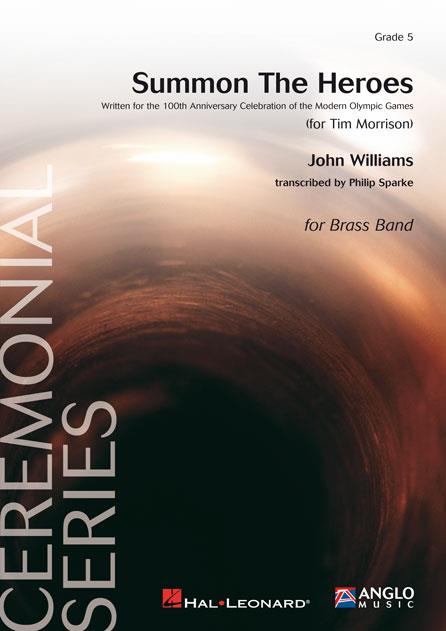
Summon the Heroes (Brass Band - Score and Parts) - Williams, John - Sparke, Philip
John Williams has written ceremonial music for many major events and ceremonies but of all these occasional pieces Summon the Heroes is the most elaborate and musically complex. It was composed for the Atlanta Olympic Games in 1996 and performed at the opening ceremony. As with all of John Williams's ceremonial compositions this work makes an ideal brass band work that will bring the house down as a concert opener.Duration: 6:20
Estimated dispatch 7-14 working days
-
 £74.95
A Portrait of Paris (Cornet and Euphonium Duet with Brass Band - Score and Parts) - Graham, Peter
A Portrait of Paris was written for Alexis Demailly and Bastien Baumet of the Paris Brass Band. The three movements, Promenade (aux Champs-?lys?es), Sur La Seine and Tour de France, are the composer's musical impressions of some of the city's landmarks and events (with occasional references to a famous Parisian composer thrown in for good measure...)
Estimated dispatch 7-14 working days
-
 £54.95
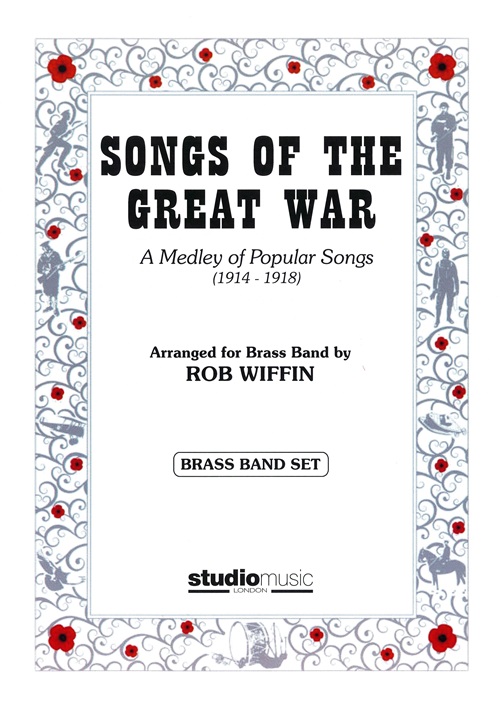
Songs of the Great War (Brass Band - Score and Parts) - Wiffin, Rob
A Medley of Popular Songs, 1914 - 1918Music of the Great War is a five year project to use music of the period to educate and engage schools, colleges, town bands, and the wider public across the UK and the world to learn in a positive way about the events, the experience of the troops involved from all sides, and how music played its part.This year, to commemorate the centenary of the Great War a specially arranged medley Songs of the Great War has been created. The medley has been arranged for bands to rehearse and eventually perform on the 11 November 2015. It brings together some of the most popular tunes played, sung and performed by the men and women of the time - in the trenches and on the various home fronts.With the support of many countries and organisations, on the 11 November the medley will be first played in New Zealand and Australia. It will ripple east across the world being performed in countries like India and Pakistan before hitting Europe and onwards to include performances in Canada and the Caribbean. This could become one of the most played pieces of music in a 24-hour period.In Britain, there will be performances across the country, including some at key events and sites involving a wide range of military and non-military personnel.The medley includes:It's a Long Way to TipperaryYour King and Country Want YouGood Bye-eeOh! It's a Lovely WarHello! Hello! Who's Your Lady FriendTake Me Back to Dear Old BlightyMademoiselle from ArmentieresThere's a Long, Long Trail A-windingIf You Were the Only Girl in the WorldPack Up Your Troubles (In Your Old Kit Bag)Old Soldiers Never Die/Last Post
Estimated dispatch 7-14 working days
-
 £69.99
South Down Pictures (Brass Band - Score and Parts) - Sparke, Philip
South Down Pictures was commissioned by Millenium Brass 2000, an organisation comprising three brass bands from the county of Sussex, England.The bands (Patcham Silver, Hangleton and Brighton Silver) had got together to organise many events to mark the new millennium and these culminated in a concert in Hove Town Hall on July 9th 2000 when all three bands combined to give the first performance of South Down Pictures. The composer spent much of his childhood amongst the South Downs, a range of hills in Sussex which runs parallel to the sea.Opening with a strong unison passage, interrupted briefly by faster figures based on the interval of a fifth, South Down Pictures develops with an often-passionate legato melody. Reaching a climax, this is then followed by the main vivo section of the work, whose main theme is based on the earlier 'fifth' figures. A bridge passage leads to a short chorale figure and a rhythmic climax which dissolves into a plaintive cornet solo over staccato chords. This theme is taken up by the whole band and leads back to a recapitulation of the main theme and earlier material. The cornet tune returns triumphantly in the major key before the opening unison passage reappears to provide a stirring coda.Duration: 5:30
Estimated dispatch 7-14 working days
-
 £72.00
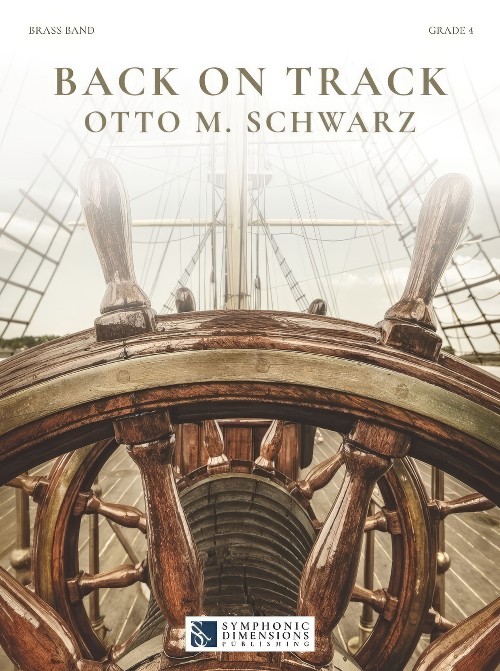
Back on Track (Brass Band - Score and Parts) - Schwarz, Otto M.
Back on Track is a spectacular composition originally written for Concert Band. Otto M. Schwarz composed an opening fanfare for the beginning, which can also be played as a short 'teaser' at festive events. A motif is treated through various rhythms and time signatures and leads to an epic finale, splendidly brought to life by the glorious timbres of the brass.
Estimated dispatch 7-14 working days
-
 £79.95
The Lost Village of Imber (Brass Band - Score and Parts) - Bond, Christopher
The Lost Village of Imber was commissioned by Bratton Silver Band in 2019 in celebration of 160 years of the band; 1859-2019. Structured in three movements, the complete work was premiered by Cory Band at Wiltshire Music Centre in February 2020.The village of Imber on Salisbury Plain had been inhabited for over one thousand years when it was evacuated in 1943 to make way for military training in the Second World War. At the time, with preparations for the Allied invasion of Europe underway, most villagers put up no resistance, despite being upset, with the belief that they'd return once the war had concluded. To this day, Imber and its surrounding land remain a military training ground. The villagers never returned, and just the shell of what was once a community remains.Structured in three movements, it is on this very real story that the work is based, setting out the series of events of 1943 in chronological order.The first movement, On Imber Downe, portrays a sense of jollity and cohesiveness, a community of individuals living and working together before news of the evacuation had broken. Sounds of the village are heard throughout, not least in a series of percussive effects, the anvil of the blacksmith; the cowbell of the cattle and the bells of the church.The second movement, The Church of St. Giles, begins mysteriously and this sonorous, atmospheric opening depicts Imber in its desolate state and the apprehension of residents as they learn they have to leave their homes. Amidst this is the Church, a symbol of hope for villagers who one day wish to return, portrayed with a sweeping melodic passage before the music returns to the apprehension of villagers facing eviction around their sadness at losing their rural way of life.In complete contrast, the third movement, Imemerie Aeternum, portrays the arrival of the military, complete with the sounds of the ammunition, firing and tanks, sounds which were all too familiar to those living in the surround areas. To close, the Church of St. Giles theme returns in a triumphant style, representing the idea that the church has always been, even to this day, a beacon of hope for the villagers and local community, both the centrepiece and pinnacle of a very real story.Duration: 13.30
Estimated dispatch 7-14 working days
-
 £89.95
Four Etudes (Brass Band - Score and Parts) - Gregson, Edward
This work was written during August and September 2016. In it, I wanted primarily to explore the elements of timbre, rhythm, texture and colour. The first three tudes (or studies) are based on a set of piano pieces I composed in 1982, whilst the last, the longest of the set, was composed specially. My reference point was the Four tudes for orchestra of 1928 by Stravinsky, a work I have always admired, and of which the first three also happen to be based on a set of earlier pieces, in his case for string quartet, with the last being a re-arrangement of a work for pianola. I have also borrowed the titles he gave to the individual studies as they seemed to fit the mood of my pieces.However, the exception is the final study, where instead of the exuberant mood of his colourful portrayal of Madrid, mine was influenced by the terrible human tragedy that was unfolding in Aleppo at the time I was writing it, and thus reflects the violence and barbarism of those events; yet towards the end it does offer a glimmer of hope for humanity with a return to the Canticle (Song) of the first study, and concludes quietly with the chords and bells that began the work. The titles of the tudes are Canticle, Dance, Excentrique, and Aleppo. Like Stravinsky's, the set is relatively short, lasting around 8 minutes.The Four tudes were commissioned by Black Dyke Band and were written specially for the recording marking the conclusion of my year as Composer-in-Residence. The concert premiere will be given by Black Dyke Band, conducted by the composer, at the RNCM Festival of Brass in January 2017.- Edward GregsonDuration: 8.00
Estimated dispatch 7-14 working days
-
 £37.95
Four Etudes (Brass Band - Score only) - Gregson, Edward
This work was written during August and September 2016. In it, I wanted primarily to explore the elements of timbre, rhythm, texture and colour. The first three tudes (or studies) are based on a set of piano pieces I composed in 1982, whilst the last, the longest of the set, was composed specially. My reference point was the Four tudes for orchestra of 1928 by Stravinsky, a work I have always admired, and of which the first three also happen to be based on a set of earlier pieces, in his case for string quartet, with the last being a re-arrangement of a work for pianola. I have also borrowed the titles he gave to the individual studies as they seemed to fit the mood of my pieces.However, the exception is the final study, where instead of the exuberant mood of his colourful portrayal of Madrid, mine was influenced by the terrible human tragedy that was unfolding in Aleppo at the time I was writing it, and thus reflects the violence and barbarism of those events; yet towards the end it does offer a glimmer of hope for humanity with a return to the Canticle (Song) of the first study, and concludes quietly with the chords and bells that began the work. The titles of the tudes are Canticle, Dance, Excentrique, and Aleppo. Like Stravinsky's, the set is relatively short, lasting around 8 minutes.The Four tudes were commissioned by Black Dyke Band and were written specially for the recording marking the conclusion of my year as Composer-in-Residence. The concert premiere will be given by Black Dyke Band, conducted by the composer, at the RNCM Festival of Brass in January 2017.- Edward GregsonDuration: 8.00
Estimated dispatch 7-14 working days
-
 £39.99
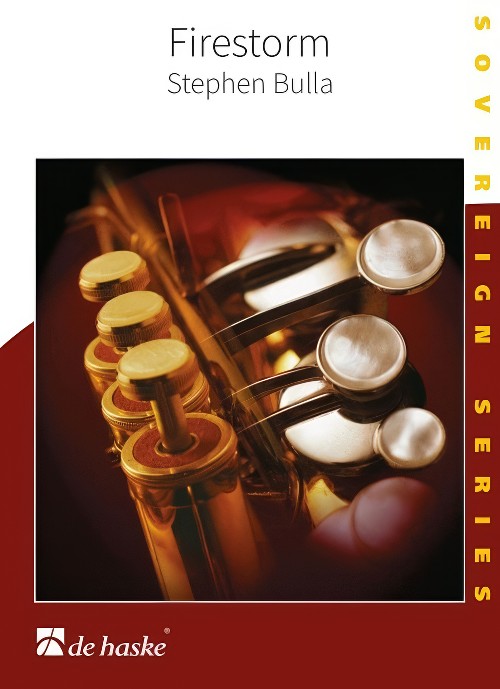
Firestorm (Brass Band - Score only) - Bulla, Stephen
The inspiration for this piece, commissioned by the United States Army Band, came from the Gulf and its constant presentation to the world as a media event on television. The composer wanted to capture the colour and events of war as they were played out on the television screen. Composed as a single movement rhapsody, the work is framed by the riveting sounds of airborne bombing raids with brass and percussion combining to create a gripping sense of tension.Duration: 11:15
Estimated dispatch 7-14 working days
-
£104.99
Firestorm (Brass Band - Score and Parts) - Bulla, Stephen
The inspiration for this piece, commissioned by the United States Army Band, came from the Gulf and its constant presentation to the world as a media event on television. The composer wanted to capture the colour and events of war as they were played out on the television screen. Composed as a single movement rhapsody, the work is framed by the riveting sounds of airborne bombing raids with brass and percussion combining to create a gripping sense of tension.Duration: 11:15
Estimated dispatch 7-14 working days
 View Music