
Results
-
 £39.95
Red Hills of Georgia, The - Jonathan Bates
DURATION: 4 minutes. DIFFICULTY: Championship. The title of this work comes from a line in Martin Luther King Jnr's famous 'I Have a Dream ' speech, portraying the vast expanses of the plains of Georgia and the notable red hue to the surrounding mountains. This piece is very much influenced by the music of American wind band composers Samuel Hazo and Richard Saucedo, both of which are regularly inspired by the scenery of 'the big country'. This piece was composed for Jaren Hornmusikkforening as part of their programme for the 2018 SIDDIS Championships held in Stavanger, Norway. .
In Stock: Estimated dispatch 1-3 working days
-
 £74.99
Cornet Concerto No.1 - Jonathan Bates
My 'Cornet Concerto No.1' was composed for Lode Violet and Brass Band Willebroek in 2018 and features 2 movements, entitled 'Dystopia' and 'Utopia'. . The nature of the music in the opening section, 'Dystopia', is very jagged, disjointed and unsettling, as the soloist almost battles against the constant churning of the mechanical accompaniment, trying to persevere with it's own ideas and styles without being dragged into conforming to it's surroundings. The movement is based largely on the 3 note interval heard right at the outset of the piece (C, D & G#, a series of notes that lends itself so well to different modes, scales, harmonies and intervals) and this forms much of the rhythmic and harmonic structure of the opening section.Whilst this movement acts as a virtuoso feature to demonstrate the extended capabilities of both the soloist and instrument, I feel the accompanying ensemble plays an equal role in the narrative of 'dystopia', and features a number of demanding and prominent episodes for soloists within the accompanying band. A short and heavy coda concludes the movement, with a sense of real pain and sorrowfulness as the music fades away into darkness. . 'Utopia' opens in an instantly more hopeful nature, with the soloist introducing the first real 'theme' of the movement, taken up shortly by the accompaniment. Throughout this movement, there are a number of timbral and melodic references back to the darkness of 'dystopia', but transformed into a much more positive outlook and soundworld. There is a moment of quiet reflect (using the initial 3 note cell as a basis) before flying head first into a frenzied wild 'tarantella' like section, full of joy and energy which tests the dexterity and light-natured approach to virtuosity (much unlike the heavier material in the 1st movement) of the soloist. Primarily, the concept of this finale is fun - joy, happiness, and freedom from restraint, so the addition of a quirky 'tongue-in-cheek' habanera section offers a brief moment of respite from the craziness of the tarantella. To conclude the work, there is an extended cadenza for the soloist which is built on several motifs heard throughout the concerto, which leads the band into a dramatic and energetic final few bars.. Jonathan Bates. (2018). .
In Stock: Estimated dispatch 1-3 working days
-
 £34.99
Submerged... (Cornet Concerto No.2) - Jonathan Bates
'Submerged..' is a virtuoso concerto for Cornet composed as a response to the 'lost' Derbyshire villages of Ashopton & Derwent,. both of which were drowned in the early 1940's to make way for a new reservoir to aid the ever-increasing water demand from nearby. Sheffield and it's steel industry during World War 2. The work is through-composed but is defined by 3 clear main sections, 'The . Packhorse Bridge, Derwent', 'Ashopton Chapel' and 'Operation Chastise'. Much of the melodic and harmonic material throughout the. concerto is inspired by 3 contrasting sources; an original motif of towering block chords which opens the concerto, the famous opening. fragment of Eric Ball's 'High Peak' (1969) which was composed as a tribute to the district of Derbyshire where Ashopton & Derwent lie, . and finally Claude Debussy's haunting 'La Cath drale Engloutie' or 'The Sunken Cathedral', which was composed in 1910 around the legend of. the submerged cathedral of Ys. . I. Packhorse Bridge, Derwent (1925). One of the most striking features of the former village of Derwent was it's Packhorse Bridge, which spanned the River Derwent. adjacent to the Derwent Hall - a grand, picturesque Jacobean country house. In 1925, the renowned impressionist artist Stanley. Royle painted a striking image of the two in midwinter, with the partially frozen river sat quietly underneath the snow-topped. bridge in the foreground, while the old hall sits peacefully and dark in the background. The opening setion of this concerto paints. this picture in a quite schizophrenic manner; with frosty, shrill march-like material picturing the villagers crossing the narrow icy. bridge, combined with wild and frenzied waltz music of the grand hall and it's masquerade balls laying, for now, quietly mysterious. across the river. . II. Ashopton Chapel (1939). Ashopton was much the smaller and less-populated of the 2 'lost' villages, but still bore home to a Roman Catholic Chapel which was. the focal point of the village. The chapel - along with the rest of Ashopton - was drowned in 1943, but the final service to take place there. was held in 1939, with the final hymn being 'Day's Dying in the West'. This hymn forms a haunting coda to the 2nd section, with firstly the . piano leading the melody before an audio track containing an old recording of the hymn is accompanied by the sound of flowing water and . the rumble of storms as the village hypothetically disappears from existence with the hymn tune still echoing around the valley, before . subsiding into the growing roar of the engine of a Lancaster Bomber as it soars overhead towards Derwent to practise it's 'Dam-Buster' raid. . III. Operation Chastise (1943). The Derwent Reservoir lies adjacent to Ladybower Reservoir (of which Ashopton & Derwent were flooded to make way for) in the . Derbyshire High Peak, and during the 2nd World War was used as one of the central low-atitude practise areas of the 617 Squadron - more . commonly known affectionately as the 'Dambusters'. Before the destruction of Derwent, it's 'Packhorse Bridge' was dismantled stone by stone . and re-assembled upstream at Howden Dam to the north end of Derwent Reservoir. This is where the music begins, with a reconstruction of . the opening material before taking flight into a whirlwind tour of virtuosity from the soloist. .
In Stock: Estimated dispatch 1-3 working days
-
 £30.00
92 Squadron - Brass Band Sheet Music Full Score & Parts - LM372
COMPOSER: Alex McGeeA concert march for brass band dedicated to 92 SquadronNumber 92 Squadron, also known asNo. 92 (East India) Squadronand currently asNo. 92 Tactics and Training Squadron, of theRoyal Air Forceis a test and evaluation squadron based atRAF Waddington,Lincolnshire. It was formed as part of theRoyal Flying CorpsatLondon Colneyas a fighter squadron on 1 September 1917. It deployed to France in July 1918 and saw action for just four months, until the end of the war. During the conflict it flew both air superiority and direct ground support missions. It was disbanded atEilon 7 August 1919. Reformed on 10 October 1939,at Tangmere Airfield, the unit was supposed to be equipped with medium bombers but in the spring of 1940 it became one of the first RAF units to receive theSupermarine Spitfire, going on to fight in theBattle of Britain.LM372 - ISMN : 9790570003723
In Stock: Estimated dispatch 3-5 working days
-
 £30.00
Alexibelle (Paul F. Cooper)- Brass Band Full Score & Parts - LM636
COMPOSER: Paul F. CooperAlexibelle(A Child's Blessing)This piece of music has been composed in memory of 2 young children from the same family, who sadly passed away from a genetic condition.Both of them used to enjoy switching on a little radio which was permanently tuned into Classic FM, hence the connection to the classical part of the composition.The music concludes with a soft tender element a lullaby, which is a soothing tune often sung or played to help a child fall asleep.
In Stock: Estimated dispatch 3-5 working days
-
 £30.00
Amazing Grace (W. Walker arr. by Paul Pennicotte-Henrie) - Brass Band Sheet Music Full Score and Parts - LM642
COMPOSER: W. WalkerARRANGER: Paul Pennicotte-Henrie"Amazing Grace" is a Christian hymn published in 1779 by English Anglican clergyman, abolitionist, and poet John Newton. It is possibly the most sung and most recorded hymn in the world and is especially popular in the United States, where it is used for both religious and secular purposes. Newton wrote the words from personal experience; he grew up without any particular religious conviction, but his life's path was formed by a variety of twists and coincidences that were often put into motion by others' reactions to what they took as his recalcitrant insubordination. He was pressed into service with the Royal Navy, and after leaving the service, he became involved in the Atlantic slave trade.In 1748, a violent storm battered his vessel off the coast of County Donegal, Ireland, so severely that he called out to God for mercy. While this moment marked his spiritual conversion, he continued slave trading until 1754 or 1755, when he ended his seafaring altogether. Newton began studying Christian theology and later became an abolitionist.Ordained in the Church of England in 1764, Newton became the curate of Olney, Buckinghamshire, where he began to write hymns with poet William Cowper. "Amazing Grace" was written to illustrate a sermon on New Year's Day of 1773. It is unknown if there was any music accompanying the verses; it may have been chanted by the congregation. It debuted in print in 1779 in Newton's and Cowper's Olney Hymns, but settled into relative obscurity in England. In the United States, "Amazing Grace" became a popular song used by Baptist and Methodist preachers as part of their evangelizing, especially in the American South, during the Second Great Awakening of the early 19th century. It has been associated with more than 20 melodies. In 1835, American composer William Walker set it to the tune known as "New Britain" in a shape note format; this is the version most frequently sung today.
In Stock: Estimated dispatch 3-5 working days
-
 £30.00
An Englishman, An Irishman & A Scotsman Walk Into A Bar - Trio & Brass Band Sheet Music Full Score & Parts - LM562
COMPOSER: Stuart J. RogersA delightful musical Scherzo (Joke) for the unlikely trio of Eb Soprano Cornet, Bb Cornet & Bb Flugelhorn.A great piece for both soloists and band alike with many a twist and turn.Suitable for 2nd Section and aboveLM562 - ISMN : 9790570005628
In Stock: Estimated dispatch 3-5 working days
-
 £73.00
Donec Iterum Conveniant - Anton Weeren
translation: "Until We Meet Again". This choral piece was dedicated to those who have gone before us into the light. The feelings of sorrow and loss for beloved people who have passed away are solemnly translated musically in this composition. Both peace, contemplation, and reflection, as well as emotion, hope, expression, and the question of "why", are clearly expressed musically. This makes this composition particularly suitable for somber occasions, as a resting point in a program, or as warm-up music.
Estimated dispatch 10-14 working days
-
 £46.00
That's the Spirit - Peter Goosensen
That's the Spirit! Is a fun and challenging work that is a great flashy opening to concert programs, for youth orchestras and smaller bands. The driving drum and percussion groove provides a solid rhythmic base. The various wind sections of the band deliver both impressive themes but also more subtle melodic lines.
Estimated dispatch 10-14 working days
-
 £69.00
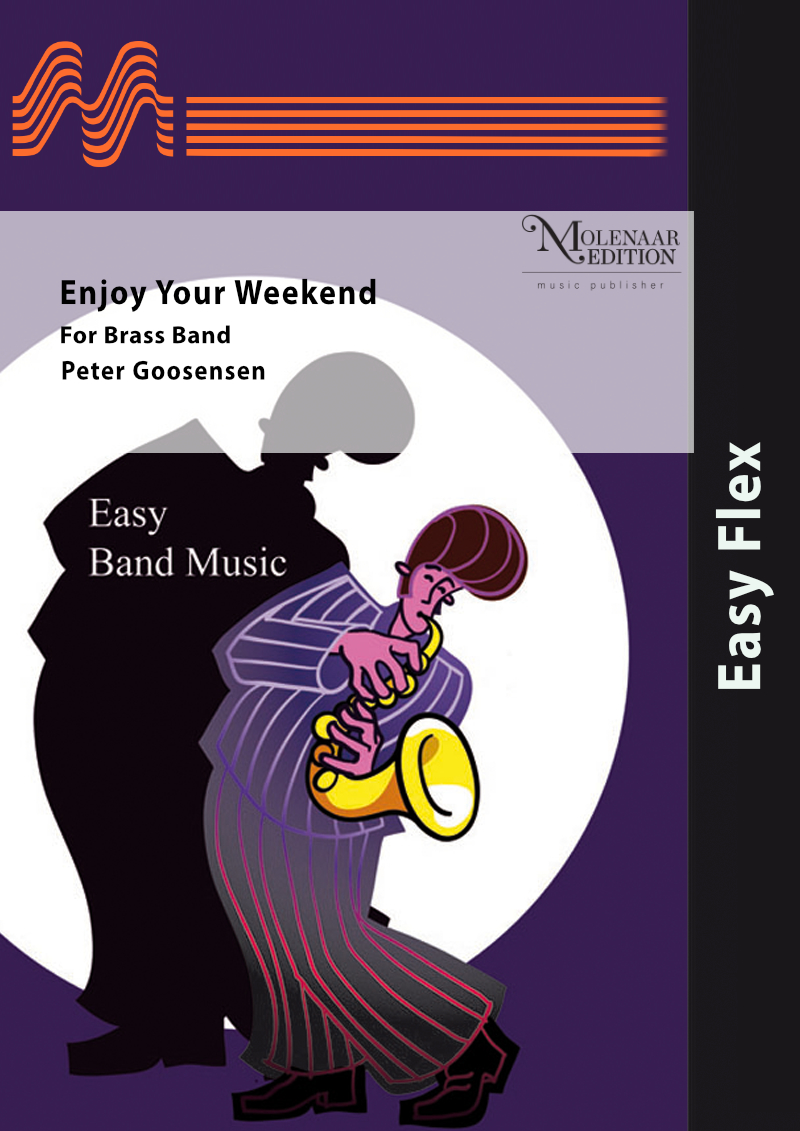
Enjoy Your Weekend! - Peter Goosensen
Enjoy your Weekend! is a fun and varied composition that offers lots of playing pleasure for both youth and smaller bands. The composition is based on a simple and pretty theme. The first part, Lazy Sunday, is built around a relaxed swinging tune. The second part, Close Friends, is more melodic and serious in nature. In Party Rock, the third part, the drummer plays a central role and the band can play their hearts out. Enjoy your Weekend!
Estimated dispatch 10-14 working days


 Listen to MP3
 View Music