
Results
-
 £29.88
How Shall I Woo Thee (Cornet Solo with Brass Band) Coleridge-Taylor arr.Bushnell
The 7 African Romances, Op. 17 for voice and piano has words by Paul Laurence Dunbar and music by Samuel Coleridge-Taylor. Published in 1897, it comprises of 7 songs, "An African Love Song", "A Prayer", "A Starry Night", "Dawn", "Ballad", "Over the Hills" and "How Shall I Woo Thee?", of which the last is arranged here.This arrangement was requested by Besses o' th' Barn Band for the The Samuel Coleridge-Taylor Festival held in Liverpool on 11 October 2025. The song is wonderfully lilting with moments to indulge in the music.This arrangement is for the UK-style brass band and either solo B-flat cornet, solo E-flat soprano cornet or soprano singer. It also has alternative parts for horns in F and bass-clef lower brass. A recording of the original song can be found here: https://www.youtube.com/watch?v=tglGpaBsWOo Duration: Approx. 3.10 minutes Difficulty Level: 4th Section + This PDF download includes the full score and parts. Includes alternative parts for soloist in Eb, horns in F and lower brass in bass clef. Sheet music available at www.brassband.co.uk (UK) or https://satradecentral.org (USA) Instrumentation: Cornet Soloist Bb Soprano Cornet Eb Solo Cornet Bb Repiano Cornet Bb 2nd Cornet Bb 3rd Cornet Bb Flugel Horn Bb Solo Horn Eb 1st Horn Eb 2nd Horn Eb 1st Baritone Bb 2nd Baritone Bb 1st Trombone Bb 2nd Trombone Bb Bass Trombone Euphonium Bb Bass Eb Bass Bb Timpani Percussion 1-2
In Stock: Estimated dispatch 1-3 working days
-
 £37.35
March - The Stewards (Brass Band) Dave Collins
This rousing march by Dave Collins is a dedication to the remarkable group of volunteers - the unsung heroes - who, each year, organise and run the iconic Whit Friday brass band contests. They ensure that the heritage and tradition of this uniquely special event is not lost, preserving its ongoing and continued success. BrookWright is offering a 25% discount for bands who perform this march at the Whit Friday Contest. To claim the discount, please send a scan or photo of your band's adjudication card after the event to [email protected] Whit Friday, 'The Greatest Free Show on Earth', is synonymous with the brass band tradition. Its importance in the annual calendar to the players, supporters and spectators is vital to the Tameside and Saddleworth community. However, this mighty contest simply could not take place without the willing volunteers who dedicate their services year after year to keep this unique banding tradition going.Traditionally, on Whit Friday Morning, Hail! Smiling Morn (Roud #1346), also known as Praise Ye the Lord, is heard across the Saddleworth villages. This is where I have taken my inspiration, and the entire march is built upon quotes and references of this joyous work.The Stewards has many traditional elements drawing on the vast repertory of well-known marches, as well as some untraditional techniques and harmonies. The work aims to be a good test for the bands in its performance, but also fun and entertaining for the players and audiences alike - featuring a cheeky cornet solo, thunderous bass feature, and lyrical euphonium melodies, before concluding with a triumphant quote from the original source material.To you all who perform or hear this work, the stewards of the brass band tradition, HAIL! To view a follow-the-score video featuring Tredegar Town Band performing the work please visit www.youtube.com/watch?v=-CNgqvc534s PDF download includes score and parts, and comes in both A4 size and A5 landscape parts for marching purposes. A single page A5 conductor reduced score is also included. Sheet music available from: UK - www.brassband.co.uk USA - www.solidbrassmusic.com Difficulty Level: 3rd Section + Instrumentation: Soprano Cornet Eb Solo Cornet Bb Repiano Cornet Bb 2nd Cornet Bb 3rd Cornet Bb Flugel Horn Bb Solo Horn Eb 1st Horn Eb 2nd Horn Eb 1st Baritone Bb 2nd Baritone Bb 1st Trombone Bb 2nd Trombone Bb Bass Trombone Euphonium Bb Bass Eb Bass Bb Cymbals Side Drum Bass Drum
In Stock: Estimated dispatch 1-3 working days
-
 £48.56
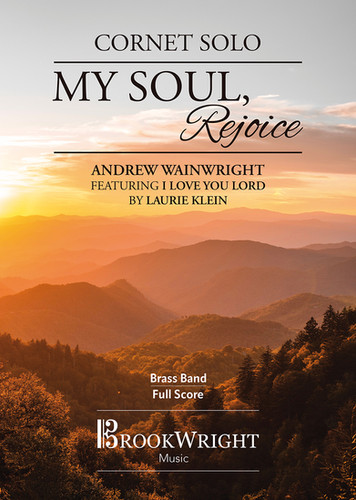
My soul, rejoice (Cornet Solo with Brass Band) Andrew Wainwright
My soul, rejoice (Andrew Wainwright) was commissioned in 2022 by Elizabeth Malovance, principal cornet of the Chicago Staff Band. A spirited and celebratory work, it is designed to showcase the dual nature of the cornet: its sparkling technical agility and its rich, vocal lyricism. The music begins in meditative fashion before transitioning into a joyful caprice featuring playful syncopations which are handed around the band. This is followed by a reflective section based on the much-loved worship song I love you Lord by Laurie Klein. The work concludes with a reprise of the original theme, building in momentum and intensity. Through a series of brilliant runs and virtuosic flourishes, the soloist leads the charge toward a majestic and triumphant finale, bringing the work to a ringing, glorious close. The solo was recorded by Richard Marshall on the 2026 CD Gothique Fantasy - The Music of Andrew Wainwright, which was his last solo recording of his 20-year tenure as principal cornet of Black Dyke Band. Technical Requirements & Electroacoustic Integration This work features an optional digital delay effect for the soloist, indicated in the score by "pedal on" and "pedal off" markings. If the required equipment is unavailable, the piece can be performed entirely acoustically. To listen to Beth Malovance performing the work with the Chicago Staff Band please visit https://on.soundcloud.com/c8IoU3CF3srTD4z0wX Duration: approx. 8 minutes Difficulty Level (Band): 2nd Section + Soloist: Advanced This PDF download includes the full score and parts. Sheet music available at www.brassband.co.uk (UK) or https://satradecentral.org (USA) Instrumentation: Soprano Cornet Eb Solo Cornet Bb 1st Cornet Bb 2nd Cornet Bb Flugel Horn Bb Solo Horn Eb 1st Horn Eb 2nd Horn Eb 1st Baritone Bb 2nd Baritone Bb 1st Trombone Bb 2nd Trombone Bb Bass Trombone Euphonium Bb Bass Eb Bass Bb Timpani & Bass Drum Percussion 1-3
In Stock: Estimated dispatch 1-3 working days
-
 £33.62
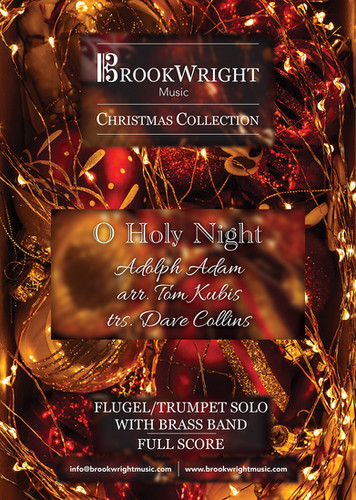
O Holy Night (Flugel/Trumpet Solo with Band) arr. Tom Kubis trs. Dave Collins
This stunning arrangement of O Holy Night, showcases the lyrical and expressive potential of the Flugel Horn or Trumpet, arranged by acclaimed jazz composer Tom Kubis and transcribed by Dave Collins. Originally made famous by the legendary Wayne Bergeron with the Tom Kubis Big Band, this arrangement has since become a favourite among brass soloists worldwide. It received its concert premiere with the North York Temple Band (Canada) under Bandmaster Glenn Barlow, featuring the virtuosic talents of Marcus and Harrington Venables. The piece was later recorded by the International Staff Band, conducted by Dr. Stephen Cobb, on their 2016 album Celebrate the Season. The featured soloist on that recording was the world-renowned Philip Cobb. This arrangement offers flexible performance options - it can be presented as a solo feature or as a duet for Flugel Horn and Soprano Cornet (cued into the parts), making it ideal for both concert settings and festive performances. To view a video of Philip Cobb performing the solo with the International Staff Band, please visit www.youtube.com/watch?v=1x_hjZyDjrA&list=RD1x_hjZyDjrA&start_radio=1 Duration: approx. 3.45 minutes Difficulty Level: 3rd Section + PDF download includes parts and score. Sheet music available at www.brassband.co.uk (UK) or https://satradecentral.org (USA) Instrumentation: Flugel Horn/Trumpet Soloist Bb Soprano Cornet Eb Solo Cornet Bb Repiano Cornet Bb 2nd Cornet Bb 3rd Cornet Bb Flugel Horn Bb Solo Horn Eb 1st Horn Eb 2nd Horn Eb 1st Baritone Bb 2nd Baritone Bb 1st Trombone Bb 2nd Trombone Bb Bass Trombone Euphonium Bb Bass Eb Bass Bb Bass Drum Percussion 1-3
In Stock: Estimated dispatch 1-3 working days
-
 £48.56
Peace in Our Time (Brass Band) Andrew Wainwright
Commissioned by Armonico Consort to mark the 85th anniversary of the Coventry Blitz, Peace in Our Time is a profoundly moving reflection on humanity's enduring quest for reconciliation amidst turmoil. Originally scored for choir, orchestra, and organ, this masterful brass band transcription beautifully captures the emotional weight of John Oxenham's evocative poetry and the timeless plea of Psalm 122. The work opens in hushed reverence, where distant muted cornets, a dark bass pedal, and a fragile, militaristic snare drum set a shadowed, contemplative scene. Out of this delicate landscape emerges a poignant cornet solo that yields to the expressive voice of the solo flugel horn, carrying the opening text with quiet conviction before introducing the solemn reminder: "O pray for peace, peace in Jerusalem." As the piece progresses, the setting turns darker and more restless. Harmonic tension builds through rich brass textures to reflect the fears, divisions, and heavy costs of historical and modern conflict. From this emotional turbulence rises a bold, ceremonial fanfare that marks a dramatic turning point, ushering in a glorious, expansive setting of the poem's final verse. Yet rather than ending in simple triumph, the music gently recedes into a serene and tender stillness. The final bars leave performers and audiences alike with a quiet, lingering echo - a persistent hope for peace that resonates just as deeply today as it did 85 years ago. This substantial work is an extraordinary addition to any brass band library, serving as an ideal centerpiece for Remembrance Sunday, historical commemorations, church services or serious concert programming. To view a multimedia presentation of the piece with audio please visit www.youtube.com/watch?v=Y2BKI_GCegw The multimedia presentation is available on request withe purchase of this work - please email [email protected] to receive a link to download it. To view a video performance of the original work for choir, orchestra and organ please visit www.youtube.com/watch?v=m6o6PJJVKCo Duration: approx. 8.45 minutes Difficulty Level: 2nd Section + This PDF download includes the full score and parts. Sheet music available at www.brassband.co.uk (UK) or https://satradecentral.org (USA) Instrumentation: Soprano Cornet Eb Solo Cornet Bb Repiano Cornet Bb 2nd Cornet Bb 3rd Cornet Bb Flugel Horn Bb Solo Horn Eb 1st Horn Eb 2nd Horn Eb 1st Baritone Bb 2nd Baritone Bb 1st Trombone Bb 2nd Trombone Bb Bass Trombone Euphonium Bb Bass Eb Bass Bb Timpani Percussion 1-2
In Stock: Estimated dispatch 1-3 working days
-
 £33.62
Swinging all the way (Brass Band) Dave Collins
Swinging all the way is a jazzy take on the most well known of Christmas tunes, Jingle Bells. We begin in a dark underground jazz club with the rich, luscious harmonies supporting the tune that we all know. But the melody is perhaps secondary to the timbres and dissonances of this darkly elegant ballad punctuated by the solo cornet, a contrast of styles between the joyous melody and sober accompaniment. As the work progresses it becomes more uplifting, with solo features from the trombone, before emerging into the bright lights of a big band set, with stride bass, crunchy punctuating rhythms and screaming trumpets. The arrangement ends where we began, after our exciting sleigh ride comes to an end. To view a rolling score video please visit www.youtube.com/watch?v=UbUMVuWFrNI PDF download includes score and parts. Sheet music available from: UK - www.brassband.co.uk USA - https://satradecentral.org Difficulty Level: 2nd Section + Length: 4.00 minutes Instrumentation: Soprano Cornet Eb Solo Cornet Bb Repiano Cornet Bb 2nd Cornet Bb 3rd Cornet Bb Flugel Horn Bb Solo Horn Eb 1st Horn Eb 2nd Horn Eb 1st Baritone Bb 2nd Baritone Bb 1st Trombone Bb 2nd Trombone Bb Bass Trombone Euphonium Bb Bass Eb Bass Bb Timpani/Sus. Cymbal Drum Kit Vibraphone/Xylophone
In Stock: Estimated dispatch 1-3 working days
-
 £33.62
Love Eternal (Trombone Solo with Brass Band) Jarrod Cooper arr. Gavin Lamplough
Love Eternal was arranged by Gavin Lamplough for trombone virtuoso Isobel Daws to perform in a special concert with the Melbourne Staff Band to honour its Bandmaster Ken Waterworth, on the occasion of his retirement after 30 years of leading the band. The arranger uses Jarod Cooper's popular contemporary worship song King of Kings, Majesty as the basis for the work and the piece seeks to provide a vehicle for the rich timbres of the trombone to be enjoyed by the listener. To view a rolling score video featuring Isobel Daws and the Melbourne Staff Band please visit www.youtube.com/watch?v=AEpbHNFPMxs This title is also available as a tenor horn solo with brass band here. PDF download includes score and parts. Sheet music available from: UK - www.brassband.co.uk USA - https://satradecentral.org Difficulty Level: 4th Section + Length: 5.00 minutes Instrumentation: Trombone Soloist Eb Soprano Cornet Eb 1st Cornet Bb 2nd Cornet Bb Flugel Horn Bb 1st Horn Eb 2nd Horn Eb 1st Baritone Bb 2nd Baritone Bb 1st Trombone Bb 2nd Trombone Bb Bass Trombone Euphonium Bb Bass Eb Bass Bb Percussion 1-3
In Stock: Estimated dispatch 1-3 working days
-
 £33.62
A Christmas Canon (Brass Band) Traditional arr. William Gordon
Seamlessly merging the traditional English carol The First Nowell with Johann Pachelbel's beloved Canon in D, A Christmas Canon is a captivating arrangement designed to bring rich texture and emotional depth to your band's winter concert repertoire. Suitable for intermediate to advanced bands, the piece opens Adagio sostenuto with a gently rolling, scalic ostinato in the euphonium and lower brass, establishing the unmistakable harmonic ground bass of Pachelbel's masterpiece. Over this foundation, expressive solo lines in the flugel and horns gracefully weave the familiar melody of The First Nowell into the texture. As the arrangement unfolds, the scoring gradually builds density and counterpoint. Intricate muted cornet passages give way to flowing arpeggios, bell-like glockenspiel accents, and cascading lines across the band, driving a gradual crescendo into a rich, full-ensemble statement of the carol theme. The work reaches its dramatic climax at an expanded Allargando section, where the full band, supported by percussion, delivers a majestic, fortissimo declaration of the melody before resolving into a warm, lingering final chord. To view a rolling score video of the Amsterdam Staff Band performing this piece please visit: www.youtube.com/watch?v=dr9hMLhAvRM Difficulty Level: 3rd Section + Duration: 3.30 minutes This PDF download includes the full score and parts. Sheet music available at www.brassband.co.uk (UK) or https://satradecentral.org (USA) Instrumentation: Soprano Cornet Eb Solo Cornet Bb 1st Cornet Bb 2nd Cornet Bb Flugel Horn Bb Solo Horn Eb 1st Horn Eb 2nd Horn Eb 1st Baritone Bb 2nd Baritone Bb 1st Trombone Bb 2nd Trombone Bb Bass Trombone Euphonium Bb Bass Eb Bass Bb Timpani Percussion 1-2
In Stock: Estimated dispatch 1-3 working days
-
 £33.62
Adoration (Cornet Solo with Brass Band) Florence Price trs. Andrew Wainwright
Florence Price was an American classical composer, pianist, organist and music teacher. She is noted as the first African-American woman to be recognised as a symphonic composer, and the first to have a composition played by a major orchestra. Price composed over 300 works: four symphonies, four concertos, as well as choral works, art songs, chamber music and music for solo instruments. In 2009, a substantial collection of her works and papers that had been previously considered lost was found in her abandoned summer home. Amongst these was this delightful work, Adoration, which had been composed in the 1950s for organ. According to IMSLP.org, the piece "failed to meet notice or renewal requirements to secure statutory copyright with no 'restoration' under the GATT amendments" and therefore is in the public domain. A version for violin and piano by Elaine Fine has become popular. This setting for cornet soloist with brass band has been arranged by Andrew Wainwright. It is also available as a Bb solo with piano here. To view a video of Andrew Roe performing the work, please visit: www.youtube.com/watch?v=_7UYlz8Fzxo Difficulty Level: 4th Section + Length: 3.15 minutes Sheet music available from: UK - www.brassband.co.uk USA - https://satradecentral.org Instrumentation: Cornet Soloist Bb Soprano Cornet Eb Solo Cornet Bb Repiano Cornet Bb 2nd Cornet Bb 3rd Cornet Bb Flugel Horn Bb Solo Horn Eb 1st Horn Eb 2nd Horn Eb 1st Baritone Bb 2nd Baritone Bb 1st Trombone Bb 2nd Trombone Bb Bass Trombone Euphonium Bb Bass Eb Bass Bb (Percussion Tacet)
In Stock: Estimated dispatch 1-3 working days
-
 £59.77
Caprice (Euphonium Solo with Brass Band) Andrew Batterham
VIEW SCORE PDF Caprice was written for Matthew van Emmerik, to showcase his virtuosity in an engaging piece of concert music. The work is in theme and variation form, with the primary material being the theme from the last of Paganini's Ventiquattro Capricci per violino solo, a collection of 24 caprices for solo violin. This theme has been the inspiration for similar works by many composers since it was first published, including Liszt, Brahms, Rachmaninov, Benny Goodman and Andrew Lloyd Webber. In this work, the famous theme is treated to a more contemporary approach. The first variation, Capricious, relies on motor rhythms and jagged dialogues between the soloist and the band. It is couched in an organic scale reminiscent of the Phrygian mode. The second variation, Sad, is in direct contrast, acting as a traditional ballad and allowing the soloist to explore the expressive side of the instrument. The third variation, Energetic, is a micro set of variations in itself, designed to display the soloist's innovative technique and stamina. Each section is more challenging than the last, until the work concludes with a whirlwind dance at breakneck speed. Like all of Batterham's recent work, the musical language of Caprice draws upon classical, jazz, funk and ska elements to create a unique sound where anything can happen, and probably will. This arrangement was made possible through Matt's instigation and generosity. To view a video of Matthew van Emmerik performing the version with brass band please visit www.youtube.com/watch?v=D0hsvux_a5o To view a video of Fletcher Mitchell performing the version with piano please visit www.youtube.com/watch?v=NOZ6KRldDVo Sheet music available from: UK - www.brassband.co.uk USA - www.solidbrassmusic.com Instrumentation: Euphonium Soloist Soprano Cornet Eb Solo Cornet Bb Repiano Cornet Bb 2nd Cornet Bb 3rd Cornet Bb Flugel Horn Bb Solo Horn Eb 1st Horn Eb 2nd Horn Eb 1st Baritone Bb 2nd Baritone Bb 1st Trombone Bb 2nd Trombone Bb Bass Trombone Euphonium Bb Bass Eb Bass Bb Percussion 1-3
In Stock: Estimated dispatch 1-3 working days