
Results
-
 £12.50
Lloyd (Brass Band - Score only) - Howard, Cuthbert - Coles, Bramwell
The first presentation of the theme can be used for the purpose of accompanying congregational singing. At Section A the second presentation of the tune appears in the key of the dominant, the melody being given throughout to Solo Horn, with First Horn, First Trombone, Soprano and Flugel reinforcing the melody in the various phrases. Incidentally, see that the players do not break these phrases; it should be possible to take the four bars in one breath quite easily. Take due care of the light and shade which should be delicately applied. In the last bar the music gathers strength as we pass back into the original key for the last verse; pay particular attention to the part allotted to Second Baritone and Euphonium which needs to be slightly stressed. For the last appearance of the tune at Section B the full Band is used, apart from the third phrase which is given solo by Solo Comet with a light accompaniment above a bass pedal. Notice the rit. operating from the end of the eleventh bar and also the short swell effect on the fourth beat of the fourteenth bar.
Estimated dispatch 7-14 working days
-
 £30.00
Black Bottom Stomp - Jelly Roll Morton
Ferdinand Joseph LaMothe, professionally known as Jelly Roll Morton, was an American ragtime and early jazz pianist, bandleader and composer who started his career in New Orleans, Louisiana. Widely recognised as a pivotal figure in early jazz, Morton is perhaps most notable as jazz's first arranger, proving that a genre rooted in improvisation could retain its essential spirit and characteristics when notated. His composition "Jelly Roll Blues" was the first published jazz composition in 1915. Morton is also notable for writing such standards as "King Porter Stomp", "Wolverine Blues", "Black Bottom Stomp", and "I Thought I Heard Buddy Bolden Say". Notorious for his arrogance and self-promotion, Morton claimed to have invented jazz outright in 1902, much to the derision of fellow musicians and the critics. At the age of fourteen, Morton began working as a piano player in a brothel (or, as it was referred to back then, a sporting house). In that atmosphere, he often sang smutty lyrics and took the nickname "Jelly Roll". While working there, he was living with his religious, church-going great-grandmother; who he convinced that he worked as a night watchman in a barrel factory. After Morton's grandmother found out that he was playing jazz in a local brothel, she kicked him out of her house and told him that "devil music" would surely bring about his downfall. Born in downtown New Orleans, Louisiana, his exact birth date differs depending to whichever source you want to believe; his half-sisters claimed he was born in September 1885, but his World War 1 draft card showed September 1884 and his California death certificate listed his birth as September 1889. He died in 1941 in Los Angeles.
-
 £30.00
Red Hot Pepper Stomp - Jelly Roll Morton
Ferdinand Joseph LaMothe, professionally known asJelly Roll Morton, was an Americanragtimeandearly jazzpianist, band leader andcomposer who started his career inNew Orleans,Louisiana. Widely recognised as a pivotal figure in earlyjazz, Morton is perhaps most notable as jazz's first arranger, proving that a genre rooted in improvisation could retain its essential spiritand characteristics when notated. His composition "Jelly Roll Blues" was the first published jazz composition in 1915. Morton is also notable for writing suchstandardsas "KingPorter Stomp", "Wolverine Blues", "Black Bottom Stomp", and "I Thought I HeardBuddy BoldenSay". Notorious for his arrogance and self-promotion, Morton claimed to have invented jazz outright in 1902, much to the derisionof fellow musicians and the critics. At the age of fourteen, Morton began working as a piano player in a brothel (or, as it was referred to back then, a sporting house). In that atmosphere,he often sang smutty lyrics and took the nickname "Jelly Roll". While working there,he was living with his religious, church-going great-grandmother; who he convinced that he worked as a night watchman in a barrel factory. After Morton's grandmother found out that he was playing jazz in a local brothel, she kicked him out of her house and told him that "devil music" would surely bring about his downfall. Born in downtown New Orleans,Louisiana, his exact birth date differs depending to whichever source you want to believe; his half-sisters claimed he was born in September 1885 but his World War 1 draft card showed September 1884 and his California death certificate listed his birth as September 1889. He died in 1941 in Los Angeles.
-
 £30.00
On Ilkley Moor Pastiche
I was commissioned to write a piece for the RNCM Trombone Quartet by the bass trombonist Trevor Slade, a true Yorkshireman. I have created a full brass band version. There is an element of comedy, (though not irreverent). The introduction is a direct reference to a well known film theme about bouncing bombs! We then hear the famous Yorkshire melody with overtones of the old BBC Grandstand theme, (for those old enough to remember). A 'patriotic' section is a mixture of "Ilkley Moor", and those bouncing bombs again! We are then taken to a 'Dixieland' treatment, with 'overtones' of a 'Hootenannyish' piece, which every bandsman/woman is familiar with! What follows is a rather pretty 'Edmundo Ross(ish)' beguine. After a brief Beethovian bit, we are taken back once again to the original pastiche, with a BIG ending. A good piece for the lighter element of the concert programme.
In Stock: Estimated dispatch 3-5 working days
-
 £34.95
The Fire and the Phoenix (Trombone Solo)
Trombone Solo with Brass BandThe Fire & the Phoenix (2015) was commissioned by Brett Baker in early 2015 as the opening track to his solo CD 'Myths & Legends'. Whilst structurally a single-movement work, it is presented so that it can link directly into the next work on the CD, adding to a continuous theme comprising a number of pieces from a number of composers.Opening with huge strident chords in the full band, the representation of the phoenix is instantly reflected; bold, powerful and a bird of great intensity. This makes way for a more mystical section marked 'distant' which reflect the beauty of the Phoenix and it's mythical nature where the trombone soars up into its higher register with a sweeping melody.Soon after, the music takes a sharp turn, becoming dramatic and instantly moving away from the mystical mood created previously. Here, we imagine the Phoenix catching fire, burning intensely with huge flames as it gradually turns into ash. We reach a tonic pedal point in the music, over which chord progressions subtly weave in and out of the texture. Here, we imagine the Phoenix rising from the ashes, with the dynamics gradually increasing to reflect this, slowly taking shape as it is born again.A return to earlier material follows, this time manipulated to reflect the Phoenix in its new form - the same bird; the same animal; but at the same time different. A beautiful chorale-like passage is heard before the music transports us back into a magical land, where delicate rhythmic ideas are juxtaposed against bolder lower chords; both ideas together transporting the listener forward into the next piece.
Estimated dispatch 7-14 working days
-
 £26.95
Do You Recall? (Trombone Solo with Brass Band - Score and Parts) - Wiffin, Rob
A slow, bluesy solo for trombone with band accompanimentLike many people, I took the opportunity offered by the COVID lockdown in Spring of 2020 to sort through old paperwork. I discovered a lot of songs that had not seen the light of day for many years and were mostly written with just the melody and chord symbols. Some offered the potential of becoming instrumental solos with a combination of heart-on-the-sleeve melodies the like of which I would not write now, together with maybe a greater sophistication in the instrumental writing. I had the notion in the back of my mind that Do you recall?; would work as a trombone solo but it seemed to fight me all the way. However, once finished it has proved to appeal to trombonists and has already been recorded by Brett Baker. It is not intrinsically difficult but needs a sense of the appropriate slow swing style and good control throughout the range.- Rob WiffinDuration: 4.15
Estimated dispatch 7-14 working days
-
 £88.00
Bass Trombone Concerto (Bass Trombone Solo with Brass Band - Score and Parts) - Brubeck, Christopher
"As a bass trombonist, I spent many years of my adolescence playing in youth orchestras, engaging in musical daydreams. I would visualize myself jumping up from the back of the orchestra to unleash improvisations much to the conductor's horror. The resultant three-movement, thirteen-minute work has enjoyed a robust life with performances by notable orchestras all around the world. Happily, the concerto works well as a recital piece, with many accomplished college players having won concerto competitions performing it. Jazz elements were inescapable, and realizing my old nightmare/dream, quite a bit of the trombone solo is meant to be improvised. I made a recording of the concerto with the London Symphony Orchestra, which was included on a CD called Bach to Brubeck released on Koch International Classics. Having already become popular as a bass trombone work with orchestra accompaniment, renowned British Bass Trombonist and publisher Roger Argente suggested he release a special Brass Band arrangement of my concerto. Roger knew the piece well because years ago he played the European premiere of the concerto with the Royal Philharmonic Orchestra at the Royal Albert Hall." - Chris Brubeck. Duration: 13.00. Suitable for 1st Section Bands and above.
Estimated dispatch 7-14 working days
-
 £69.99
The Pioneers (Brass Band - Score and Parts) - Sparke, Philip
In The Pioneers Philip Sparke salutes the bicentenary of an expedition by two all time American heroes - Meriwether Lewis and William Clark. They were commissioned by US President Thomas Jefferson to find the headwaters of the Missouri and a route to the Pacific following the Louisiana Purchase, which doubled the size of the USA. They set out as the 'Corps of Discovery' from Louisville, Kentucky, in May 1804 and not only did they succeed in reaching the Pacific through hostile territory, but also found their way back - in 3 years! The piece is not descriptive of the journey but gives the composer the opportunity to celebrate the 200th anniversary of this amazing feat. Add a touch of the wild-west to any concert with this exciting work.Duration: 5:30
Estimated dispatch 7-14 working days
-
 £84.95
In League with Extraordinary Gentlemen (Euphonium Solo with Brass Band - Score and Parts) - Graham, Peter
Concerto for EuphoniumIn League with Extraordinary Gentlemen combines two of composer Peter Graham's life interests - composition and 19th century popular fiction. Each of the concerto's three movements takes its musical inspiration from extraordinary characters who have transcended the original genre and have subsequently found mass audiences through film, television and comic book adaptations.The first movement follows a traditional sonata form outline with one slight modification. The order of themes in the recapitulation is reversed, mirroring a plot climax in the H.G. Wells novella The Time Machine (where the protagonist, known only as The Time Traveller, puts his machine into reverse bringing the story back full circle).The Adventure of the Final Problem is the title of a short story published in The Memoirs of Sherlock Holmes by Arthur Conan Doyle. This is an account of the great detective's final struggle with his long-time adversary Professor Moriarty at the Reichenbach Falls in Switzerland. The music takes the form of a slowed down lndler (a Swiss/Austrian folk dance) and various acoustic and electronic echo effects call to mind the alpine landscape. The final bars pose a question paralleling that of Conan Doyle in the story - have we really seen the last of Sherlock Holmes?The final movement, The Great Race, (available separately) follows Phileas Fogg on the last stage of his epic journey "Around the World in Eighty Days" (from the novel by Jules Verne). The moto perpetuo nature of the music gives full rein to the soloist's technical virtuosity. As the work draws to a conclusion, the frantic scramble by Fogg to meet his deadline at the Reform Club in Pall Mall, London, is echoed by the soloist's increasingly demanding ascending figuration, set against the background of Big Ben clock chimes.In League with Extraordinary Gentlemen was first performed in the brass band version by David Thornton and the Black Dyke Band, conductor Nicholas Childs, at the RNCM Concert Hall Manchester on January 30, 2009.
Estimated dispatch 7-14 working days
-
 £119.95
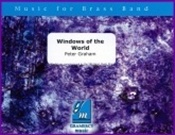
Windows of the World (Brass Band - Score and Parts) - Graham, Peter
Commissioned by YBS Band, this is a kaleidoscopic six movement sequel to Cry of the Celts. The work provides solo opportunities for several principal players. Peter Graham takes us first to Latin America, then to Japan and onwards to Saharan Africa. We get a gentle reprieve via a nostalgic hint of the British Isles before we land in the melting pot of all styles, the USA. In this final section the driving swing section is abruptly stopped and a drum cadenza leads us back into the opening Latin music. The movements are: Amazonia; Rainforest; The Rising Sun; Drums of Thunder; Celtic Dream; Earth Walk. Any of the movements can be programmed individually. Some movements are recorded on QPRL215D Master Brass (Volume Thirteen). All movements are recorded on QPRL123D Windows of the World. Total Duration: 20:30.
Estimated dispatch 7-14 working days
 View Music