
Results
-
 £74.99
A Medieval Christmas - Philip Sparke
Christmas is full of customs and traditions, both old and new. This is especially evident in Christmas songs, some of which have been part of Christian worship for centuries. A Medieval Christmas combines three ancient melodies that are still popular around the world today. Philip Sparke chose Gaudete, a song of praise from the middle ages, Coventry Carol, an English song from the 14th century, and In dulci jubilo, which can also be traced back to the 14th century, to form this joyous suite.
Estimated dispatch 5-14 working days
-
 £79.99
A Midwest Fanfare - Philip Sparke
A Midwest Fanfare was commissioned by the Brass Band of Battle Creek and premiered by them during their appearance at the Midwest Clinic in Chicago on 20th December 2017 where this fanfare was the opening piece of the entire event. This piece is designed to be played with the cornets split into two teams either side of the band. It opens with the two groups answering each other antiphonally over a repeated figure in the lower band. A calmer central section introduces a euphonium solo which is then taken up by the whole ensemble. This leads back to a repeat of the opening fanfares over a rhythmic accompaniment and a short coda which brings the work to a close.
Estimated dispatch 5-14 working days
-
 £99.99
Sparkling Brass - Philip Sparke
Sparkling Brass was commissioned by Osaka Concert Brass, one of Japan's top brass bands, and premiered by them on 27th December 2018 during a concert which celebrated their 10th Anniversary. The work opens in lively mood with fanfare-style figures from the lower band which are answered by the cornets. This interplay intensifies until the mood calms suddenly to introduce a chorale which leads to a duet-cadenza for cornet and euphonium. The rhythmic mood of the opening soon returns and leads to the main theme of the work, a modal caccia which features various section of the band. A short bridge passage leads to a change of key and a new cantabile theme which isintroduced by euphoniums and baritone. This is taken up by the full band after another change of key and leads back to the caccia theme. A transformed version of the opening fanfare returns to close the work.
Estimated dispatch 5-14 working days
-
£54.99
Dear Frog - Victor Trojan - Georges Moreau
Dear Frog describes the story of a prince who changes into a frog and then waits for a princess to kiss him so that he can turn back into a prince again. A musical satire for the trombone and orchestra. What is remarkable about this work is the use of the "wah-wah sourdine" throughout the entire piece, which gives it an extra amusing flavour.
Estimated dispatch 5-14 working days
-
 £60.99
Spiritual Moments - Dizzy Stratford
In a pop style that is characteristic for Dizzy Stratford, this composition contains famous and lesser-known spirituals which are brought back to life in a refreshing manner.
Estimated dispatch 5-14 working days
-
 £60.99
Vom Himmel hoch, O Englein kommt - Traditional - Jan de Haan
The German Christmas song Von Himmel hoch, O Englein kommt is one of the oldest known German carols, with the earliest versions, also known as Susani, going back to the 14th century. This exceptional arrangement by Jan de Haan works extremely well for brass band and will make an ideal work for any Christmas concert.
Estimated dispatch 5-14 working days
-
 £84.99
Pacific Dreams - Jacob de Haan
Pacific Dreams describes the experience of Miguel, a traveling composer from Spain who, feeling somewhat alienated from his homeland, is wandering through an area of Sydney known as The Rocks. At a small outdoor market in a typical street of this oldcolonial neighbourhood, he discovers a print of William DeShazos painting "Pacific Dreams" Portrayed in the painting is the surf of one of the exotic islands in the Pacific. Next, with the impressive Sydney Harbour Bridge looming over the narrowstreets of The Rocks, he envisions sultry Pacific beaches. Suddenly a theme he once composed about the lakes in Japan comes to him. Is it the Asian influences present in cosmopolitan Sydney that bring this theme to mind? Or perhaps the waters aroundSydney, over which he could sail to Tahiti? He is uncertain. Could this same theme be used to create a new composition about his feelings for the metropolis Sydney? How then to work his Pacific Dreams into the mix? Miguel is certainly no fan ofHawaiian music. Mayby he could use the vocabularies of islands like Hawaii and Tahiti, their beautiful vowel combinations being sung ad libitum by a mixed choir.With these ideas and his newly purchased print of "Pacific Dreams", he boards the Metroat Circular Quay. He has a final glimpse of the harbour and the Sydney Opera House as the train races into the ground. On to the hotel! To work! He must compose!Maestoso : Miguel is impressed as he gazes upon the Sydney Harbour Bridge. And yet, hewants to go away from this city. Away, to an exotic island in the Pacific.Steady Rock : In the Rocks, musicians are playing at a square. Miguel basks in the atmosphere but at the same time he is fantasizing about Hawaii and Tahiti.Andante Lamentoso :In his hotel room, Miguel is feeling sad and lonely in this big city. He takes comfort in his "Pacific Dreams".Allegro : Miguel boards the boat that takes him from Darling Harbour to Circular Quay. In his mind he is traveling on to Hawaii. Or is ithome, where the bolero is playing? He is pulled back to reality by the skyline of Sydney.
Estimated dispatch 5-14 working days
-
 £60.99
Angels from the Realms of Glory - Roland Kernen
The title of this clever arrangement reveals the Christmas song it is based on. The melody can be traced back to a French folksong from the 18th century which is now known around the world. In France it is called Les anges dans nos campagnes, in Germany it is most widely known as Engel auf den Feldern singen and in England it was originally called Angels From the Realms of Glory but it often known as Angels We Have Heard on High. Everyone will rejoice upon hearing the 'Gloria in excelsis Deo' refrain!
Estimated dispatch 5-14 working days
-
 £60.99
Emerald Jubilee - Jan de Haan
An Emerald Jubilee celebrates a 40th anniversary. Jan de Haan composed this colourfully orchestrated concert march to celebrate Will van der Beek's 40th anniversary as conductor of the Deutsche Musikverein Haaren. As publisher of van der Beek's transcriptions of classical works Jan de Haan can look back on many years of successful collaboration with the knowledge that there will be many more to come. Unusually cast in a minor key, the main theme provides an interesting contrast to the more melodic major key of the second movement. The relatively slow theme gives this march a dignified stately and subdued quality.
Estimated dispatch 5-14 working days
-
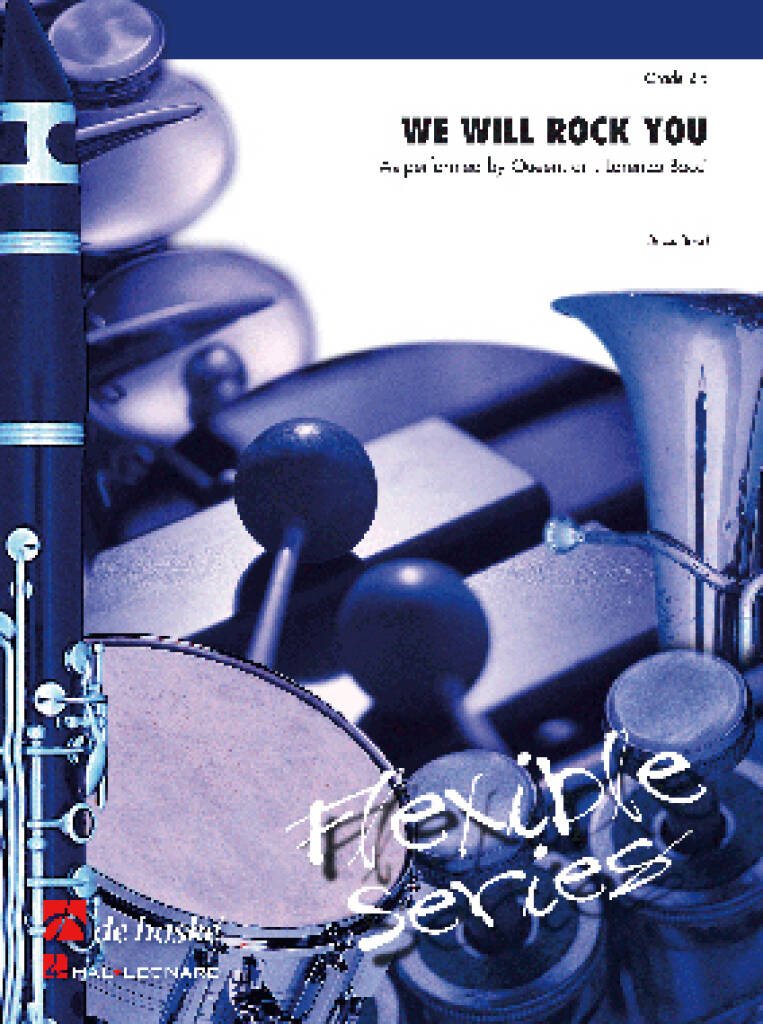 £54.99
We Will Rock You - Lorenzo Bocci
Brian May's We Will Rock You was not Queen's biggest hit when it first came out. However, looking back it has become much more than simply a successful song. It is the group's hymn, welcomed with loud cheers whenever and wherever it is played. Let the good times roll with Lorenzo Bocci's outstanding arrangement that will rock your band!
Estimated dispatch 5-14 working days
 Listen to MP3
 View Music