
Results
-
£74.95
Second Suite in F (Score and Parts)
During Holst's earlier years as a composer, he took interest, as did many other English composers at the time, in writing pieces based on folk music. His contemporary Ralph Vaughan Williams had written his English Folk Song Suite, all based on English folk tunes. Holst followed suit and composed the Second Suite as a result. Six tunes are compressed into the four movements of the suite, each with their own character.The Second Suite consists of movements based on specific English folk songs
Estimated dispatch 7-14 working days
-
£32.95
Second Suite in F (Score Only)
During Holst's earlier years as a composer, he took interest, as did many other English composers at the time, in writing pieces based on folk music. His contemporary Ralph Vaughan Williams had written his English Folk Song Suite, all based on English folk tunes. Holst followed suit and composed the Second Suite as a result. Six tunes are compressed into the four movements of the suite, each with their own character.The Second Suite consists of movements based on specific English folk songs
Estimated dispatch 7-14 working days
-
 £189.95
'The New Christmas Collection' - Full Set March Card Size
The new Christmas Collection carol books contain all the traditional Christmas Carols, with some new 'pop' music arrangements included to add more variety to your carolling this year.
* Note, these are not compatible with the New Christmas Praise books.
Full list of works in The Christmas Collection:-
• A child this day is born
Estimated dispatch 7-14 working days
• A Christmas lullaby
• A great and mighty wonder
• All I want for Christmas is you
• All my heart this night rejoices
• Angels, from the realms of Glory (Come and worship)
• Angels, from the realms of Glory (Iris)
• Angels we have heard on high
• A starry night
• As with gladness men of old
• Auld lang syne
• A virgin most pure
• Away in a manger (The manger scene)
• Away in a manger (Traditional)
• A winter’s tale
• Bethlehem
• Brightest and best (Spean)
• Brightest and best (Traditional)
• Calypso Carol
• Carol for the Nativity
• Carol of the bells
• Carol of the drum
• Child of Mary
• Christians Awake!
• Christ is born (Il est né)
• Christ was born on Christmas Day
• Come and join the celebration
• Come, children, come quickly
• Coventry Carol
• Deck the hall
• Ding dong! merrily on high
• Do you hear what I hear?
• Frosty the snowman
• Gabriel’s Message
• Gaudete
• Glory in the highest
• Glory in the highest Heaven
• God of God, the uncreated
• God rest you merry, gentlemen
• Good Christian men, rejoice
• Good King Wenceslas
• Go, tell it on the mountain!
• Happy Christmas (War is over)
• Hark the glad sound!
• Hark! the herald angels sing
• Have yourself a merry little Christmas
• Here we come a-wassailing
• How far is it to Bethlehem?
• Huron Carol
• Infant Holy
• In the bleak midwinter (Cranham)
• In the bleak midwinter (Darke)
• I saw mommy kissing Santa Claus
• I saw three ships come sailing in
• It came upon a midnight clear (Traditional)
• It came upon a midnight clear (Willis)
• It’s beginning to look a lot like Christmas
• It’s the most wonderful time of the year
• I wish it could be Christmas everyday
• I wonder as I wander
• Jesus, good above all other
• Jingle Bells
• Jingle bell rock
• Joy to the world!
• Last Christmas
• Let it snow!
• Little baby Jesus
• Little children, wake and listen
• Little Donkey
• Little Jesus, sweetly sleep
• Lo! he comes with clouds descending
• Long, long ago
• Love came down at Christmas
• Mary’s boy child
• Mary’s Child
• Masters in this hall
• Merry Christmas everyone
• Mistletoe and wine
• Noel
• O Christmas tree
• O come, all ye faithful
• O come, Immanuel
• O Heaven-sent King
• O holy night!
• O little town of Bethlehem (Christmas Carol)
• O little town of Bethlehem (Forest Green)
• O little town of Bethlehem (St Louis)
• Once in royal David’s city
• Past three o’clock
• Patapan
• Personent Hodie
• Praise ye the Lord
• Ring the bells
• Rise up, shepherd!
• Rockin’ around the Christmas tree
• Rudolph, the red-nosed reindeer
• Sans day carol
• Santa Claus is comin’ to town
• Saviour’s Day
• See, amid the winter’s snow
• Silent Night!
• Sleigh Ride
• Softly the night is sleeping
• So here it is, merry Christmas
• Stars are shining
• Still, still, still
• Stop the cavalry
• Sussex Carol
• Sweet chiming bells
• Sweet chiming Christmas bells
• The candle song
• The cherry tree carol
• The Christmas song
• The first Nowell
• The holly and the ivy
• The infant King
• The light has come
• The shepherds’ farewell
• The stable door
• The star in the east
• The twelve days of Christmas
• The virgin Mary had a baby boy
• They all were looking for a king
• Thou didst leave thy throne
• Three kings’ march
• Unto us a boy is born
• Walking in the air
• We gather round the manger-bed
• We three kings of Orient are
• We wish you a merry Christmas
• What child is this?
• When a child is born
• When Santa got stuck up the chimney
• Whence is that goodly fragrance flowing?
• When wise men came seeking
• While shepherds watched (Cranbrook)
• While shepherds watched (Handel)
• While shepherds watched (Winchester Old)
• White Christmas
• Who is he?
• Winter Wonderland
• Worldwide Christmas message
• Zither Carol
• A starry night
• Christmas Joy
• Christmas Praise
• Coventry Carol
• Infant Holy
• Mid-winter
• Rudolph, the red-nosed reindeer
• The everlasting light
• To celebrate his birth
• Yuletide Rag
-
 £33.59
E lucevan le stelle (Cornet/Euphonium Duet with Brass Band) Puccini arr.Bushnell
Tosca is an opera in three acts by the Italian composer Giacomo Puccini. The opera is set in June 1800 in Rome, and tells the story of the Kingdom of Naples and the threat to its control of Rome by Napoleon's invasion of Italy. Some of Puccini's best-known arias can be found in Tosca. The opera is based on Victorien Sardou's dramatic play of the same name (La Tosca). Puccini saw the play at least twice in 1889 and begged his publisher, Giulio Ricordi, to obtain the rights to turn it into an opera, which were secured in 1891 - although Puccini relinquished the rights to Alberto Franchetti before being recommissioned in 1895. Puccini wrote "I see in this Tosca the opera I need, with no overblown proportions, no elaborate spectacle, nor will it call for the usual excessive amount of music." It took four years to write, with Puccini arguing with his librettists (Luigi Illica and Giuseppe Giacosa) and his publisher. Although the first performance was delayed by a day due to the unrest in Rome at the time, the opera was premiered on 14 January 1900 at the Teatro Costanzi in Rome. The critics reviews were indifferent, but it was an immediate success with the public. The opera is through-composed, with the different musical elements weaved from piece to piece. Puccini used the Wagner's leitmotif concept to identity different parts of the opera. Taken from Act 3, E lucevan le stelle is sung by Cavaradossi, a painter, who has fallen for the singer Tosca. The corrupt Chief of Police, Baron Scarpia, longs for Tosca himself and, upon suspecting Cavaradossi of helping a political prisoner escape, he takes the opportunity to get rid of Cavaradossi and blackmail Tosca into being with him. The guards lead Cavaradossi to the roof of Castel Sant'Angelo, where he is told he has 1 hour to live before being executed. He asks to write a letter to Tosca, overcome by memories, he sings E lucevan le stelle (And the stars shone). It was selected by the tenor Wynne Evans as one of the most romantic songs for his top ten arias for Classic FM. He described it as "another tenor classic, both tragic and beautiful." This arrangement (for cornet and euphonium duet with brass band) includes alternative parts for horns in F and lower brass in bass clef. A recording of the original song can be found here: www.youtube.com/watch?v=EAqHQMX7GHY
In Stock: Estimated dispatch 1-3 working days
" frameborder="0" allowfullscreen> -
 £37.32
Whodunnit? Murder Mystery for Brass & Percussion (Brass Band) Karl Whelan
The composer writes: 'One of my all time favourite films is Clue (1985) based on the board game of the same name (Cluedo, if you're from the UK). Clue follows the night of six guests who are invited to a mansion for dinner. The host, Mr. Boddy is murdered, and the guests must work together to find the killer before any more lives are lost. I implore you to give it a watch if you haven't already, even if it's just for Tim Curry's magical performance as The Butler. Running at 82 minutes, the film is over before you know it. I wanted to create a similar story here with Whodunnit?, which like it's inspiration, Clue, moves at an incredible pace as it follows a dinner party, to which our guests have been invited. This work is rather dark throughout and full of intentional cliches, for which, I make no apology!' To view a rolling score video please visit www.youtube.com/watch?v=hdviJUrCvOE Sheet music available from: UK - www.brassband.co.uk USA - www.cimarronmusic.com Difficulty Level: 2nd Section + Length: 6.00 minutes Instrumentation: Soprano Cornet Eb Solo Cornet Bb Repiano Cornet Bb 2nd Cornet Bb 3rd Cornet Bb Flugel Horn Bb Solo Horn Eb 1st Horn Eb 2nd Horn Eb 1st Baritone Bb 2nd Baritone Bb 1st Trombone Bb 2nd Trombone Bb Bass Trombone Euphonium Bb Bass Eb Bass Bb Timpani Percussion 1 (Suspended Cymbal**, Shaker, Drum Kit, Vibraslap) Percussion 2 (Bass Drum, Suspended Cymbal**, Wood Blocks, Tam-tam) Percussion 3 (Glockenspiel, Xylophone, Tubular Bells, Vibraphone) * Doubling on Trumpet (if possible) ** Shared
In Stock: Estimated dispatch 1-3 working days
-
 £34.95
Behold the Power of God - Christopher Bond
Behold the Power of God (2010) was written for and premiered by the Cornwall Youth Brass Band in dedication to their Musical Advisor at the time; the late Cornish composer Goff Richards who later described the work as 'a remarkable piece of writing'. The work's title, while implying a religious meaning, actually references Goff's name, with his full name Godfrey translating as 'God-peace' and Richards meaning 'Power'. Two energetic outer sections fall either side of a more lyrical middle section featuring the solo cornet. The perfect opening item at any concert.
Estimated dispatch 10-14 working days
-
 £79.95
Neverland - Christopher Bond
"All children, except one, grow up" wrote J.M. Barrie about Peter Pan in 1911; the first line and an expression of beautiful melancholy and fantasy, coming to represent one of the best-loved children's stories of the twentieth century. 'Peter & Wendy', as the book was first released, has subsequently been transformed into adaptations for film and stage, with subsequent books based on this iconic tale. In writing this new work for brass band, the composer has taken three of the main themes from J. M. Barrie's book, and used these themes to create new musical material, forming a work in three contrasting sections. I. Journey to Neverland The opening of the work, mysterious in its style, reflects the opening chapters of the story - a leafy London street, still in the dead of night - with the music transforming quickly as it builds in texture and momentum - a Journey to Neverland through the night sky; Second Star to the Right and straight on 'til morning. "Then Peter knew that there was not a moment to lose. 'Come,' he cried imperiously, and soared out at once into the night, followed by John and Michael and Wendy. Mr & Mrs Darling and Nana rushed into the nursery too late. The birds were flown." II. The Windows that Closed The central section of the work takes its inspiration from the sense of longing throughout the book, mainly by Peter Pan, the Darling Children & The Lost Boys. Distant memories of life before Neverland, memories of the Lost Boys' mothers, and regret at what the children have missed. Peter says "Long ago, I thought like you that my mother would always keep the window open for me; so I stayed away for moons and moons and moons, and then flew back; but the window was barred, for mother had forgotten all about me, and there was another little boy sleeping in my bed." III. Aboard the Pirate Ship The final section of the work takes its inspiration from the Pirate Ship, and Peter Pan's ultimate battle with its infamous Captain Hook. "In person, he was cadaverous and blackavized, and his hair was dressed in long curls, which at a distance looked like black candles, and gave a singularly threatening expression to his handsome countenance. His eyes were the blue of the forget-me-not, and of a profound melancholy, save when he was plunging his hook into you, at which time two red spots appeared in them and lit them up horribly."
Estimated dispatch 10-14 working days
-
.png) £34.95
£34.95Christmas Carol, A - Jonathan Bates
DURATION: 4'00". DIFFICULTY: 3rd+. Composed for Strata Brass in 2020 as part of their COVID-19 induced, virtually recorded 'A Christmas Carol' (a new suite for brass bandlasting around 30 minutes in total), 'A Christmas Carol' was used as the grand finale to the whole show in which Ebenezer Scrooge has been shown the error of his ways by 3 ghosts on Christmas Eve and becomes a transformed man just in time for Christmas day. This uplifting and energetic work portrays all the joyous emotions associated with the festive period, incorporating a number of well-cherished Christmas carols and various quotes from through the 'A Christmas Carol' suite of music. .
In Stock: Estimated dispatch 1-3 working days
-
 £79.95
Grieg Variations - Jonathan Bates
DURATION: 12'30". DIFFICULTY: 2nd+. . 'Grieg Variations' is a through-composed work in the traditional style of a 'theme & variations'. The work opens with the main melodic fragment featured throughout Grieg Variations which comes from Grieg's Peer Gynt Suite No.2; the final movement - 'Solveig's Song'. . This theme is followed by a set of 9 variations, each taking inspiration from various melodies and styles found within the Peer Gynt Suite. The first variation, a light-footed scherzo based upon the tonal line of Solveig's Song is followed by an 'Alla marcia' variation - in which the music is inspired by the 2nd movement - 'Arab Dance' - of the original suite. The 3rd variation takes a far darker and more aggressive turn in a variation set around the music of the 1st movement of the Peer Gynt Suite before a relaxation into a solemne revisiting of the original theme. Opening with a sombre and longing solo for Flugel horn, the focal point of this 4th variation is an extended solo for the Solo Euphonium, marked 'molto espressivo'. The new material here is used as a theme throughout this variation, being reprised by the full band immediately after as the music builds to a climax point at the top of the musical line. . Following this, there are 2 cadenzas for the Solo Horn and Solo Cornet respectively; the former inspired by the thematic material of Solveig's Song, and the latter from the Oboe cadenza at the beginning of Grieg's '2 Lyric Pieces, Op.68'. These cadenzas lead swiftly into the 7th variation, a bustling rhyhm-driven movement set in complex time. The 3rd movement of the Peer Gynt Suite No.2 - 'Peer Gynt's Homecoming' - makes it's first appearance in variation 8 in a triumphant battle-like setting before a combination of both this material and the Solveig's Song combine to bring Grieg Variations to it's close -not without a little nod to potentially Grieg's most famous work - In The Hall of the Mountain King. . .
In Stock: Estimated dispatch 1-3 working days
-
 £103.00
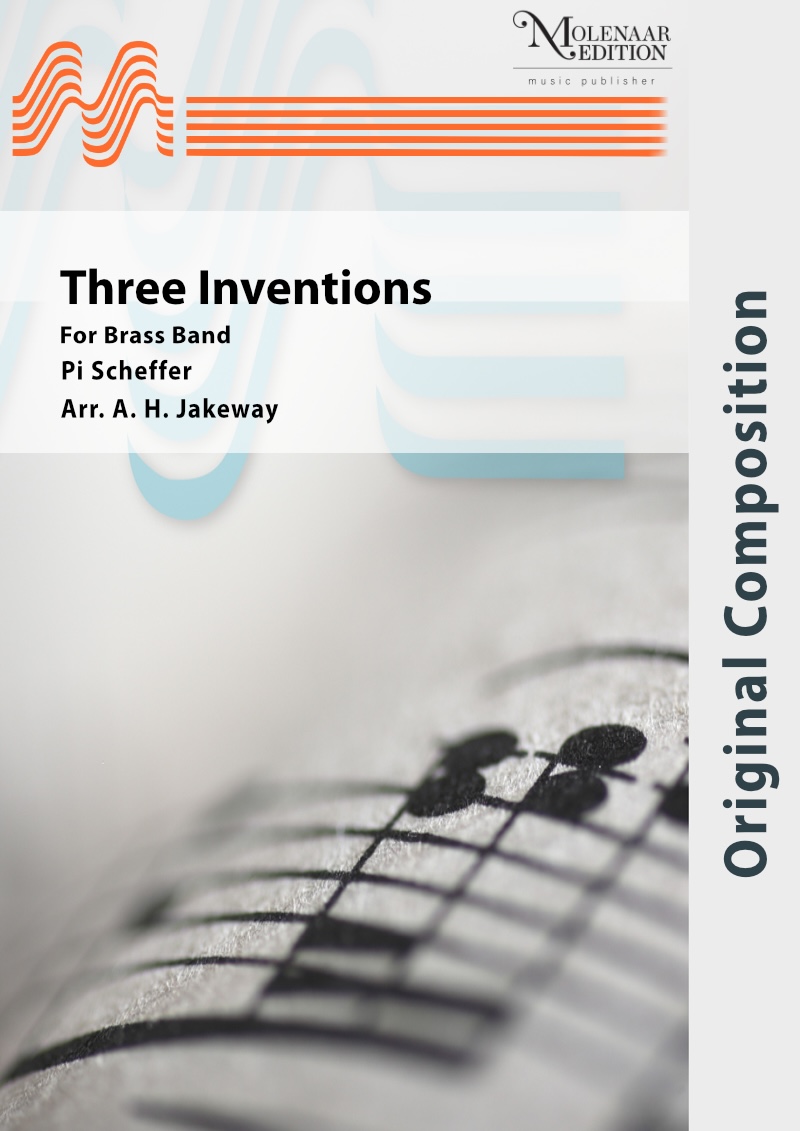
Three Inventions - Pi Scheffer/A. H. Jakeway
Dr. J (Pi) Scheffer was the leader of the famous Dutch AVRO Radio Big Band 'The Skymasters' in the 50's, as well as also being an English teacher. He also had a huge success with his composition for wind band 'Three Inventions', not only in Europe but also in the USA. At the time of publication (1971) there was no promotion with sound sample of this work, so for this reason now Molenaar Edition has a complete new score and parts available in their 'Creative Compositions' (c) series. The work is in the movements. 'Flippant', 'Whimsical' and 'Sorta Mixed Up'. A recent edition of the American magazine publication 'The School Musician' even compared Scheffer with Leonard Bernstein.
Estimated dispatch 10-14 working days
 View Music