
Results
-
 £115.60
Griffenfeldt - John Philip Hannevik
Here we present "Griffenfeldt, a folk-dance in the style of a Norwegian reinlender.This arrangement can be used as the first item in a concert, or after an interval.The musicians can come on stage as they join in. That is why two of the measures are notated "repeat till ready", here you have to wait until everyone is in place! If everyone is ready from the start, the repetition can be omitted.Be sure to play with a bouncy but singing style, not with short and harsh articulations.Do the trills on the beat, but these can also be omitted if it makes it too difficult.To bring out the folk music style a little extra, you can ask the musicians to play on the "backbeat", i.e. emphasize the last half of each quarter-note.In addition, the music will really come to life if all "solo" places are done standing up.The musician Anon Egeland tells this story:This song got its name from a party where it all just got a bit too lively: one of the party-goers started shooting into the ceiling with a gun just as this reinlender was being played. The fiddler - or was it the man with the gun? - was called Griffenfeldt, and that gave the name for the song.
Estimated dispatch 5-14 working days
-
 £228.70
Fanfare and Chorale - Egil Hovland - Ray Farr
This arrangement (or edition) for brass band will give the possibility for more performances of this fine work by Hovland. The composer, before his death, examined my work and made no suggestions for changes, and his approving comments were complimentary and encouraging. The work was originally written for Concert Band in 1966 as Op. 54a to St. Olaf College Band in the US. It was transcribed in 1967 for symphony orchestra as Op. 54b by the composer himself. The challenges in arranging the piece for brass band were mostly concerned with satisfactorily covering the upper register used by piccolo, flutes and clarinets, and while there are wonderful brass players around who have amazing high registers, I have aimed this edition at a level achievable by reasonably good brass band players who are willing to give time and effort into the proper preparation and delivery of the music. Having worked on this new edition with a top-class brass band, I think it sounds wonderful and interestingly different to the original. Besides the obvious differences of tone-colour and absent high notes, I have used in my scoring, the option for using a vibraphone in place of a celeste. Vaughan Williams, in his Variations for brass band writes for celeste, but because the instrument is quite rare, performances have been mostly given using a glockenspiel- but this, of course sounds two octaves higher than it was intended. I think that vibraphone and brass is an excellent combination and recommend it without hesitation in this piece. Every detail of articulation and dynamic has been considered, so in order to keep the integrity of the music, please do not change anything in the name of "interpretation". As Ravel says- "What is there to interpret?" Ray Farr
Estimated dispatch 5-14 working days
-
 £119.99
The Binding of the Wolf - Torstein Aagaard-Nilsen
This piece was commissioned by Nordhordland Brass Seminar in 1990 and written for a youth band. The title referes to a story from norse mythology. "The Binding of the Wolf" is not a programmatic piece of music, but I felt that there was a kind of coherence between the music and the dramatic story: "...The wolf Fenrir was one of the demonic offspring of Loki, and as he grew up in Asgard among the gods, he became so huge and fierce that only Tyr was willing to feed him. It was decided that he must be bound, and Odin in his wisdom caused the cunning dwarfs to forge a chain which could not be broken. It was made from the invisible and yet potent powers ofthe world, such as the roots of a mountain, the noise of a moving cat, the breath of a fish. When completed, this chain seemed to be no more than a silken cord, but the wolf refused to let it be laid upon him unless one of the gods would put a hand between his jaws as a pledge that it was harmless. Only Tyr was prepared to do this, and when the wolf found that the chain was unbreakable, the gods rejoiced, but Tyr lost his hand. The binding of the wolf may be seen as a means of protecting the world of men, as well as that of the gods, from destruction. The story of the god losing his hand appears to be one of the fundamental myths of nothern Europe..."
Estimated dispatch 5-14 working days
-
 £127.30
Hoppeslatt - Øystein Olsen Vadsten
This is an original piece of music composed by Oystein Olsen Vadsten, inspired by old Norwegian folk dances. "Jumpety Jump" actually started out as a "reinlender" (Norwegian Folk Dance) which origins from Rhinland. The reinlender is well disguised in this arrangement by adding the shuffle- and swing style to it. The piece is first of all meant as a "happy go lucky" tune, but is full of rhythmical and technical challenges. Its put up as a jazz-tune, first presenting the melody, then "improvisasations" by the different instrument groups, before going back to the first theme. The title "Jumpety Jump" refers to the kind of jumping feeling the shuffle groove gives.
Estimated dispatch 5-14 working days
-
 £154.99
The Divine Right - Philip Harper
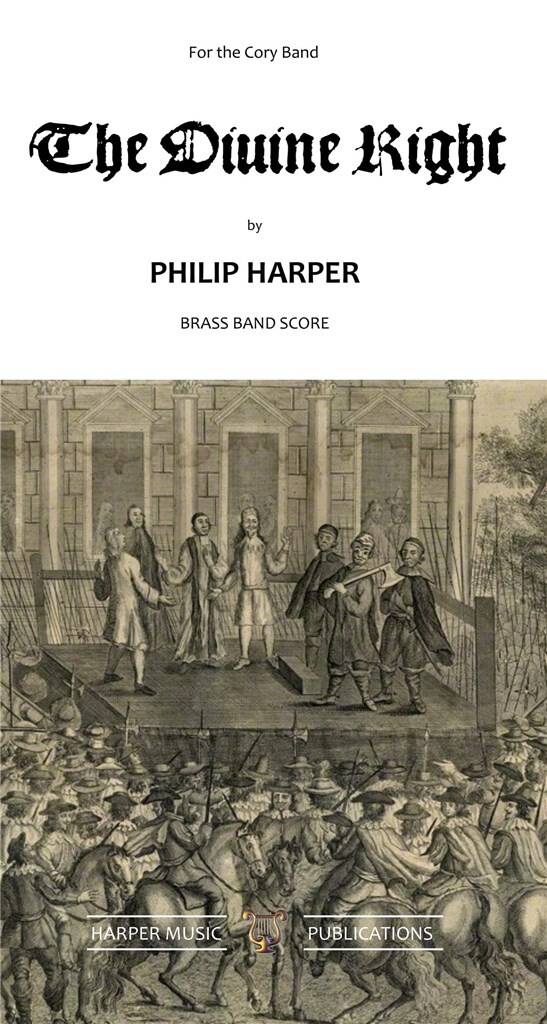
At the time of composing this piece, the Arab Spring was sweeping through the Middle East. It seemed that almost every week a new countrys people had risen up against the regimes and dictatorships which had prevailed for generations, leaving manynations at a defining crossroads in their history. There were so many possible ways ahead: so many hopes, yet so many uncertainties.My music is a depiction of these revolutionary times, and several musical themes are in turn presented, discussed, considered, fought over, altered, rejected or accepted. Most nations have had, or probably will have, their own Arab Spring, including my own, the United Kingdom. Events of 17th Century Britain provide the context for this piece, particularly those following the execution of the tyrant King Charles I on30 January 1649. The regicide was in part due to Charless steadfast belief in the Divine Right of Kings, and led to a tumultuous interregnum, where England stood at its own defining crossroads.The music begins turbulently, before King Charles appears and is led to the gallows outside Banqueting House in central London where he is brutally decapitated. From the assembled crowd rose, according to one observer, a moan as I never heard before and desire I may never hear again.The music descends to emptiness. The musical argument which follows is not strictly programmatic, but a number of musical themes are all thrown into the melting pot, representing ideas such as: religion; military force; reasoned Parliamentary debate; and the chattering,irrepressible voice of the people. Additionally, there are some quotations from the music of royalist composer Thomas Tomkins (1572-1656), who was often in tune with the feeling of the times. This defining episode in Englands history was brought to a close with the Restoration of the monarchy in 1660, and as the exiled King Charles II rode back into London the diarist John Evelyn wrote: Never was so joyful a day seen in this nation. I stood in the Strand and beheld it, and blessed God.At the end of the piece the bells ring out, and the musical appearance of the King has transformed from turbulent to triumphant. Philip Harper, 2013
Estimated dispatch 5-14 working days
-
 £174.10
Three Gentle Giants - Svein H. Giske
Three Gentle Giantswas commissioned by Grenland International Brass Festival as a test piece for the 2nd division in 2008.Three Gentle Giants. The three giants each have their own monologue which leads into a conversation. They gather recognition and respect from each others views as the dialogue evolves. Eventually they find a more nutual and singular expression to their conversation.The giants are old with a long life behind them. This can be heard through a slow, melancholic waltz. A waltz is dance commonly linked to festiveoccasions, such as weddings, but for the giants it holds much more significance. It gives room to think about people they have met, placesthey have been, and all that life has given them.Quietly it ends, more or less like it began. We hear echoes of the past, before it all fades out.The giants wander off into a new beginning.Svein H. Giske- January 2023 -In Memoriam Thorvald, Finn and Thor Louis
Estimated dispatch 5-14 working days
-
 £105.20
Optimist - John Teigen - Øystein Sjøvaag Heimdal
"Optimist" is one of the most well-known songs by Norwegian singer and composer Jahn Teigen. It was written for the Norwegian Eurovision in 1989. It did not win this competition, but is still one of the greatest Norwegian songs from the late 1980's. This arrangement is very close to the original in form, rhythmic- and melodic lines. The repeat at bar 65 may be played as many times as one wish, or it can be omitted.
Estimated dispatch 5-14 working days
-
 £68.90
Three Pictures for Band - Oliver Waespi
This composition consists of three sound pictures. Numerous associations mutually link those parts as far as motifs and harmony are concerned. The motif of the ascending and descending fourth plays an important role in many a theme. There are many fourth chords by means of which I try to put a harmonic and unifying stamp on the composition as a whole. Moreover there are similar or identical, though varied, motifs in the successive parts. The first part 'Cortege' (Procession) describes the dignified majestic procession by means of simple, precise rhythms. At first, the music is scarcely audible, as if coming from a distance; it gradually comes nearer until it reaches its climax in large chords, before fading away again. At each quarter note one could imagine a step. The second part 'Dialogue' consists in broad outlines of dialogues between the different orchestral groups. Some instruments are asking questions, others are giving answers. After a rather sad passage, the music turns into a climax followed by a second passage that brings comfort and leads to a quiet ending. In the third part, there is a sudden movement coming up in the shape of 'Waves'. The principle of the wave, successively swelling and decreasing, dominates the entire musical structure of this part, even in the separate motifs.Oliver Waespi
Estimated dispatch 5-14 working days
-
 £55.00
Coronation Scene. - Modest Mussorgsky
Few operas have had such a remarkable history as Mussorgsky's masterpiece Boris Godunov. It exists in no less than three complete versions by the composer himself, as well as posthumous editions andorchestrations by Rimsky-Korsakov (from which this arrangement is taken), Shostakovich and others.The Coronation Scene is set in the Square of the Moscow Kremlin, between the Cathedral of the Assumption and theCathedral of Archangel Michael, the year is 1598. After being crowned as Tsar, Boris Godunov acknowledges the people's acclamations and the bells of the two cathedrals, as well as many churches within the vicinity, canbeheard ringing out across St Petersburg.Available here are the score and parts for Mussorgsky's Coronation Scene (Boris Godunov), as arranged for Brass Band by Phillip Littlemore.
Estimated dispatch 5-14 working days
-
 £107.80
Myrsnipa - Vocal or Instrumental Solo - Jan Eggum - David Hveem
Jan Eggum released "Myrsnipa" on the album "Hjerteknuser", which was released in 2007. The text is a variant of the folk tale with the moral "everyone likes their own children best and has for many years been one of Eggum's regular encores at concerts.The arrangement is attempted to stay true to Eggum's version and has retained its somewhat delicate character in order to support the text as much as possible. Although the arrangement is written for vocal soloist, it also works great with a solo instrument instead, and you can also choose whether you want a guitar or not, to keep it even more true to the original recording.The arrangement requires good balance and intonation, but will be a nice part of the concert repertoire the audience is guaranteed to recognize.
Estimated dispatch 5-14 working days
 View Music