
Results
-
 £379.99
Tranquil Abiding - Paul Mealor
An 18-minute work for brass band, written for the world renowned Foden's Band. This is a melodic work divided into three movements. All sections of the band are featured with solo parts. Each movement is headed by a line from a poem by James Agee, the American novelist and poet. 'Tranquil Abiding', often referred to as 'Shamatha' in Buddhist traditions, signifies a state of peaceful and calm mental stillness, achieved through focused meditation, where the mind rests peacefully and without agitation."The term has always resonated with me particularly during my long, regular walks into, around and along the amazingly beautiful woodlands, mountains and streams of North Wales at night lit only by the stars. It's during these walks that my meditative focus is at its most emotive and I am at one with the 'it' that surrounds us", says Paul Mealor. "Often on these walks and meditations I am reminded of the American poet, James Agee's pantheistic vision of the natural world and the stars above, 'Sure on this Shining Night' which conjures a serene and harmonious image of a summer night, illuminated by celestial bodies and bathed in kindness. The poem evokes a sense of peace and tranquillity as nature heals and the earth is rejuvenated".
Estimated dispatch 5-14 working days
-
 £109.99
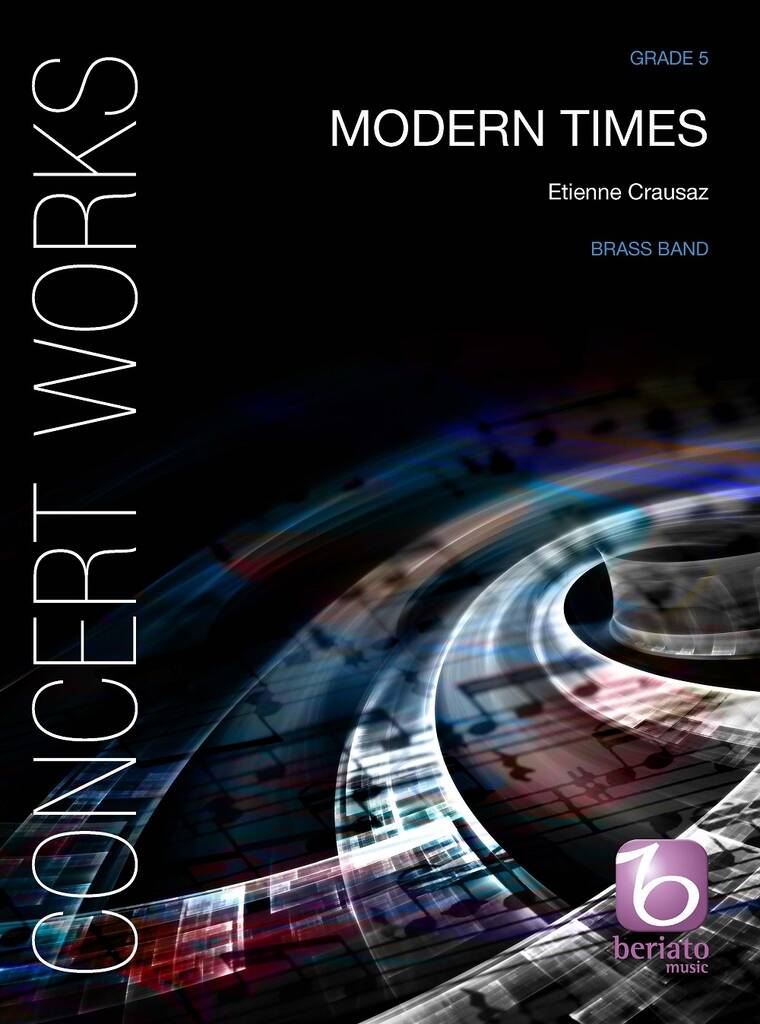
Modern Times - Etienne Crausaz
Modern Times is a concert suite from the musical and theatrical show Le Temps de Lyre, written and directed by Nicolas Bussard. The work was commissioned for the 100th anniversary of the Lyre de La Roche, directed by Marc-Olivier Broillet, with the premiere taking place in July 2024 in front of an audience of over 2,000.This suite highlights three of the dozen tableaux in the show. After an introduction evoking a sort of journey back in time, the first tableau (bar 20) illustrates various disasters that have occurred in the village over the years. The sky darkens, the thunder rumbles, the rain lashes down, and violent gusts of wind are unleashed on this corner of the country. The storm finally calms down, giving way to great desolation.The second tableau (bar 117) describes the resilience of the villagers, who summon up all their courage to repair the damage. The music is soft, calm, and hopeful.On the strength of this new beginning, the village can embrace modernity: motor vehicles replace horses, a dam is built, and tourism develops, encouraging a society open to other cultures. The third tableau in this suite illustrates all these advances (bar 177). Musically, this final section pays tribute to George Gershwin and Leonard Bernstein, two of the 20th century's great musicians and composers, who worked during the fascinating period of modern times and well beyond.
Estimated dispatch 5-14 working days
-
 £59.99
Old Hundredth - Louis Bourgeois - Philip Sparke
The tune Old Hundredth is one of the best-known melodies in all Christian musical traditions and first appeared in the 1551 psalter "Pseaumes Octante Trois de David", where it is used as a setting for a version of Psalm 134; it is usually attributed to the French composer Louis Bourgeois (c.1510 - c.1560). The melody was then used in 1561 by the Scots clergyman, William Kethe in Sternhold and Hopkins' Psalter for his paraphrase of Psalm 100 - All People that on Earth do Dwell, which is still the most familiar hymn sung to this noble tune. When Tate and Brady's "New Version of the Psalms" was published in 1696, the melody became know as the 'old' version - henceits current title. This arrangement presents three contrasting verses and is effective as a concert piece as well as an instrumental interlude as part of a church service or wedding.
Estimated dispatch 5-14 working days
-
 £52.70
Far Eastern Dream - Paul Voet
The longest trip we make is to the Far East. Japan, China, Tibet,... all countries with an enormous cultural background and history. Percussion is very important here to give a rich dimension to this Japanese 'Black Bamboo' theme. Tam-tam, Chinese cymbals, Tibetan gong and a kododrum (if not possible, large floor tom) together with marimba and glockenspiel are used all the time in a carefulway. A solo cornet presents the main theme that is answered by the whole lower brass section. While this theme develops now and then the sounds of the impressive 'dung' is heard. (dung is the Tibetan very large trumpet-like instrument with loud and very deep sounds) In a quicker tempo Eb bass, euphonium and solo cornet start with the theme and even the counter theme. The whole group joins the party but everything ends very silently with mute.
Estimated dispatch 5-14 working days
-
£60.99
Conzensus - Jan Van der Roost
This stately concert opener was originally written by Jan Van der Roost for a special event in which six respected wind orchestras (two Belgian and four Dutch) of different composition (two symphonic bands, two fanfare bands and two brass bands) were featured during six concerts. Each evening brought forth a performance by a symphonic band, a fanfare, and brass band, so that the audience could experience all three types of ensembles. This was indeed an original concept.The name, ConZEnSus, comes from a combination of the words, 'Concert Cyclus' (concert series) and 'zes' (Dutch for 'six'). This leads to a new word, which refers to 'consensus'. The general tenor of the cycle isthus immediately indicated. The richness of color of the various ensembles is revealed through an open and friendly atmosphere. During all six concerts (over a span of three years), ConZEnSus functioned as a permanent opening number for each orchestra. Thus the same musical story was portrayed in three different packages.
Estimated dispatch 5-14 working days
-
 £74.99
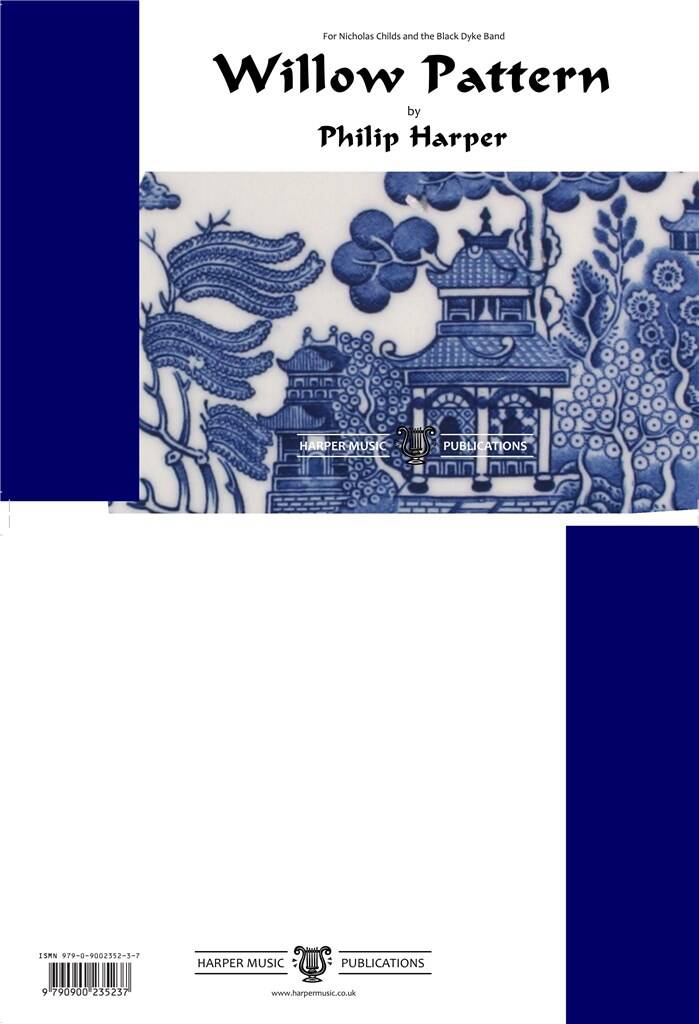
Willow Pattern - Philip Harper
Composed in 2009 for Nicholas Childs and the Black Dyke BandThis piece tells the Willow Pattern legend through music. Several leitmotifs are used both for the different characters and also for some of the important emotions in the tale. Additionally, Knoon-se's part is mainly played by the flugel horn, Changby the euphonium, the Mandarin by the Eb Bass and the Duke Ta-jin by the trombone. The Willow Pattern LegendOnce, in ancient China, there lived a wealthy and powerful Mandarin who had a beautiful daughter, Knoon-se. She had fallen in love with Chang, a humble accountant, which angered her father who imprisoned her in the Pavilion by the river with only theexotic birds for company. She learnt that the Mandarin planned to marry her to the pompous Duke Ta-jin and that the wedding would take place on the day the blossom fell from the willow tree, so she sent Chang a message: "Gather thy blossom, ere it bestolen". The Duke arrived by sea amid great fanfare when the tree was heavy with bud, and nights of magnificent banquets followed. After one such occasion when the Mandarin slept, Chang crept over the crooked fence and tiptoed into the Pavilion to rescueKnoon-se, but as they escaped the alarm was raised. They fled over the bridge with the Mandarin close on their heels brandishing his whip.They managed to escape by boat to a secluded island where they lived happily for a time. Meanwhile, the Mandarin learned of their refuge and, intent on revenge, he ordered his soldiers to kill them. As Knoon-se and Chang slept at night, the men setfire to the pagoda in which they lived and the lovers perished in the flames. However, the Gods, moved by the lovers' plight, transformed their souls into two turtle-doves which rose from the charred remains, soaring above the Earth, symbolising eternal happiness. Willow Pattern is dedicated to the memory of Jean Harper who passed away as I was completing the piece and who was a great collector of porcelain and china-ware. NOTES ON PERFORMANCEMute Requirements:Metal mutes soprano cornet, repiano cornet, 2nd cornets, 3rd cornets (6 in total) Cup mutes all cornets and trombones (10 + 3) Harmon mutes soprano cornet, solo cornets, repiano cornet (6) Percussion Requirements:There are two parts for percussion on the score. The minimum requirements are as follows: 2 players - Timpani, 2 Large tom toms, 2 Wood Blocks, Triangle, Sleigh Bells, Whip, Clash Cymbals, Suspended Cymbal, Hi-hat, Glockenspiel, Xylophone, Tam tam (or susp. cym.) For performances with extra resources, and to achieve closer authenticity, the full requirements are as follows: 3 players - Timpani, 3 Taiko Drums played with thick wooden sticks (or Large tom toms), 2 Wood Blocks, Triangle, Chinese Bells (or Sleigh Bells), Whip, Clash Cymbals, Chinese Cymbals (small clash cymbals approx 12"), Suspended Cymbal, Glockenspiel,Xylophone, Tam tam
Estimated dispatch 5-14 working days
-
 £149.40
Winter Solstice - Stig Nordhagen
This work describes the shortest day og the year, but also the longest night. The solo cornet summarizes the struggle of the winter and darkness. The solo rises out of the coral in the beginning of the piece, and escapades into rhapsodic parts, until the coral again catches all players in the ensemble.Throughout the piece we hear the soloist take us on a journey from despair and darkness, through gratitude for the solstice that turns the night into day. And gives us all light and hope for a better tomorrow.
Estimated dispatch 5-14 working days
-
 £74.99
Kingdom of Dragons - Philip Harper
The 'Kingdom of Dragons' is Gwent in South Wales, known in ancient times as the Kingdom of Gwent, and more recently home to the Newport Gwent Dragons Rugby Union team. This piece was commissioned by the Gwent Music Service with additionalfunding from Ty Cerdd - Music Centre Wales to celebrate the 50th anniversary in 2010 of the formation of the Gwent Youth Brass Band. Although the music is continuous, it is divided into four distinct sections, each one representing one of theunitary authorities which make up the County of Gwent. I. Monmouthshire, which has a large number of ancient castlesII. Blaenau Gwent, an historic area of iron and coal miningIII. Torfaen, where Pontypool Park is a notablelandmarkIV. Newport, the largest city in the region. The music begins with a two-bar fanfare, which sets out all the thematic material of the piece. The mood of pageantry that follows describes some of the ancient castles inMonmouthshire, with rolling tenor drums and fanfaring cornets. After a majestic climax the music subsides and quite literally descends into the coal mines of Blaenau Gwent. The percussion provides effects that suggest industrial machineryclanking into life, and the music accelerates to become a perilous white-knuckle ride on the underground railroad. There is a brief respite as a miner's work-song is introduced and, after a protracted build-up, this is restated at fortissimo beforethe music comes crashing to an inglorious close, much like the UK's mining industry itself. The middle sonorities of the band portray the tranquillity of Pontypool Park, a place of great natural beauty. Brief cadenzas for cornet and euphoniumlead to a full band reprise of the pastoral mood. At the end of this section we find ourselves at the top of the park's 'Folly Tower' from which the distant castle turrets of Monmouthshire are visible. Pontypool RFC was one of eleven clubs inthe first Welsh league in 1881 and a brief but bruising musical portrayal of the formidable Pontypool front-row, the 'Viet Gwent' leads into the work's final section. This portrays Newport, a symbol for progress and optimism for the future, idealsshared by the Gwent Youth Band itself. The music is a vigorous fugue which advances through various keys and episodes before the final triumphant augmented entry which brings the work to a magnificent conclusion. NOTES ONPERFORMANCEPercussion requirements: (3 players) Timpani, 2 Tenor Drums, 2 Tom toms, Snare Drum (sticks and brushes required), Bass Drum, Clash Cymbals, Suspended Cymbal, Hi-hat, Sizzle Cymbal, Tambourine, Metal block with metalbeater (eg hammer), Rattle (eg football rattle), Glockenspiel, Xylophone
Estimated dispatch 5-14 working days
-
 £23.50
A Brussels Requiem - SCORE ONLY - Bert Appermont
The attacks in Brussels on 22 March 2016 created a shockwave throughout Belgium and the rest of the world. Equally, the attacks in Paris and Nice led to great public indignation, fear and disbelief. What has happened to the western world? Have our cultures grown apart to such an extent that we do not understand each other anymore? Bert Appermont's intention was to voice certain emotions that these acts of terror have caused: particularly fear, grief, anger, and helplessness. He uses the French children's song Au Claire de la Lune as a connecting thread throughout the work. This piece is also about hope and faith in another world, and is meant to pay homage to all victims, resulting in a dignified remembrance. The musical development is presented in four through-composed parts, titled Innocence, In Cold Blood, In Memoriam - We Shall Rise Again and A New Day. This work was commissioned by the Brassband Oberosterreich (Brass Band Upper Austria) to be played at the European Brass Band Championships 2017.
Estimated dispatch 5-14 working days
-
 £154.99
A Brussels Requiem - Bert Appermont
The attacks in Brussels on 22 March 2016 created a shockwave throughout Belgium and the rest of the world. Equally, the attacks in Paris and Nice led to great public indignation, fear and disbelief.What has happened to the western world? Have our cultures grown apart to such an extent that we do not understand each other anymore? Bert Appermont's intention was to voice certain emotions that these acts of terror have caused: particularly fear, grief, anger, and helplessness. He uses the French children's song Au Claire de la Lune as a connecting thread throughout the work.This piece is also about hope and faith in another world, andis meant to pay homage to all victims, resulting in a dignified remembrance. The musical development is presented in four through-composed parts, titled Innocence, In Cold Blood, In Memoriam - We Shall Rise Again and A New Day.This work was commissioned by the Brassband Obersterreich (Brass Band Upper Austria) to be played at the European Brass Band Championships 2017.
Estimated dispatch 5-14 working days
 View Music