
Results
-
 £109.99
Land of Legends - Andreas Ludwig Schulte
In 'Land of Legends' German composer Andreas Ludwig (what's in a name) Schulte takes you along to the fictional world of legends, myths and fairy tales. The introduction to the first part (The Castle) describes the majestic contours of the scene of action. Its instrumentation (horns) immediately makes you imagine being in Medieval spheres. The addition of trenchant copper instruments even gives the part a heroic tinge. After entering through the gate, a lot of hustle and bustle appears to be going on in the courtyard. Pages, squires and soldiers are busy attending to their arms. Beer is being brewed, flax is being spun, cattle are being tended and some craftsmen fromneighbouring villages are busily at work. In the upper chamber of the round tower lives an old man (The Old Wizard). He hardly ever comes out, and nobody knows exactly what he is doing. It is said that he is engaged in wizardry and magic. It is all very mysterious. There are also festivities, some of them sober, others exuberant. The wedding in the third part is celebrated in a grand manner. With a flourish of trumpets, the bride makes her entrance at the hand of her father. Afterwards, at the party there is dancing to the music played by minstrels and of course a plentiful banquet follows.
Estimated dispatch 5-14 working days
-
 £104.99
Scottish Dances - Peter Martin - Menno Haantjes
Scottish Dances is based on three Scottish traditionals: Cock of the North, The Bonnie Bank's O'Loch Lomond and Marie's Wedding. I. Cock of the North's name is used for multiple things or events. For example for a locomotive to a famous, it seems, delicious liqueur, and rallies to snowboard competitions. Furthermore is "Cock O' the North " a nickname of a famous Duke. (The 4th Duke of Gordon). In this composition Cock of the North (a Jig) is a traditional Scottish bagpipe tune, regularly played on tattoos by Pipe Bands. Not infrequently the drummers sing the text. Auntie Mary, had a canary, Up the leg of her trousers While she was sleeping Iwas peeping Up the leg of her trousers. II. " The Bonnie Bank's O'Loch Lomond " is about a sad story that took place during an revolt against the British. In 1745 Bonnie Prince Charlie had to retreat. Two of his men were captured. One was convicted and executed, while the other was released. The spirit of the executed soldier would arrive in Scotland via the 'low road' (underworld) before his companion, who had still a long way to go. You'll take the high road And I'll take the low road And I'll be in Scotland afore ye But me and my true love will never meet again On the Bonnie Bonnie Banks of Loch Lomond III. In a Scottish wedding, after the official ceremonies, there is often danced. This is called a ceilidh. For this we use traditional Scottish music such as "Marie's Wedding '. Mid dance we go back to the church, where a lovely song in honor of the couple sounds. Marie's Wedding has been recorded by Van Morrison (among many others). Step we gaely, on we go, heel for heel and toe for toe Arm and arm and on we go, all for Marie's wedding
Estimated dispatch 5-14 working days
-
 £154.99
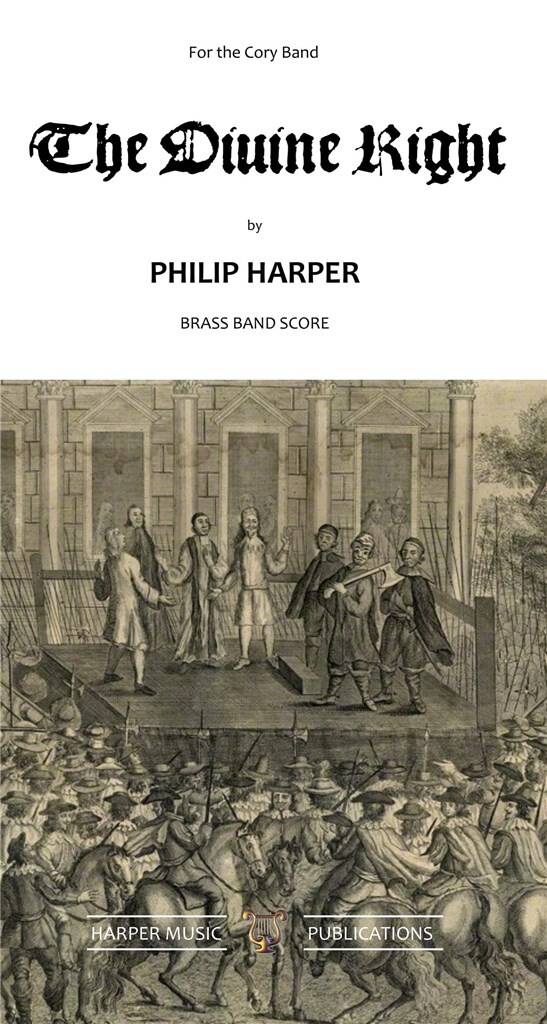
The Divine Right - Philip Harper
At the time of composing this piece, the Arab Spring was sweeping through the Middle East. It seemed that almost every week a new countrys people had risen up against the regimes and dictatorships which had prevailed for generations, leaving manynations at a defining crossroads in their history. There were so many possible ways ahead: so many hopes, yet so many uncertainties.My music is a depiction of these revolutionary times, and several musical themes are in turn presented, discussed, considered, fought over, altered, rejected or accepted. Most nations have had, or probably will have, their own Arab Spring, including my own, the United Kingdom. Events of 17th Century Britain provide the context for this piece, particularly those following the execution of the tyrant King Charles I on30 January 1649. The regicide was in part due to Charless steadfast belief in the Divine Right of Kings, and led to a tumultuous interregnum, where England stood at its own defining crossroads.The music begins turbulently, before King Charles appears and is led to the gallows outside Banqueting House in central London where he is brutally decapitated. From the assembled crowd rose, according to one observer, a moan as I never heard before and desire I may never hear again.The music descends to emptiness. The musical argument which follows is not strictly programmatic, but a number of musical themes are all thrown into the melting pot, representing ideas such as: religion; military force; reasoned Parliamentary debate; and the chattering,irrepressible voice of the people. Additionally, there are some quotations from the music of royalist composer Thomas Tomkins (1572-1656), who was often in tune with the feeling of the times. This defining episode in Englands history was brought to a close with the Restoration of the monarchy in 1660, and as the exiled King Charles II rode back into London the diarist John Evelyn wrote: Never was so joyful a day seen in this nation. I stood in the Strand and beheld it, and blessed God.At the end of the piece the bells ring out, and the musical appearance of the King has transformed from turbulent to triumphant. Philip Harper, 2013
Estimated dispatch 5-14 working days
-
 £24.95
The M-lisada March - Jim Trott
All proceeds from "The M-lisada March" are donated to Brass for Africa, a charity making a positive change to the lives of disadvantaged children and young people in Africa through brass music and brass music education. The composer, Jim Trott, is the founder of a charity called Brass for Africa and one of the organizations the charity supports and works with is the MLISADA organization located in the slums of Kampala, Uganda. MLISADA is a home for ex-street kids, orphans and vulnerable children and at the heart of the home is music and dance. MLISADA have a junior and senior brass band and the bands earn income to feed the home by playing at functions and marches. Jim has often been with the band as they work up anthems and themes for their various engagements and he thought it would be great for MLISADA to have their own theme. So, he has written this short March for these inspiring young people and is delighted that they love to play it whenever they can.
Estimated dispatch 5-14 working days
-
 £84.99
Snow Island - Thierry Deleruyelle
The Swiss canton of Valais is home to a number of wind and brass bands that regularly stand on the podium in Swiss and European competitions. For the general public, the Valais is above all a unique place, between the Rhone Glacier and Lake Geneva, where life is pleasant. The brass players of the five music associations of the villages of Crans-Montana - an internationally renowned "snow island" - were awarded the organisation of the 224 cantonal festival, for which this work was commissioned.
Estimated dispatch 5-14 working days
-
 £64.40
The Master Plan! - Dean Jones
We all have a purpose...whether those are found in daily routines or much larger parts of our lives. Having a plan or a goal is a great way we can measure our success. Here's a small piece of music that explores 3 such elements:Covert Mission - a militaristic theme where the music conveys action and drama.Finding Someone - at some point, we share our lives with people who are special to us. The music has a more lyrical feel to help illustrate affection.Life Goals! - the strong rhythmic pattern to this section is the undertone for portraying a a sense of focus. We need to match desire with action when attempting something new - the sense of excitement and hope will need to be drawn from the music to convey this message.The music tells a compelling story of purpose, hope and passion....in the words of Col. Hannibal Smith from the A-Team, "I love it when a plan comes together!"
Estimated dispatch 5-14 working days
-
 £149.99
Redbad - Jan de Haan
Redbad was written for the Championship Section of the Dutch Brass Band Championships - and thus it contains plenty of musical and technical challenges. In this work of seven connected movements we get to know Redbad, who was the King of the Frisians from c. 680 to 719. The composer drew his inspiration from historical information, but also from stories, anecdotes, myths and legends around this figure. The themes within the composition are closely interwoven whereas the music is varied and appealing - from heroic motifs to the melancholy of elegies. Impressive tutti passages alternate with fragments that sound more open and in which various players can take centre stage. To crown it all, the work concludes with a majestic finale.
Estimated dispatch 5-14 working days
-
 £42.50
Fanfare for an Occasion - Philip Sparke
Fanfare for an Occasion was written to celebrate the 20th anniversary of the founding of Anglo Music Press, the publishing company dedicated to the works of British composer, Philip Sparke. It is a bright and festive work in which the main theme starts on the tenor instruments of the band before appearing as canonical imitation by all sections in turn. A short, repeated bridge passage leads to a second theme on the horns that is taken up by the full band and leads back to a return of the main theme and a repeat of the second subject, which brings the fanfare to a brilliant close.
Estimated dispatch 5-14 working days
-
 £154.60
Circius - Torstein Aagaard-Nilsen
The work is important for me because it was my first piece to be performed outside Norway. Black Dyke Band/David King performed it and did a recording of it in 1991. In the original score I quote a Swedish bishop (Olaus Mangnus) who lived in the 15th century. He travelled around Scandinavia and drew maps - very important historic material. When he came to the north of Norway (where I come from) he decribed the wind from the north as Ciricus: (something like) Worst of all winds is Circius, that revolves (?= turn upside down) heaven and earth. (Well, not a good translation Im afraid). The fast sections reflects the mighty winds from the north. In the middle section, I borrowed afolksong-like tune (by C. Elling, a Norwegian composer). The text (by Kristoffer Janson) tells about old times when the fishermen used open boats: they had to put their lives in the hands of God.
Estimated dispatch 5-14 working days
-
 £174.99
The Turing Test - Simon Dobson
Alan Turing is considered the father of modern computational science and much, if not all, of our modern computer technology and the connectivity that we now take for granted is born of the work of this one great, but troubled man. His famous test was designed to prove whether artificial intelligence (AI) could successfully imitate human thought. The single movement of The Turing Test is essentially non-programmatic, but it does seek to show something of the emotion and colour of Turing's life in its different sections. The composer employs bi-tonality and complex rhythms to show opposing worlds colliding. At the end of each test, we must decide: has true AI beenborn?
Estimated dispatch 5-14 working days
 View Music