
Results
-
 £15.00
Perseverance
DescriptionPerseverance was commissioned by Middleton Band to mark their 140th anniversary in 2016, supported using public funding by the National Lottery through Arts Council England, and featured on Middleton Band's CD of the same name.The title is taken from the original name of the 1876 band, the Middleton Perseverance Drum and Fife Band. According to the band's historical records, the Drum and Fife band was formed by six Middleton youngsters eager to learn music but short of funds. Following a whip round, they visited a music shop in Oldham where they purchased a 'one key flute' for six shillings and sixpence, and ('later on') a drum.This determination to make music despite the odds has been a characteristic of the band ever since; at the end of the second world war the band was again down to six players, who rebuilt the 'Middleton Borough Band' back to twenty-six players. After a period of some considerable success throughout the sixties and seventies culminating in winning the National Third Section title in 1983 the band hit hard times again in the late eighties and was down to only four members in 1987 before again being brought back to life. In recent decades the band has built a strong relationship with the East Lancashire Railway, another organisation which has battled sometimes mighty obstacles in its struggle to survive, and has maintained a thriving and successful youth band.The band's will to survive through adversity is reflected in the music, which builds from a sextet of four brass and two percussion players three times, only to fall back to the sextet twice. In the central slow movement the bass drum plays a 'heartbeat' rhythm as the remaining players remember those lost in the war. The relentless pace of the final section culminates in the band triumphing over the adversity which has curtailed the previous two sections. As a former member of Middleton Band (and one of the team that regained the National Third Section title in 2007) it is my pleasure to dedicate this work to the 'Pop and Ale Boys', Middleton Band.You can read more about the piece here.To view the accompanying video by Andy Marshall, designed to precede the piece, clickhereand find out more about the link between the video and the music here.Recording with Score VideoPerformance NotesIn performance the four brass members of the sextet (soprano, solo horn, solo trombone and solo euphonium) should stand at the sides of the band - soprano and horn behind the cornets, trombone and euphonium behind the trombones. Percussion may stand with them at the conductor's discretion, but only if the band has TWO snare drums and TWO concert bass drums available, as these are also needed at the back of the band in the tutti sections. In the second sextet snare drum should be muffled with a heavy cloth OR have the snares turned off (not both).Percussion and mutesPercussion required:snare drum (muffled with a heavy cloth at one point)concert bass drum, kit bass drum, hi-hat, suspended (crash) cymbal2 x tom-tomswood blockclash cymbals3 x timpanitam-tamglockenspielSoprano cornet, repiano and 2nd cornets, flugel and all trombones require metal straight mutes. Soprano, Solo Cornet 3/4, Repiano 2nd and 3rd cornets require cup mutes. Solo Cornet 1/2, Repiano, 2nd and 3rd cornets require harmon mutes.
Estimated dispatch 7-14 working days
-
 £33.62
Call of the Victor (Brass Band) Marcus Venables
VIEW SCORE PDF The music within this piece by Canadian composer Marcus Venables portrays the image of a victorious and triumphant call - the battle's won and the victor proclaims supreme authority. As with any ruling authority and power, the growing opposition rise to conquer. After the opening fanfare and a call of victory, the music portrays the lavishness of victory with this driving sense of impending conflict. Once again, the victor must go to war and battle the threats. The music continues to express the sorrow and the loss that comes with being the victor. With sacrifice and pain, the victor now grows in passion and motivation to once again conquer the enemies. With a final swift battle, the victor calls out to claim supremacy once again. PDF download includes score and full set of parts. Sheet music available from: UK - www.brassband.co.uk USA - www.solidbrassmusic.com Difficulty Level: Second Section + Instrumentation: Soprano Cornet Eb Solo Cornet Bb Repiano Cornet Bb 2nd Cornet Bb 3rd Cornet Bb Flugel Horn Bb Solo Horn Eb 1st Horn Eb 2nd Horn Eb 1st Baritone Bb 2nd Baritone Bb 1st Trombone Bb 2nd Trombone Bb Bass Trombone Euphonium Bb Bass Eb Bass Bb Timpani Percussion 1-3
In Stock: Estimated dispatch 1-3 working days
-
 £64.99
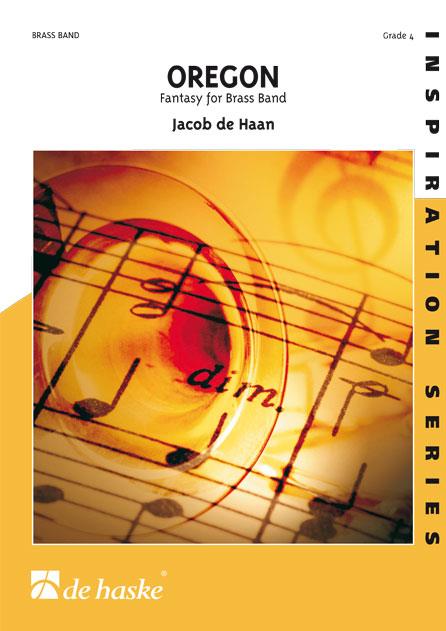
Oregon (Brass Band - Score and Parts)
This fantasy tells the story of Oregon, one of America's north-western states. Traveling by train on the Northern Pacific Railroad, the listener is taken through the fascinating Oregon landscape. Indians, cowboys, golddiggers and hooded wagons will file past on this adventurous journey. The piece has some similarities with a soundtrack of a movie. Various melodies, which could be the main themes of a movie, pass the review.The piece begins in a slow movement, introducing the first theme in minor. Then we hear in the following fast movement the trombones imitate the train, whistling the steam-flute. We hear the characteristic minor theme again, but now in different variants (also in major). The rhythmic structure of "western" stile and rock succeed each other. This is leading to the slow movement, where the signals of horns and trumpets introduce a wonderful vocal melody. After this characteristic melody, the fast movement appears shortly again, the trombones whistling the steam-flute again (now in major). We hear also some musical elements, that plays a part in the following Presto. Barchanges, jazzy chords, interesting rhythmic patterns (with bongo) and an original theme are the characteristics of this Presto. After this, the horns announce the last section of the piece. Interesting is the fact that we hear in this Allegro section a variant of the vocal melody in the slow movement. Also the Presto theme returns shortly, followed by the Allargando, which is a grand characteristic end of a soundtrack. The movie of our travelling fantasy has come to an end.Duration: 9:10
Estimated dispatch 7-14 working days
-
 £85.00
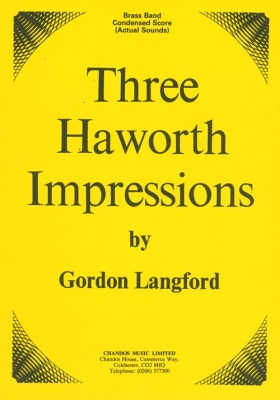
Three Haworth Impressions (Brass Band - Score and Parts)
A wonderful three movement suite which conjures up fabulous musical imagery of the lands of northern England. Well worth including as a concert item in your next programme, but this great original composition should really should be set again as a test-piece soon - rewarding musically for audience and bandsmen alike.Includes:TOP WITHENS - A GENERAL EVOCATION OF THE ATMOSPHERE OF WUTHERING HEIGHTS The sinister opening motif symbolises the influence of the evil Heathcliffe, Soon this motif experiences several changes of character in order to portray emotions other than those of hatred and jealousy. The overall mood is, however, one of gloom and foreboding.THE THREE BELLS This is a reference to the pseudonyms adopted by Ann, Charlotte and Emily Bronte. The music begins with three "bell"-notes; Ab for Acton Bell, Cb for Currer Bell and Eb for Ellis Bell, and these three notes form the basis of a wistful waltz tune. Again the mood is rather sombre -- save for a brighter middle section -- and the opening motif from "Top Withens" is to be heard, again symbolising the frustrations and ill-fortune by which their lives were plagued.THE WORTH VALLEY RAILWAY The Brontes were not the only people in Haworth and not all is desperation and gloom. The third impression is a celebration of the victory of the people of Haworth in their fight to retain their railway. The nine-eight rhythm of a slow train is prominent, and our once-sombre motif is transformed into a triumphant fanfare.Duration: 12.00Please note that there are only 3 solo cornet parts included in this set
Estimated dispatch 7-14 working days
-
£16.00
Three Haworth Impressions (Brass Band - Score only)
A wonderful three movement suite which conjures up fabulous musical imagery of the lands of northern England. Well worth including as a concert item in your next programme, but this great original composition should really should be set again as a test-piece soon - rewarding musically for audience and bandsmen alike.Includes:TOP WITHENS - A GENERAL EVOCATION OF THE ATMOSPHERE OF WUTHERING HEIGHTS The sinister opening motif symbolises the influence of the evil Heathcliffe, Soon this motif experiences several changes of character in order to portray emotions other than those of hatred and jealousy. The overall mood is, however, one of gloom and foreboding.THE THREE BELLS This is a reference to the pseudonyms adopted by Ann, Charlotte and Emily Bronte. The music begins with three "bell"-notes; Ab for Acton Bell, Cb for Currer Bell and Eb for Ellis Bell, and these three notes form the basis of a wistful waltz tune. Again the mood is rather sombre -- save for a brighter middle section -- and the opening motif from "Top Withens" is to be heard, again symbolising the frustrations and ill-fortune by which their lives were plagued.THE WORTH VALLEY RAILWAY The Brontes were not the only people in Haworth and not all is desperation and gloom. The third impression is a celebration of the victory of the people of Haworth in their fight to retain their railway. The nine-eight rhythm of a slow train is prominent, and our once-sombre motif is transformed into a triumphant fanfare.Duration: 12.00Please note that there are only 3 solo cornet parts included in this set
Estimated dispatch 7-14 working days
-
 £34.95
Song of the Night Sky - Christopher Bond
Orpheus is known as the most talented music player of the ancient times. It is said that god Apollo was his father, from whom took his extreme talent in music, and the Muse Calliope was his mother. Tragedy struck when his wife, Eurydice stepped on a viper which in turn bit her, injecting its fatal venom. Nothing could stop his cries of anguish and sheer pain and sorrow upon realizing his beautiful Eurydice was dead. Orpheus decided to go into the Underworld to get his wife back. Apollo, his father, would talk to Hades, the god of the Underworld to accept him and hear his plea. And so Orpheus set off into the Underworld and was warned that for no reason must he look back while his wife was still in the dark, for that would undo everything he hoped for. As Orpheus was reaching the exit of the Underworld, he could hear the footfalls of his wife approaching him. As his was approaching the exit, his heart was beating faster and faster. The moment he stepped on the world of the living, he turned his head to hug his wife. Unfortunately, he got only a glimpse of Eurydice before she was once again drawn back into the underworld. When Orpheus turned his head, Eurydice was still in the dark, she hadn't seen the sun and, was drowned back to the dark world of the dead. Waves of anguish and despair swept over him and shuddering with grief he approached the Underworld again but this time, he was denied entry, the gates were standing shut and god Hermes, sent by Zeus, wouldn't let him in. His songs were no more joyful but extremely sad. His only comfort was to lay on a huge rock and feel the caress of the breeze, his only vision were the open skies. Song of the Night Sky was recorded by Tom Hutchinson and the Cory Band in June 2015, featuring on his debut solo album.
Estimated dispatch 10-14 working days
-
 £33.91
Stargazer - Kevin Ackford
Score & Parts Again, not a traditional march but a great opener. Stargazer is the third of Kevin's space trilogy. Again, this piece shows all the hallmarks of Kevin's writing with a great melody and plenty of energy with a little twist, as in the middle section the title is spelled out in the cornets using Morse code. A must for any band.
Estimated dispatch 5-7 working days
-
 £235.00
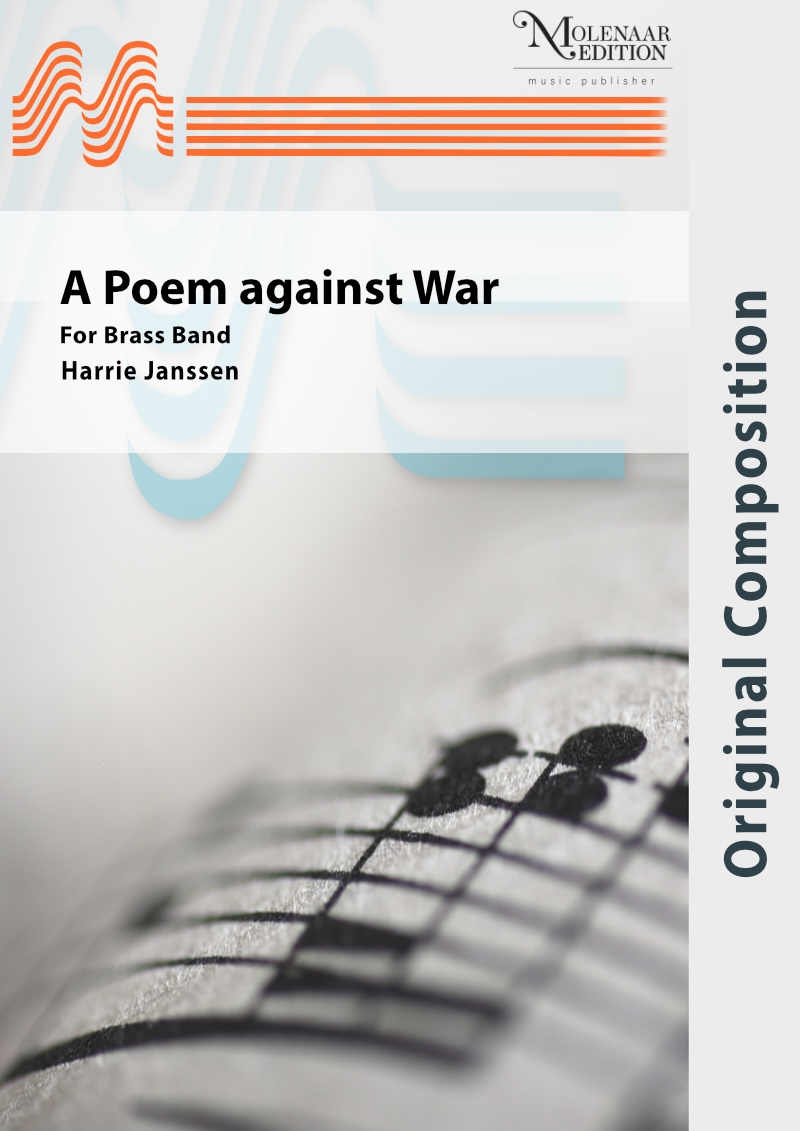
A Poem Against War - Harrie Janssen
A Poem against War A Poem against War was commissioned by Psalm 150, Dinxperlo for the project Leven in Vrijheid!.Starting point of the composition of this piece was the poem A Poem against War from the American poet Karen Kapowich. The poem tells of young lives that are broken in their start because of war.A monument - founded in memory of the soldiers who gave their lives - is hardly noticed and even ignored. Children find the tree-sheltered memorial place rather scary and even the narrator speeds up his stride when passing. Underlying theme is the otiosity of war.The musical piece is composed of two parts that are being played without interruption. The first part explains the drama of the battle. The second part is based on the poem of Karen Karpowich in which we look back on the sacrifices that have been made. The text is sung by a Mezzo Soprano and emphasizes the bloodshed that comes along with every war. The opening theme returns at the end of the piece but in a complete metamorphosis, wherein optimism and vigor take place for resignation knowing that history repeats itself time and time again. A Poem against War had its premiere on 25th November 2012 in de DRU Cultuurfabriek in Ulft by Fanfare-orchestra Psalm 150, Dinxperlo led by Tijmen Botma. The Mezzo Soprano was Elske ter Lindert.commissioned by Psalm 150, Dinxperlo for the project Leven in Vrijheid!.Starting point of the composition of this piece was the poem A Poem against War from the American poet Karen Kapowich. The poem tells of young lives that are broken in their start because of war.A monument - founded in memory of the soldiers who gave their lives - is hardly noticed and even ignored. Children find the tree-sheltered memorial place rather scary and even the narrator speeds up his stride when passing. Underlying theme is the otiosity of war.The musical piece is composed of two parts that are being played without interruption. The first part explains the drama of the battle. The second part is based on the poem of Karen Karpowich in which we look back on the sacrifices that have been made. The text is sung by a Mezzo Soprano and emphasizes the bloodshed that comes along with every war. The opening theme returns at the end of the piece but in a complete metamorphosis, wherein optimism and vigor take place for resignation knowing that history repeats itself time and time again. A Poem against War had its premiere on 25th November 2012 in de DRU Cultuurfabriek in Ulft by Fanfare-orchestra Psalm 150, Dinxperlo led by Tijmen Botma. The Mezzo Soprano was Elske ter Lindert.
Estimated dispatch 10-14 working days
-
 £36.30
On Ilkley Moor Pastiche
I was commissioned to write a piece for the RNCM Trombone Quartet by the bass trombonist Trevor Slade, a true Yorkshireman. I have created a full brass band version. There is an element of comedy, (though not irreverent). The introduction is a direct reference to a well known film theme about bouncing bombs! We then hear the famous Yorkshire melody with overtones of the old BBC Grandstand theme, (for those old enough to remember). A 'patriotic' section is a mixture of "Ilkley Moor", and those bouncing bombs again! We are then taken to a 'Dixieland' treatment, with 'overtones' of a 'Hootenannyish' piece, which every bandsman/woman is familiar with! What follows is a rather pretty 'Edmundo Ross(ish)' beguine. After a brief Beethovian bit, we are taken back once again to the original pastiche, with a BIG ending. A good piece for the lighter element of the concert programme.
In Stock: Estimated dispatch 3-5 working days
-
 £39.95
The Irish Blessing (Score and Parts) - Joyce Eilers Bacak arr. Stephen Bradnum
The Irish Blessing is a celtic gem - the words of the traditional benediction aptly portrayed in music which is both affirming and uplifting. This finely crafted and sensitively scored arrangement provides an excellent training vehicle for bands of all ages, helping to develop dynamic range; integrate solo and tutti, and at the same time enteraining an audience! Perfect for devotional or concert use. The Irish Blessing May the road rise up to meet you. May the wind be always at your back. May the sunshine warm up on your face, The rains fall soft upon your elds. And until we meet again, And until we meet again. May the God that loves us all Hold you in the palm of his hand. Amen, Amen, Amen. Duration: 3 minutes
Estimated dispatch 7-9 working days
 Watch video
 View Music