
Results
-
 £89.99
Frida's Whiskers - David Well
David Well composed 'Frida's Whiskers' in commemoration of his own cat, who met an untimely end. Frida (whose real name was 'Godefrida van Coopersburg thoe Nieuwenhuys') was a lively creature, who led a playful and uncomplicated life. She used to sleep in her basket for hours, but when she woke up she upset the entire house and its furnishing. Curtains were inspected from top to bottom and flower pots fell from window-sills just like that! Outside, in the open air she was in her element. She used to frolic, bouncing into the air. After such playful moods she would return to her basket tired but satisfied where, being the cleanly cat that shewas, she subjected her entire body, whiskers included, to a thorough wash.
Estimated dispatch 5-14 working days
-
 £54.99
Sumba Samba - Ron Gilmore
The Samba is a Latin American dance, which is mostly associated with parties, as a result of the fast tempo in which it is usually played. 'Sumba Samba' forms an exception to this rule. In order to get this samba to swing it is important to stick to the tempo prescribed. 'Sumba Samba' starts with a motif which will play an important role throughout the piece. This motif can be heard in the first notes of the 'refrain' and, as said before, has been used in the introduction, as well as in the transition after the middle part (letter G). Furthermore, it plays an important role in the middle part itself (letter E), in which the samba has momentarily disappeared and acompletely different atmosphere has been created. At letter H we pick up where we left off with the samba and swing to the end of this composition.
Estimated dispatch 5-14 working days
-
£76.99
Jubilant Prelude - Toon Hagen - Dirk Annema
'Jubilant Prelude' is an orchestration of the 'Preludium over Psalm 150' originally composed for organ by Toon Hagen. Since 1998 Toon Hagen has been organ-player of the 'Grote or Sint Michaelskerk' in Zwolle (the Netherlands). He has written several 'contemporary' compositions for organ.'Jubilant Prelude' has a capricious character by the use of irregular measures and its many measure changes. The structure of the Prelude is that of a fugue and is based on motives from the psalm.After the first climax, which is both dynamic and harmonic, the theme in the Andante Jubiloso is clearly audible and it is alternated with erratic motifs. Tension increases until at last the psalm itself isheard in all its glory. The melody of the psalm sounds as a cantus firmus in tenor register, with motifs in ornamentation for saxophones, bugles and trumpets. The finale, like the prelude is capricious and vehement.The instrumentation for brassband was made by Dirk Annema. It is particularly colourful and has a surprising role for the percussion section.
Estimated dispatch 5-14 working days
-
 £104.99
Like a Child - Andreas Ludwig Schulte
The young have the future. This is the statement made at the beginning of 'Like a Child' by Andreas Ludwig Schulte. The opening radiates strength and ambition, but one is also made to wonder which direction will be chosen, which choices will have to be made.After the introduction the first steps on the path of life are taken, still somewhat unsteadily (the 3/4th time used illustrates this uncertainty). However, the child has now set off and will meet the future with an open mind, unafraid, even though experience will teach it how easily it can be hurt.Fortunately, it is sometimes allowed to be vulnerable and it discovers there will always be someone to offer shelter,support and love. (Adagio) The last part breathes a far greater independence. Youth is able to face the future, it can even take on the whole world!
Estimated dispatch 5-14 working days
-
 £76.99
Well Done! - David Well
Sitting behind his desk in his new office, David Well thought : 'Well Done! After weeks of slogging he had his old office despite everything turned into a nice room. A lot of daylight, fresh colors and a beautiful view of the rural setting. And you can hear it. Well Done!: light, cheerful and excited, in a pop / rock style with an slight hint of blues.
Estimated dispatch 5-14 working days
-
 £80.00
St. Magnus - Kenneth Downie
Dedicated to Alastair Massey, an inspirational music teacher. Commissioned by the Scottish Brass Band Association for the 2004 European Brass Band Championships in Glasgow. This music is a set of variations on the tune known as St Magnus, which is attributed to Jeremiah Clarke. Most people will associate it with Thomas Kelly's hymn which begins: "The Head that once was crowned with thorns is crowned with glory now". The tune is very simple, consisting of just two, four-bar phrases. Neither is there much in the way of rhythmic variety, every note being a crotchet with the exception of two quavers, and the last note in each phrase. Within such a simple structure, however, lies considerable strength. THEME The listener is given the opportunity of hearing it twice, in full, at the beginning, starting with one player but soon taken up by the full ensemble. It returns in the middle of the music and is stated again near the end. This has been done quite deliberately in the hope that there will be an appreciation of what material is being developed, by the listener as well as by those with access to the score, who are able to see the visual connections. VARIATION 1 This takes the rhythm of the last part of the theme and also uses the shape of the opening as a recurring figure. The mood is whimsical and skittish, with short, teasing rhythmic figures tossed around the band, and quick interplay with percussion, at a fast tempo. An energetic flourish finishes this variation before the Andante espress. VARIATION 2 This commences with chords related to the opening of Variation 1. The cantabile on solo comets establishes a new, lyrical mood and there is scope for expressive playing in a series of short solo passages. The theme works its way unobtrusively into the texture before a reprise of the solo cornet melody and some more lyrical interchanges between Eb bass, euphonium, flugel horn and comets. The variation ends serenely with clear references to the last phrase of the theme. VARIATION 3 The first idea to dominate is clearly linked to the shape of the theme's first phrase. There is a frenetic feel to much of this variation, with considerable energy and instability created by extensive use of cross-rhythms. A thinning-out of the score marks a clear change to development of the start of the second phrase of the theme. This proves to be short-lived however, and the opening material returns leading to a restatement of the theme, "Maestoso," after which a euphonium cadenza links to Variation 4. VARIATION 4 Here we have some solos for euphonium, cornet, trombone and Eb bass set against a background of horns and baritones presenting a pensive statement of the theme's opening. VARIATION 5 This commences Allegro, with lively work for cornet and euphonium spreading to the whole band before attention focuses on the beginning of the second phrase of the theme which is initially presented in diminution, then in regular rhythm, then in inversion. An increase in tempo coupled with a decrease in volume, requires dexterity and control, with several metrical challenges thrown in for good measure. The same fragment of phrase becomes an ostinato which generates a frenzied climax, punctuated by short, dramatic silence, before the opening figure returns and the music gradually winds down. The tubular bells herald the final return of the theme, in augmentation, marking the start of the Finale. FINALE This features the running semiquavers of the previous variation sounding in counterpoint. A fast, furious coda speeds the work to a conclusion while references to the opening of the theme are still trying to break into the texture of the music. Kenneth Downie
Estimated dispatch 5-14 working days
-
 £68.90
Three Pictures for Band - Oliver Waespi
This composition consists of three sound pictures. Numerous associations mutually link those parts as far as motifs and harmony are concerned. The motif of the ascending and descending fourth plays an important role in many a theme. There are many fourth chords by means of which I try to put a harmonic and unifying stamp on the composition as a whole. Moreover there are similar or identical, though varied, motifs in the successive parts. The first part 'Cortege' (Procession) describes the dignified majestic procession by means of simple, precise rhythms. At first, the music is scarcely audible, as if coming from a distance; it gradually comes nearer until it reaches its climax in large chords, before fading away again. At each quarter note one could imagine a step. The second part 'Dialogue' consists in broad outlines of dialogues between the different orchestral groups. Some instruments are asking questions, others are giving answers. After a rather sad passage, the music turns into a climax followed by a second passage that brings comfort and leads to a quiet ending. In the third part, there is a sudden movement coming up in the shape of 'Waves'. The principle of the wave, successively swelling and decreasing, dominates the entire musical structure of this part, even in the separate motifs.Oliver Waespi
Estimated dispatch 5-14 working days
-
 £116.40
Decennium - Eric Swiggers
'Decennium' was composed in 2003 as a commission by the municipality of Berheze for its tenth anniversary. The composition describes the history of this town in the Province of Brabant, consisting of 6 different villages: Heesch, Heeswijk, Dinther, Nistelrode, Loosbroek and Vorstenbosch. The composition starts with a slow introduction, Adagio Misterioso, suggesting the atmosphere in long-ago days when the area consisted mainly of swamps, meres and low woods. (The word 'Bern' is a synonym of 'Born' meaning source or water, whereas 'Hese' is derived from 'Haisjo' meaning brushwood ). Above the dark sounds we hear far away trumpet signals announcing the Middle Ages. After a piercing crescendo, we hear the full sound of festive trumpets. A medieval dance, as was to be heard in the Heeswijk castle, follows. This dance gets a more and more stirring character and finally turns into a merry popular dance ending with a burst of laughter reproduced by descending scales with the muted trombones and trumpets. A slow transition with a quotation from a Gregorian plainsong (Domine Deus) and church bell ringing, referring to the Abbey of Berne, brings us to a romantic Larghetto. This part describes the quiet rural life in a beautiful natural surrounding. The last dying note contrasts with the threatening ostinato, referring to the rise of the industrialization, which provoked quite some resistance with the local people. Once more we hear the 'Domine Deus' but much more powerful this time. When the resistance calms down, the work concludes with an Alla Marcia. The first notes of the main theme could be heard all through the composition and now we hear the complete main theme again. The new town is born. A festive conclusion refers both to the tenth anniversary and the optimism and confidence as to the future.
Estimated dispatch 5-14 working days
-
 £74.10
Have A Break-Break Away - Patrick Millstone
With these two 'breaks' Patrick Millstone killed two birds with one stone. You can conclude the first part of your concert with 'Have a break' and start again after the interval with 'Break Away'.
Estimated dispatch 5-14 working days
-
 £88.10
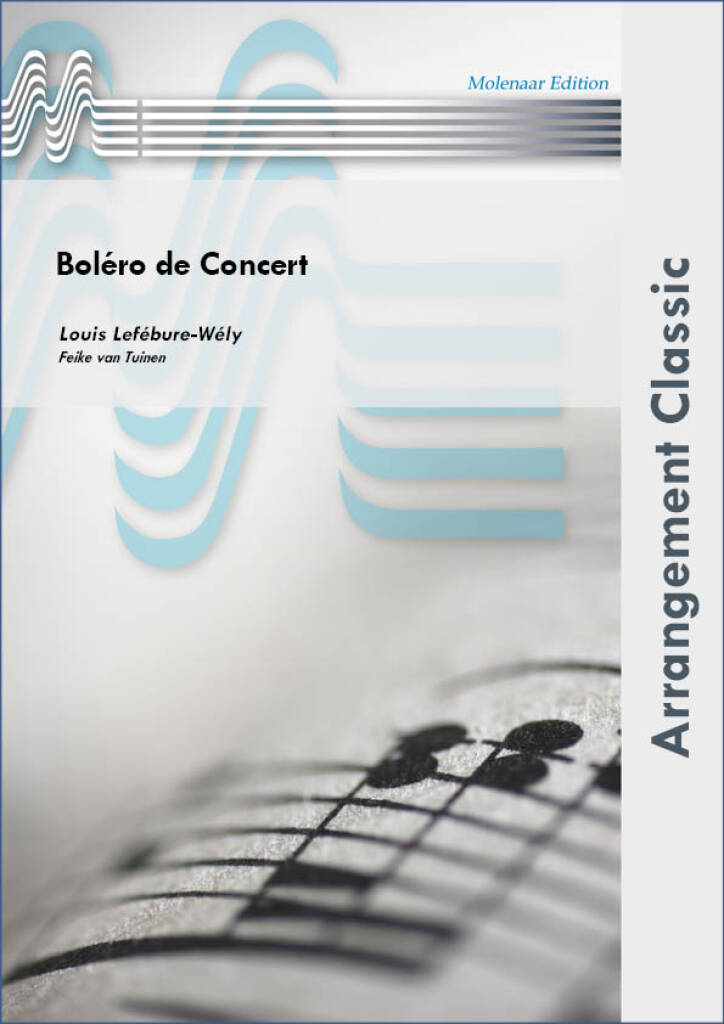
Bolero De Concert - Louis Jaime Alfred Lefebure-Wely - Feike van Tuinen
After having heard this piece for the first time at an organ recital, Feike van Tuinen was convinced that an orchestral version would be fantastic and would work very well. This piece has a stimulating character and the use of castanets will create a Spanish atmosphere at your next concert. Strongly recommended!
Estimated dispatch 5-14 working days
 View Music