Results
-
 £35.00
A Suffolk Prelude. Andrew Duncan
Recommended - Championship to 2nd Section Written for the Ipswich & Norwich Co-Op Band, A Suffolk Prelude is based around five traditional folk tunes from Suffolk in England. Nutting Time, Blackberry Fold, Cupid's Garden, A Seaman's Life and The Bold Richard. A Suffolk prelude is ideal as an opening item in a concert. Includes score & Parts
-
£100.00
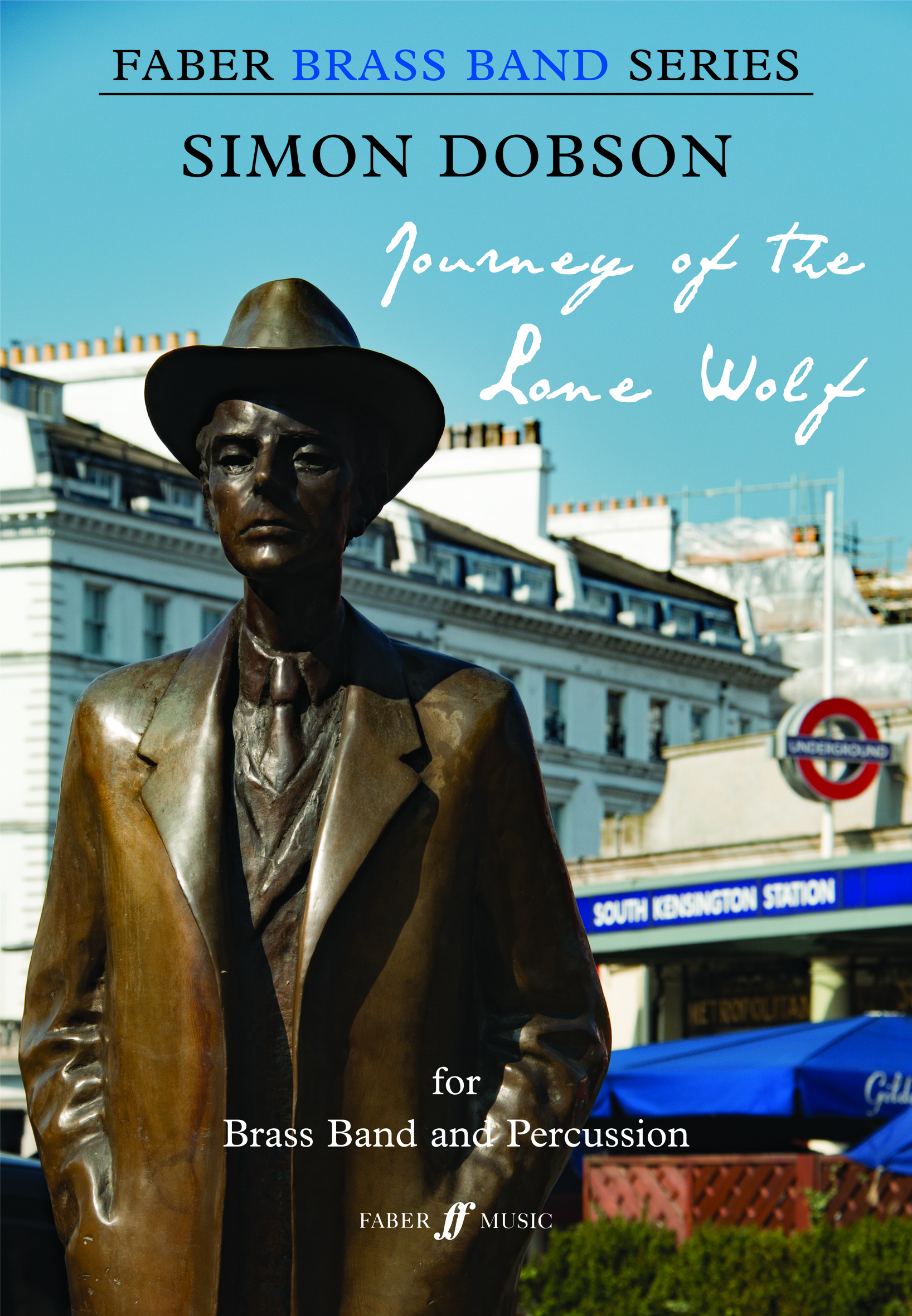
Journey of the Lone Wolf (score & parts) - Simon Dobson
Journey of the Lone Wolf tells the story of the hungarian composer Bla Bartk. It was commissioned by Dr. Nicholas Childs for Black Dyke Band, who gave the first performance on Sunday 26 January 2014 at the Bridgewater Hall, Manchester as part of the Royal Northern College of Music Festival of Brass.The composer's programme notes for each movement: 1. Capturing the Peasants' SongAfter the upheaval of moving to Budapest the young Bla Bartk meets Zoltn Kodly and the pair embark on summertime adventures throughout the Hungarian countryside to collect and catalogue the astonishing variety (both harmonically and rhythmically) of gypsy and folk music heard in the Balkans. The arrival of WW1 plunges Bartk's beloved Hungary into chaos.2. Night MusicBartk was at times a cold man, aloof and lonely. The odd moments of tenderness he showed are portrayed here in a series of evocative solos. His brief but intense affairs speak of a love he could only long for. Jazz is my night music and here there are hints of what Bartk may have heard in the USA later in his life.3. Flight and FightHaving been forced by the world's evils to leave his homeland of Hungary for America, Bartk, the anti-fascist, felt isolated and angry. In this movement we hear his longing for a simpler time of gypsy folk dances as well as his maturity and depth as a composer finally exploring deeper colours and darker themes. Duration: 15 minutes.Level: Championship
In Stock: Estimated dispatch 1-3 working days
-
 £30.00
A Floral Christmas - Brass Band Sheet Music Full Score & Parts - LM264
COMPOSER: VariousARRANGER: Chris CobonISMN : 9790570002641A superb new collection of Christmas carols carefully crafted into a medley, with a hint of the Katy Moss classic "Floral Dance", ready for your Christmas concerts.Christmas Carols include :The Holly & The IvyJingle BellsHark!, The Herald Angels SingThe Twelve Days of ChristmasIt Came Upon A Midnight ClearDeck The HallsCarol of The BellsAway In A MangerSilent NightFloral DanceO Holy NightO Come, O Come EmmanuelThe Twelve Days of ChristmasJoy To The WorldO Come, All Ye FaithfulThe Twelve Days of ChristmasLM264 - ISMN : 9790570002641
In Stock: Estimated dispatch 3-5 working days
-
 £30.00
All Shall Be Well - Brass Band Sheet Music Full Score & Parts - LM931
COMPOSER: Tamsin TateCOMPOSERS NOTE"All shall be well" was composed during the first lockdown of the Covid crisis, from May 2020.This was a worrying time for many and a time of great anxiety and sadness for some.I have always tried to be practically optimistic in trying times, but still I needed hope.I am lucky to have a faith in God which gives me hope and assurance that things will be better,and I also know that music, particularly playing it, can help express some of these emotions.Certainly, music through the crisis was a wonderful, enjoyable escape for meand one I shared with my family and my band family through our online recordings.Julian of Norwich was an anchoress in the 14th Century.She set herself apart for God and spent a lot of time in prayer.Interestingly, she was the first published woman in the English language.Julian of Norwich is quoted as saying "all shall be well, all shall be well,and all manner of thing shall be well." The paraphrase of this spurred me on to develop this piece for brass band.Hopefully you will also find that the music portrays the worries and trials of this uniquetime through the natural minor key, with the rhythm hinting towards the phrase"All shall be well" and then the dawning transition to the major keyfollowed by a triumphant ending with the whole band joining together.Thanks to Adam Cable and the Martlesham Brass family for support and encouragement always.Thanks also to Alan Fernie and his supportive critique of my initial efforts.LM931 - ISMN : 9790570009312
In Stock: Estimated dispatch 3-5 working days
-
 £30.00
Amazing Grace (W. Walker arr. by Paul Pennicotte-Henrie) - Brass Band Sheet Music Full Score and Parts - LM642
COMPOSER: W. WalkerARRANGER: Paul Pennicotte-Henrie"Amazing Grace" is a Christian hymn published in 1779 by English Anglican clergyman, abolitionist, and poet John Newton. It is possibly the most sung and most recorded hymn in the world and is especially popular in the United States, where it is used for both religious and secular purposes. Newton wrote the words from personal experience; he grew up without any particular religious conviction, but his life's path was formed by a variety of twists and coincidences that were often put into motion by others' reactions to what they took as his recalcitrant insubordination. He was pressed into service with the Royal Navy, and after leaving the service, he became involved in the Atlantic slave trade.In 1748, a violent storm battered his vessel off the coast of County Donegal, Ireland, so severely that he called out to God for mercy. While this moment marked his spiritual conversion, he continued slave trading until 1754 or 1755, when he ended his seafaring altogether. Newton began studying Christian theology and later became an abolitionist.Ordained in the Church of England in 1764, Newton became the curate of Olney, Buckinghamshire, where he began to write hymns with poet William Cowper. "Amazing Grace" was written to illustrate a sermon on New Year's Day of 1773. It is unknown if there was any music accompanying the verses; it may have been chanted by the congregation. It debuted in print in 1779 in Newton's and Cowper's Olney Hymns, but settled into relative obscurity in England. In the United States, "Amazing Grace" became a popular song used by Baptist and Methodist preachers as part of their evangelizing, especially in the American South, during the Second Great Awakening of the early 19th century. It has been associated with more than 20 melodies. In 1835, American composer William Walker set it to the tune known as "New Britain" in a shape note format; this is the version most frequently sung today.
In Stock: Estimated dispatch 3-5 working days
-
 £30.00
An Englishman, An Irishman & A Scotsman Walk Into A Bar - Trio & Brass Band Sheet Music Full Score & Parts - LM562
COMPOSER: Stuart J. RogersA delightful musical Scherzo (Joke) for the unlikely trio of Eb Soprano Cornet, Bb Cornet & Bb Flugelhorn.A great piece for both soloists and band alike with many a twist and turn.Suitable for 2nd Section and aboveLM562 - ISMN : 9790570005628
In Stock: Estimated dispatch 3-5 working days
-
 £30.00
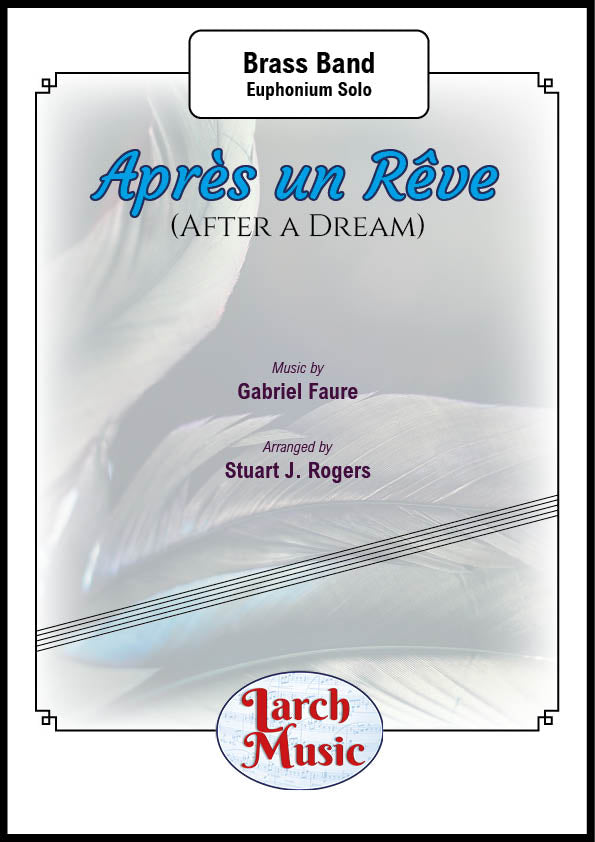
Apres un Reve - Euphonium & Brass Band Sheet Music Full Score & Parts - LM563
COMPOSER: Gabriel FaureARRANGER: Stuart J. RogersTrois melodiesis a set ofmelodiesfor solo voice and piano, byGabriel Faure.It consists of "Apres un reve" (Op. 7, No. 1), one of Faure's most popular vocal pieces,"Hymne" (Op. 7, No. 2), and "Barcarolle" (Op. 7, No. 3).The songs were written between 1870 and 1877, and published in 1878.They were not, however, originally conceived together as a set of three;theopus number7 was imposed on them retrospectively in the 1890s,almost 20 years after their first publications.In "Apres un Reve" (After a Dream),a dream of romantic flight with a lover,away from the earth and "towards the light", is described.However, upon awakening,the dreamer longs to return to the "mysterious night"and the ecstatic falsehood of his dream.LM563 - ISMN : 9790570005635
In Stock: Estimated dispatch 3-5 working days
-
 £42.00
Euphonium Music (Score only) - Brian Bowen
Written in 1978, the work is constructed in three movements and is virtually a concerto for euphonium and band. The first movement begins with an unaccompanied motto theme, which uses all twelve notes of the scale but with a tonal feel. The slow second movement is based on an original song melody by the composer - 'The Eyes of God' - and affords lyrical and richly expressive playing that is typically euphonium. Movement three follows without a break - a capricious movement which ends triumphantly. Now available in versions for piano, brass band, wind band, and orchestra, Euphonium Music can be seen as a major contribution to the literature for the instrument. Duration: 15 minutes An orchestral version is available on hire.
Estimated dispatch 7-9 working days
-
 £60.00
Fantasie Concertante (Score only) - Philip Wilby
This exciting new concerto is a welcome addition to the repertoire of french and tenor horn players alike. Like the 18th-Century Serenade form there are five movements, arranged symmetrically around a slow movement - Soliloquy - which separates movements entitled Burlesque (two) and Valse Caprice (three) respectively. The first and last movements share common material of a more symphonic stature, and the concerto ends with a brisk fugato. The solo horn is (in the band version) accompanied by a quintet of solo players (two cornets, euphonium, trombone, and tuba) who provide the lion's share of the counterpoint and contrast with the main body of musicians who provide musical punctuation in the more sonorous tutti sections. The first movement, Don Quixote's Dream, contains references to Cervantes' famous hero, the Spanish nature of his stories, and the ambling gait of his horseback adventures.
Estimated dispatch 7-9 working days
-
 £42.00
Concerto 1945 (Score only) - Philip WIlby
At a time when we are being encouraged to survey the recent past, its title aims to catch a flavour of that spirit of optimistic vision which coloured the British psyche at the end of the Second War, at once heroic, elegiac, and confident. The concerto's three movements are arranged in a circular pattern around a reflective slow movement. At the heart of that movement is a Cadenza, marked to be played off-stage, where the soloist is surrounded and supported by an additional group of fanfare players. By contrast, the outer movements are energetic and brisk, at times heroic, and at times virtuosic. Also available with piano accompaniment.
Estimated dispatch 7-9 working days