
Results
-
£76.99
The Universal Band Collection - Jacob de Haan
A collection of 5 short works in pop style which can be performed by any kind of compilation. The titles can be presented on the programme as separate works but the Universal Band Collection can also be performed as a complete suite. From a didactic point of view it is a suitable work to teach musicians something about the structure in music. For this purpose not only the big structure but also the small structure was kept very clear.Western Girl : A girl from the west of the USA rides her horse across the prairie, dreaming of her future. The rough structure: introduction - theme in a blues scale - the same thing in a different instrumentation - finale.Just a ballad : A balladin pop style with a rough A-B-A form. First there is the introduction of the main theme (A), then follows a tenor melody in minor with a rhythmical reference to the main theme (B). Finally there is the main melody, performed tutti with a different rhythm in the drums (A').Play the Game : An English saying meaning: play fairly. Playful music in up-tempo with a wink to China, where almost all games are manufactured nowadays. Once again an A-B-A structure here.San Diego : A Mexican fugitive enjoys his freedom in America but also remembers his place of birth with melancholy. A sad minor melody with a straight trendy beat appears twice. The second time it has a slightly different instrumentation, in which the muted trumpets represent the Mexican feeling.Final Dance : Eventually there is a dance with an introduction in renaissance style, followed by a fast dance in rock style. All this composed in a classical song structure: introduction, verse, bridge, chorus, shortened verse, bridge, chorus, chorus.
Estimated dispatch 5-14 working days
-
 £84.99
Snow Island - Thierry Deleruyelle
The Swiss canton of Valais is home to a number of wind and brass bands that regularly stand on the podium in Swiss and European competitions. For the general public, the Valais is above all a unique place, between the Rhone Glacier and Lake Geneva, where life is pleasant. The brass players of the five music associations of the villages of Crans-Montana - an internationally renowned "snow island" - were awarded the organisation of the 224 cantonal festival, for which this work was commissioned.
Estimated dispatch 5-14 working days
-
 £115.60
Griffenfeldt - John Philip Hannevik
Here we present "Griffenfeldt, a folk-dance in the style of a Norwegian reinlender.This arrangement can be used as the first item in a concert, or after an interval.The musicians can come on stage as they join in. That is why two of the measures are notated "repeat till ready", here you have to wait until everyone is in place! If everyone is ready from the start, the repetition can be omitted.Be sure to play with a bouncy but singing style, not with short and harsh articulations.Do the trills on the beat, but these can also be omitted if it makes it too difficult.To bring out the folk music style a little extra, you can ask the musicians to play on the "backbeat", i.e. emphasize the last half of each quarter-note.In addition, the music will really come to life if all "solo" places are done standing up.The musician Anon Egeland tells this story:This song got its name from a party where it all just got a bit too lively: one of the party-goers started shooting into the ceiling with a gun just as this reinlender was being played. The fiddler - or was it the man with the gun? - was called Griffenfeldt, and that gave the name for the song.
Estimated dispatch 5-14 working days
-
£60.99
The New Covenant - James Curnow
Throughout The New Covenant the composer seeks to portray through programmatic music the sensitivity, love and understanding of a compassionate Christ and the strength and wisdom of the Son of God who gave Himself to become the new covenant between God and man. This descriptive work creates a word painting by use of fragments from John Newton's beautiful hymn 'How Sweet The Name of Jesus'. An ideal work for any concert but especially for those taking place in Churches or Cathedrals.
Estimated dispatch 5-14 working days
-
 £109.99
The Power of the Megatsunami - Carl Wittrock
The word 'tsunami' is of Japanese origin. When you look it up in a dictionary, you will find that it means 'a great sea wave produced by submarine earth movement or volcanic eruption'. A megatsunami is the superlative of this awesome expressionof power that nature can create, and has catastrophic consequences. When Carl Wittrock completed this composition not many such big earth movements had occurred, but since then we have become all too familiar with the disastrousconsequences which a tsunami may have. On the 26th of December 2004 a heavy seaquake took place near the Indonesian island of Sumatra. Tidal waves 10 meters in height ravaged the coastal regions of many countries for miles around. The tsunamitook the lives of thousands of people and destroyed many villages and towns. There are more areas which run the risk of being struck by a tsunami, such as the island of La Palma, one of the Canary Islands. This island is based on oceaniccrust at a fracture zone and as such is one of nature's time bombs. The consequences of a natural calamity like a megatsunami are immense. In the case of La Palma, the tidal wave will move in the direction of South America, where it may reach 50km inland, destroying everything on its way. In his composition Wittrock describes an ordinary day which will have an unexpected ending. Right from the beginning there seems to be something in the air, the music creating an oppressiveatmosphere of impending disaster. Themes are interrupted, broken off suddenly, followed by silence, suggesting the calm before the storm. Suddenly a short climax (glissandi in the trombone part) indicates the seaquake, and the megatsunami isa fact. Hereafter follows a turbulent passage symbolising the huge rolling waves. After nature's force has spent itself, resignation sets in and the composition ends with a majestic ode to nature.
Estimated dispatch 5-14 working days
-
 £131.00
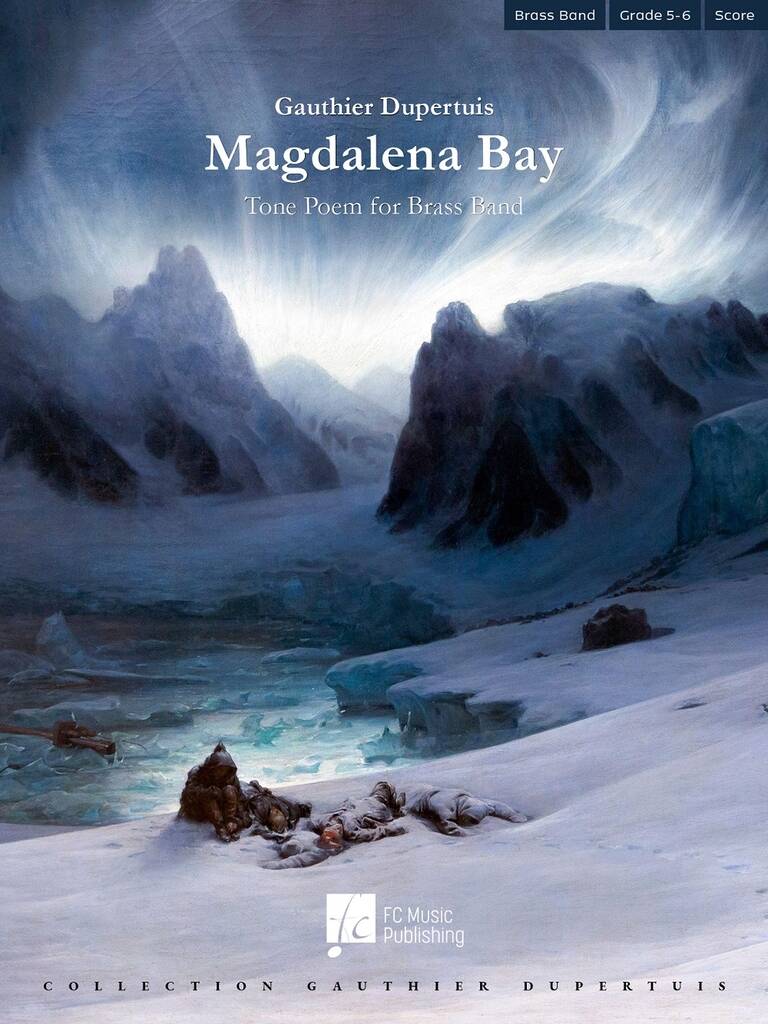
Magdalena Bay - Gauthier Dupertuis
While admiring many masterpieces at the Louvre Museum in Paris, Gauthier Dupertuis' attention was drawn to a less famous painting: Magdalena Bay, by French painter Francois-Auguste Biard (1799-1882).The work depicts a magnificent snowy landscape on the Norwegian island of Spitsbergen. However, in the foreground, the presence of the wreckage of a ship, bodies covered in snow and a visibly dying character make us understand that tragic events took place there. Thus, a strong contrast is formed between death and the sublime, between the desolation of the survivors of the shipwreck and the magnificence of the landscape. When we look in more detail at the painting, we notice that footprints have been made in the snow: so, could someone have gone to get help? This little glimmer of hope makes the picture even more touching. In this work, Gauthier Dupertuis tried to describe the different elements of the painting, using contrasting sections and dissonances (in particular, the conflict between the minor and the major) to convey the duality between death and the sublime. The work also attempts to highlight a wide palette of orchestral colors, from the most shimmering lines to the darkest low brass colours. In 2024, Magdalena Bay was awarded the first Prize as well as the band Prize at the 9th European Composition Competition for Brass Band, which was held in Palanga (LT). It was premiered on May 2, 2024 by The Cory Band, conducted by Philip Harper.
Estimated dispatch 5-14 working days
-
 £67.50
Columbus - Thierry Deleruyelle
Columbus is a brilliant and dynamic overture for brass band, with a soft and melodious central passage. In addition to the many American towns that hold the name, Columbus is a European space laboratory that is part of the International Space Station. Launched in 2008 by the American space shuttle Atlantis, it makes it possible to carry out continuous scientific experiments in fundamental physics, life sciences, fluid physics, etc. Several hundred experiments take place within Columbus every year. Commissioned by the Brass Band Bourgueillois, this piece celebrates the 10th anniversary of the launch of the band at the instigation of its conductor, Michael Auclert. The ensemble brings together musicians from the various wind bands of the Bourgueillois region and beyond. Thus, just like the space laboratory that inspired this work, the Brass Band Bourgueillois also serves as a laboratory, albeit a musical one, within a territory that is discovering this ensemble and its original repertoire.
Estimated dispatch 5-14 working days
-
 £60.99
Campus Intrada - Jacob de Haan
This work was composed for a series of concerts that were characterised by a variety of musical directions. These musical directions are captured in Campus Intrada, which was named after the Cultuurcampus in which the concerts took place. A typical fanfare-like section, a jazzy section and a section reminiscent of pop music are contained in this three-minute work.
Estimated dispatch 5-14 working days
-
 £154.99
REM-scapes - Thomas Doss
Sweet echoes of Beethoven's Moonlight Sonata in the introduction bring a gentle slumber. Breathing is calm and sleep holds the promise of rest and relaxation.With the onset of the REM sleep phase, however, in which most dreams take place and where the day's events are worked through, we hear other sounds played.With distorted sounds, reminiscent of an old gramophone, the music pulls the listener inevitably ever deeper into the dreamscape, in a very realistic dangerous situation that comes to a dramatic head. It triggers a desperate struggle between theimpulse to awaken and the exhausting urge to flee. For a short moment, it seems as if the wakeful urge has won out, before dream's powerful spell is again cast, and there's no escape...
Estimated dispatch 5-14 working days
-
 £89.99
Arctic Funk - Torstein Aagaard-Nilsen
Arctic Funk might just as well have been a flashing sequel to a scene from Leonard Bernstein's West Side Story. Popular music but with a difference, as indicated by the title. The work's quiet section temporarily soothes down the heated passion of its two corner movements, but everywhere else action is required throughout. The work was commissioned in 1991 by Troms? Brass. Situated just above the Polar Circle, Troms? is one of Norway's northernmost towns. Topographically, the town probably comes across as freezing cold, but Troms? is famous for its 'warm' night-life. The Composer: In Arctic Funk you might get a feeling of a party that takes place betweenice-rocks and snow-capped mountains.
Estimated dispatch 5-14 working days
 View Music