
Results
-
£10.00
INFINITY (Brass Band Study Score) - Robert Redhead
In the post-modern age in which we live, 'absolutes' are difficult for many to comprehend. Yet infinity, which means absolute, total, all-embracing, having no limits or boundaries in time, space, extent, or magnitude, has always been central to the Christian's concept of God.Through the ages, as human understanding has grown, particularly at a remarkable rate from the latter part of the twentienth century, Christianity has been continually challenged to interpret traditional beliefs in the light of new discoveries, but always within the reality of the infinite Being. In addition, scripture tells us that 'humanity was made in God's image'. Humankind is part of God's creation and as such, responsible for its upkeep. Such a commission has never been more relevant than in this present age. Psalm 8 creates a great picture of the majesty, eternal, infinte quality of God and yet reveals the desire of God to share in spirit with humankind. It recognises humankind as being, not a tool of the infinite, but as a creative contributing part of the ongoing movement and activity of the infinite. The music is deliberately melodic in context, creating a sense of unity with the infinite, in tandem with the varying expressions of individuality. It is not based on the Psalm but reflects some of the sentiments lying therein. The 'hymn-like' theme expresses the nature of the Divine using the Old Testament image of the infinite God coming to finite humankind, not in the 'wind', the 'earthquake', the 'fire', but in the 'still small voice' of quietness (1 Kings 19: 11-13). The ensuing musical development, in different styles and patterns, expresses this continual link between infinite and finite. Thus the conclusion, rather than being a symbol of might, power and magnificence, reflects the same sentiment as the opening.
Estimated dispatch 7-14 working days
-
 £39.95
Swing into Christmas (Brass Band - Score and Parts)
Written during Colonel Robert Redhead's tenure as Bandmaster of The International Staff Band, this bright and good-humoured selection - originally titled Sounds of the forties - was composed for the UK Territory's annual Christmas event at the Westminster Central Hall in 1993. It features lively treatments of Good King Wenceslas, Carol of the drum, Silent Night! and Deck the hall and brings fresh sparkle to these familiar carols. With the permission of the Redhead family, the work has been readied for publication. Colonel Redhead lives in retirement in Canada, and this release stands as a welcome addition to the journals.The secret to a successful presentation of this piece (and any swing number) is for the band to have a clear grasp of basic swing principles. Players should aim for a relaxed, buoyant feel built on back'beat emphasis (2 and 4), light articulation, and a sense of forward motion without rushing. Note that, apart from the intentionally straight quavers on the drum kit in sections D and E, quavers elsewhere should be swung.A drum kit will be essential as it provides the stylistic anchor throughout, setting up the tempo, supporting the back'beat, and giving the band confidence to embrace the swing style.The Glenn Miller-inspired opening cornet feature sets the tone for the whole piece and should be played with strength, clarity, and stylistic assurance. The outer movements share this brighter, punchier swing character, with crisp rhythmic definition and confident ensemble playing.In contrast, the central setting of Silent Night! adopts a slow 'shuffle' feel. This section should feel spacious and unhurried, with warm phrasing, gentle back'beat, and a laid'back rhythmic pulse. In the melody line, think breadth, and in the accompaniment, think subtlety rather than weight.
Estimated dispatch 7-14 working days
-
 £55.00
Triumph Series Brass Band Journal, Numbers 1351 - 1354, July 2023
1351: The anointed King (Marcus Venables)This piece was originally written as a massed band item for the Ontario Central-East Divisional Music Day in 2019. The updated version includes two songs, King of kings, majesty (S.A.S.B. 376) and O worship the King (S.A.S.B. 52) to a rhythmic setting of the tune Laudate Dominum (T.B. 481). Both songs present the contrasting characteristics of God; the powerful King and gentle, loving Saviour.1352: A suite of English Christmas carols (Kenneth Downie)This suite is the result of a request for a piece of music featuring exclusively English Christmas carols.The first movement features The holly and the ivy (C.C. 87). In sharp contrast, the second movement calls for a broad, sensitive, song-like approach. Using The cherry tree carol (C.C. 85), a much slower tempo than is normally applied to encourage the listener to see this beautiful tune in a new light. The rumbustious arrival of the finale is based on I saw three ships come sailing in (C.C. 44) with the festive mood prevailing until the end.1353: Nothing but thy blood (Norman Bearcroft)This two-verse setting of Richard Slater's much-loved hymn Nothing but thy blood (S.A.S.B. 769) appears straight-forward in nature, but requires a careful sense of the musical line across all parts.1354: Meditation - Reflections on Advent (Andrew Blyth)Two well-known carols, Away in a manger (C.C. 12) and Silent Night! (C.C. 77) are featured alongside original material. The piece attempts to convey a sense of reflection and meditation on the wonderful and awe-inspiring Advent story.
Estimated dispatch 7-14 working days
-
 £59.77
Sleigh Ride Suite (Brass Band) Leopold Mozart arr. Alex McGee
Today Leopold Mozart (1719-1787) is known almost exclusively as the stern father of Wolfgang, but he was a prominent and successful musician in his own time. The Sleigh Ride, composed just before Wolfgang was born, certainly shows that Mozart the elder had as good a sense of humour as his more famous son. Wolfgang must, in fact, have known and enjoyed his father's piece - he included a short Sleigh Ride in his German Dances, K.605, in 1791. Leopold's more complicated piece is a programmatic serenade, with short titles for each section: a musical picture of a cold evening's ride to a party. The score calls for sleigh bells, rattle, a whip, and triangle. The action begins with a short overture (Intrada), followed by the Sleigh Ride itself, a lively duple-meter dance accompanied by jangling sleigh bells and punctuated by the cracking of a whip. There is then a nice bit of musical pantomime - The Young Lady Shivers With Cold. The sleigh finally arrives at the party, a ball with a small dance orchestra. The Ball Begins, not surprisingly, with a courtly menuet, and the End of the Ball is a spirited Kehraus, a lively rondo-form dance. This transcription faithfully seeks to convey the light touch of the Age of Enlightenment to the modern brass band and provides ensembles with new material for their annual Christmas concerts. To view a rolling score video of the work please visit https://www.youtube.com/watch?v=tgrBe1u8Xag Duration: Approx. 11.45 minutes Difficulty Level: 3rd Section + PDF download includes parts and score. Sheet music available from www.brassband.co.uk Instrumentation: Soprano Cornet Eb Solo Cornet Bb Repiano Cornet Bb 2nd Cornet Bb 3rd Cornet Bb Flugel Horn Bb Solo Horn Eb 1st Horn Eb 2nd Horn Eb 1st Baritone Bb 2nd Baritone Bb 1st Trombone Bb 2nd Trombone Bb Bass Trombone Euphonium Bb Bass Eb Bass BbTimpani Percussion 1-2
In Stock: Estimated dispatch 1-3 working days
-
 £59.77
The Glory of Colour (Brass Band) Ivan G. Andrews
This work by Ivan Andrews was inspired by the large Baptistry window of the new Coventry Cathedral and will be suitable both as a contest or concert work. The window was conceIved and designed by Basil Spence and was intended to be a worldwide experience. When installed it was claimed to be "the single largest window in stained glass that hitherto had ever been contemplated and brought into existance." The stained glass design was done by artist John Piper and when completed was described by Bishop Bardsley as a "triumphant expression of faith, a faith encapsulated in the 'glory of colour'".* Hence the title for the piece. The composer writes: 'When thinking of this music the traditional tune now often called Monks Gate kept coming to me. The words often sung to this tune were penned by John Bunyan and each stansa ends with the words "To be a pilgrim". The Cathedral in Coventry, although a Christian Church, is designed to bring all faiths together in Unity - there is a "Unity Chapel" opposite the Baptistry window so the concept of pilgrimage seemed perfectly apt to me. The music is therefore designed to reflect many colours as there are many expressions of faith. Single fragments of the Monks Gate tune are used as a basis for what might be deemed 'variations'. The tune is heard in full towards the end of the piece and then the music rises to a climax of bright brilliant white light. The colours of the window are darker on the outer edges but they all circulate towards the brilliant white at the centre - representing the source of all faith.' To view a rolling score video of the work please visit https://www.youtube.com/watch?v=zPN_EhhMDAE Duration: Approx. 11.30 minutes Difficulty Level: 2nd Section + PDF download includes parts and score. Sheet music available from www.brassband.co.uk Instrumentation: Soprano Cornet Eb Solo Cornet Bb Repiano Cornet Bb 2nd Cornet Bb 3rd Cornet Bb Flugel Horn Bb Solo Horn Eb 1st Horn Eb 2nd Horn Eb 1st Baritone Bb 2nd Baritone Bb 1st Trombone Bb 2nd Trombone Bb Bass Trombone Euphonium Bb Bass Eb Bass BbTimpani Percussion 1-2
In Stock: Estimated dispatch 1-3 working days
-
 £44.95
Judd: Trailblazers
This overture draws its inspiration from the story of the first Household Troops Band. It tells the story of the 1887 band, the subsequent lull of nearly a hundred years and the re-awakening of the Troops phenomenon in 1985. It was originally written in 1995 and featured prominently by the band on its North American tour of 2002. Given the history of the Household Troops Band, it is fitting that this composition is preoccupied with marching. It begins with a marching song played by a solitary muted cornet, symbolic not only of the call to bandsmen to join the evangelical effort but also a muso-dramatic device to indicate the steady increase in members and technical ability! The music quickly develops into stirring versions of 'A robe of white' and 'Storm the forts of darkness' with two early day Salvation Army tunes crucially adding to the narrative; 'Marching on in the light of God' and 'Soldiers of our God, arise!' The second section is a reflective setting of the Herbert Booth song, 'The penitent's plea'. This song serves to represent the many people who were 'saved' during those early day campaigns. The expressive music transports the listener through a period of uncertainty and angst until finally reaching the song, 'There is a message, a simple message, and it's a message for us all'. The final section deals first with the emergence from the annals of history with the muted cornet figure again before, symbolically, the present day band bursts forth with an emphatic statement of 'Would you be free from your burden of sin? There's power in the blood'. The stirring climax represents a fitting tribute to those gallant pioneering musicians and their equally impressive and dedicated contemporaries.
Estimated dispatch 7-14 working days
-
£44.95
TRAILBLAZERS (Brass Band Set) - Andrew Mackereth
This overture draws its inspiration from the story of the first Household Troops Band. It tells the story of the 1887 band, the subsequent lull of nearly a hundred years and the re-awakening of the Troops phenomenon in 1985. It was originally written in 1995 and featured prominently by the band on its North American tour of 2002. Given the history of the Household Troops Band, it is fitting that this composition is preoccupied with marching. It begins with a marching song played by a solitary muted cornet, symbolic not only of the call to bandsmen to join the evangelical effort but also a muso-dramatic device to indicate the steady increase in members and technical ability! The music quickly develops into stirring versions of 'A robe of white' and 'Storm the forts of darkness' with two early day Salvation Army tunes crucially adding to the narrative; 'Marching on in the light of God' and 'Soldiers of our God, arise!' The second section is a reflective setting of the Herbert Booth song, 'The penitent's plea'. This song serves to represent the many people who were 'saved' during those early day campaigns. The expressive music transports the listener through a period of uncertainty and angst until finally reaching the song, 'There is a message, a simple message, and it's a message for us all'. The final section deals first with the emergence from the annals of history with the muted cornet figure again before, symbolically, the present day band bursts forth with an emphatic statement of 'Would you be free from your burden of sin? There's power in the blood'. The stirring climax represents a fitting tribute to those gallant pioneering musicians and their equally impressive and dedicated contemporaries.
Estimated dispatch 7-14 working days
-
 £37.35
Three Carols at Midnight (Brass Band) Martin Cordner
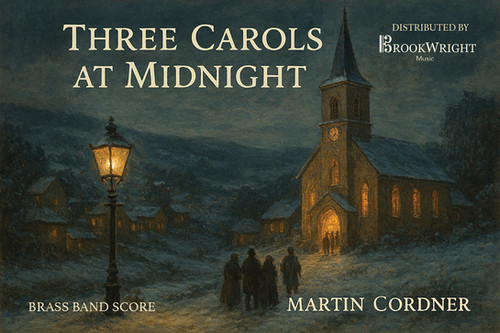
Rooted in the sacred stillness of a French village on Christmas Eve, this suite by Martin Cordner draws upon traditional carols that have echoed through centuries of candlelit chapels and midnight vigils. Each movement offers a window into the Nativity story: I. Mystery: Noel Nouvelet (Christmas Comes Anew) opens with modal wonder, evoking the anticipation of Christ's coming and the quiet awe of Advent. II. Cradle: Entre le boeuf et l'ane gris (Between the Ox and the Grey Donkey) rests in pastoral tenderness, where the newborn Savior lies between humble beasts, watched over by angels and the Virgin. III. Joy: Il est ne, le divin enfant (He is born, the Divine Infant) bursts forth in celebration, proclaiming the divine birth with rustic dance and jubilant praise. Together, these carols form a musical triptych - moving from mystery to intimacy to exultation. Three Carols at Midnight invites listeners to step into the hush of a French Noel, where the sacred story is told not only in word, but in melody, memory, and light. All proceeds support the mission and ministry of The Salvation Army Delaware Command, USA. To view a rolling score video of the work please visit www.youtube.com/watch?v=fUcCluBS18Q Difficulty level: 4th Section + Duration: approx. 5.00 minutes This PDF download includes parts and score. Sheet music available at www.brassband.co.uk or www.durhammusicshop.co.uk (UK) or https://satradecentral.org (USA) Instrumentation: Soprano Cornet Eb 1st Cornet Bb 2nd Cornet Bb 1st Horn Eb 2nd Horn Eb 1st Baritone Bb 2nd Baritone Bb 1st Trombone Bb 2nd Trombone Bb Bass Trombone Euphonium Bb Bass Eb Bass Bb Percussion 1-2 Glockenspiel
In Stock: Estimated dispatch 1-3 working days
-
 £65.00
AN ELGAR PORTRAIT - D.Price
This work was composed in commemoration of the 150th Anniversary of the birth English Composer Sir Edward Elgar. The suite is in three movements: 'Introduction', 'Elegy' and 'March', each of which have been inspired by three of Elgar's most celebrated works; Chanson de Matin, Nimrod ('Variation IX' from the Enigma Variations) and Pomp and Circumstance No.1.'Introduction' - Hollybush HillHollybush Hill is the name of one of the peaks of the Malvern Hills in Worcestershire. The Malverns were a favourite walking area for Elgar and his wife, and their panoramic views inspired much of Elgar's music.'Elegy' - BroadheathBroadheath is the small village at the foot of the Malvern Hills where Elgar was born (and lived at various times throughout his life). Elgar is buried not far from Broadheath at St Wulstan's in Little Malvern. 'March' - Worcester CathedralMany of the Worcestershire ensembles and music festivals played an important role in Elgar's early musical education. He was heavily involved in The Three Choirs Festival and either conducted or played in many of the light orchestras and vocal groups that performed at venues across Worcester. A statue of Elgar overlooks the Cathedral at the end of Worcester High Street.An Elgar Portrait has been used regularly as an own-choice test-piece for Section 4 bands, and was also selected as the set work for the Swiss National Championships in 2007 as well as the Pontins Championships in 2008. The composer has slightly reworked this piece for the Section 4 Final of the National Brass Band Championships of Great Britain 2020 and it's this version that should be performed at the contest. If bands currently have an older version in their libraries, please contact us directly for more information.
In Stock: Estimated dispatch 3-5 working days
-
 £77.00
General Series Brass Band Journal, Numbers 2265 - 2268, April 2026
2265: Holy God, we praise your name (Micael Dikantsa)This bolero introduces composer Micael Dikantsa of the Amriswil Corps, Switzerland, and is based on the hymn Holy God, We Praise Your Name (Grosser Gott, wir loben dich). Set in the traditional slow, dramatic bolero style, the work builds steadily from a distinctive percussion figure as the melody passes through different instrumental groups. With its growing intensity and rich scoring, this piece offers an engaging and atmospheric addition to concert programmes.2266: Tell the story (Barrie Gott)This work continues the Swing series that began nearly 40 years ago with Light'Walk. After a bold introduction, the melody unfolds through unison and close'harmony writing, leading to a Flugel Horn solo with scope for improvisation. The well'known hymn I Love to Tell the Story is heard in a New Orleans style before a modulation launches an energetic shout chorus and lively coda. Smooth, relaxed swing style is key throughout.2267: The old rugged cross (Erik Leidzn)This arrangement by Erik Leidzn is an early and lesser'known setting of a well'loved hymn, rediscovered during research into his work. Edited from a rare score found in the USA East Music Department archives, it demonstrates Leidzn's economical and effective style, creating a practical and expressive arrangement at a time when concise, serviceable hymn settings were greatly needed.2268: Heaven came down! (Michael Cooper)Inspired by William Booth's famous challenge to use contemporary styles for sacred purpose, this piece blends high'energy jazz'fusion big'band writing with a joyful gospel hymn. Driven by rhythm, syncopation and precision, the music proclaims its message of transformation and spiritual joy with vitality, clarity and infectious swing.
Estimated dispatch 7-14 working days