
Results
-
 £37.95
Schneewalzer (The Snow-Waltz) (Brass Band with Optional Choir)
Brass Band Set - With optional Choir. Chorus parts (SATB or TTBB with Piano) are available separately.
Estimated dispatch 7-14 working days
-
 £45.00
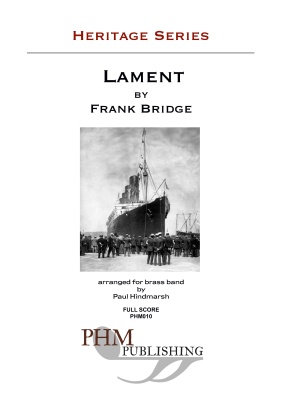
Lament (Brass Band - Score and Parts)
The English composer Frank Bridge (1879 - 1941) did not take an active part in the First World War. However, he was devastated by the slaughter on the western and the eastern fronts, especially the loss of so many of his musicians friends and colleagues. Writing in 1963, his former pupil Benjamin Britten confessed that 'a lot of my feelings about the First World War which people seemed to see in the War Requiem came from Bridge. He had written a piano sonata in memory of a friend killed in France and though he didn't encourage me to take a stand for the sake of a stand, he did make me argue and argue and argue. His own pacifism was not aggressive, but typically gentle'.Bridge composed this Lament for string orchestra on 14 June 1915, in memory of Catherine Crompton, who drowned when the Cunard liner Lusitania was torpedoed by a German submarine on 7 May, 1915. According to figures researched by Liverpool historian Kevin Roach (www.lusitania.net), 1201 men, women and children lost their lives out of the 1962 people aboard. Ninety-four children died, including Catherine, her twin brother Paul and four other siblings. Paul Crompton, Snr. (44), a British businessman working in Philadelphia, his wife Gladys (40) and the family nanny were also drowned. How Bridge's dedication came about is uncertain. The music critic Edwin Evans, who knew Bridge well, has written that the Catherine was a young friend. It is also possible that he came across the family photograph which was published in many newspapers in the wake of the tragedy. By that time, Bridge was greatly distressed by the war as a whole. It seems perfectly in keeping with his pacifist leanings and the strength of his reaction, that this poignant and deeply touching 'war memorial' should mourn a child who he did not know, rather than one of the thousands of young men who fell in battle.Through the musical tears of this melancholy lullaby, Bridge may have regarded the death of young Catherine Crompton as symbolic of the loss of so many innocent lives in wartime. His response to this personal tragedy was characteristically spontaneous and utterly sincere. It is one of his most effective miniatures, poignant yet restrained in its lyrical beauty, with a compelling directness and simplicity of construction.This brass band transcription is pitched one tone lower than the original for string orchestra.- Paul HindmarshDuration: 5.00
Estimated dispatch 7-14 working days
-
 £34.99
Love Divine (Brass Band - Score and Parts)
One of Howard Goodalls most popular choral settings, Love Divine has been skilfully arranged for brass band by Andrew Wainwright, with the approval of the composer. This version is based on the setting with piano and strings and can be performed as a self-standing concert work or as an accompaniment for performance by a large choir.
Estimated dispatch 7-14 working days
-
 £95.00
Concertante (Piano Solo with Brass Band - Score and Parts) - Gregson, Edward
This work was written in 1966, when I was a student at the Royal Academy of Music in London. It was the first major work to be written for this combination. The Concertante is unashamedly romantic in idiom and is cast in three movements: Prelude, Nocturne and Rondo.The Prelude is in sonata form with a contracted recapitulation. There are two main themes, the first announced after the opening flourish on piano. The second theme is lyrical in character and the interplay between these two themes forms the main focus of the movement.The pensive Nocturne opens with an introduction from the band which contains hints of the two main ideas to follow. The solo piano announces the main theme, which has a slightly 'blues' character in its flattened third and seventh notes of the scale. The band enters with the chorale theme already heard in the introduction. Eventually the first theme returns, this time from piano and band and building to a powerful climax before subsiding to a peaceful ending.The Rondo is full of energetic rhythms and changing time patterns. The main theme is 'giocoso' in character and in the first episode there is more than a hint of the tune 'Onward Christian Soldiers' in what amounts to a good humoured parody. Before the final coda there is a long piano cadenza underlying the virtuoso element of the work.The work had a number of public performances leading up to a memorable one in the Royal Albert Hall in 1989 as part of the Gala Concert that used to be held after the National Brass Band Championship in the Royal Albert Hall. That year, the 'centre band' in the massed bands concert were the GUS Band (then known for sponsorship reasons as 'Rigid Containers Group Band'!) conducted by my great friend and champion, Bramwell Tovey, with myself as the soloist.- Edward GregsonDuration: 18.00
Estimated dispatch 7-14 working days
-
£35.00
Concertante (Piano Solo with Brass Band - Score only) - Gregson, Edward
This work was written in 1966, when I was a student at the Royal Academy of Music in London. It was the first major work to be written for this combination. The Concertante is unashamedly romantic in idiom and is cast in three movements: Prelude, Nocturne and Rondo.The Prelude is in sonata form with a contracted recapitulation. There are two main themes, the first announced after the opening flourish on piano. The second theme is lyrical in character and the interplay between these two themes forms the main focus of the movement.The pensive Nocturne opens with an introduction from the band which contains hints of the two main ideas to follow. The solo piano announces the main theme, which has a slightly 'blues' character in its flattened third and seventh notes of the scale. The band enters with the chorale theme already heard in the introduction. Eventually the first theme returns, this time from piano and band and building to a powerful climax before subsiding to a peaceful ending.The Rondo is full of energetic rhythms and changing time patterns. The main theme is 'giocoso' in character and in the first episode there is more than a hint of the tune 'Onward Christian Soldiers' in what amounts to a good humoured parody. Before the final coda there is a long piano cadenza underlying the virtuoso element of the work.The work had a number of public performances leading up to a memorable one in the Royal Albert Hall in 1989 as part of the Gala Concert that used to be held after the National Brass Band Championship in the Royal Albert Hall. That year, the 'centre band' in the massed bands concert were the GUS Band (then known for sponsorship reasons as 'Rigid Containers Group Band'!) conducted by my great friend and champion, Bramwell Tovey, with myself as the soloist.- Edward GregsonDuration: 18.00
Estimated dispatch 7-14 working days
-
 £94.95
An Age of Kings (Mezzo-Soprano Solo with Brass Band and optional choir - Score and Parts) - Gregson, Edward
The origins of this work date back to 1988, when I was commissioned by the Royal Shakespeare Company to write the music for The Plantagenets trilogy, directed by Adrian Noble in Stratford-upon-Avon. These plays take us from the death of Henry V to the death of Richard III. Later, in 1991, I wrote the music for Henry IV parts 1 and 2, again in Stratford. All of these plays are concerned with the struggle for the throne, and they portray one of the most turbulent periods in the history of the British monarchy.Much of the music used in these productions was adapted into two large symphonic suites for wind band - The Sword and the Crown (1991) and The Kings Go Forth (1996). An Age of Kings is a new version for brass band incorporating music from both the symphonic suites for wind band. It was specially composed for a recording made by the Black Dyke Band, conducted by Nicholas Childs, in 2004.An Age of Kings is music on a large-scale canvas, scored for augmented brass band, with the addition of harp, piano, mezzo-soprano solo, male chorus, as well as two off-stage trumpets. The music is also organized on a large-scale structure, in three movements, which play without a break - "Church and State", "At the Welsh Court", and "Battle Music and Hymn of Thanksgiving".The first movement, "Church and State", opens with a brief fanfare for two antiphonal trumpets (off-stage), but this only acts as a preface to a Requiem aeternam (the death of Henry V) before changing mood to the English army on the march to France; this subsides into a French victory march, but with the English army music returning in counterpoint. A brief reminder of the Requiem music leads to the triumphal music for Richard Plantagenet, Duke of York, father of Edward IV and Richard III (the opening fanfare transformed). However, the mood changes dramatically once again, with the horrors of war being portrayed in the darkly-drawn Dies Irae and Dance of Death, leading to the final section of the first movement, a funeral march for Henry VI.The second movement, "At the Welsh Court", takes music from the Welsh Court in Henry IV part 1 with a simple Welsh folk tune sung by mezzo-soprano to the inevitable accompaniment of a harp. This love song is interrupted by distant fanfares, forewarning of battles to come. However, the folk song returns with variation in the musical fabric. The movement ends as it began with off-stage horn and gentle percussion.The final movement, "Battle Music and Hymn of Thanksgiving", starts with two sets of antiphonally placed timpani, drums and tam-tam, portraying the 'war machine' and savagery of battle. Trumpet fanfares and horn calls herald an heroic battle theme which, by the end of the movement, transforms itself into a triumphant hymn for Henry IV's defeat of the rebellious forces.- Edward GregsonDuration - 22'00"Optional TTBB available separately.
Estimated dispatch 7-14 working days
-
 £37.95
Song of India (Euphonium Solo with Brass Band - Score and Parts) - Rimsky-Korsakov, Nikolai - Wilson, Eric
Song of India (or more accurately the 'Song of the Hindu'), from Rimsky-Korsakov's opera-bilina Sadko, provides a technical challenge as well as a musical one, requiring a great degree of control and accurate intonation as the subtly varied chromatic phrases weave their way over a gently undulating, almost hypnotic accompaniment. The Piano Accompaniment verion has been set for Trinity College music exams for 2019-22 (Grade 5), so this brass band version is the ideal opportunity to give young soloists experience with their band.
Estimated dispatch 7-14 working days
-
 £44.95
Brasilia (Trombone Solo with Brass Band - Score and Parts) - Dewhurst, Robin
From the Robin Dewhurst collection, this multi-talented young composer has produced a simply wonderful solo for trombone and brass band. Premiered by virtuoso Brett Baker, this latin-styled work reaches its climax in a stunning cadenza for soloist supported by percussion section. (Also available with piano accompaniment).
Estimated dispatch 7-14 working days
-
 £25.00
Let Me Try Again (Soprano Cornet Solo with Brass Band - Score and Parts) - Caravelli, Francois - Kerwin, Simon
Soprano Cornet & Brass Band. Also available with Piano accompaniment
Estimated dispatch 7-14 working days
-
£27.95
Queen of the Night Aria (Soprano Cornet Solo with Brass Band - Score and Parts) - Mozart, Wolfgang Amadeus - Golland, John
Soprano Cornet & Brass Band. Also available with Piano accompaniment
Estimated dispatch 7-14 working days
 View Music