
Results
-
 £49.95
WHEN WORLDS COLLIDE (Brass Band - Score only) - Clarke, Nigel
Subtitled: Little Green Men in Intergalactic Spaceships with Ray-Guns and Phasers, A Space Symphony for Brass band. Written for the free choice test piece for Brass Band Buizingen for the Flemish Open Brass Band Championships. When Worlds Collide seeks to recreate the atmosphere and sentiment of the American cult Sci-Fi movies of the 1950's such as Robert Wise's 1951 film 'The day the Earth Stood Still' and 'Invasion of the Body Snatches' directed by Don Siegel in 1956, as well as Rudolph Mate's 1951 film 'When Worlds Collide'. It is programmatic with subtitled sub-sections as follows: Crop Circles; Lights in the Sky; Strange Happenings; Sightings; "We Come in Peace"; Alien Abduction; Analysis of the Earthlings; Teleportation; New Understandings; Visions of Far Off Worlds; Colonisation. Duration: approx. 19 mins.
Estimated dispatch 7-14 working days
-
 £43.95
WHO IS HE? (Brass Band) - Hanby, Benjamin - Phillips, Richard
Richard Phillips' ever-popular brass band arrangement of the Christmas hymn Who Is He? is now available in a brand new edition complete with SATB choral parts. The vocal score, which is fully compatible with the brass band version, provides a keyboard reduction for rehearsal or performance without band.
Estimated dispatch 7-14 working days
-
 £37.95
Connotations (Brass Band - Score only) - Gregson, Edward
Connotations was commissioned for the 1977 National Brass Band Championship finals, held in the Royal Albert Hall, London (the winner, incidentally, of that particular competition was the famous Black Dyke Mills Band).At the age of 32 Gregson was the youngest composer to have received the honour of such a commission. It came at the end of a productive five years writing for the brass band publisher R Smith. Some of those works - The Plantagenets, Essay and Patterns for example, with their direct and tuneful style, have remained popular with brass bands the world over.For Gregson, these were the means by which he sharpened the tools of his trade, preparing the ground, as it were, for his finest work to date - Connotations. He thought of calling the piece Variations on a Fourth, but with due deference to Gilbert Vinter perhaps (Variations on a Ninth), he chose a more appropriate one. As Gregson has written, 'Connotations suggests more than one way of looking at something, an idea, and this is exactly what the piece is about'.Writing a competition piece brought its own problems. 'It has to be technically difficult and yet musically satisfying. I didn't like being kept to an eleven-minute maximum. The inclusion of short cadenzas for less usual solo instruments seems to signify a certain test-piece mentality'.Gregson solved the problems admirably by adopting a symphonic approach to variation form: Introduction - fanfares, a call to attention, in effect Variation 1; Theme - a six-note motif, given a lyrical and restrained first statement; Variation 2 - a delicate toccata; Variation 3 - typically robust in melody and rhythm; Variation 4 - lyrical solos; Variation 5 - a scherzo; Variation 6 - cadenzas; Variations 7-9 - an introduction, fugato and resounding restatement of the theme.Duration: 10.30
Estimated dispatch 7-14 working days
-
£74.95
Connotations (Brass Band - Score and Parts) - Gregson, Edward
Connotations was commissioned for the 1977 National Brass Band Championship finals, held in the Royal Albert Hall, London (the winner, incidentally, of that particular competition was the famous Black Dyke Mills Band).At the age of 32 Gregson was the youngest composer to have received the honour of such a commission. It came at the end of a productive five years writing for the brass band publisher R Smith. Some of those works - The Plantagenets, Essay and Patterns for example, with their direct and tuneful style, have remained popular with brass bands the world over.For Gregson, these were the means by which he sharpened the tools of his trade, preparing the ground, as it were, for his finest work to date - Connotations. He thought of calling the piece Variations on a Fourth, but with due deference to Gilbert Vinter perhaps (Variations on a Ninth), he chose a more appropriate one. As Gregson has written, 'Connotations suggests more than one way of looking at something, an idea, and this is exactly what the piece is about'.Writing a competition piece brought its own problems. 'It has to be technically difficult and yet musically satisfying. I didn't like being kept to an eleven-minute maximum. The inclusion of short cadenzas for less usual solo instruments seems to signify a certain test-piece mentality'.Gregson solved the problems admirably by adopting a symphonic approach to variation form: Introduction - fanfares, a call to attention, in effect Variation 1; Theme - a six-note motif, given a lyrical and restrained first statement; Variation 2 - a delicate toccata; Variation 3 - typically robust in melody and rhythm; Variation 4 - lyrical solos; Variation 5 - a scherzo; Variation 6 - cadenzas; Variations 7-9 - an introduction, fugato and resounding restatement of the theme.Duration: 10.30
Estimated dispatch 7-14 working days
-
 £59.95
Essay (Brass Band - Score and Parts) - Gregson, Edward
This work was specially commissioned as the test piece for a new brass band competition in 1971, held at the Royal Albert Hall, London. It is in three movements, the titles of which all have literary connotations. The first movement, Dialogue takes the form of 'conversations' between the instruments, based on the opening melody announced in unison on cornets and euphoniums. A second theme is introduced on the flugel horn and developed alongside this, creating a sonata form shell.The second movement, Soliloquy is dedicated to the memory of Gilbert Vinter - a composer who did so much in the 1960s to bring the brass band into the modern world. The movement is poignant in mood, which is depicted by a cornet solo announced after a brief introduction. The middle section builds to a powerful climax, at which point the opening theme of the first movement is heard again. Tranquillity returns however, with a solo trombone now playing the original theme with other instruments adding decorative accompanying patterns.The final movement, Epigram, creates strong rhythmic contrasts and exploits the more virtuoso character of the brass band. The middle section, with its changing time patterns and open expansive melody, suggests a 'big-country' style. A rhythmically charged coda concludes the work in exciting fashion.Duration: 12.00
Estimated dispatch 7-14 working days
-
£29.95
Essay (Brass Band - Score only) - Gregson, Edward
This work was specially commissioned as the test piece for a new brass band competition in 1971, held at the Royal Albert Hall, London. It is in three movements, the titles of which all have literary connotations. The first movement, Dialogue takes the form of 'conversations' between the instruments, based on the opening melody announced in unison on cornets and euphoniums. A second theme is introduced on the flugel horn and developed alongside this, creating a sonata form shell.The second movement, Soliloquy is dedicated to the memory of Gilbert Vinter - a composer who did so much in the 1960s to bring the brass band into the modern world. The movement is poignant in mood, which is depicted by a cornet solo announced after a brief introduction. The middle section builds to a powerful climax, at which point the opening theme of the first movement is heard again. Tranquillity returns however, with a solo trombone now playing the original theme with other instruments adding decorative accompanying patterns.The final movement, Epigram, creates strong rhythmic contrasts and exploits the more virtuoso character of the brass band. The middle section, with its changing time patterns and open expansive melody, suggests a 'big-country' style. A rhythmically charged coda concludes the work in exciting fashion.Duration: 12.00
Estimated dispatch 7-14 working days
-
 £56.00
Ave Verum, KV.618 (Brass Quartet with Brass Band - Score and Parts) - Mozart, Wolfgang Amadeus - Smith, Sandy
For Brass Quartet (Flugel Horn, Eb Horn, Baritone and Euphonium) with Brass Band
Estimated dispatch 7-14 working days
-
 £37.95
Prelude and Mazurka (from Coppelia)/Easter Flowers (Brass Band Set) - Delibes & Sanderson - Herbert, Sydney
This work is a Double Number. Prelude and Mazurka is a Brass Band Classical Transcription and Easter Flowers is a Cornet Solo with Brass Band.
Estimated dispatch 7-14 working days
-
 £42.95
Scaff! (Brass Band - Score and Parts) - Berlioz, Hector - Wheeler, Alastair
While in the Oxford University Jazz Orchestra, trumpeter Alex Gallafent confided that he had always wished there was a big band arrangement of 'March to the Scaffold' opening with Gene Kruppa toms. Fast forward several years to the Kew Wind Orchestra, where Andy Black is a chartered surveyor who "loves a nice piece of scaff...". Here is a great arrangement done for brass band.The protagonist in the story of this 4th movement is having a nightmare that he has killed his loved one, that he is condemned and he is being led to execution where he will witness his own guillotining.
Estimated dispatch 7-14 working days
-
 £94.99
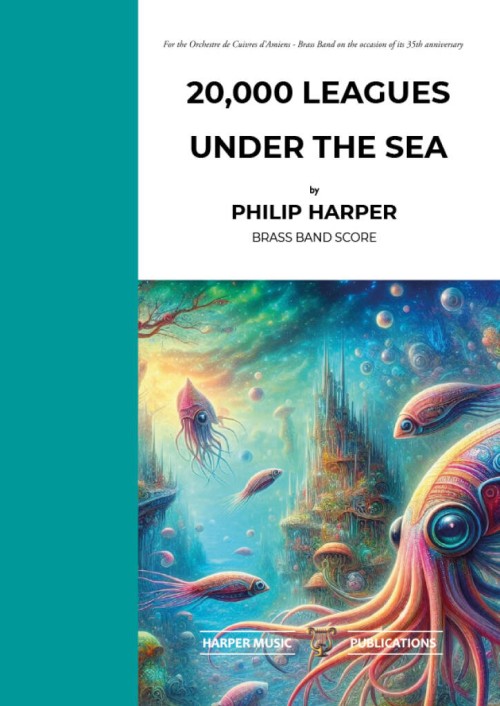
20,000 Leagues Under the Sea (Brass Band - Score and Parts) - Harper, Philip
Frenchman Jules Verne was a pioneer in science fiction during the late 19th Century, penning some classic stories such as Journey to the Centre of the Earth and Around the World in 80 Days - both of which have already been the subject of brass band test-pieces. It was therefore natural for me to choose Verne's 1869 watery magnum opus as the subject for this piece to which there are five sections, as well as an introduction and a finale.THE NAUTILUS. After a mysterious introduction we are introduced to The Nautilus - a fantastical submarine.THE CORAL KINGDOM. We visit awe-inspiring underwater coral formations.SQUID ATTACK. The Nautilus is attacked by a school of giant squid, or 'devilfish'.CAPTAIN NEMO. Captain Nemo is a loner and an eccentric. Some say he is a madman. Soloists of the band help to uncover the character of this enigmatic but powerful figure.MAELSTROM. The Nautilus is dragged into the ocean's deadliest whirlpool but Captain Nemo lives to fight another day.Duration: 12.30
Estimated dispatch 7-14 working days
 View Music